Legal methods (DP IB History: SL): Revision Note

Summary
Stalin used laws, show trials and the judicial system to give repression a legal basis and strengthen his authority
The 1936 Constitution created the appearance of democracy and civil rights while reinforcing Communist Party control
Show trials used legal procedures to remove political opponents and justify repression
Broad and vague criminal laws allowed the regime to prosecute perceived enemies of the state
The 1936 Constitution
Stalin introduced the 1936 Constitution, also known as the 'Stalin Constitution', to present the USSR as a democratic socialist state
It promised:
Universal suffrage
Freedom of speech
Freedom of religion,
Freedom of assembly
Freedom of the press
It declared the USSR had achieved socialism, claiming greater political participation for citizens
Elections remained tightly controlled, with Communist Party-approved candidates standing unopposed
In practice, constitutional rights were ignored during the Great Purge, making the Constitution largely a propaganda tool rather than a guarantee of legal rights
The Constitution helped legitimise Stalin's regime both domestically and internationally
Show trials (1936–38)
Public trials gave legal legitimacy to the removal of Stalin's political opponents during the Great Purge
Defendants were accused of crimes including:
Treason
Espionage
Sabotage
Counter-revolutionary activity
Confessions were often obtained through intimidation, torture or threats against family members
Verdicts had been decided before proceedings began,
The trials served political rather than judicial purposes
High-profile defendants included Zinoviev, Kamenev (1936) and Bukharin and Rykov (1938)
The trials reinforced the idea that repression was lawful and necessary to protect the Soviet state
[INSERT LEADERS ELIMINATED IMAGE HERE]
Article 58
Article 58 of the Soviet Criminal Code criminalised counter-revolutionary activity
The definition of counter-revolutionary crimes was deliberately broad and vague
Individuals could be prosecuted for:
Criticism of the regime
Alleged sabotage
Suspected disloyalty
The law enabled the arrest and conviction of millions during the Great Purge
Article 58 provided a legal framework for eliminating perceived enemies while maintaining the appearance of due process
Stalin also increasingly ruled through emergency legislation, expanding state powers to investigate, arrest and prosecute perceived enemies
Legal procedures increasingly prioritised protecting the socialist state over safeguarding individual rights
Courts became instruments of the Communist Party rather than independent judicial bodies
The legal system reinforced the authority of the regime by institutionalising political repression
Examiner Tips and Tricks
Remember to distinguish legal methods from force. Focus on laws, constitutions, courts and trials, not the NKVD, Gulags or terror itself
Explain how legal measures legitimised repression, creating the appearance that opponents had been removed through lawful procedures
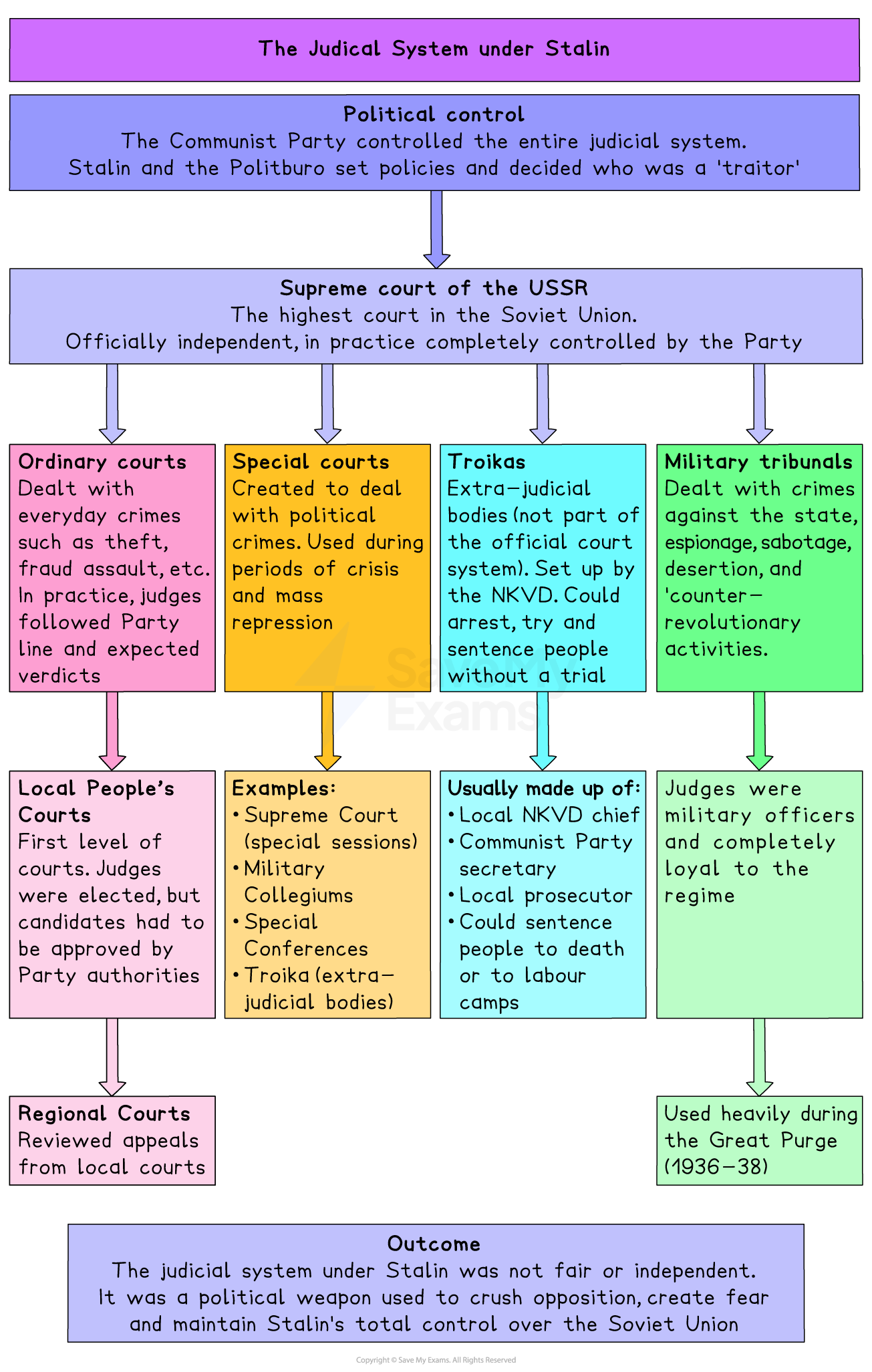
The judicial system
Judges and prosecutors were expected to uphold Communist Party interests rather than remain politically independent
Courts frequently convicted defendants based on political accusations rather than reliable evidence, and defendants were often presumed guilty
Legal rights were limited, with many trials conducted in secret and confessions frequently obtained through intimidation or torture
The NKVD controlled arrests and investigations and often influenced judicial outcomes before trials even began
Troikas, composed of local NKVD officials, Party secretaries and prosecutors, could sentence individuals to execution or labour camps without a formal trial
Legal institutions reinforced ideological conformity by punishing behaviour deemed hostile to socialism or the state
Military tribunals dealt with political crimes such as espionage, sabotage and alleged counter-revolutionary activities
Judicial decisions supported Stalin's wider campaign against perceived enemies of the state, particularly during the Great Purge (1936–38)
Harsh punishments, including execution, exile and imprisonment in Gulag labour camps, created fear and obedience within society
Historiography
Orthodox interpretation
Orthodox historians such as Robert Conquest, argue that Stalin used the legal system to legitimise repression, with the Constitution, Article 58 and the Show Trials providing a legal foundation for authoritarian rule.
Revisionist interpretation
Revisionist historians argue that legal methods were largely symbolic, with the real basis of Stalin's power resting on coercion, the NKVD and political terror.
Post-revisionist interpretation
Post-revisionist historians including Sheila Fitzpatrick, argue that legal methods and coercion worked together, with laws and courts giving repression an appearance of legitimacy while force ensured compliance.

Unlock more, it's free!
Join the 100,000+ Students that ❤️ Save My Exams
the (exam) results speak for themselves:

Was this revision note helpful?
