Role of conflict (DP IB History: SL): Revision Note

Summary
The legacy of the Russian Civil War (1918–21) strengthened Bolshevik support for strong leadership and centralised authority, creating favourable conditions for Stalin's rise
The succession struggle (1924–29) was the most important internal conflict, allowing Stalin to exploit divisions and gradually eliminate rivals
Ideological conflicts divided the Communist Party and weakened Stalin's opponents
Economic conflicts, particularly the Grain Procurement Crisis (1927–28), intensified divisions within the party and undermined support for Bukharin and the NEP
Legacy of the Russian Civil War
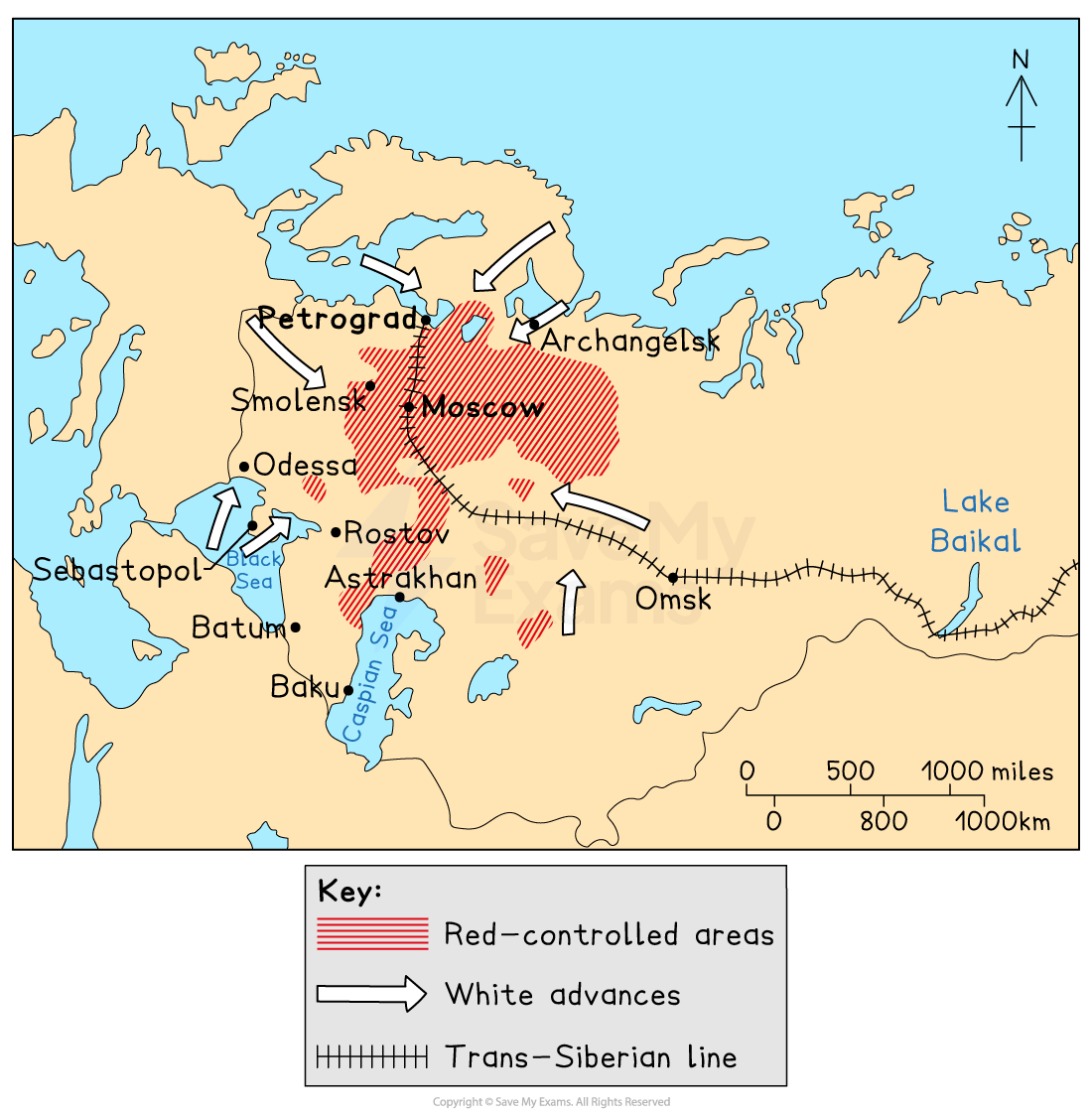
The Russian Civil War (1918–21) reinforced Bolshevik beliefs that survival depended on party unity, discipline and strong central leadership
The experience of fighting counter-revolutionaries increased suspicion of political opposition within the Communist Party
Many Bolsheviks believed disagreement weakened the revolution and threatened Soviet survival
Stalin's emphasis on unity and discipline reflected values strengthened during the Civil War
The legacy of the Civil War therefore created a political culture that favoured Stalin's leadership
The succession struggle (1924–29)
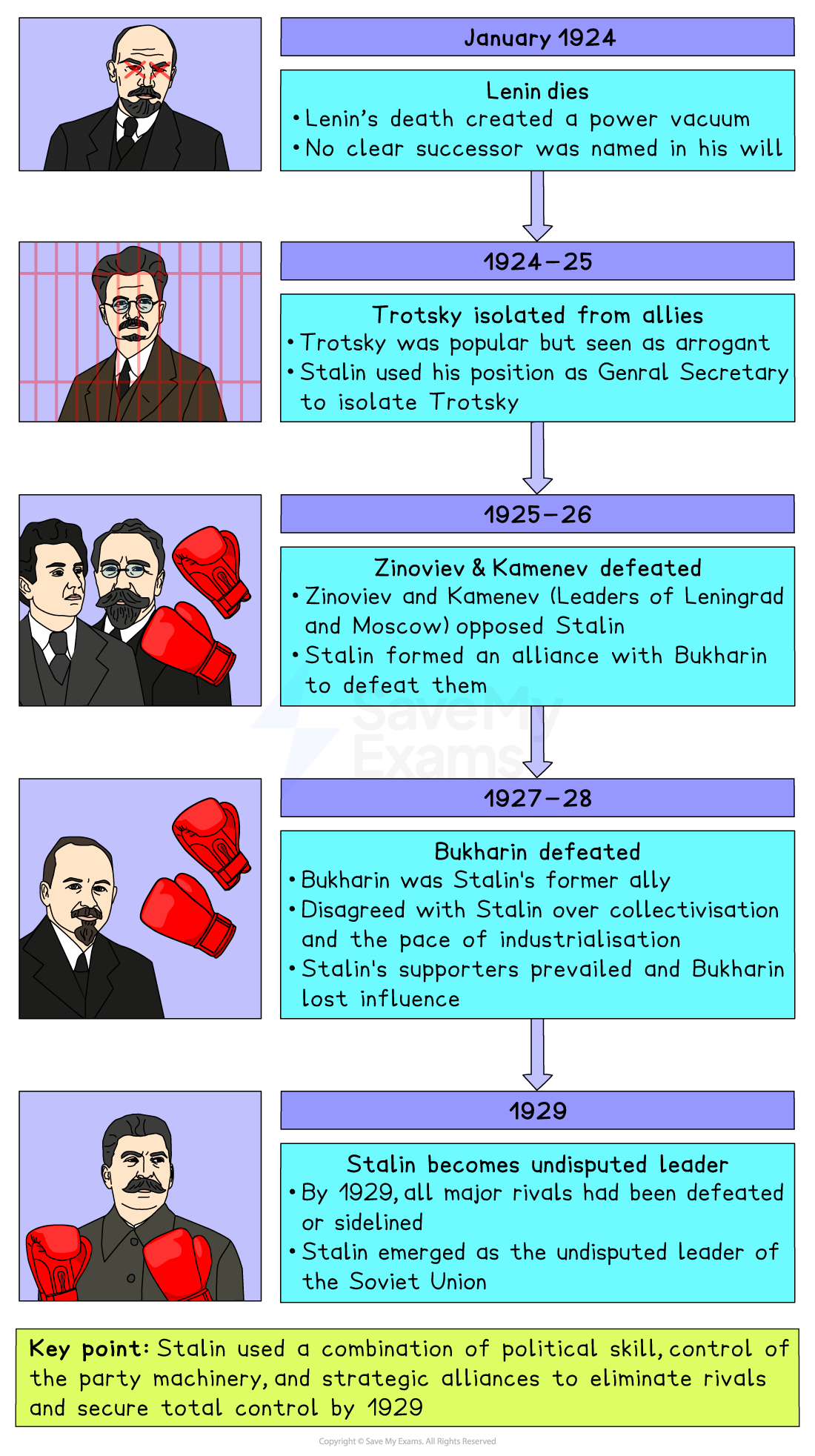
Following Lenin's death on 21 January 1924, no clear successor had been appointed
This led to a power struggle within the Communist Party
Stalin formed shifting alliances to isolate rivals, first working with Zinoviev and Kamenev against Trotsky, before later turning against them
Stalin promoted 'Socialism in One Country', while Trotsky supported 'Permanent Revolution'
This allowed Stalin to portray his ideas as more practical and better suited to Soviet conditions
Trotsky was:
Removed as People's Commissar for War (1925)
Expelled from the Communist Party in 1927
Exiled to Alma-Ata in 1928
Deported from the USSR in 1929
By 1929, Stalin had eliminated the Left Opposition, United Opposition, and Right Opposition, emerging as the undisputed leader of the Soviet Union
Case Study
Nikola Bukharin
Nikolai Bukharin (1888–1938) was a leading Bolshevik and leader of the Right Opposition during the succession struggle.
He supported continuing the New Economic Policy (NEP) and favoured gradual industrialisation rather than forced collectivisation.
Bukharin initially allied with Stalin to defeat Trotsky, Zinoviev and Kamenev, but later became one of Stalin's main rivals.
He was removed from power in 1929 after opposing Stalin's economic policies and was executed during the Great Purge in 1938.
Ideological conflict
The leadership struggle was intensified by disagreements over the future direction of socialism
Stalin promoted Socialism in One Country, while Trotsky supported Permanent Revolution
Stalin portrayed Trotsky's ideas as unrealistic following the failure of revolutions in Europe
Ideological disagreements divided opposition groups, preventing them from presenting a united challenge
These divisions strengthened Stalin's position throughout the succession struggle
Economic conflict
Disagreements over the future of the New Economic Policy (NEP) divided the Communist Party during the mid-1920s
The Grain Procurement Crisis (1927–28) intensified debate over industrialisation and agriculture
Stalin abandoned his alliance with Bukharin, arguing that stronger state intervention was needed
The crisis weakened the Right Opposition and allowed Stalin to justify a change in economic policy
Economic conflict therefore contributed to Stalin's final victory in the succession struggle
Examiner Tips and Tricks
In your essays on this subject, make sure to explain how conflict created opportunities for Stalin, rather than simply describing wars or rivalries.
Strong answers argue that conflict created favourable conditions, but Stalin's political manoeuvring was ultimately more decisive.

Unlock more, it's free!
Join the 100,000+ Students that ❤️ Save My Exams
the (exam) results speak for themselves:

Was this revision note helpful?
