Animal & Plant Cells (AQA GCSE Biology): Revision Note
Exam code: 8461

Animal cells
Eukaryotic cells have sub-cellular structures, called organelles, each carrying out a particular function
Organelles are sub-cellular compartments where specific processes take place
The main sub-cellular structures in animal cells are:
the nucleus
cell membranes
mitochondria
ribosomes
cytoplasm
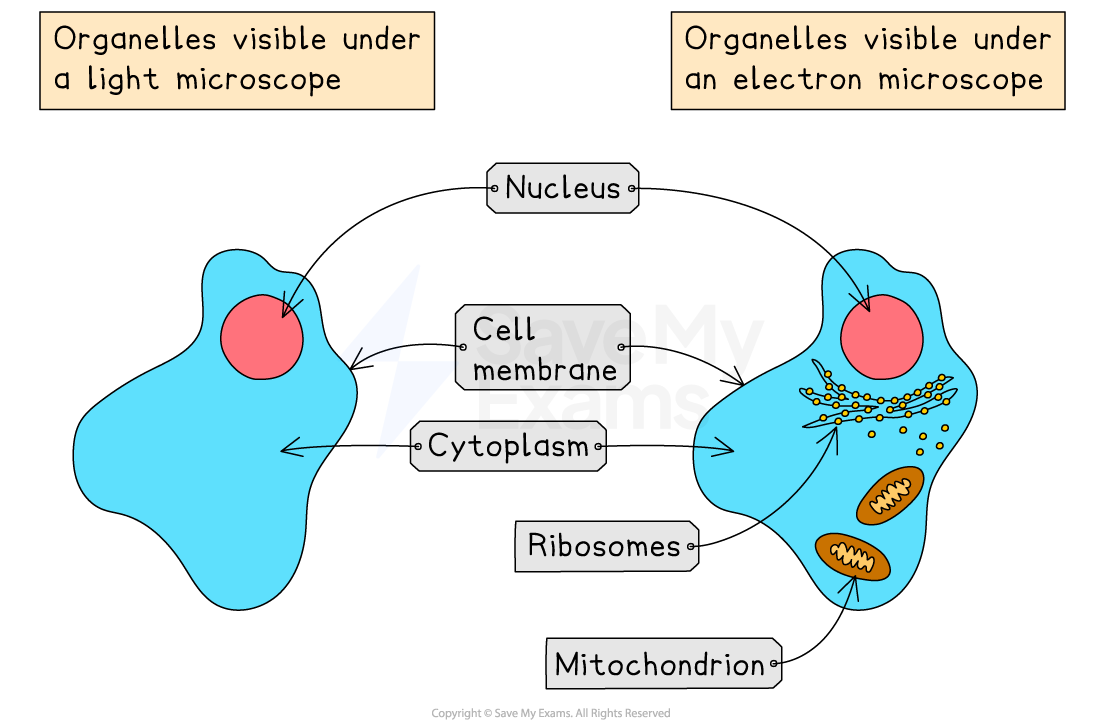
Cell structures and functions
Nucleus:
Contains the genetic material (DNA) which controls the activities of the cell
Cytoplasm:
A gel-like substance composed of water and dissolved solutes
Supports internal cell structures
Site of many chemical reactions, including anaerobic respiration
Cell membrane:
Holds the cell together, separating the inside of the cell from the outside
Controls which substances can enter and leave the cell
Ribosomes:
Found in the cytoplasm
Site of protein synthesis
Mitochondria:
Site of the reactions of aerobic respiration, where energy is released for cellular processes
Cells with high rates of metabolism (carrying out many different cell reactions) have significantly higher numbers of mitochondria than cells with fewer reactions taking place
Estimating size and area
Estimations can be used to judge the relative size or area of sub-cellular structures in microscopy images of cells
Estimation is useful when an exact measurement cannot easily be made, for example, because a structure has an irregular shape
You could estimate that a nucleus is about one-third of the width of a cell, or that a vacuole occupies about half of a plant cell’s area
Plant cells
In addition to the sub-cellular parts found in animal cells, plant cells have:
a cell wall made of cellulose which strengthens the cell (algal cells also have this structural feature)
a permanent vacuole filled with cell sap
Plant cells found in the leaf and stem may also contain chloroplasts

Plant cell structure and function
Cell wall:
Made of cellulose (a polymer of glucose)
Gives the cell extra support, defining its shape
It does not stop water entering: when water enters by osmosis, the wall stops the cell bursting. An animal cell (e.g. a red blood cell) has no cell wall, so it can burst
Cell membrane:
Holds the cell together, separating the inside of the cell from the outside
Controls which substances can enter and leave the cell
Chloroplasts:
Contains green chlorophyll pigments (to absorb light energy) and the enzymes needed for photosynthesis
Permanent vacuole:
Contains cell sap
a solution of sugars and salts dissolved in water
Used for storage of certain materials
Also helps support the shape of the cell
Examiner Tips and Tricks
There are some common vocabulary mistakes you want to watch out for when doing exam questions:
Energy is "released" by mitochondria; it is never "produced", "made" or "created"
The nucleus "controls the activities of the cell"; it is not "the brain of the cell"
Writing that chloroplasts "make the plant green" or just "contain chlorophyll" will earn no marks — the answer required is "carry out photosynthesis".
If asked to name a structure found in a plant cell but not in an animal cell, write cell wall, chloroplast or permanent vacuole. "Chlorophyll" and "cellulose" are substances, not structures, so they earn no marks
Examiner Tips and Tricks
Make sure to get some practice drawing cells.
Always remember:
include a magnification or scale bar
use continuous lines with no gaps
don't shade
draw the cell walls wide enough to recognise
don't overlap or leave gaps between cells
label the parts

Unlock more, it's free!
Join the 100,000+ Students that ❤️ Save My Exams
the (exam) results speak for themselves:

Was this revision note helpful?
Build on this topic