Free Response Questions (College Board AP® Environmental Science): Exam Questions

30 mins3 questions
1a
1 mark

A research team is investigating the effect of solar and wind energy adoption on local air quality in a city previously reliant on coal power. The study measures airborne particulate matter (PM 2.5) and carbon dioxide (CO₂) levels before and after transitioning to renewables.

Identify the dependent variable in the study.

1b
1 mark

 Identify a testable hypothesis for the study.

1c
1 mark

Describe one reason why researchers should include a city that has not switched to renewables as a control.

1d
1 mark

Explain how seasonality might affect air quality measurements in the study.

1e
1 mark

Identify one source of PM2.5 pollution that would still be present even after transitioning to renewable energy.

1f
1 mark

Describe one possible economic impact of transitioning from coal to renewable energy in the city.

1g
1 mark

Explain how increased solar panel production could create a different environmental problem.

1h
1 mark

Identify one way a government policy could accelerate the transition to renewable energy [1 point].

1i
1 mark

Explain how a life cycle assessment (LCA) could help policymakers understand the full environmental impact of wind and solar energy.

1j
1 mark

Describe one reason why some communities may resist the transition to solar and wind power.

2a
1 mark

Biofuels, derived from plant material, are being promoted as an alternative to fossil fuels. While biofuels reduce CO₂ emissions compared to gasoline, they also have environmental drawbacks.

Identify one biomass-based fuel that can be used as an alternative to gasoline.

2b
1 mark

Explain why biofuels are considered carbon neutral in theory but may not be in practice.

2c
1 mark

Describe one disadvantage of large-scale corn-based ethanol production.

2d
1 mark

Explain how biofuel production could contribute to deforestation.

2e
1 mark

Explain one advantage of algae-based biofuels over corn-based biofuels.

2f
1 mark

Describe how government policies, such as subsidies, could influence biofuel adoption.

2g
1 mark

Identify one major limitation of replacing all fossil fuels with biofuels.

2h
1 mark

Describe one impact of increased biofuel demand on global food prices.

2i
1 mark

Explain how biofuel use could still contribute to climate change despite lower CO₂ emissions.

2j
1 mark

Propose a sustainable method to produce biofuels while minimizing environmental damage.

3a
1 mark

Humans use energy from a variety of sources, both renewable and non-renewable, resulting in positive and negative consequences.

Based on the data below, identify the form of renewable energy that has seen the greatest increase in generation since 2000.

US electricity generation from renewable sources (billion kWh)

Renewable energy source

2000

2010

2022

Hydropower

275

260

262

Wind

6

95

435

Solar

1

1

205

Geothermal

14

15

17

Biomass

60

56

50

3b
1 mark

Describe one environmental drawback associated with this form of energy.

3c
1 mark

Energy from biomass involves converting agricultural feedstocks into ethanol, which is often added to gasoline.

Describe what makes biofuel from corn or sugarcane a renewable resource.

3d
1 mark

Support or refute the claim that energy obtained from ethanol produced from agricultural feedstocks does not add additional carbon dioxide to the atmosphere.

3e
1 mark

Describe an unintended consequence of using agricultural feedstocks for biofuel production.

3f
1 mark

Describe a strategy to reduce the impact of the consequence you described in (e)

3g
1 mark

Currently, only the kernel of the corn plant, which is high in sugar, can efficiently be used for ethanol production. Using waste parts of the plant, which are made of cellulose, requires enzymes to break the complex carbohydrates into simple sugars. All energy use has advantages and disadvantages. 

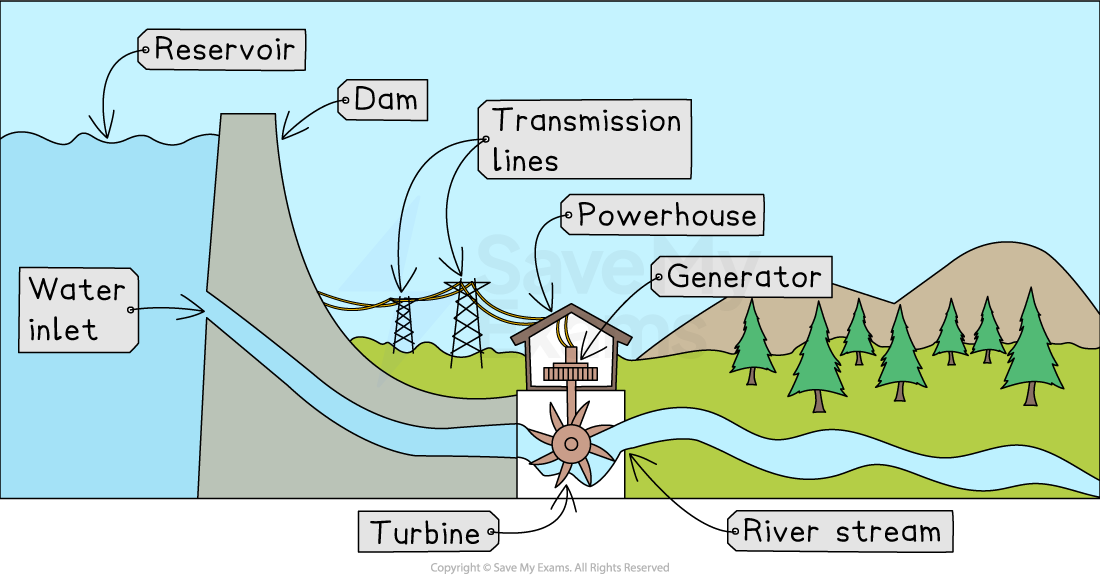
Hydroelectric power is one of the oldest forms of renewable energy. The diagram below depicts a modern hydroelectric plant.

Diagram of a hydroelectric power station showing dam, reservoir, water inlet, turbine, generator, powerhouse, river stream and transmission lines

Identify the source of potential energy in the diagram.

3h
1 mark

Describe how hydroelectric dams can have a negative impact on aquatic ecosystems.

3i
1 mark

Propose a solution, other than switching to a different energy source, to mitigate the impacts of hydroelectric dams on aquatic ecosystems.

3j
1 mark

Justify the solution you proposed by describing an economic advantage.