Free Response Questions (College Board AP® Environmental Science): Exam Questions

25 mins3 questions
1a
1 mark
Diagram showing temperature inversion in a city: cool air is trapped in a valley, smog builds up under a warm air layer, with pollutants released below.
A diagram showing a temperature inversion trapping pollutants in a valley.

The city of Los Altos is located in a valley surrounded by mountains. Despite reducing emissions from vehicles and industries, the city continues to suffer from frequent photochemical smog episodes, especially in winter months. Residents report increased respiratory issues and reduced visibility.

Identify the primary pollutant involved in the formation of photochemical smog.

1b
1 mark

Describe the chemical reaction that leads to the formation of tropospheric ozone.

1c
1 mark

Using the image, explain how thermal inversion traps pollutants near the ground.

1d
1 mark

Describe one human health impact of photochemical smog.

1e
1 mark

Identify one natural factor that worsens smog formation in cities like Los Altos.

1f
1 mark

Propose one urban planning strategy to reduce photochemical smog.

1g
1 mark

Explain the role of volatile organic compounds (VOCs) in the formation of photochemical smog.

1h
1 mark

Describe one way climate and topography influence the severity of smog.

1i
1 mark

Explain how reducing NOₓ emissions could affect smog levels.

1j
1 mark

Describe one reason public education campaigns are important in managing air pollution.

2a
1 mark

A health agency is investigating increased respiratory illness reports in a low-income urban neighborhood. Homes are older, poorly ventilated, and located near busy roads. Inspections found high levels of radon-222 gas, particulates, and volatile organic compounds (VOCs).

Identify one natural source and one anthropogenic source of indoor air pollution.

2b
1 mark

Describe how radon-222 gas enters homes.

2c
1 mark

Explain one health risk associated with radon-222 exposure.

2d
1 mark

Describe one indoor source of VOCs and their impact on health.

2e
1 mark

Explain why low-income communities may experience higher exposure to indoor pollutants.

2f
1 mark

Identify one air pollutant commonly released by indoor combustion and describe its effect.

2g
1 mark

Describe one method to reduce radon exposure in homes.

2h
1 mark

Propose a strategy to reduce VOCs in indoor air.

3a
1 mark

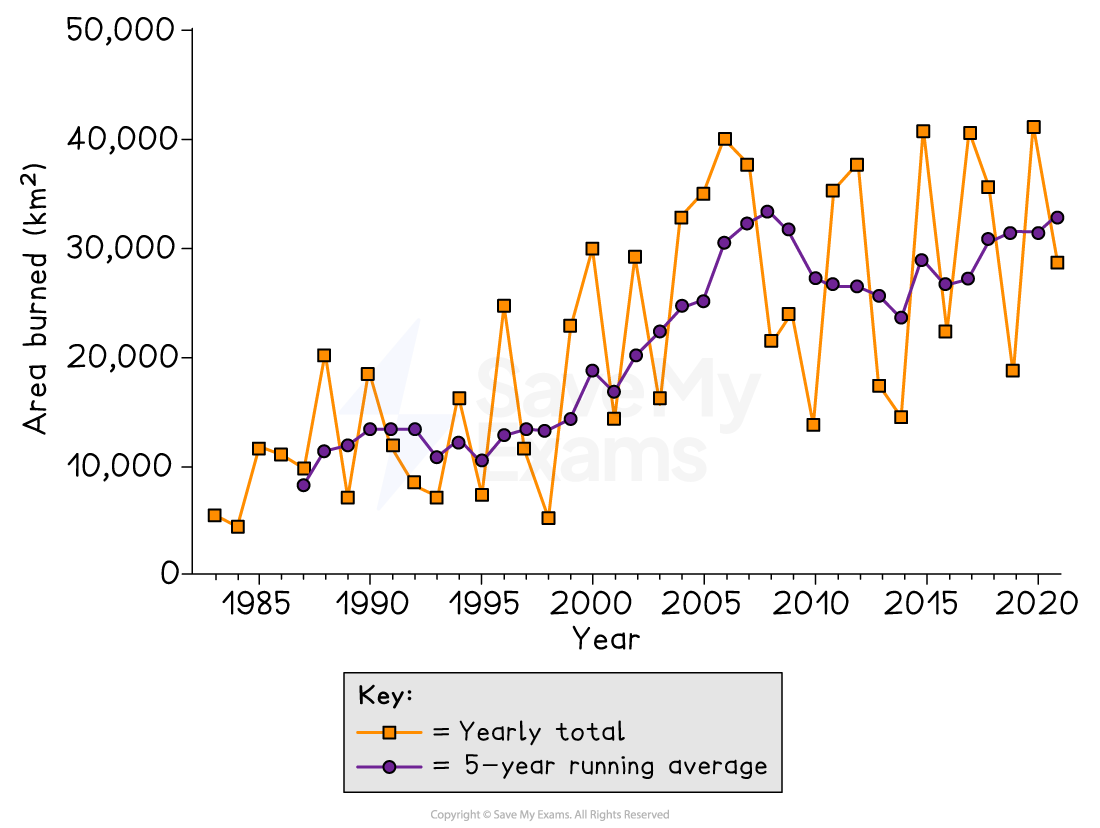
Particulate matter (PM) originates from both natural and human-made sources, contributing to environmental and human health concerns. Scientists are particularly concerned about PM2.5 emissions from wildfires. 

Describe the relationship displayed on the graph.

Line graph of yearly and 5‑year average forest area burned (km²) from 1984–2020, showing fluctuating values with a clear long‑term upward trend.
3b
1 mark

Describe how fire can be used as a forest management tool.

3c
1 mark

In 2020, wildfires emitted 40 million metric tons of particulate matter. In 2021, the amount increased to 55 million metric tons. Calculate the percent change in particulate matter emissions from wildfires between these two years. 

3d
1 mark

A region’s coal-burning power plant emits 25 million metric tons of particulate matter annually. If wildfires in the same region released 60 million metric tons in a particularly bad fire season, calculate the percent difference in emissions between wildfires and industry?

3e
1 mark

An average adult breathes approximately 11m3 of air per day. If the concentration of fine particulate matter PM2.5 in the air is 35 micrograms per cubic meter (µg/m³), calculate the mass of  (in milligrams)  PM2.5 a person inhales in a day? (1 microgram µg = 0.001 milligrams mg)

3f
1 mark

Identify one strategy to reduce the amount of particulate matter from burning coal.

3g
1 mark

Describe one drawback of the strategy you described in (f)