Free Response Questions (College Board AP® Environmental Science): Exam Questions

16 mins2 questions
1a
1 point

Islands provide unique environments for studying patterns of biodiversity.

Researchers have examined how various island characteristics influence the number of species present.

The graph below presents data collected from islands of different sizes, showing the relationship between island area and species richness.

Graph showing a positive trend of species richness against island area on a log scale. Blue crosses represent data; dashed line is the trend.

Identify the general trend shown in the graph for species richness as island area increases.

1b
1 point

Describe one factor that contributes to the increase in species richness on larger islands.

1c
1 point

Researchers are interested in testing how distance from the mainland affects island biodiversity.

They conduct an experiment on several islands that are different distances from the nearest mainland.

Identify the independent variable in this experiment.

1d
1 point

Identify the dependent variable in this experiment.

1e
1 point

Identify a testable hypothesis for this experiment.

1f
1 point

The researchers find that islands located farther from the mainland tend to have fewer species.

Explain why islands farther from the mainland tend to have lower species richness.

1g
1 point

The researchers also find that smaller islands have higher extinction rates than larger islands.

Explain why smaller islands tend to have higher extinction rates.

1h
1 point

Propose a strategy conservationists could use to help maintain biodiversity on small islands.

2a
1 point

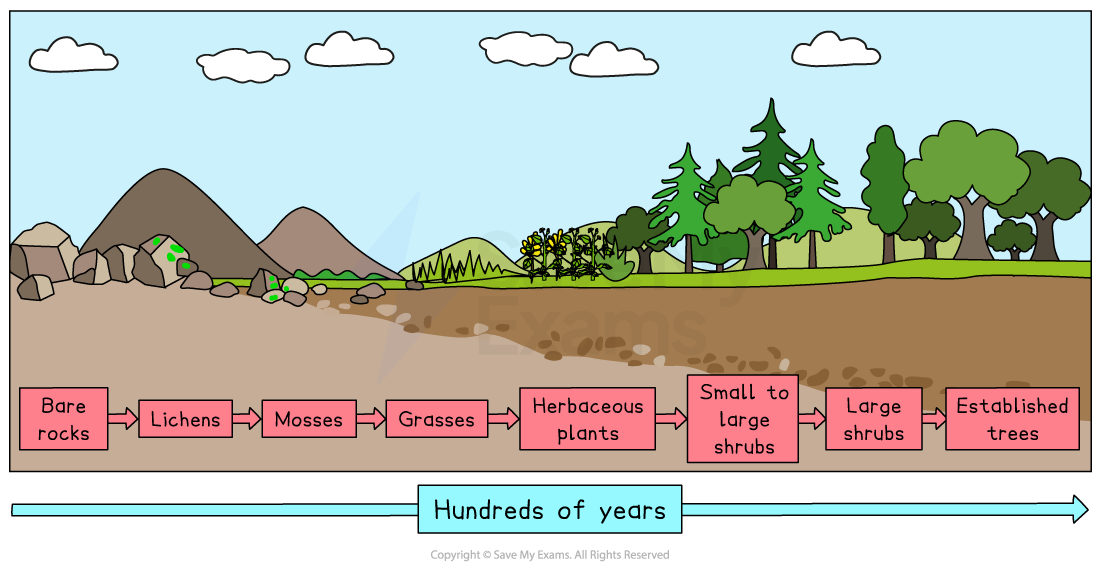
Forests, grasslands, and other ecosystems undergo natural changes over time, a process known as ecological succession.

Scientists studying a volcanic island that formed 50 years ago have observed gradual changes in the island’s vegetation and species composition.

The diagram below illustrates the development of plant communities on the island over time

Diagram of ecological succession from bare rocks to established trees over hundreds of years, showing stages like lichens, mosses, and shrubs.

Identify the type of ecological succession that occurred after the volcanic eruption.

2b
1 point

Describe one challenge that pioneer species face when colonizing the volcanic landscape.

2c
1 point

After 20 years, shrubs and small trees began to establish themselves at the site, and scientists observed an increase in insect and bird populations.

Explain how the arrival of shrubs and trees influenced biodiversity at the site.

2d
1 point

Invasive species, such as fast-growing grasses, were observed spreading into the recovering ecosystem.

Scientists noted that some native species declined in population as a result.

Explain how the introduction of an invasive species could alter the process of succession at the site.

2e
1 point

Over time, the recovering forest ecosystem will develop into a stable, mature community.

However, some scientists worry that climate change may influence the trajectory of succession.

Propose a strategy to protect the recovering ecosystem from the impacts of climate change.

2f
1 point

Concerned about the future of the recovering ecosystem, conservationists want to take action to protect native species from the effects of climate change and invasive species.

Justify one conservation strategy that could help preserve native species at the volcanic site.

2g
1 point

Describe one way that climate change could alter the natural process of succession on the volcanic island.

2h
1 point

Describe one way animal species could influence the progression of succession on the volcanic island.