Speed & Velocity (Cambridge (CIE) IGCSE Physics): Revision Note
Exam code: 0625 & 0972

Speed
The speed of an object is defined as
Distance travelled per unit time
Speed is a scalar quantity
This is because it only contains a magnitude (without a direction)
For objects that are moving at a constant speed, the equation for calculating speed is:
Where:
= speed, measured in metres per second (m/s)
= distance travelled, measured in metres (m)
= time, measured in seconds (s)
Average speed
The speed of an object can vary throughout its journey
Therefore, it is often more useful to know an object's average speed
Examples of average speeds
Average walking speed = 1.5 m/s
Average running speed = 3 m/s
Average cycling speed = 6 m/s
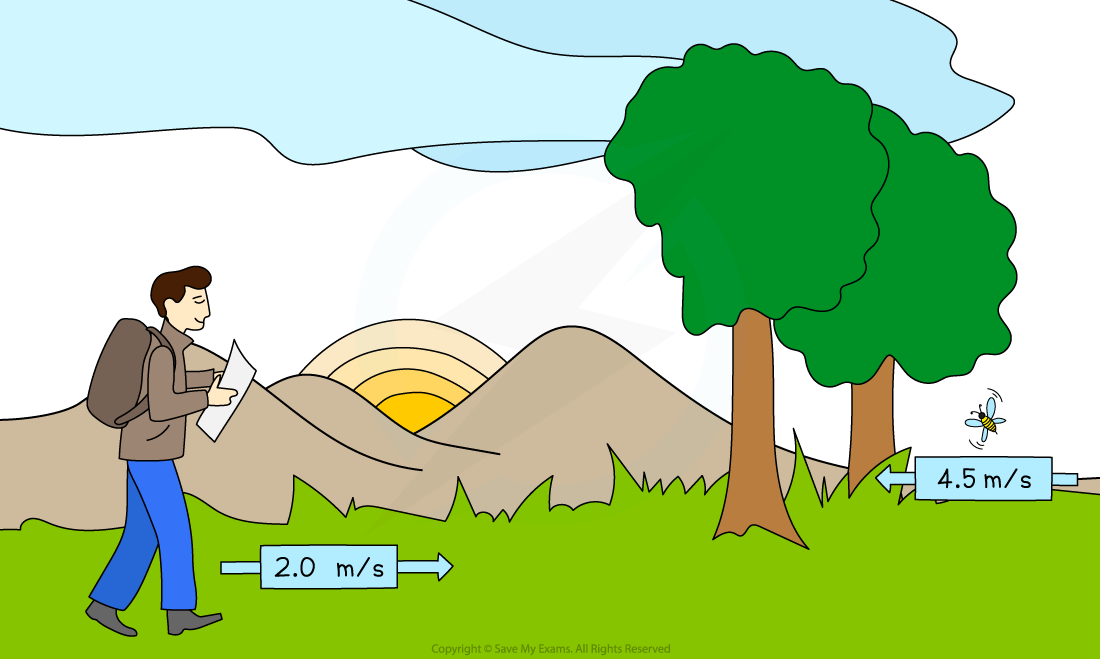
A car travels at different instantaneous speeds throughout its journey
The car speeds up and slows down
The car may stop at junctions and traffic lights
The average speed of the journey of the car can be found by dividing the total distance travelled by the total time taken
The equation for calculating the average speed of an object is:
Average speed considers the total distance travelled and the total time taken

Worked Example
Planes fly at typical average speeds of around 250 m/s.
Calculate the distance travelled by a plane moving at this average speed for 2 hours.
[3]
Answer:
Step 1: List the known quantities
Average speed = 250 m/s
Time taken = 2 hours
Step 2: Write the relevant equation
Step 3: Rearrange to make distance travelled the subject
[1 mark]
Step 4: Convert any units
The time given in the question is not in standard units
Convert 2 hours into seconds:
[1 mark]
Step 5: Substitute the values for average speed and time taken
[1 mark]
Velocity
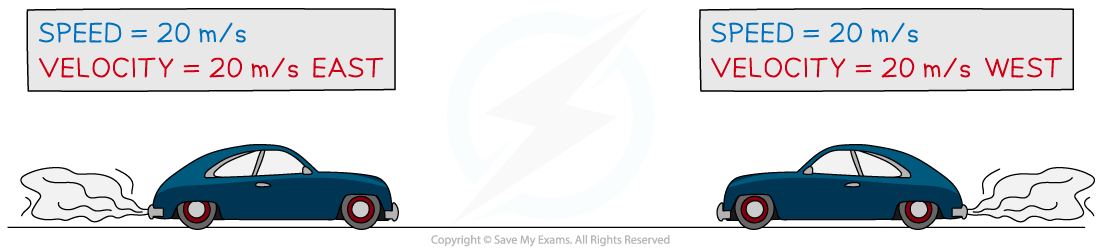
Velocity is a vector quantity with magnitude and direction
Velocity is defined as:
Speed in a given direction
The direction of a velocity can be given in words
For example, 20 m/s east
Or the direction of velocity can be given using a positive or negative value
For example, −20 m/s
A positive direction is typically in the direction of the initial motion, to the right or upward
A negative velocity is typically in the opposite direction to the initial velocity, to the left or downward
Examiner Tips and Tricks
The positive and negative values of velocity can be assigned to any direction as long as the negative velocity is in the opposite direction to the positive value. You can decide which direction you assign to be positive as long as you are consistent throughout a question.
The equation for velocity is very similar to the equation for speed:
Where:
= velocity, measured in metres per second (m/s)
= displacement, measured in metres (m)
= time, measured in seconds (s)
Velocity is a vector quantity, so it uses displacement, s, which is another vector quantity
When dealing with velocities, direction must be stated alongside the answer

Unlock more, it's free!
Join the 100,000+ Students that ❤️ Save My Exams
the (exam) results speak for themselves:

Was this revision note helpful?
Build on this topic