Required Practical: Reaction Time (AQA GCSE Biology): Revision Note
Exam code: 8461

RP7: Reaction time
Reaction time is the time taken to respond to a stimulus
Reaction time can be affected by factors such as:
age
stress
caffeine intake
Aim
Plan and carry out an investigation into the effect of a factor on human reaction time
Method
Each volunteer needs to sit in a chair with a good upright posture
Ensure that the volunteer places their forearm on the table so that it extends over the edge
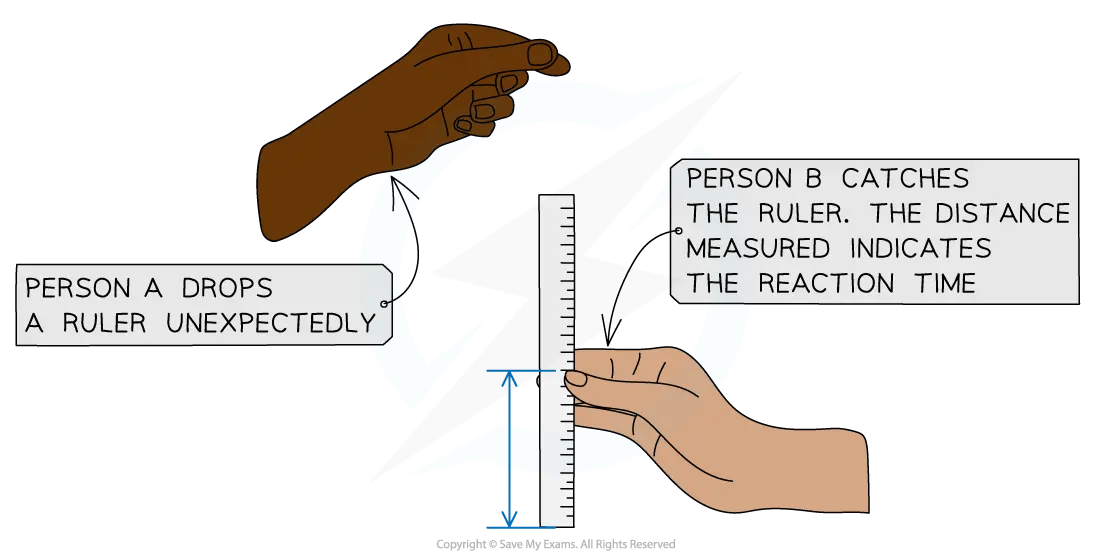
Ask the volunteer to place their thumb and fingers finger on either side of the lower edge of a vertically placed meter ruler with 0 cm at the bottom and 100 cm at the top
Tell the volunteer that the ruler will be dropped without warning; the volunteer needs to catch the ruler with their thumb and forefinger as soon as they sense it dropping
Drop the ruler. When your volunteer catches it, record the number on the ruler displayed just over the thumb
The lower the number, the faster the reaction time
Conduct five trials with the same volunteer
Repeat the experiment with a changed independent variable, e.g.
a different volunteer
after a caffeinated drink
with loud music playing
Use a conversion table to convert the measurements into reaction times
There are many control variables that should be considered in this experiment, such as:
the person catching the ruler using their dominant hand each time
dropping the same ruler from the same height each time, with the ruler oriented in the same direction (0 cm facing down)
if the effect of caffeine is being investigated then none should have been consumed before the start of the experiment, o
if background noise is being investigated then the room should be silent for the first set of repeats
Interpreting information about the nervous system
It is necessary to be able to extract and interpret data from graphs, charts and tables about the functioning of the nervous system
This includes calculations such as mean reaction times or evaluating whether a mean is reliable if any anomalous results were included
Worked Example
Three students played a computer game which measured their reaction time to click when they saw a blue light flash on the screen
Their results were recorded in the table below:
Attempt Number | Student A Time (ms) | Student B Time (ms) | Student C Time (ms) |
|---|---|---|---|
1 | 259 | 276 | 270 |
2 | 267 | 260 | 266 |
3 | 250 | 252 | 573 |
4 | 255 | 262 | 264 |
5 | 243 | 261 | 268 |
Mean | 255 | 262 |
Complete the results table to determine which student had the fastest reaction time.
Answer
Step 1: note that there is an anomaly recorded for student C on their third attempt
573 ms is much higher than the other results recorded
This should not be used to calculate a mean
Step 2: calculate the mean for student C
=
= 267 ms
Step 3: determine the fastest student
The lowest reaction time equates to the person with the fastest reaction time.
Student A has the fastest reaction time at 255 ms

Unlock more, it's free!
Join the 100,000+ Students that ❤️ Save My Exams
the (exam) results speak for themselves:

Was this revision note helpful?
Build on this topic