Control of Body Temperature (AQA GCSE Biology): Revision Note

Exam code: 8461

Lára Marie McIvor

Written by: Lára Marie McIvor

Reviewed by: Dr Natalie Lawrence

Updated on

Monitoring of body temperature

  • The human body needs to maintain a temperature at which enzymes work best, around 37°C

  • Processes such as respiration release energy as heat; and the body loses heat energy to its surroundings – the energy gained and lost must be regulated to maintain a constant core body temperature

  • Body temperature is monitored and controlled by the thermoregulatory centre in the brain

  • The thermoregulatory centre contains receptors sensitive to the temperature of the blood

  • The skin contains temperature receptors and sends nervous impulses to the thermoregulatory centre

Diagram of cross section of human skin

Cross-section of human skin showing the epidermis, dermis and underlying fatty tissue and muscle. Labelled structures include hairs, sweat pores and glands, arterioles, capillaries, sensory neurones, free nerve endings sensitive to pain and temperature, and touch and pressure receptors in the dermis.
Human skin contains structures involved in processes that can increase or reduce heat loss to the surroundings

Use this image

Controlling body temperature

  • If the body temperature is too high, blood vessels dilate (vasodilation) and sweat is produced from the sweat glands

  • Both these mechanisms cause a transfer of energy from the skin to the environment, cooling the body down

Diagram of skin responses to high body temperature

Cross-section of skin showing responses when body temperature is too high. Blood vessels dilate to increase blood flow near the skin surface, sweat glands produce sweat that evaporates and cools the skin, and hair erector muscles relax so the hairs lie flatter. Heat is lost from the skin by radiation.
When there is an increase in body temperature, responses of the skin increase heat loss to the surroundings

Use this image

  • If the body temperature is too low, blood vessels constrict (vasoconstriction), sweating stops and skeletal muscles contract (shiver)

  • These mechanisms reduce heat loss to the surroundings (with skeletal muscle contraction increasing heat released in the body)

 Diagram of skin responses to low body temperature

Responses in skin when cold, IGCSE & GCSE Biology revision notes

Use this image

Examiner Tips and Tricks

Remember, heat energy transfer always occurs from ‘hotter’ regions to ‘cooler’ regions. Radiation is heat energy transfer by electromagnetic radiation. Conduction and convection are the other two types.

Examples of body temperature control

Higher Tier Only

  • The mechanisms described above lower or raise body temperature

  • In the exam, you may be given examples of different contexts in which the body temperature needs to decrease (when someone is too hot) or increase (when someone is too cold)

  • Learn the following concepts to ensure you can suggest what changes are happening and why:

Body temperature regulation summary table

Body Temperature Too High

Body Temperature Too Low

  • Sweat is secreted by sweat glands in the skin

  • Sweat evaporates, cooling the skin

  • Heat energy from the body is lost as liquid water in sweat becomes water vapour (a state change)

  • Skeletal muscles contract rapidly and shivering occurs

  • Skeletal muscle contraction is involuntary and requires energy from respiration (which releases heat energy)

  • Blood vessels close to the skin get wider (dilate)

  • This allows excess heat to radiate from the blood into the environment

  • This is called vasodilation

  • Blood vessels close to the skin get narrower (constrict)

  • This reduces heat loss from the blood into the environment

  • This is called vasoconstriction

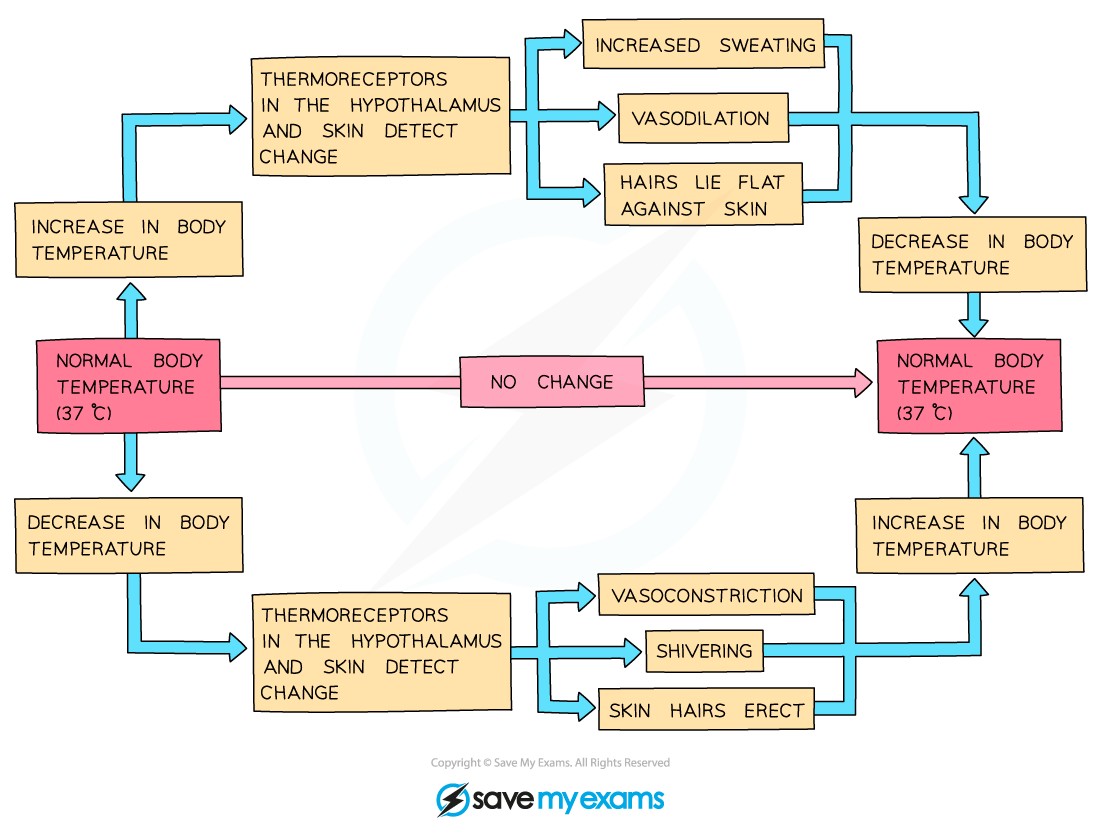
Flow diagram showing negative feedback in human temperature regulation. At the normal body temperature of 37°C, no corrective response is needed. An increase in temperature is detected by thermoreceptors in the hypothalamus and skin, causing increased sweating, vasodilation and hairs lying flat, which decrease body temperature. A decrease in temperature is detected by thermoreceptors, causing vasoconstriction, shivering and erection of skin hairs, which increase body temperature. Both pathways restore normal body temperature.
Negative feedback maintains human body temperature at approximately 37°C

Use this image

Unlock more, it's free!

Join the 100,000+ Students that ❤️ Save My Exams

the (exam) results speak for themselves:

Build on this topic

Lára Marie McIvor

Author: Lára Marie McIvor

Expertise: Content Creator

Lára graduated from Oxford University in Biological Sciences and has now been a science tutor working in the UK for several years. Lára has a particular interest in the area of infectious disease and epidemiology, and enjoys creating original educational materials that develop confidence and facilitate learning.

Dr Natalie Lawrence

Reviewer: Dr Natalie Lawrence

Expertise: Content Writer

Natalie has a MCantab, Masters and PhD from the University of Cambridge and has tutored biosciences for 14 years. She has written two internationally-published nonfiction books, produced articles for academic journals and magazines, and spoken for TEDX and radio.