Cash Flow (AQA A Level Business): Exam Questions

Exam code: 7132

Syllabus Edition

First teaching 2026

First exams 2028

2 hours15 questions
1
6 marks

Source B: Riverford Organic Farmers Ltd

Riverford Organic Farmers Limited grows and delivers organic vegetables. Guy Singh-Watson began delivering boxes of vegetables to local households from the family farm in Devon, and the business was registered as a private limited company in 1999. Its registered office is still Wash Barn at Buckfastleigh in Devon, and its registered business activity is the growing of vegetables, roots and tubers.

Customers subscribe to a weekly box rather than choosing individual items. Boxes are packed at Riverford's own sites and delivered straight to the door by its own drivers, so the company controls its route to market and does not sell through supermarkets. Subscribers pay in advance and can pause or change an order online. Riverford owns five of its sites outright and holds another nine on lease.

In 2018 Guy Singh-Watson began transferring ownership of the company to the people who work in it. The process finished on 8 June 2023, when he sold his remaining shares and the Riverford Employee Ownership Trust became the company's only person with significant control. The business is now held in trust on behalf of its roughly 1 000 employees. There are no outside shareholders, so no dividends are paid to investors outside the business.

In the year ended 3 May 2025 turnover rose by 5.9% to £116.9 million. Cash held at the bank rose by a quarter to £12.31 million, and total liabilities fell by 13.0%.

Organic food remains a small part of UK grocery, and supermarkets have been widening their own organic ranges at lower prices.

Because there are no outside shareholders, the directors and the trust decide together what to do with each year's profit. There is £2.4 million available this year. It could be paid to the co-owners as a profit share, or it could be spent on solar panels and new refrigeration at Wash Barn, which would cut the company's running costs every year from then on. Appendix F shows information on the two options.

Source: information sourced from Companies House, 2026

Riverford Organic Farmers Ltd's subscribers pay for their boxes in advance, but can pause or change an order online at any time.

Analyse one way in which this might affect how much cash Riverford Organic Farmers Ltd needs to hold.

2
6 marks

Source A: Good Energy Group plc

Good Energy Group plc sells electricity and gas to homes and businesses, and it installs solar panels, heat pumps and batteries. It is a public limited company and its shares are traded on AIM.

The electricity it sells is bought from a community of more than 2 500 independent renewable generators, many of them small: wind turbines, solar farms and hydro schemes. Good Energy is an accredited B Corp, the only domestic energy supplier in the United Kingdom to hold that certification, with an impact score of 118.5. B Corp certification is awarded to companies that meet standards on social and environmental performance, and it has to be re-earned.

The year to 31 December 2024 looked strange on the face of it. Revenue fell 29.3% to £180.07 million, down from £254.7 million. Profit before tax rose 16.0% to £6.59 million, and profit after tax rose 64.9% to £4.75 million. The company took less money and kept more of it.

The explanation lies outside the business. Wholesale energy prices rose sharply after Russia's invasion of Ukraine and then fell back, and the Ofgem price cap on what a domestic supplier may charge followed them up and down. Appendix B shows the cap. When the price a supplier charges falls, its revenue falls with it, even if it is serving exactly the same customers.

The company is also changing what it does. During the year it bought JPS, which installs heat, solar and storage across southern England, and it completed the acquisition of Amelio Enterprises Limited. Installing equipment is a different business from supplying energy: it is a one-off sale rather than a monthly bill, and it is not capped by Ofgem.

One thing sits awkwardly alongside the B Corp badge. Good Energy also sells gas, which is a fossil fuel, to customers who have gas boilers. It cannot make gas renewable in the way it can make electricity renewable, and every gas customer it keeps is a household it is not selling a heat pump to.

Source: information sourced from Good Energy Group plc results for the year ended 31 December 2024

Good Energy Group plc buys the electricity it sells from more than 2 500 independent renewable generators.

Analyse one way in which buying from many small generators might affect Good Energy Group plc's cash flow.

3
6 marks

Source B: Wetherby Green Garden Centre

Wetherby Green is a garden centre on the edge of a market town, owned and run by Priya Sharma as a sole trader. The business has no separate legal identity from her, so she keeps all of the profit and is personally responsible for all of its debts.

The business sells plants it grows itself in polytunnels behind the site, plants bought in from nurseries, plus compost, tools, pots and garden furniture. There is a small coffee hut. Twelve people work there, most of them part time and most of them only from March to June.

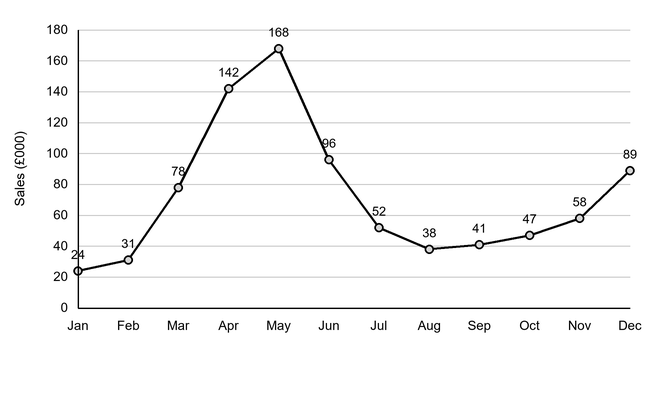
The business took £864 000 last year. Appendix E shows when. April and May alone take £310 000 of it, and the whole of July to October together comes to £178 000, barely more than May on its own.

The difficulty is the inventory. A pot of compost keeps. A shrub does not. Plants have to be bought or sown months before anybody wants them, they need watering and space while they wait, and if they are not sold in their season they either have to be discounted heavily or kept through the winter. Kept plants take up space, need heating in a cold snap, and a proportion of them die.

At the end of last July the business was holding £96 000 of unsold plants at cost. Appendix F sets out the two things it could do with them.

Appendix E: Wetherby Green Garden Centre monthly sales

Line graph of monthly sales (£000), peaking at £168 000 in May after rising from £24 000 in January, then falling to £38 000 in August before recovering to £89 000 in December. Months are shown on the x-axis and sales from £0 to £180 000 on the y-axis.

Source: Analyst

Wetherby Green Garden Centre takes more than a third of its yearly sales in April and May.

Analyse one way in which this might affect how Wetherby Green Garden Centre decides what to order in January.

4
6 marks

Source B: Brackenhill Films Ltd

Brackenhill Films Ltd makes documentaries and children's series in Bristol. It is a private limited company with eleven permanent staff: producers, an office manager and two editors. Everyone else is hired for the length of a production.

It does not sell to the public. Broadcasters and streaming services commission a programme, agree a fee and a budget, and Brackenhill Films Ltd delivers it. Last year it delivered four productions for a total of £2 140 000, an average of £535 000 each. The direct costs of making them came to £1 722 000. Fixed overheads, meaning the office, the permanent staff and the edit suites, were £468 000, and they are paid whether a production is in progress or not. The company therefore lost £50 000 on the year.

The budget for each production is agreed with the broadcaster at the start. If a production comes in under budget Brackenhill Films Ltd keeps the difference. If it goes over, Brackenhill Films Ltd pays the difference itself. On the four productions delivered last year the budgets were set by copying the previous year's figures for a similar programme and adding a little for inflation.

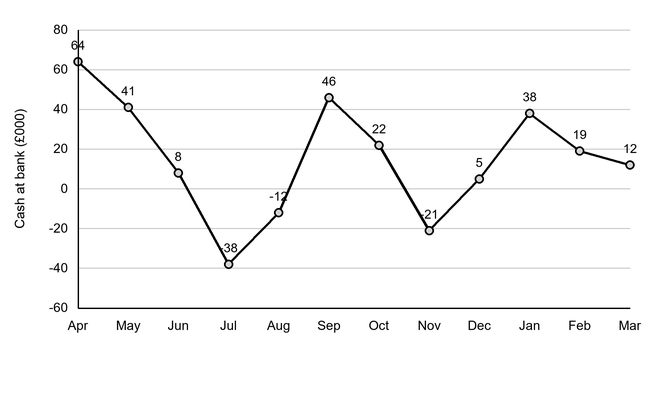
Money arrives in three instalments: a third when the programme is commissioned, a third when a rough cut is delivered and a third on final delivery. Costs do not arrive in three instalments. Crews, camera hire and studio time are paid as the work happens, which is why the company's bank balance looks the way it does.

Brackenhill Films Ltd has an overdraft facility of £50 000.

Appendix D: Brackenhill Films Ltd cash at bank, month by month

Line chart of Brackenhill Films Ltd cash at bank (£000) from April to March: Apr 64, May 41, Jun 8, Jul −38, Aug −12, Sep 46, Oct 22, Nov −21, Dec 5, Jan 38, Feb 19, Mar 12. Y-axis −60 to 80, intervals of 20.

Source: Analyst

Brackenhill Films Ltd is paid in three instalments, but pays crews and hires equipment as the work happens.

Analyse one way in which this might affect the amount of cash Brackenhill Films Ltd needs to have available.

5
6 marks

Source B: Whitbourne Coaches Ltd

Whitbourne Coaches Ltd runs 18 coaches out of a depot in Herefordshire. It is a private limited company owned by Carol Whitbourne and her son Ryan, and it employs 22 people, most of them drivers.

Rather more than half its work is school contracts, run for the county council and for three private schools, which together brought in £1.36 million last year. The rest is private hire and day trips, which brought in £0.98 million. Total revenue was £2.34 million.

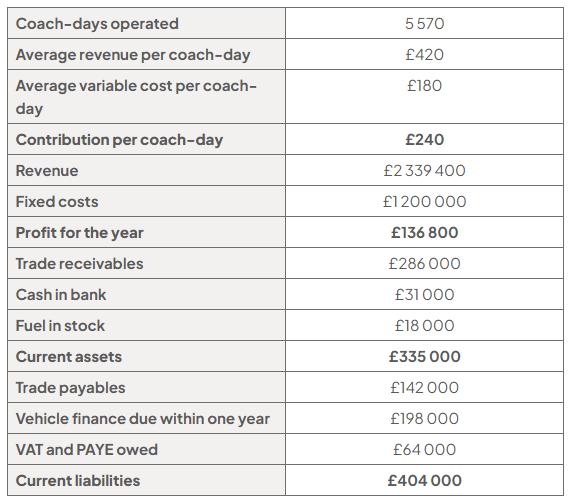
The company thinks in coach-days. A coach out on the road for a day earns an average of £420 and costs £180 in fuel, tolls and cleaning, leaving £240. Last year its coaches were out for 5 570 days. Against that it pays £1 200 000 a year in costs that do not change with use: the depot, insurance, vehicle finance and the drivers' basic wages. Profit for the year was £136 800.

The difficulty is that the profit is not in the bank. The council and the schools pay on their own timetable, which is usually somewhere between 60 and 90 days, and at the year end Whitbourne Coaches Ltd was owed £286 000. It had £31 000 in the bank and £18 000 of fuel in the tank. Against that it owed £142 000 to suppliers, £198 000 of vehicle finance falling due within the year, and £64 000 of VAT and PAYE.

Carol and Ryan Whitbourne take most of their own pay as dividends rather than salary, which is legal and costs the company less in national insurance than paying themselves the same amount as wages.

Appendix D: Whitbourne Coaches Ltd, summary of last year

Appendix D summary table: 5,570 coach-days; £420 revenue and £180 variable cost per day; £240 contribution; £2,339,400 revenue; £1,200,000 fixed costs; £136,800 profit; £286,000 receivables; £31,000 cash.

Source: Analyst

The county council and the three private schools that Whitbourne Coaches Ltd works for take between 60 and 90 days to pay.

Analyse one way in which being paid this slowly might affect the amount of cash Whitbourne Coaches Ltd needs to hold.

6
6 marks

Source B: Ashgrove Print Ltd

Ashgrove Print Ltd is a commercial printer in Dewsbury. Ken Ashgrove started it in 1994 after fifteen years at a firm that lost its only large customer and closed in a fortnight, and he told his daughter Nadia more than once that he built Ashgrove Print Ltd so that nobody would ever again be able to tell him what to charge. Nadia Ashgrove has run it since 2021. It is a private limited company and employs 34 people.

The work comes in two kinds. Long-run work is leaflets and shelf-edge cards for Fenwold Stores, a supermarket group: high volume, printed to a price Fenwold Stores fixes, and paid for in 74 days. It brought in £2 472 000 last year and cost £2 100 000 in paper, ink, plates and press time. Short-run work is menus, packaging, programmes and art prints for about 300 small local customers: low volume, priced job by job, and paid for in 21 days, often on collection. It brought in £1 648 000 and cost £784 000.

Across all its customers, Ashgrove Print Ltd waits an average of 53 days to be paid. It buys paper from two mills on 30-day terms. Its agreed terms with its own smaller suppliers, the plate makers, the bindery, the finishers and the courier, are also 30 days. Last year it paid them on average in 61 days. Its overdraft facility is £150 000 and it was £96 000 into it at the year end.

Fenwold Stores has now offered Ashgrove Print Ltd all of its print work on a three-year contract. It would need a new press costing £340 000, which the bank will lend against. Appendix F sets out that future and the one Nadia Ashgrove has been building towards instead.

Ashgrove Print Ltd buys paper on 30-day terms and waits an average of 53 days to be paid by its customers.

Analyse one way in which this might affect the cash Ashgrove Print Ltd has available to run the business.

7
6 marks

Source A: Jet2 plc

Jet2 plc describes itself as the UK's leading provider of package holidays and its third largest airline. It is a public limited company with shares traded on the London Stock Exchange, based at Leeds Bradford Airport, and it employs more than 14 000 people. Steve Heapy is the chief executive.

The company sells two different things. A package holiday combines flights, a hotel and transfers in one booking. A flight-only seat is just the flight. In the year to 31 March 2026 Jet2 flew a record 20.83 million passengers, up 5%. Within that total, flight-only passengers rose 15% to 7.64 million while package holiday customers rose 1% to 6.62 million. Jet2 counts each package holiday customer once, while flown passengers are counted on every flight, outbound and return. Appendix B shows the two side by side.

Customers pay for a holiday months before they take it, so money arrives long before the flight happens. At the year end the company held £3 292.5 million in cash and money market deposits, and net cash of £2 012.9 million.

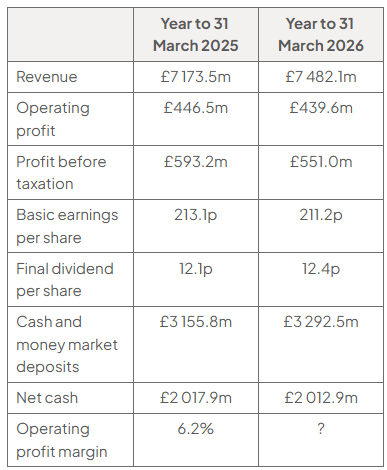
The year's results were mixed. Revenue reached a record £7 482.1 million, up 4%. But operating profit fell 2% to £439.6 million, after absorbing £11.0 million of start-up costs for a new base at London Gatwick and £50 million of increased costs from employment taxes and sustainable aviation fuel. Profit before tax fell 7% and earnings per share fell 1% to 211.2p.

Shareholders were rewarded anyway. Jet2 returned £363.0 million to them during the year through share buybacks and dividends, raised the final dividend 2% to 12.4p a share, and announced a further £250 million buyback. The company says this reflects its strong liquidity and its confidence in the medium-term outlook.

Source: Jet2 plc preliminary results, 8 July 2026, and Companies House

Appendix A: Jet2 plc selected financial results

Jet2 results for years to 31 March 2025/2026 (£m unless stated): revenue 7,173.5/7,482.1; operating profit 446.5/439.6; profit before tax 593.2/551.0; EPS 213.1p/211.2p; dividend 12.1p/12.4p; cash 3,155.8/3,292.5; net cash 2,017.9/2,012.9; margin 6.2%/unknown.

Source: Jet2 plc

Customers pay Jet2 plc for a package holiday months before they take it.

Analyse one way in which being paid this far in advance might affect the cash Jet2 plc has available during the year.

1
9 marks

Source B: Paper Lane Ltd

Paper Lane Ltd sells stationery, cards and gifts from two small shops in market towns about 15 miles apart. Nina Okafor and Rhys Pritchard opened the first shop nine years ago and set the business up as a private limited company, with the two of them as the only directors and shareholders. They now employ nine other people, most of them part time.

The shops sell notebooks, pens, wrapping paper, cards and small gifts. Customers come in to browse, and a large share of what they buy was not on a list when they walked through the door. Nina and Rhys buy most of their inventory from small makers and from two wholesalers, and they order the Christmas range in August to get an 8% early order discount.

The business makes most of its profit in six weeks. December takes more money than August, September and October put together. That pattern is the heart of Paper Lane's problem. The inventory for Christmas is paid for in the autumn, months before it is sold, so the money goes out long before it comes back.

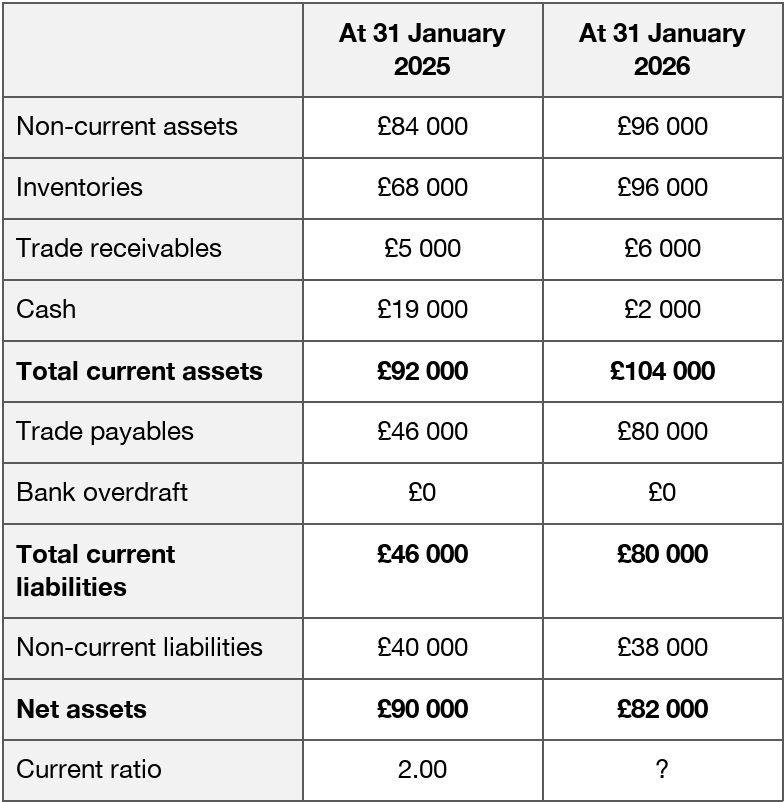
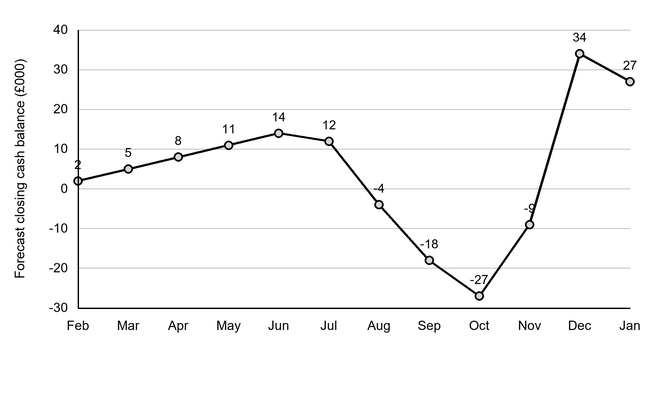
Sales have been steady and the shops are busy. Even so, cash at the bank fell from £19 000 to £2 000 during the year to 31 January 2026, and at its lowest point in the autumn the company was £22 000 into its overdraft. The overdraft limit is £25 000. Appendix D sets out the company's financial position and Appendix E shows what Nina and Rhys forecast will happen to the cash balance over the coming year.

They have been talking about opening a third shop. Their accountant has told them to sort the cash out first. They are also arguing about whether to ask their customers what they actually want, or to trust what nine years behind the counter has taught them.

Appendix D: Paper Lane Ltd summarised statement of financial position

Table comparing Paper Lane Ltd’s financial position at 31 January 2025 and 2026: current assets £92,000/£104,000, current liabilities £46,000/£80,000, net assets £90,000/£82,000; current ratio 2.00 and ?.

Source: Analyst

Appendix E: Paper Lane Ltd forecast closing cash balance, February 2026 to January 2027

Line chart of forecast closing cash balance (£000) from February 2026 to January 2027: £2k, £5k, £8k, £11k, £14k, £12k, −£4k, −£18k, −£27k, −£9k, £34k and £27k respectively.

The company's overdraft limit is £25 000.

Source: Analyst

Assess whether the cash flow forecast in Appendix E is a good enough reason for Nina and Rhys to delay opening a third shop.

2
9 marks

Source B: Calder Vale Ceramics Ltd

Calder Vale Ceramics Ltd makes tableware: plates, bowls and serving dishes, thrown and glazed at a single factory in Lancashire. It is a private limited company owned by its two directors, Nadia Okonjo and Rob Hartley, and it employs 19 people.

It does not sell to the public. Its customers are restaurant groups, hotels and independent homeware shops, who order in batches and expect the same glaze to be available again in two years' time. Last year it fired and sold 77 500 pieces at an average price of £16.00, which brought in £1 240 000.

Two kilns do all the work. They cost £14 200 a month to run, staff, maintain and insure, and that is paid whether or not a single piece is fired. A third kiln would cost £180 000 and would let the company take the larger restaurant contracts it currently turns down.

The difficulty is not profit. The difficulty is when the money arrives. Calder Vale Ceramics Ltd's largest customers are restaurant groups, and they take 62 days to pay. Its own clay and glaze come from two small family firms, and Calder Vale Ceramics Ltd pays them within 30 days, because it always has. Finished inventory sits in the warehouse for about seven weeks before a customer calls it off.

Last year it made a gross profit of £558 000 on its £1 240 000 of revenue, once the £682 000 of clay, glaze, packaging and firing was paid for. Wages came to £298 000 and the kiln, factory, insurance and other fixed costs to £170 400, leaving a profit for the year of £89 600. It ended the year with £18 300 in the bank.

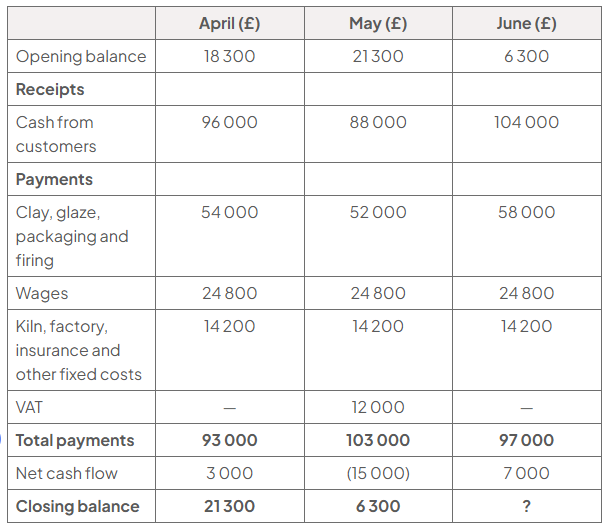
Appendix D: Calder Vale Ceramics Ltd cash flow forecast, April to June

Cash flow forecast table for April to June: opening balances are £18,300, £21,300 and £6,300; net cash flows are £3,000, minus £15,000 and £7,000. June closing balance is shown as ?.

Source: Analyst

Assess whether Calder Vale Ceramics Ltd is likely to run short of cash during the coming year.

Calculate Calder Vale Ceramics Ltd's forecast closing cash balance at the end of June to support your answer.

3
9 marks

Source B: Galliford Try Holdings plc

Galliford Try Holdings plc builds things: schools, hospitals, water treatment works, roads and defence sites. It is a public limited company listed in London and it works almost entirely in the United Kingdom, mostly for public sector clients and regulated utilities. It does not build houses for sale.

Construction is a low-margin business and Galliford Try Holdings plc says so. In the year to 30 June 2025 revenue was £1.9 billion, 6% up on the year before, and the divisional adjusted operating margin was 3.0%. The company had set itself a target of 3.0% and reached it a year earlier than it had planned.

On a job of this size almost nothing is built by Galliford Try Holdings plc's own employees. The work is done by subcontractors: groundworkers, electricians, roofers, most of them small firms. In construction the usual way to hold on to cash is to pay those firms slowly, and the industry has a long record of doing exactly that. In the six months to 31 December 2025 Galliford Try Holdings plc paid its supply chain in an average of 29 days, and it publishes how quickly it pays.

It also holds a great deal of cash. The figure it reports is the average of its cash balance at the end of each month, which was £179 million, up from £155 million. It reports the average rather than the year-end figure because a construction company's cash moves a long way from month to month, and the balance on any single day says very little.

Source: information sourced from Galliford Try Holdings plc results for the year ended 30 June 2025 and the six months ended 31 December 2025

Appendix D: Galliford Try Holdings plc selected results

Table of Galliford Try Holdings plc selected results: revenue £1.79bn and £1.90bn, operating margin 2.6% and 3.0%, and average month-end cash £155m and £179m for 2024 and 2025; percentage increase is blank and marked “?”.

Source: Galliford Try Holdings plc

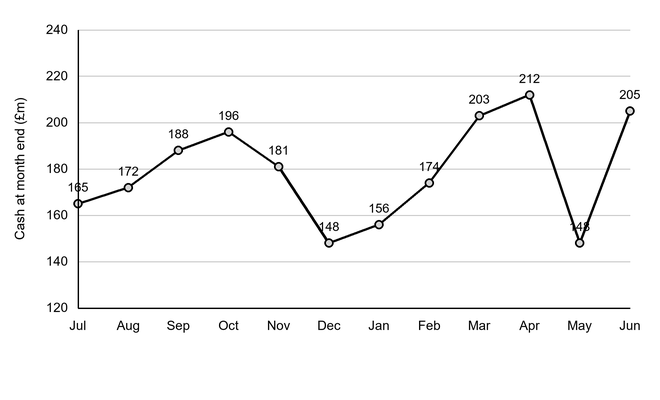
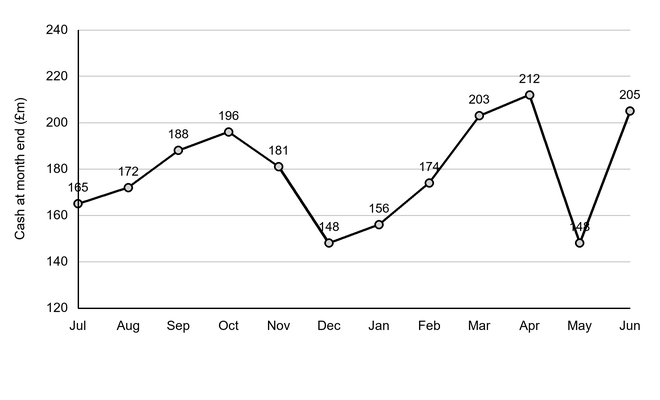
Appendix E: Galliford Try Holdings plc cash at each month end, analyst estimates

Line chart of estimated month-end cash (£m), with months July to June on the x-axis and £120m to £240m on the y-axis: 165, 172, 188, 196, 181, 148, 156, 174, 203, 212, 148 and 205.

Source: Analyst

Assess whether Galliford Try Holdings plc is holding more cash than it needs.

Calculate the percentage increase in Galliford Try Holdings plc's average month-end cash to support your answer.

Give your answer to one decimal place.

4
9 marks

Source B: Thorne Valley Orchards Ltd

Thorne Valley Orchards Ltd grows apples on 180 acres in Herefordshire and turns them into juice and chutney in a press and kitchen on the same site. It is a private limited company run by Marianne Vance, whose family has farmed the land since 1954, and it employs 26 people, more in the picking season.

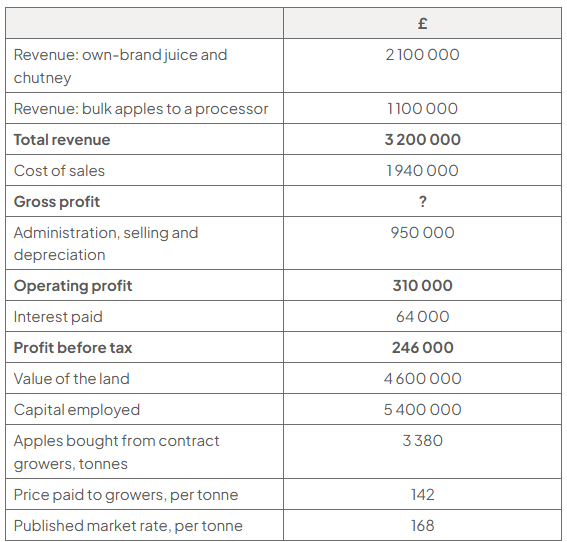
It sells in two ways. Its own-brand juice and chutney go to farm shops, delicatessens and garden centres, and brought in £2.1 million last year. Bulk apples it does not need go to a large juice processor, which brought in £1.1 million. Total revenue was £3.2 million.

Its own orchards do not produce enough. Thorne Valley Orchards Ltd buys a further 3 380 tonnes of apples a year from fourteen contract growers, all of them small farms within thirty miles. It pays them £142 a tonne. The published market rate last year was £168 a tonne, and Appendix E shows how that gap has widened. The growers accept it because Thorne Valley Orchards Ltd takes the whole crop, pays within fourteen days and has done so for years. Its own customers, the farm shops and delicatessens, take about 45 days to settle.

The land is worth £4.6 million. Together with the buildings, press and kitchen, capital employed is £5.4 million. Against that, operating profit last year was £310 000 and profit before tax, after £64 000 of interest, was £246 000.

Marianne Vance has been offered a contract by a supermarket for 900 000 bottles of own-label juice a year at £1.10 a bottle. Her own brand sells at £2.40. The press currently runs at about 40% of what it could do.

Appendix D: Thorne Valley Orchards Ltd, summary of last year

Financial summary: revenue £3.2m (£2.1m own-brand, £1.1m bulk); cost of sales £1.94m; operating profit £310 000; profit before tax £246 000; capital employed £5.4m; 3 380 tonnes bought at £142 versus £168 market rate per tonne.

Source: Analyst

Assess whether Thorne Valley Orchards Ltd should take longer than fourteen days to pay its contract growers.

5
9 marks

Source B: Aldergate Landscapes Ltd

Aldergate Landscapes Ltd designs and builds gardens across Cheshire and north Staffordshire. It is a private limited company owned by Joss Aldergate and his wife Ruth, and it employs 19 people alongside regular subcontractors for stonework and electrics.

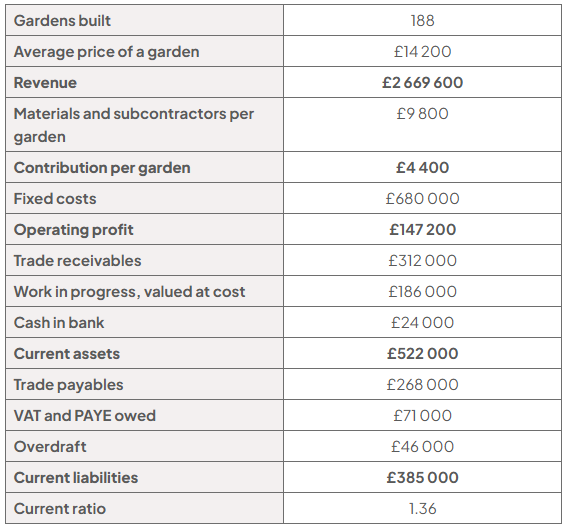
Most of the work is for private clients having a whole garden rebuilt, at an average of £14 200 a garden. The rest is for two housing developers who want the gardens finished before a show home opens. Last year the company built 188 gardens for revenue of £2 669 600. Materials and subcontractors cost £9 800 a garden. Everything else, meaning the yard, the vans, the permanent staff, the designer and the office, cost £680 000.

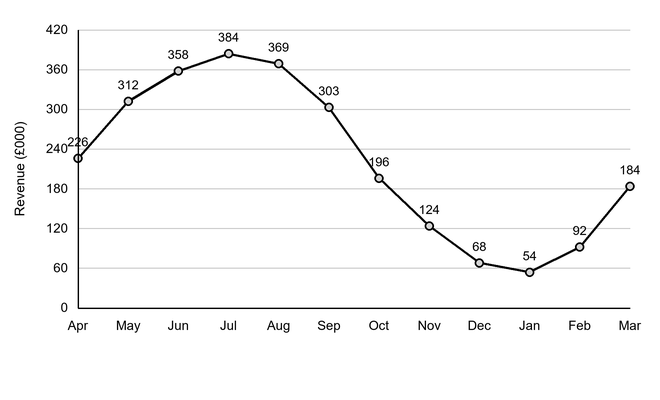
The work does not arrive evenly. Appendix E shows what comes in each month, and the three months from December to February brought in £214 000 between them, against fixed costs of about £170 000 for the same period.

To manage this, Aldergate Landscapes Ltd asks private clients for a 50% deposit when the design is signed off. The deposit is spent almost immediately, though not usually on that client's garden: it pays for materials on the job already running.

At the year end the company was owed £312 000 by clients and developers, held £186 000 of gardens that were half built and not yet invoiced, and had £24 000 in the bank. Against that it owed £268 000 to suppliers and subcontractors, £71 000 in VAT and PAYE, and was £46 000 into its overdraft.

Appendix D: Aldergate Landscapes Ltd, summary of last year

Appendix D summary table: current assets are £522,000, including £312,000 trade receivables, £186,000 work in progress and £24,000 cash; current liabilities total £385,000.

Source: Analyst

Appendix E: Aldergate Landscapes Ltd, revenue month by month

Line chart of monthly revenue, in £000, falling from £384,000 in July to £54,000 in January before rising to £184,000 in March. Values: Apr 226, May 312, Jun 358, Aug 369, Sep 303, Oct 196, Nov 124, Dec 68, Feb 92.

Source: Analyst

Assess whether Aldergate Landscapes Ltd will be able to pay its bills through the winter.

Calculate Aldergate Landscapes Ltd's acid test ratio to support your answer.

Give your answer to two decimal places.

1
15 marks

Source A: Ridgeway Signs

Tomasz Nowak trades as Ridgeway Signs. He is a sole trader, which means the business is not separate from him in law: he owns everything it owns and he is personally responsible for everything it owes. He has no employees and works from a rented unit on a small industrial estate, with a van.

He designs, prints and fits signs for local businesses: shop fascias, vehicle graphics, banners, menu boards and exhibition displays. Almost all of his customers are other businesses within about twenty miles. Every job is quoted separately, and he wins roughly one quote in three.

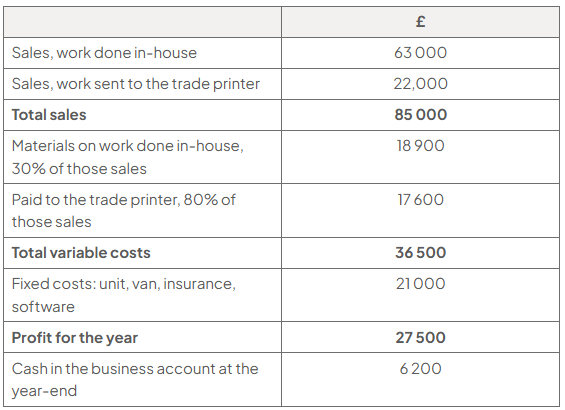
Last year Ridgeway Signs took £85 000. Materials cost about 30p in every pound of work Tomasz does himself, so he keeps about 70p. Rent on the unit, the van, insurance and design software cost £21 000 a year whatever he sells.

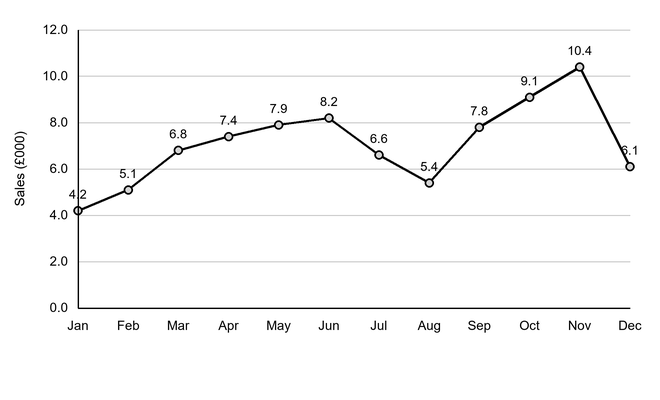
The business has a shape to it. Appendix B shows sales month by month. October and November are his best months, because retailers refit before Christmas, and January and February are his worst.

There is one piece of work he cannot do. Large-format printing, such as vehicle wraps and big banners, needs a machine he does not own, so he sends those jobs to a trade printer in another town. Last year that work was worth £22 000 of his sales, but the trade printer takes most of it: Tomasz keeps only about 20p in the pound. He also turns away large jobs when the trade printer is busy.

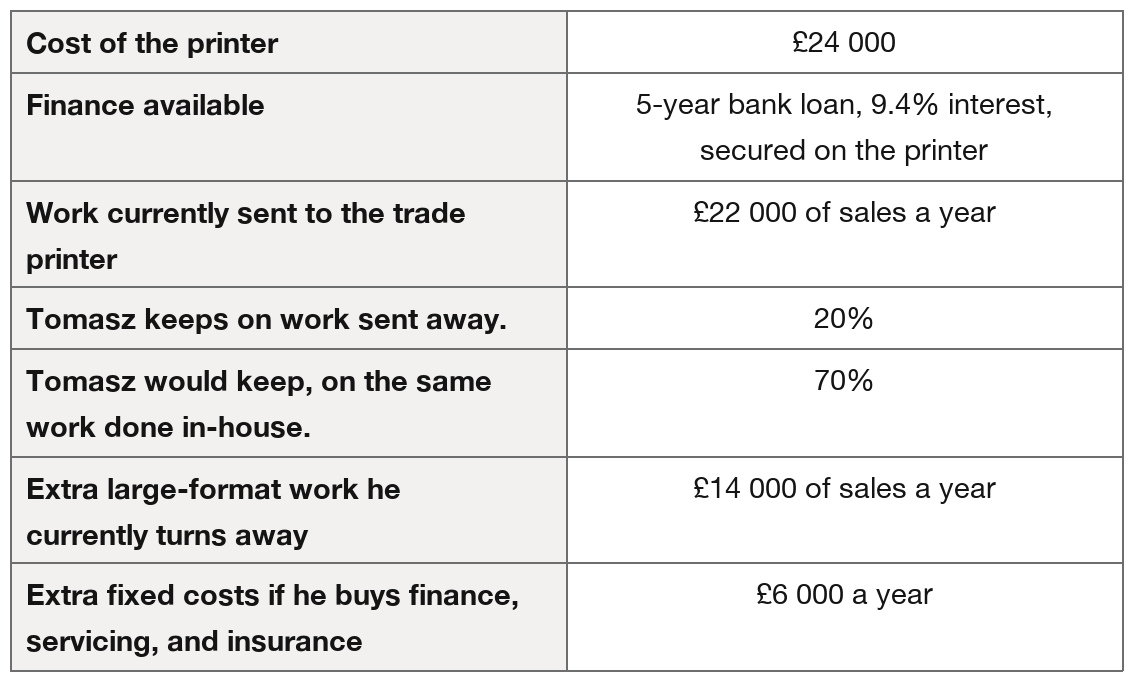
A wide-format printer costs £24 000. Tomasz has £6 200 in the business account. Appendix C sets out what his accountant thinks would happen if he bought one.

Appendix A: Ridgeway Signs, summary of last year

Appendix A financial summary (£): in-house sales £63,000; trade-printer sales £22,000; total sales £85,000; materials £18,900; printer payment £17,600; variable costs £36,500; fixed costs £21,000; profit £27,500; year-end cash £6,200.

Source: Analyst

Appendix B: Ridgeway Signs monthly sales

Line chart of Ridgeway Signs’ monthly sales (£000), rising from £4.2k in January to £8.2k in June, falling to £5.4k in August, then peaking at £10.4k in November before £6.1k in December.

Source: Analyst

Appendix C: Data on buying a wide-format printer

Appendix C table of printer-finance data: printer cost £24,000; five-year bank loan at 9.4% secured on printer; trade-printer work £22,000 yearly, with 20% kept versus 70% in-house; turned-away work £14,000; extra fixed costs £6,000 yearly.

Source: Analyst

Appendix C sets out what would happen if Tomasz bought a wide-format printer.

Evaluate whether Tomasz should buy the printer or carry on sending large-format work to the trade printer.

2
15 marks

Source B: Galliford Try Holdings plc

Galliford Try Holdings plc builds things: schools, hospitals, water treatment works, roads and defence sites. It is a public limited company listed in London and it works almost entirely in the United Kingdom, mostly for public sector clients and regulated utilities. It does not build houses for sale.

Construction is a low-margin business and Galliford Try Holdings plc says so. In the year to 30 June 2025 revenue was £1.9 billion, 6% up on the year before, and the divisional adjusted operating margin was 3.0%. The company had set itself a target of 3.0% and reached it a year earlier than it had planned.

On a job of this size almost nothing is built by Galliford Try Holdings plc's own employees. The work is done by subcontractors: groundworkers, electricians, roofers, most of them small firms. In construction the usual way to hold on to cash is to pay those firms slowly, and the industry has a long record of doing exactly that. In the six months to 31 December 2025 Galliford Try Holdings plc paid its supply chain in an average of 29 days, and it publishes how quickly it pays.

It also holds a great deal of cash. The figure it reports is the average of its cash balance at the end of each month, which was £179 million, up from £155 million. It reports the average rather than the year-end figure because a construction company's cash moves a long way from month to month, and the balance on any single day says very little.

Source: information sourced from Galliford Try Holdings plc results for the year ended 30 June 2025 and the six months ended 31 December 2025

Appendix D: Galliford Try Holdings plc selected results

Table comparing results for years to 30 June 2024 and 2025: revenue £1.79bn and £1.90bn; adjusted operating margin 2.6% and 3.0%; average month-end cash £155m and £179m. Percentage increase in cash: dash and question mark.

Source: Galliford Try Holdings plc

Appendix E: Galliford Try Holdings plc cash at each month end, analyst estimates

Line chart of Galliford Try’s estimated month-end cash from July to June, fluctuating between £148m and £212m. It rises to £212m in April, falls to £148m in May, then reaches £205m in June.

Source: Analyst

Appendix F: Data for two uses of the cash balance

Table comparing keeping cash with returning £60m: keep—about £179m cash, £8.1m interest, 1.2 months’ costs, no dividend change; return—£119m, £5.4m, 0.8 months, dividend rises about 40%.

Source: Analyst

Appendix F shows two things Galliford Try Holdings plc could do with its cash balance.

Evaluate whether Galliford Try Holdings plc should keep its cash where it is or return £60 million of it to shareholders.

3
15 marks

Source B: Kettleby Plant Hire Ltd

Kettleby Plant Hire Ltd hires excavators, dumpers and telehandlers to builders across the East Midlands. It is a private limited company owned by Sean Kettleby and it employs 22 people, including four fitters who service the machines and two drivers who deliver them.

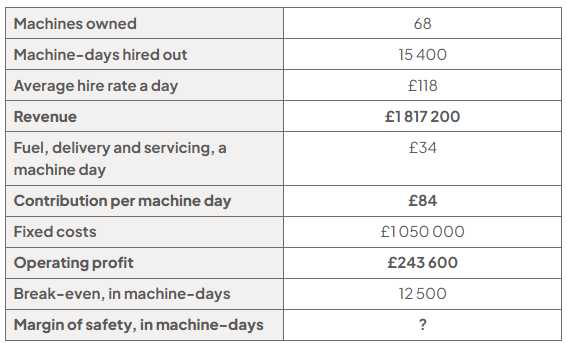
It owns 68 machines. Last year they were out on hire for 15 400 machine-days in total, at an average of £118 a day, which is revenue of £1 817 200. Fuel, delivery and servicing cost £34 for every day a machine is out. Everything else costs £1 050 000 a year and is paid whether the machines are out or standing in the yard.

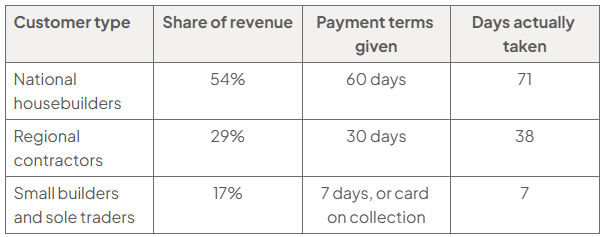
Its customers are not alike. National housebuilders take more than half the revenue and are given sixty days to pay, which in practice becomes seventy-one. Small builders and sole traders are given seven days, or asked for a card when they collect. Sean Kettleby set it up that way and is candid about why: the housebuilders would go elsewhere if he pushed them, and the sole traders would not.

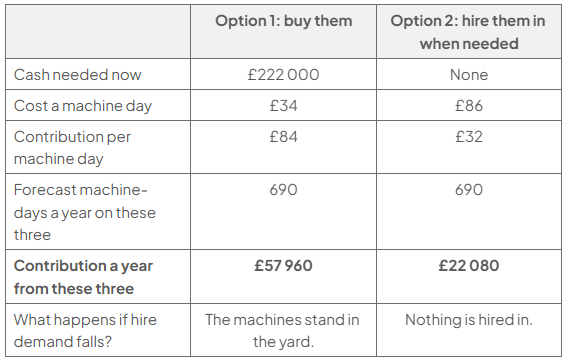
The machines are wearing out. Three excavators need replacing this year at £74 000 each. Sean Kettleby can buy them, which is what he has always done, or he can hire them in from a larger national firm when a customer needs one and hand the margin over. The bank has offered him a five-year loan for the £222 000, and he has enough in the company to pay cash if he chooses to.

Appendix D: Kettleby Plant Hire Ltd, summary of last year

Summary table: 68 machines; 15,400 machine-days hired out; £118 average daily hire rate; £1,817,200 revenue; £34 variable cost and £84 contribution per machine-day; £1,050,000 fixed costs; £243,600 operating profit; 12,500 break-even machine-days; margin of safety: ?.

Source: Analyst

Appendix E: Kettleby Plant Hire Ltd, who pays and when

Table of customer payment data: national housebuilders 54% revenue, terms 60 days, actually 71; regional contractors 29%, 30 days, 38; small builders and sole traders 17%, 7 days or card on collection, 7.

Source: Analyst

Appendix F: Data for the three replacement excavators

Table comparing buying three excavators with hiring as needed: buy costs £222,000 now, £34 per machine-day and contributes £84; hire costs nothing upfront, £86 and contributes £32. Forecast: 690 machine-days a year each; annual contributions £57,960 versus £22,080. If demand falls, bought machines stand idle; none are hired.

Source: Analyst

Appendix F shows two ways in which Kettleby Plant Hire Ltd could provide the three replacement excavators.

Evaluate whether Kettleby Plant Hire Ltd should buy the three excavators or hire them in when a customer needs one.