Environmental Impact of Operations (AQA A Level Business): Exam Questions

Exam code: 7132

Syllabus Edition

First teaching 2026

First exams 2028

2 hours15 questions
1
6 marks

Source A: SHEIN

SHEIN is an online fashion retailer. It has nearly 10 000 employees, sells in over 150 countries and operates in over 20 languages.

SHEIN's annual revenue target for 2025 is $58.5 billion, up from $22.7 billion in 2022. That would exceed the existing combined sales of its main competitors, H&M and Zara.

The average price of an item sold by SHEIN is just £7.90. The company's website has over 600 000 items on sale. It adds 6 000 new items each day.

SHEIN has a lean production model. It only produces 100 to 200 pieces of any item when launched and responds with increased production only if demand justifies it. The company uses computer models to try and estimate future sales accurately and match production to demand more closely than its competitors. Through its on-demand production, SHEIN is able to consistently limit the amount of excess inventory to a level that is much lower than traditional retailers.

The company supports its suppliers with training and investment in advanced technology. SHEIN ships orders to its customers directly, mostly from one huge warehouse near Guangzhou in China. This means that deliveries to customers around the world are slower than those of some competitors who have warehouses in different countries.

The fast fashion business model that SHEIN adopts has been widely criticised. It has been suggested that 8% of global carbon emissions are produced by the fashion industry. Fast fashion businesses are also criticised for encouraging consumers to replace, rather than repair or reuse clothing. Fast fashion allows customers to buy cheap products which they then discard, before quickly buying something new. There have also been criticisms of conditions in some of SHEIN's suppliers' factories in China.

SHEIN has now decided to focus more on environmental sustainability. It states, "Our operations are guided by a sustainability mindset tackling waste and circularity at every stage". The company aims to optimise the efficiency of its processes to conserve water, energy and raw materials while minimising waste. In September 2022, as part of its sustainability approach, SHEIN committed to reducing absolute (total) greenhouse gas emissions by 25% by 2030, when those of the industry are predicted to rise by 45% by 2030.

SHEIN has strict quality standards. Its approach includes a quality-check process where products are examined when they arrive at the warehouse. Factors tested include tear-strength and whether the colour of an item will fade when washed. Departments within the business are treated as if they are customers as part of its quality assurance approach.

SHEIN's values for employees include being good team-players who work well in a collaborative environment.

If SHEIN was seeking to launch a new range of clothing in 2026, it might consider two new suppliers: Xpress and Reliont. Appendix A shows information on these suppliers. The expected orders for the product in the first year would total 2.4 million units.

Source: Shein, 2024

Analyse one way in which improving the environmental sustainability of its operations might affect SHEIN's management of its supply chain.

2
6 marks

Source B: Primark

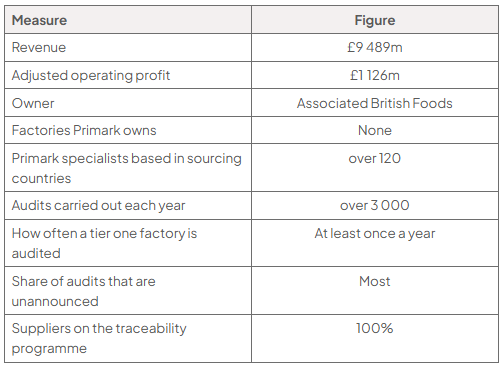
Primark sells clothing at prices far below most of the high street. It is owned by Associated British Foods, and in the 52 weeks to 13 September 2025 it had revenue of £9 489 million and an adjusted operating profit of £1 126 million.

Selling cheap clothing in very large quantities raises two questions that the company is asked constantly: who made it, and what it does to the planet.

On the first, Primark does not own the factories that make its clothes. It buys from suppliers, mostly in Asia, and checks them. More than 120 of its own specialists are based in the main countries it buys from, and together with approved third-party auditors they carry out over 3 000 audits a year. Every tier one factory approved to make Primark products is audited at least once a year, and most audits are unannounced.

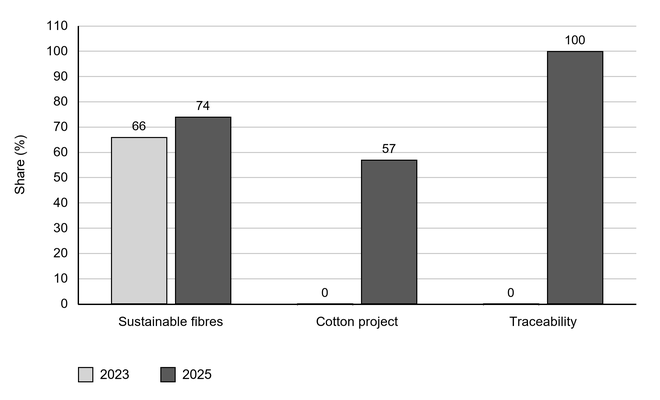
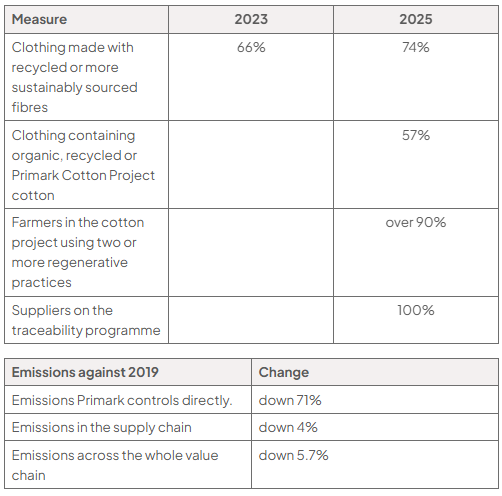
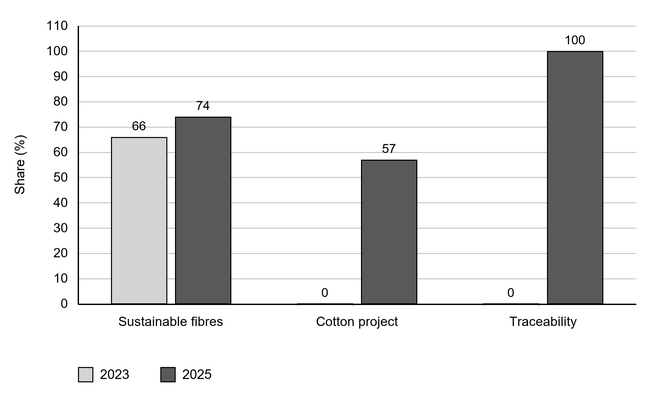
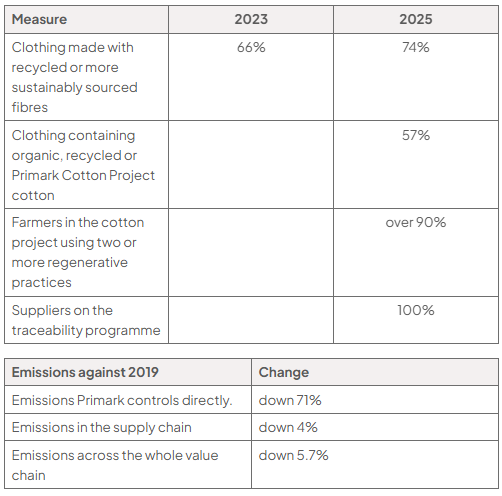
On the second, it has set out what it has changed. 74% of its clothing is now made with recycled or more sustainably sourced fibres, up from 66% in 2023. 57% of its clothing contains cotton that is organic, recycled or grown through the Primark Cotton Project, and over 90% of the farmers in that project have adopted at least two regenerative farming practices on at least 30% of their land. Every clothing, textile and footwear supplier is now on its traceability programme. Emissions across the whole value chain are down 5.7% against 2019, with the emissions Primark controls directly down 71% and those in its supply chain down 4%.

That last pair of figures is the difficulty in one line. The part Primark can change itself has almost gone. The part it cannot has barely moved.

Source: Associated British Foods annual results 2025 and Primark Sustainability and Ethics Progress Report

Appendix F: What Primark has changed

Bar chart of Primark’s sustainability measures, showing sustainable fibres rising from 66% in 2023 to 74% in 2025; 2025 cotton project share is 57% and traceability is 100%. Y-axis: share, 0–110%.
Table of Primark sustainability measures: sustainable fibres rose from 66% in 2023 to 74% in 2025; cotton 57%, regenerative farming over 90%, traceability 100%. Emissions fell 71% directly, 4% in supply chain and 5.7% overall.

Source: Primark

Analyse one way in which raising the share of clothing made with more sustainably sourced fibres might affect Primark's costs.

3
6 marks

Source B: Unilever

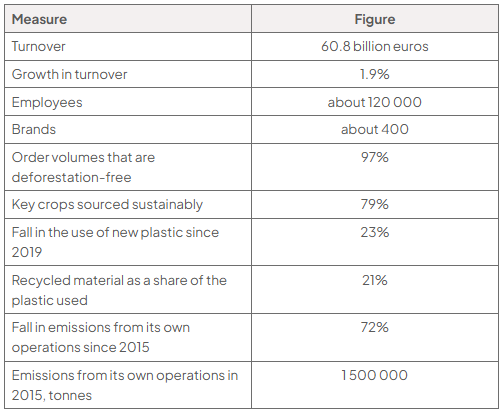
Unilever makes soap, shampoo, washing powder, ice cream, tea and stock cubes, under about 400 brands sold in more than 190 countries. Turnover in 2024 was 60.8 billion euros, up 1.9%, and it employs around 120 000 people.

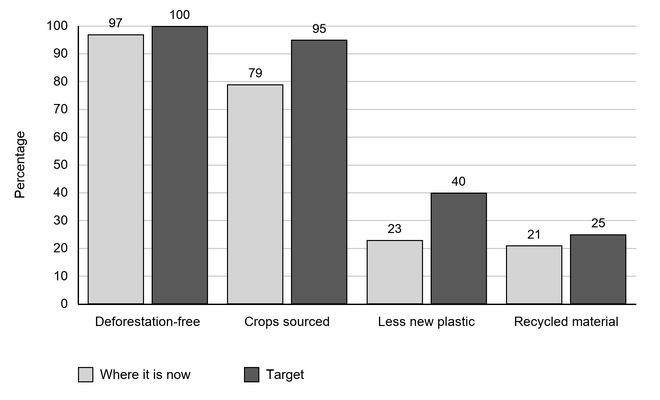
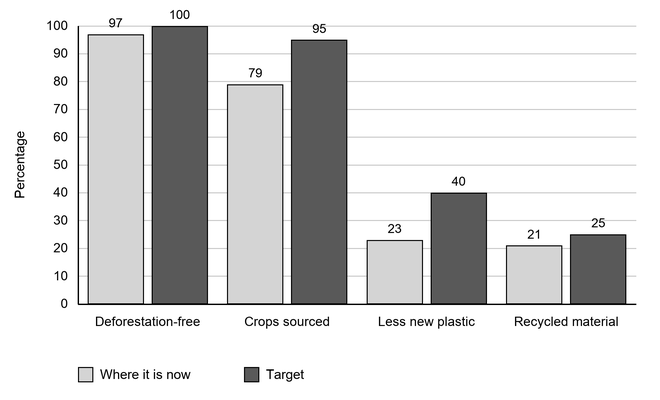
It is also one of the most closely watched companies in the world on sustainability, and it publishes figures most businesses would not. In 2024, 97% of its order volumes of palm oil, paper and board, tea, soy and cocoa were deforestation-free, and 79% of its key crops were sourced sustainably. It has cut its use of new plastic by 23% since 2019 against a target of 40% by 2028, and recycled material now makes up 21% of the plastic it uses. Emissions from its own operations are 72% lower than in 2015.

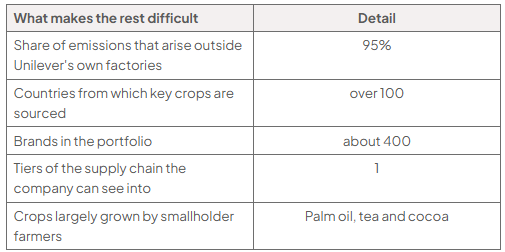
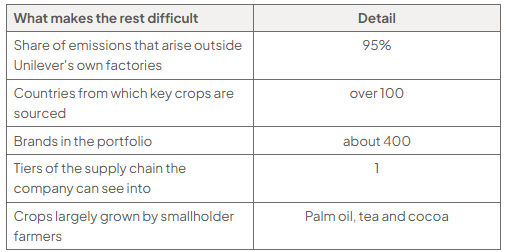
What those numbers hide is how little of it Unilever does itself. Almost all of its emissions arise somewhere other than its own factories, in the fields where its crops are grown and the lorries and homes at either end of its products' lives. Its key crops come from more than a hundred countries, and some of them are grown by farms too small to appear on any list.

That is why the supplier code of conduct matters. Every supplier signs it, and a share of them are audited each year. Most of those audits are arranged in advance.

The question the company keeps being asked is whether signing a code and visiting a fraction of suppliers on an agreed date tells anyone very much about conditions in a field eight thousand miles away.

Source: Unilever Annual Report and Accounts 2024

Appendix F: How far Unilever has got, and what makes the rest difficult

Bar chart comparing Unilever’s current percentages with targets: deforestation-free 97 versus 100, crops sourced sustainably 79 versus 95, less new plastic 23 versus 40, and recycled material 21 versus 25.
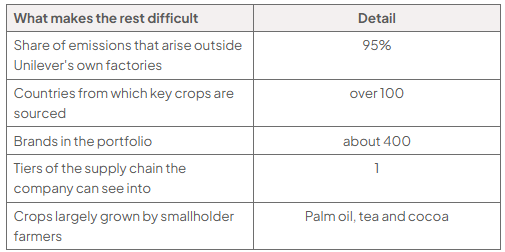
Table: “What makes the rest difficult”. It lists 95% of emissions outside Unilever’s factories, key crops from over 100 countries, about 400 brands, visibility of one supply-chain tier, and palm oil, tea and cocoa largely grown by smallholders.

Source: Analyst

Analyse one way in which 95% of Unilever's emissions arising outside its own factories might affect its ability to reach its emissions targets.

4
6 marks

Source B: Unilever

Unilever makes soap, shampoo, washing powder, ice cream, tea and stock cubes, under about 400 brands sold in more than 190 countries. Turnover in 2024 was 60.8 billion euros, up 1.9%, and it employs around 120 000 people.

It is also one of the most closely watched companies in the world on sustainability, and it publishes figures most businesses would not. In 2024, 97% of its order volumes of palm oil, paper and board, tea, soy and cocoa were deforestation-free, and 79% of its key crops were sourced sustainably. It has cut its use of new plastic by 23% since 2019 against a target of 40% by 2028, and recycled material now makes up 21% of the plastic it uses. Emissions from its own operations are 72% lower than in 2015.

What those numbers hide is how little of it Unilever does itself. Almost all of its emissions arise somewhere other than its own factories, in the fields where its crops are grown and the lorries and homes at either end of its products' lives. Its key crops come from more than a hundred countries, and some of them are grown by farms too small to appear on any list.

That is why the supplier code of conduct matters. Every supplier signs it, and a share of them are audited each year. Most of those audits are arranged in advance.

The question the company keeps being asked is whether signing a code and visiting a fraction of suppliers on an agreed date tells anyone very much about conditions in a field eight thousand miles away.

Source: Unilever Annual Report and Accounts 2024

Appendix F: How far Unilever has got, and what makes the rest difficult

Bar chart comparing Unilever’s current percentages with targets: deforestation-free 97 versus 100, crops sourced sustainably 79 versus 95, less new plastic 23 versus 40, and recycled material 21 versus 25.
Table titled “What makes the rest difficult”: 95% of emissions arise outside Unilever’s factories; key crops come from over 100 countries; the portfolio has about 400 brands; the company sees one supply-chain tier; palm oil, tea and cocoa are largely grown by smallholders.

Source: Analyst

Analyse one way in which buying its key crops from over 100 countries might affect Unilever's ability to source them sustainably.

5
6 marks

Source B: Severnside Plastics Ltd

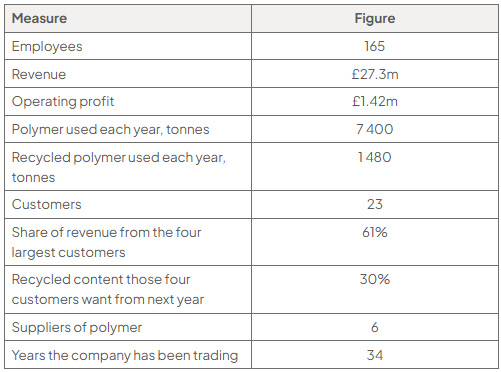
Severnside Plastics Ltd makes rigid plastic trays and pots for food manufacturers from a single factory in Gloucestershire. It employs 165 people, had revenue of £27.3 million in the year to March 2025 and an operating profit of £1.42 million. Twenty-three customers buy from it, and the four largest account for 61% of revenue.

The company uses 7 400 tonnes of polymer a year, of which 1 480 tonnes is recycled. Those four largest customers have told Severnside that from next year they will only buy packaging with at least 30% recycled content, so the company has to find more recycled material or lose nearly two thirds of its sales.

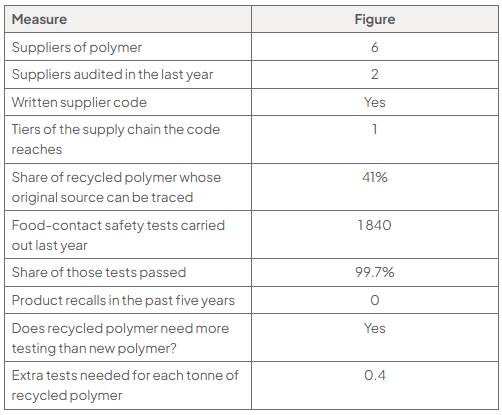
Recycled polymer is harder to work with than new polymer. It costs £310 a tonne more, only about two thirds of what the company needs is available in the United Kingdom, and it varies more in quality: when recycled content goes above 25%, the share of batches rejected rises to 3.1%. Because the trays hold food, every batch has to pass a food-contact safety test, and the company ran 1 840 of those last year.

There is also the question of where the material comes from. Severnside has a written supplier code, but it reaches only its six direct polymer suppliers, it audited two of them last year, and the original source of most of its recycled material cannot be traced.

The board has to decide how to get to 30%.

Source: Severnside Plastics Ltd

Appendix F: The polymer Severnside uses, and what 30% would take

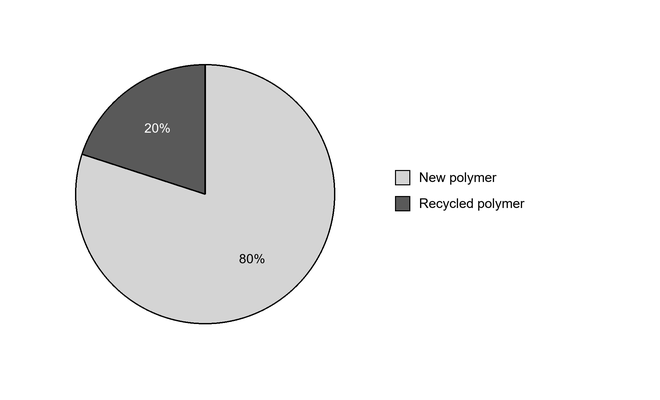
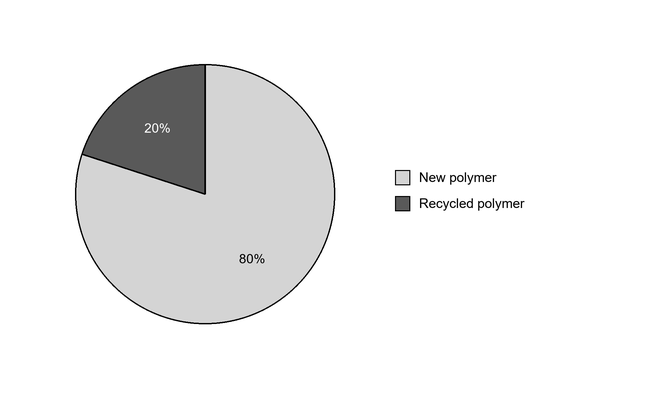
Pie chart showing Severnside’s current polymer mix: 80% new polymer (light grey) and 20% recycled polymer (dark grey), with a legend identifying the two segments.
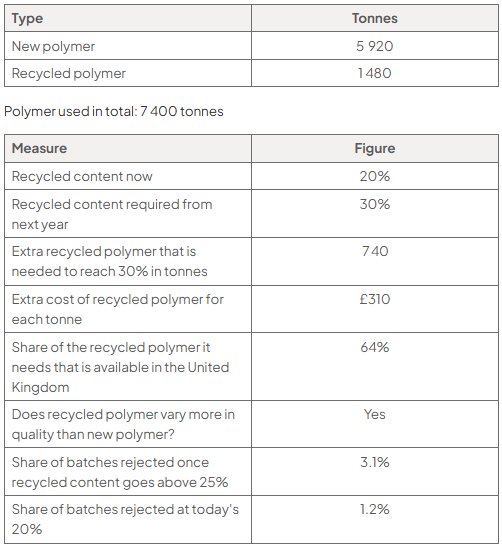
Two tables. Polymer used, in tonnes: new polymer 5 920; recycled polymer 1 480; polymer used in total 7 400 tonnes. A table of measures: recycled content now 20%; recycled content required from next year 30%; extra recycled polymer needed to reach 30%, 740 tonnes; extra cost of recycled polymer for each tonne £310; 64% of the recycled polymer it needs is available in the United Kingdom; recycled polymer does vary more in quality than new polymer; 3.1% of batches rejected once recycled content goes above 25%; 1.2% of batches rejected at today's 20%.

Source: Analyst

Analyse one way in which raising recycled content from 20% to 30% might affect Severnside Plastics Ltd's costs.

6
6 marks

Source B: Calder Vale Coffee Roasters Ltd

Calder Vale Coffee Roasters Ltd roasts coffee for cafés and food retailers from one roastery near Skipton. It employs 84 people, roasts about 1 850 tonnes of green beans a year, and in the year to March 2025 had revenue of £19.6 million and an operating profit of £1.35 million. It has been trading for twenty-nine years and supplies 240 customers.

The beans come from eleven co-operatives in four countries. Calder Vale pays £4 920 a tonne when the market price is £4 500, not under any certification scheme but under its own agreement with the growers, and it tells customers so. It visited seven of the eleven co-operatives last year and can name the farm of origin for 83% of what it buys.

Roasting coffee is a gas-fired business. Of the 2 775 tonnes of carbon dioxide equivalent the company produced last year, the largest share came from the three roasters themselves rather than from shipping beans halfway round the world. The oldest roaster is twenty-two years old.

Packaging is the other half of the environmental question, and the harder half to move. Forty-six per cent of what Calder Vale packs can be recycled at home and none of it is reused, because a bag of coffee is normally thrown away once it is empty.

A second roastery has been agreed in principle, and the board also has to decide what to do about the emissions it already has.

Source: Calder Vale Coffee Roasters Ltd

Appendix G: What Calder Vale emits, and what it packs

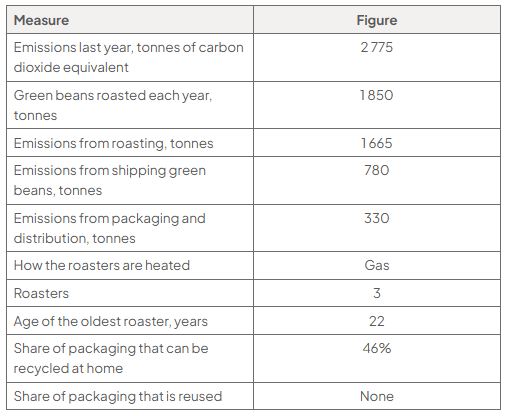
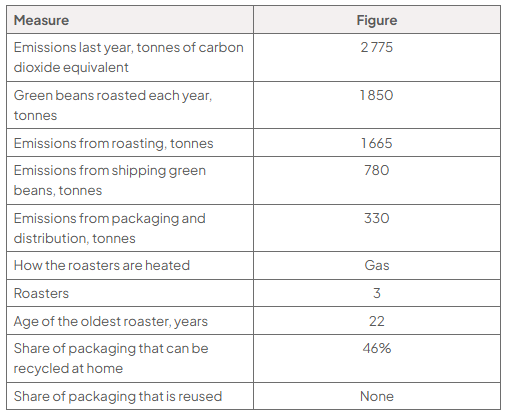
Table of Calder Vale’s measures and figures: total emissions 2,775 tonnes carbon dioxide equivalent; roasting 1,665, shipping 780, packaging and distribution 330; 1,850 tonnes of beans roasted; three gas-heated roasters, oldest 22 years; 46% recyclable at home and none reused.

Source: Analyst

Analyse one way in which heating its roasters with gas might affect Calder Vale Coffee Roasters Ltd.

7
6 marks

Source A: Thornbury Garden Products Ltd

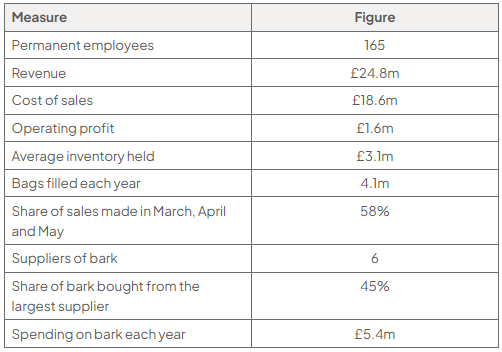
Thornbury Garden Products Ltd makes peat-free compost, bark mulch and growing media at one site near Evesham. It fills about 4.1 million bags a year, employs 165 permanent people, and in the year to March 2025 had revenue of £24.8 million, cost of sales of £18.6 million and an operating profit of £1.6 million.

The whole business is shaped by three months. Fifty-eight per cent of the year's sales happen in March, April and May, because that is when people garden. In the peak the site fills 96 000 bags a week; in the quietest week of the year it fills 22 000. Nothing about the weather is known in advance, and a cold, wet April cannot be made up later in the year.

So the company builds inventory through the winter. By February it is holding about eleven weeks of finished bags, against three weeks in July. Compost is bulky and cheap: a lorry fills up long before it reaches its weight limit, the yard holds 620 000 bags and anything beyond that goes into rented outside storage. Bags left in sunlight begin to degrade after about nine months.

The other pressure is bark. Thornbury buys from six suppliers and 45% of its bark comes from one of them, on an annual bark spend of £5.4 million. Since peat was withdrawn from retail growing media, every maker in the country has been competing for the same bark, and the largest supplier knows it.

The operations director has to decide how to secure the bark before next winter's inventory build begins.

Source: Thornbury Garden Products Ltd

Appendix A: Thornbury Garden Products Ltd selected data, year to March 2025

Table of Thornbury Garden Products Ltd selected data for the year to March 2025: 165 permanent employees; revenue £24.8m; cost of sales £18.6m; operating profit £1.6m; average inventory held £3.1m; 4.1m bags filled each year; 58% of sales made in March, April and May; 6 suppliers of bark; 45% of bark bought from the largest supplier; spending on bark each year £5.4m.

Source: Thornbury Garden Products Ltd

Analyse one way in which peat no longer being sold in retail growing media might affect the environmental impact of Thornbury Garden Products Ltd's operations.

1
9 marks

Source B: Primark

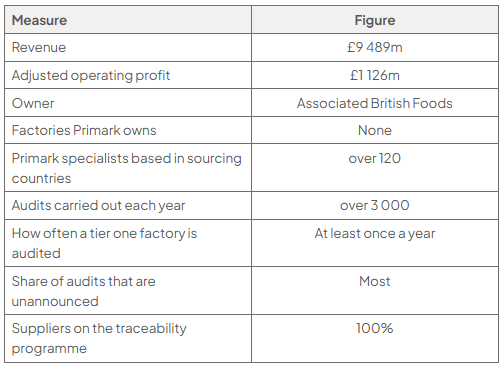
Primark sells clothing at prices far below most of the high street. It is owned by Associated British Foods, and in the 52 weeks to 13 September 2025 it had revenue of £9 489 million and an adjusted operating profit of £1 126 million.

Selling cheap clothing in very large quantities raises two questions that the company is asked constantly: who made it, and what it does to the planet.

On the first, Primark does not own the factories that make its clothes. It buys from suppliers, mostly in Asia, and checks them. More than 120 of its own specialists are based in the main countries it buys from, and together with approved third-party auditors they carry out over 3 000 audits a year. Every tier one factory approved to make Primark products is audited at least once a year, and most audits are unannounced.

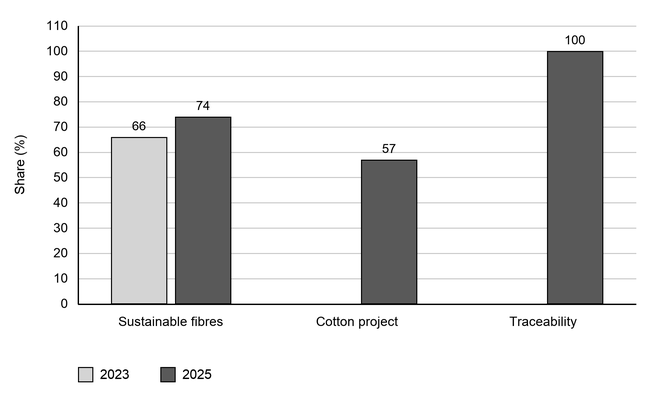
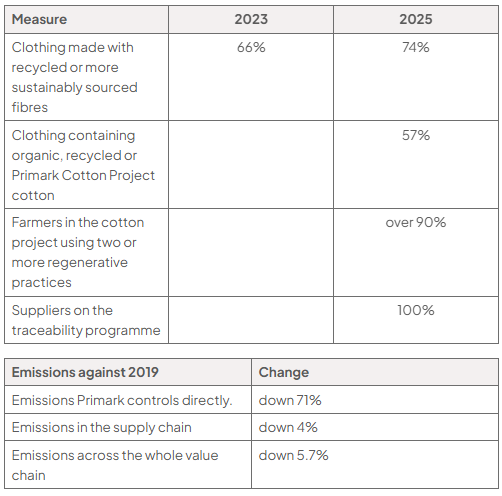
On the second, it has set out what it has changed. 74% of its clothing is now made with recycled or more sustainably sourced fibres, up from 66% in 2023. 57% of its clothing contains cotton that is organic, recycled or grown through the Primark Cotton Project, and over 90% of the farmers in that project have adopted at least two regenerative farming practices on at least 30% of their land. Every clothing, textile and footwear supplier is now on its traceability programme. Emissions across the whole value chain are down 5.7% against 2019, with the emissions Primark controls directly down 71% and those in its supply chain down 4%.

That last pair of figures is the difficulty in one line. The part Primark can change itself has almost gone. The part it cannot has barely moved.

Source: Associated British Foods annual results 2025 and Primark Sustainability and Ethics Progress Report

Appendix E: Selected data for Primark, 52 weeks to 13 September 2025

Primark data table: revenue £9 489m; adjusted operating profit £1 126m; owner Associated British Foods; no factories; over 120 specialists; over 3 000 annual audits; tier-one audits at least yearly, mostly unannounced; traceability 100%.

Source: Associated British Foods

Appendix F: What Primark has changed

Bar chart of Primark’s clothing and supplier shares in 2023 and 2025: sustainable fibres 66% and 74%, cotton project 57% and traceability 100% in 2025 only. Y-axis: share, 0 to 110%.
Two tables show sustainable-fibre clothing rising from 66% in 2023 to 74% in 2025; 2025 shares are 57% cotton, over 90% regenerative farmers and 100% traceable suppliers. Emissions fall 71% directly, 4% in the supply chain and 5.7% overall.

Source: Primark

Assess how much progress Primark has made in reducing the environmental impact of its operations.

2
9 marks

Source B: Unilever

Unilever makes soap, shampoo, washing powder, ice cream, tea and stock cubes, under about 400 brands sold in more than 190 countries. Turnover in 2024 was 60.8 billion euros, up 1.9%, and it employs around 120 000 people.

It is also one of the most closely watched companies in the world on sustainability, and it publishes figures most businesses would not. In 2024, 97% of its order volumes of palm oil, paper and board, tea, soy and cocoa were deforestation-free, and 79% of its key crops were sourced sustainably. It has cut its use of new plastic by 23% since 2019 against a target of 40% by 2028, and recycled material now makes up 21% of the plastic it uses. Emissions from its own operations are 72% lower than in 2015.

What those numbers hide is how little of it Unilever does itself. Almost all of its emissions arise somewhere other than its own factories, in the fields where its crops are grown and the lorries and homes at either end of its products' lives. Its key crops come from more than a hundred countries, and some of them are grown by farms too small to appear on any list.

That is why the supplier code of conduct matters. Every supplier signs it, and a share of them are audited each year. Most of those audits are arranged in advance.

The question the company keeps being asked is whether signing a code and visiting a fraction of suppliers on an agreed date tells anyone very much about conditions in a field eight thousand miles away.

Source: Unilever Annual Report and Accounts 2024

Appendix E: Unilever, published figures for 2024

Table of Unilever's published figures: turnover 60.8 billion euros; growth in turnover 1.9%; about 120 000 employees; about 400 brands; 97% of order volumes deforestation-free; 79% of key crops sourced sustainably; 23% fall in the use of new plastic since 2019; recycled material 21% of the plastic used; 72% fall in emissions from its own operations since 2015; emissions from its own operations in 2015, 1 500 000 tonnes.

Source: Unilever Annual Report and Accounts 2024

Appendix F: How far Unilever has got, and what makes the rest difficult

Bar chart comparing Unilever’s current percentages with targets: deforestation-free 97 versus 100, crops sourced sustainably 79 versus 95, less new plastic 23 versus 40, and recycled material 21 versus 25.
Table headed “What makes the rest difficult” lists: 95% of emissions outside Unilever’s factories; over 100 crop-source countries; about 400 brands; one visible supply-chain tier; and palm oil, tea and cocoa grown mainly by smallholders.

Source: Analyst

Assess Unilever's progress in reducing the environmental impact of its operations.

3
9 marks

Source B: Severnside Plastics Ltd

Severnside Plastics Ltd makes rigid plastic trays and pots for food manufacturers from a single factory in Gloucestershire. It employs 165 people, had revenue of £27.3 million in the year to March 2025 and an operating profit of £1.42 million. Twenty-three customers buy from it, and the four largest account for 61% of revenue.

The company uses 7 400 tonnes of polymer a year, of which 1 480 tonnes is recycled. Those four largest customers have told Severnside that from next year they will only buy packaging with at least 30% recycled content, so the company has to find more recycled material or lose nearly two thirds of its sales.

Recycled polymer is harder to work with than new polymer. It costs £310 a tonne more, only about two thirds of what the company needs is available in the United Kingdom, and it varies more in quality: when recycled content goes above 25%, the share of batches rejected rises to 3.1%. Because the trays hold food, every batch has to pass a food-contact safety test, and the company ran 1 840 of those last year.

There is also the question of where the material comes from. Severnside has a written supplier code, but it reaches only its six direct polymer suppliers, it audited two of them last year, and the original source of most of its recycled material cannot be traced.

The board has to decide how to get to 30%.

Source: Severnside Plastics Ltd

Appendix E: Severnside Plastics Ltd selected data, year to March 2025

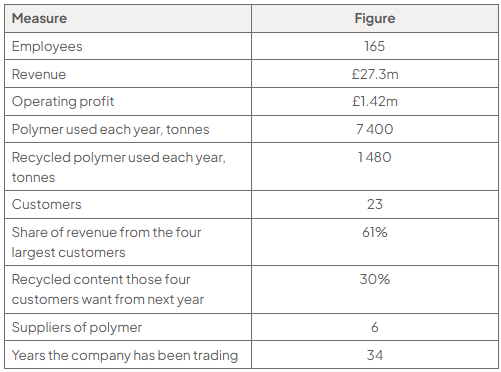
Table of Severnside Plastics Ltd selected data: 165 employees; revenue £27.3m; operating profit £1.42m; 7 400 tonnes polymer, 1 480 recycled; 23 customers; top four 61%; target 30%; six suppliers; trading 34 years.

Source: Severnside Plastics Ltd

Appendix F: The polymer Severnside uses, and what 30% would take

Pie chart showing Severnside’s polymer use: 80% is new polymer and 20% is recycled polymer, as indicated by the legend.
Tables show 5 920 tonnes of new and 1 480 tonnes of recycled polymer, totalling 7 400; recycled content must rise from 20% to 30%, with 740 extra tonnes needed. Cost is £310 per tonne and UK availability 64%.

Source: Analyst

Assess how difficult it will be for Severnside Plastics Ltd to reach 30% recycled content.

Calculate Severnside Plastics Ltd's operating profit margin, now and after paying for the extra recycled polymer, to support your answer.

4
9 marks

Source B: Calder Vale Coffee Roasters Ltd

Calder Vale Coffee Roasters Ltd roasts coffee for cafés and food retailers from one roastery near Skipton. It employs 84 people, roasts about 1 850 tonnes of green beans a year, and in the year to March 2025 had revenue of £19.6 million and an operating profit of £1.35 million. It has been trading for twenty-nine years and supplies 240 customers.

The beans come from eleven co-operatives in four countries. Calder Vale pays £4 920 a tonne when the market price is £4 500, not under any certification scheme but under its own agreement with the growers, and it tells customers so. It visited seven of the eleven co-operatives last year and can name the farm of origin for 83% of what it buys.

Roasting coffee is a gas-fired business. Of the 2 775 tonnes of carbon dioxide equivalent the company produced last year, the largest share came from the three roasters themselves rather than from shipping beans halfway round the world. The oldest roaster is twenty-two years old.

Packaging is the other half of the environmental question, and the harder half to move. Forty-six per cent of what Calder Vale packs can be recycled at home and none of it is reused, because a bag of coffee is normally thrown away once it is empty.

A second roastery has been agreed in principle, and the board also has to decide what to do about the emissions it already has.

Source: Calder Vale Coffee Roasters Ltd

Appendix E: Calder Vale Coffee Roasters Ltd selected data, year to March 2025

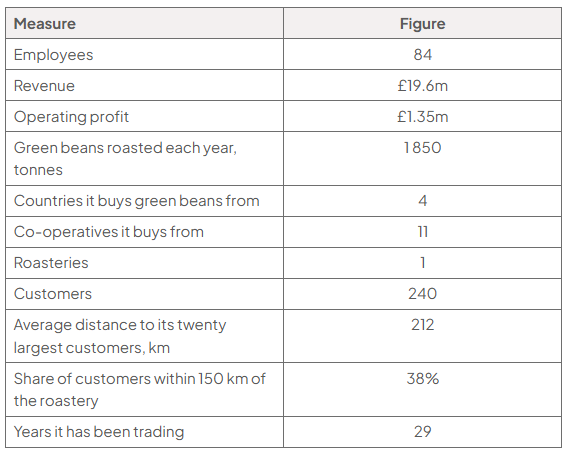
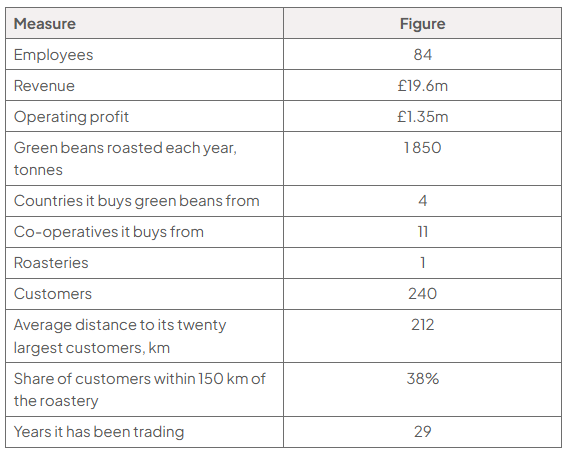
Table of Calder Vale Coffee Roasters Ltd selected data: 84 employees; revenue £19.6m; operating profit £1.35m; 1 850 tonnes of green beans roasted each year; buys green beans from 4 countries; buys from 11 co-operatives; 1 roastery; 240 customers; average distance to its twenty largest customers 212 km; 38% of customers within 150 km of the roastery; trading for 29 years.

Source: Calder Vale Coffee Roasters Ltd

Appendix G: What Calder Vale emits, and what it packs

Environmental-impact table: emissions total 2 775 tonnes carbon dioxide equivalent; 1 850 tonnes beans roasted; 1 665 roasting, 780 shipping and 330 packaging and distribution. Gas-fired roasters: 3, oldest 22 years; 46% recyclable at home, none reused.

Source: Analyst

Assess how well Calder Vale Coffee Roasters Ltd measures its environmental impact.

5
9 marks

Source B: Severnside Plastics Ltd

Severnside Plastics Ltd makes rigid plastic trays and pots for food manufacturers from a single factory in Gloucestershire. It employs 165 people, had revenue of £27.3 million in the year to March 2025 and an operating profit of £1.42 million. Twenty-three customers buy from it, and the four largest account for 61% of revenue.

The company uses 7 400 tonnes of polymer a year, of which 1 480 tonnes is recycled. Those four largest customers have told Severnside that from next year they will only buy packaging with at least 30% recycled content, so the company has to find more recycled material or lose nearly two thirds of its sales.

Recycled polymer is harder to work with than new polymer. It costs £310 a tonne more, only about two thirds of what the company needs is available in the United Kingdom, and it varies more in quality: when recycled content goes above 25%, the share of batches rejected rises to 3.1%. Because the trays hold food, every batch has to pass a food-contact safety test, and the company ran 1 840 of those last year.

There is also the question of where the material comes from. Severnside has a written supplier code, but it reaches only its six direct polymer suppliers, it audited two of them last year, and the original source of most of its recycled material cannot be traced.

The board has to decide how to get to 30%.

Source: Severnside Plastics Ltd

Appendix E: Severnside Plastics Ltd selected data, year to March 2025

Table of selected 2025 data: 165 employees; revenue £27.3m; operating profit £1.42m; 7,400 tonnes of polymer used, including 1,480 recycled; 23 customers; top four provide 61% of revenue; 30% recycled required; six suppliers; 34 years trading.

Source: Severnside Plastics Ltd

Appendix G: How Severnside checks its suppliers and its products

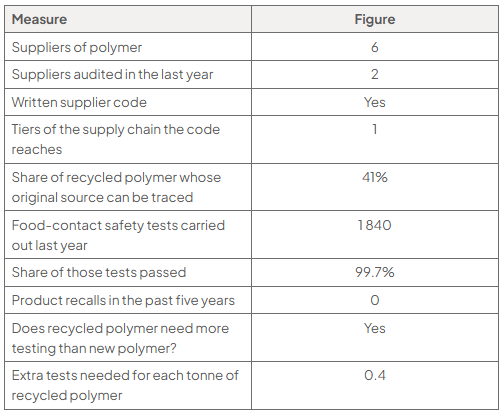
Supplier and product checks table: 6 polymer suppliers, 2 audited, a written code reaching 1 supply-chain tier; 41% of recycled polymer traceable; 1,840 tests, 99.7% passed, 0 recalls, and 0.4 extra tests per tonne.

Source: Analyst

Assess the environmental benefit to Severnside Plastics Ltd of raising the recycled content of its trays from 20% to 30%.

1
15 marks

Source B: Primark

Primark sells clothing at prices far below most of the high street. It is owned by Associated British Foods, and in the 52 weeks to 13 September 2025 it had revenue of £9 489 million and an adjusted operating profit of £1 126 million.

Selling cheap clothing in very large quantities raises two questions that the company is asked constantly: who made it, and what it does to the planet.

On the first, Primark does not own the factories that make its clothes. It buys from suppliers, mostly in Asia, and checks them. More than 120 of its own specialists are based in the main countries it buys from, and together with approved third-party auditors they carry out over 3 000 audits a year. Every tier one factory approved to make Primark products is audited at least once a year, and most audits are unannounced.

On the second, it has set out what it has changed. 74% of its clothing is now made with recycled or more sustainably sourced fibres, up from 66% in 2023. 57% of its clothing contains cotton that is organic, recycled or grown through the Primark Cotton Project, and over 90% of the farmers in that project have adopted at least two regenerative farming practices on at least 30% of their land. Every clothing, textile and footwear supplier is now on its traceability programme. Emissions across the whole value chain are down 5.7% against 2019, with the emissions Primark controls directly down 71% and those in its supply chain down 4%.

That last pair of figures is the difficulty in one line. The part Primark can change itself has almost gone. The part it cannot has barely moved.

Source: Associated British Foods annual results 2025 and Primark Sustainability and Ethics Progress Report

Appendix E: Selected data for Primark, 52 weeks to 13 September 2025

Selected Primark data table: revenue £9 489m; adjusted operating profit £1 126m; owner Associated British Foods; no factories; over 120 specialists; over 3 000 annual audits; most unannounced; 100% traceability.

Source: Associated British Foods

Appendix F: What Primark has changed

Bar chart of Primark’s sustainability shares from 2023 to 2025: sustainable fibres rise from 66% to 74%, cotton project reaches 57% and traceability 100% in 2025; y-axis shows share from 0 to 110%.
Primark sustainability tables: sustainable fibres rose from 66% in 2023 to 74% in 2025; 2025 cotton was 57%, regenerative farming over 90% and traceability 100%. Emissions versus 2019 fell 71% directly, 4% in supply chain and 5.7% overall.

Source: Primark

Appendix H: Two ways for Primark to go further

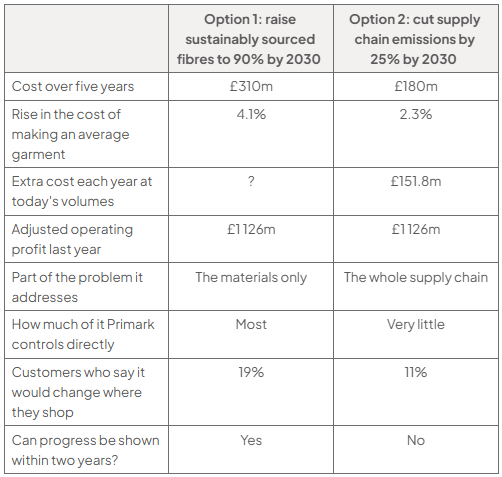
1.1 billion garments sold each year, at an average cost of £6.00 to make

Table comparing Option 1, raise sustainably sourced fibres to 90% by 2030, with Option 2, cut supply chain emissions by 25% by 2030: cost over five years £310m and £180m; rise in the cost of making an average garment 4.1% and 2.3%; extra cost each year at today's volumes, not provided for Option 1 and £151.8m for Option 2; adjusted operating profit last year £1 126m for both; part of the problem it addresses, the materials only and the whole supply chain; how much of it Primark controls directly, most and very little; customers who say it would change where they shop 19% and 11%; whether progress can be shown within two years, yes and no.

Source: Analyst

Primark is considering two ways of going further:

Option 1: raise sustainably sourced fibres to 90% by 2030

Option 2: cut supply chain emissions by 25% by 2030

Evaluate both options and recommend which one Primark should choose.

Calculate the extra cost each year under Option 1 to support your answer.

2
15 marks

Source B: Severnside Plastics Ltd

Severnside Plastics Ltd makes rigid plastic trays and pots for food manufacturers from a single factory in Gloucestershire. It employs 165 people, had revenue of £27.3 million in the year to March 2025 and an operating profit of £1.42 million. Twenty-three customers buy from it, and the four largest account for 61% of revenue.

The company uses 7 400 tonnes of polymer a year, of which 1 480 tonnes is recycled. Those four largest customers have told Severnside that from next year they will only buy packaging with at least 30% recycled content, so the company has to find more recycled material or lose nearly two thirds of its sales.

Recycled polymer is harder to work with than new polymer. It costs £310 a tonne more, only about two thirds of what the company needs is available in the United Kingdom, and it varies more in quality: when recycled content goes above 25%, the share of batches rejected rises to 3.1%. Because the trays hold food, every batch has to pass a food-contact safety test, and the company ran 1 840 of those last year.

There is also the question of where the material comes from. Severnside has a written supplier code, but it reaches only its six direct polymer suppliers, it audited two of them last year, and the original source of most of its recycled material cannot be traced.

The board has to decide how to get to 30%.

Source: Severnside Plastics Ltd

Appendix G: How Severnside checks its suppliers and its products

Table of how Severnside checks its suppliers and its products: 6 suppliers of polymer; 2 suppliers audited in the last year; a written supplier code, yes; the code reaches 1 tier of the supply chain; 41% of recycled polymer can be traced to its original source; 1 840 food-contact safety tests carried out last year; 99.7% of those tests passed; 0 product recalls in the past five years; recycled polymer needs more testing than new polymer, yes; 0.4 extra tests needed for each tonne of recycled polymer.

Source: Analyst

Appendix H: Two ways of reaching 30% recycled content

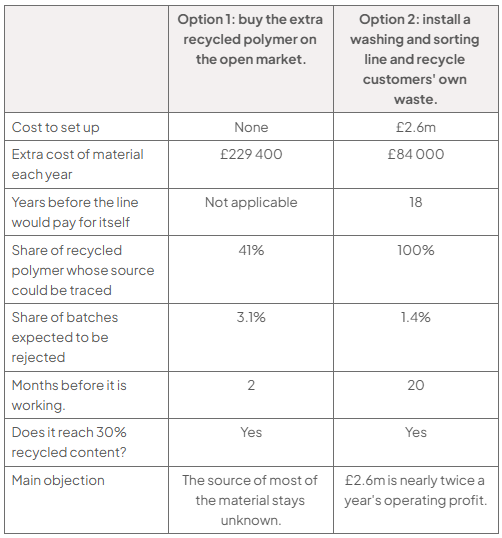
Recycled polymer costs £310 a tonne more than new polymer. Operating profit is £1.42m.

Comparison table: open-market polymer has no setup cost, £229 400 extra yearly, 41% traceable, 3.1% rejected and works in 2 months; washing/sorting costs £2.6m, £84 000 yearly, 100% traceable, 1.4% rejected and pays back in 18 years.

Source: Analyst

Severnside Plastics Ltd is considering two ways of reaching 30% recycled content:

Option 1: buy the extra recycled polymer on the open market

Option 2: install a washing and sorting line and recycle customers' own waste

Evaluate both options and recommend which one Severnside Plastics Ltd should choose.

Calculate the return on investment for Option 2 to support your answer.

3
15 marks

Source B: Calder Vale Coffee Roasters Ltd

Calder Vale Coffee Roasters Ltd roasts coffee for cafés and food retailers from one roastery near Skipton. It employs 84 people, roasts about 1 850 tonnes of green beans a year, and in the year to March 2025 had revenue of £19.6 million and an operating profit of £1.35 million. It has been trading for twenty-nine years and supplies 240 customers.

The beans come from eleven co-operatives in four countries. Calder Vale pays £4 920 a tonne when the market price is £4 500, not under any certification scheme but under its own agreement with the growers, and it tells customers so. It visited seven of the eleven co-operatives last year and can name the farm of origin for 83% of what it buys.

Roasting coffee is a gas-fired business. Of the 2 775 tonnes of carbon dioxide equivalent the company produced last year, the largest share came from the three roasters themselves rather than from shipping beans halfway round the world. The oldest roaster is twenty-two years old.

Packaging is the other half of the environmental question, and the harder half to move. Forty-six per cent of what Calder Vale packs can be recycled at home and none of it is reused, because a bag of coffee is normally thrown away once it is empty.

A second roastery has been agreed in principle, and the board also has to decide what to do about the emissions it already has.

Source: Calder Vale Coffee Roasters Ltd

Appendix E: Calder Vale Coffee Roasters Ltd selected data, year to March 2025

Table of Calder Vale Coffee Roasters Ltd selected data: 84 employees; revenue £19.6m; operating profit £1.35m; 1 850 tonnes of green beans roasted each year; buys green beans from 4 countries; buys from 11 co-operatives; 1 roastery; 240 customers; average distance to its twenty largest customers 212 km; 38% of customers within 150 km of the roastery; trading for 29 years.

Source: Calder Vale Coffee Roasters Ltd

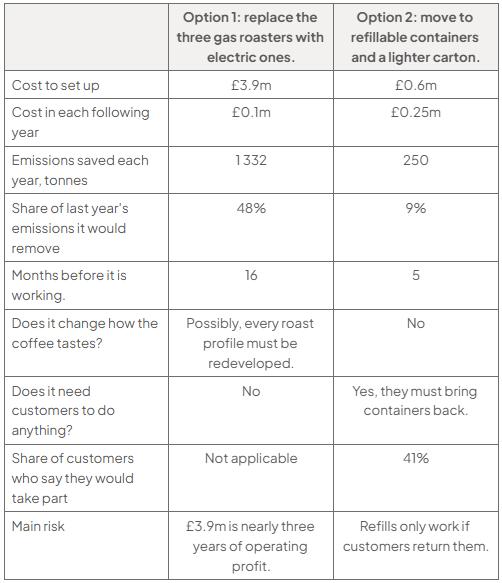
Appendix H: Two ways of cutting emissions

Emissions were 2 775 tonnes last year, of which 1 665 tonnes came from roasting.

Comparison table of emissions-cutting options: replace three gas roasters or use refillable containers and lighter cartons. Setup costs £3.9m/£0.6m; annual costs £0.1m/£0.25m; savings 1 332/250 tonnes; lead times 16/5 months.

Source: Analyst

Calder Vale Coffee Roasters Ltd is considering two ways of cutting its emissions:

Option 1: replace the three gas roasters with electric ones

Option 2: move to refillable containers and a lighter carton

Evaluate both options and recommend which one Calder Vale Coffee Roasters Ltd should choose.