Inventory Management (AQA A Level Business): Exam Questions

Exam code: 7132

Syllabus Edition

First teaching 2026

First exams 2028

2 hours15 questions
1
6 marks

Source B: Ocado Retail

Ocado Retail is the United Kingdom's only large supermarket that sells groceries online and has no shops at all. It is a joint venture owned half by Ocado Group and half by Marks and Spencer.

Instead of shops it runs seven customer fulfilment centres. These are huge automated warehouses in which thousands of robots travel across a grid above crates of groceries, lifting out the items each customer has ordered and passing them to packers. The centre at Erith has more than 3 500 robots and about 750 000 storage locations. A fleet of branded vans then delivers from these centres, and from smaller regional sites called spokes, to more than 80% of UK households.

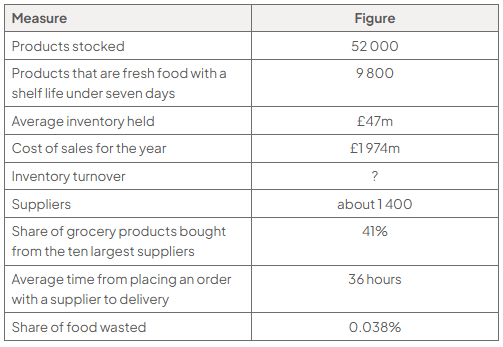
The automation gives Ocado Retail very tight control of its inventory. It wastes 0.038% of the food it handles, which is roughly one product in every 2 600.

Trading has been strong. In the year to 6 April 2025 revenue rose 15.5% to £2 826.8 million, from £2 446.6 million. Active customers rose 14.6% to 1.2 million and orders rose 13% to 469 600 a week, while the average basket held steady and selling prices rose only 0.4%, well below inflation.

The business is also using its warehouses much harder than it was. Capacity utilisation across the fulfilment centres rose from 75% at the end of the 2023 financial year to as much as 94% by February 2025. Profitability improved with it: adjusted earnings before interest, tax, depreciation and amortisation rose 78.3% to £53.5 million, and the loss before tax narrowed from £121.7 million to £60.0 million.

Demand is not spread evenly. Orders peak sharply on Friday and Saturday, and again in the week before Christmas, and every order has to be picked, packed and delivered within a slot the customer has chosen.

Source: Ocado Retail and Ocado Group annual reports and trading statements, 2024 to 2026

Appendix H: Ocado Retail's inventory and suppliers

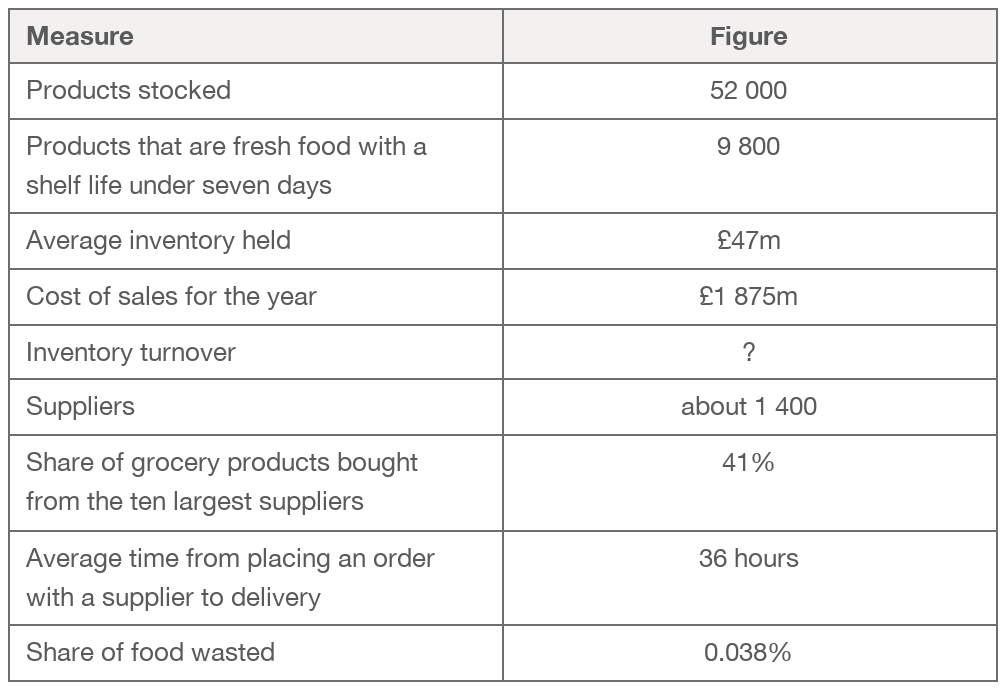
Table of Ocado Retail's inventory and suppliers: 52 000 products stocked; 9 800 products are fresh food with a shelf life under seven days; average inventory held £47m; cost of sales for the year £1 974m; inventory turnover not provided; about 1 400 suppliers; 41% of grocery products bought from the ten largest suppliers; 36 hours on average from placing an order with a supplier to delivery; 0.038% of food wasted.

Source: Analyst

Analyse one way in which holding very little inventory of fresh food might affect Ocado Retail's ability to satisfy its customers.

2
6 marks

Source B: Thaxted Seed Co Ltd

Thaxted Seed Co Ltd supplies vegetable and flower seed to garden centres and smallholdings across eastern England. It employs 28 people at a single site in Essex, and in the year to September 2025 it had revenue of £4.2 million and an operating profit of £310 000.

Almost everything it sells, it sells in eight weeks. Gardeners buy seed in March and April, and garden centres want their shelves full by the last week of February. Between May and January the warehouse is quiet. In the year to September 2025, 71% of the company's revenue came in March and April alone.

Seed cannot simply be made to order. It has to be grown, harvested, dried, tested for germination and packeted, and that work happens on a different timetable from the selling. Thaxted therefore buys and packets its seed through the autumn and holds it until spring. Seed also loses the ability to germinate as it ages, so anything unsold at the end of a season is worth far less the following year and is usually written off.

The company buys 62% of its seed from one Dutch grower, Verhoeven BV, which it has used since 1994. Verhoeven offers lower prices than anyone else and has never missed a delivery, but in August 2025 a wet harvest cut the quantity it could supply by a fifth, and Thaxted had to buy the shortfall elsewhere at short notice and at a higher price. The managing director, Tom Prideaux, has started asking whether depending on one supplier for most of what the company sells is wise.

Source: Thaxted Seed Co Ltd

Appendix F: Thaxted Seed Co Ltd inventory

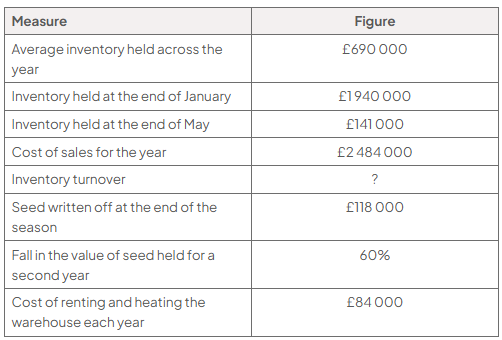
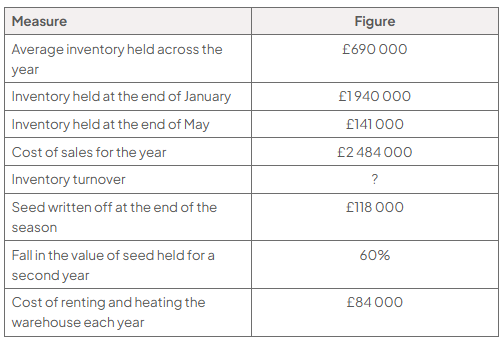
Table of Thaxted Seed Co Ltd inventory: average inventory held across the year £690 000; inventory held at the end of January £1 940 000; inventory held at the end of May £141 000; cost of sales for the year £2 484 000; inventory turnover not provided; seed written off at the end of the season £118 000; fall in the value of seed held for a second year 60%; cost of renting and heating the warehouse each year £84 000.

Source: Analyst

Analyse one way in which holding £1 940 000 of seed at the end of January might affect Thaxted Seed Co Ltd's cash flow.

3
6 marks

Source B: Screwfix

Screwfix sells tools, fixings, plumbing and electrical supplies to tradespeople. It is owned by Kingfisher, which also owns B&Q. Its branches are not really shops: most of the inventory sits in a warehouse behind a counter, and customers order on a phone or a screen and collect in minutes.

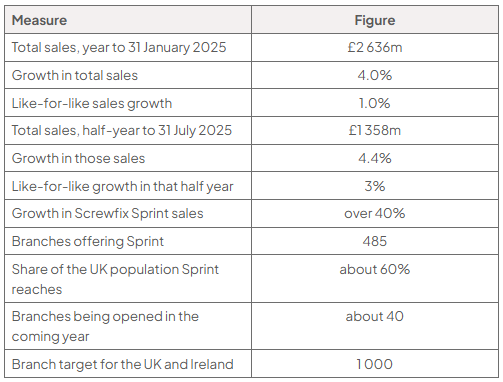
That speed is the product. A plumber halfway through a job cannot wait until tomorrow. Screwfix promises that what is ordered will be ready to collect in about a minute, and its Screwfix Sprint service delivers to a customer's door within an hour. Sprint sales grew by more than 40% in the year, and the service was extended to 151 more branches, so it now runs from 485 branches covering roughly 60% of the United Kingdom's population.

Trading has been solid in a difficult market for home improvement. Total sales rose 4.0% to £2 636 million in the year to 31 January 2025, with like-for-like sales up 1.0%. In the first half of 2025/26 sales rose 4.4% to £1 358 million, with like-for-like up 3%. The business is opening about 40 more branches and is working towards 1 000 across the United Kingdom and Ireland.

All of this depends on something invisible to the customer: having the right item within a few minutes of them. A branch is small, so it cannot hold everything, and what it does not hold has to come from a distribution centre fast enough to matter. Where those distribution centres sit, and how much inventory they hold, is the decision the business keeps returning to.

Source: Kingfisher plc results for the year to 31 January 2025 and the half year to 31 July 2025

Appendix G: What a Screwfix branch holds

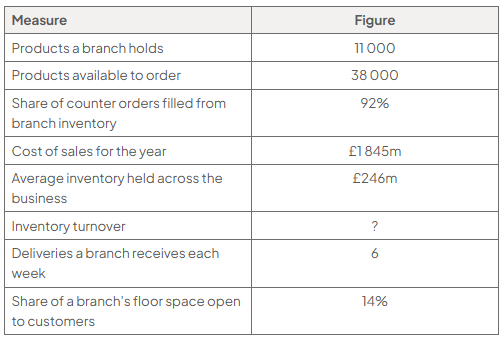
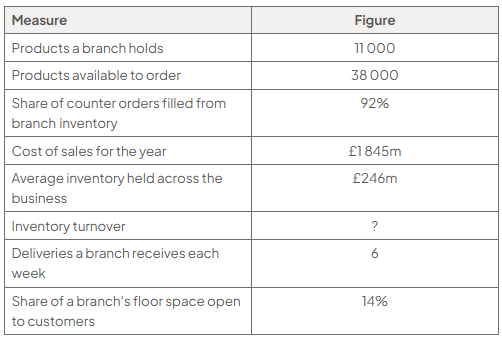
Table of Screwfix measures: 11 000 products held; 38 000 available to order; 92% of counter orders filled from inventory; £1 845m cost of sales; £246m average inventory; turnover unknown; six weekly deliveries; 14% customer floor space.

Source: Analyst

Analyse one way in which filling 92% of counter orders from branch inventory might affect Screwfix's costs.

4
6 marks

Source B: Greencore

Greencore is the largest sandwich manufacturer in the world and the biggest maker of pre-packed sandwiches in the United Kingdom. Almost nothing it makes carries its own name: it makes food to go for supermarkets and coffee chains, who sell it as their own.

In the financial year to 26 September 2025 revenue rose 7.7% to £1 947.0 million and adjusted operating profit rose 28.9% to £125.7 million. Food to go, which covers sandwiches, salads, sushi and chilled snacking, brought in £1 337.8 million. The company employs about 13 300 people.

What makes the business unusual is that it holds almost no finished goods inventory. A sandwich made on Tuesday night is in a shop on Wednesday morning and must be sold that day. There is no warehouse of sandwiches to draw on if demand is higher than expected, and nothing can be made in advance and held. Greencore makes close to exactly what its customers have ordered, every day, and the order changes daily.

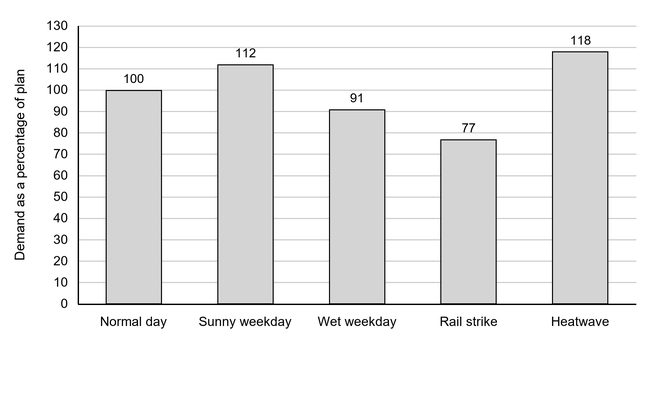
Demand is also unpredictable in ways the company does not control. A sunny Thursday sells more sandwiches than a wet one. A train strike empties city centres. Customers send their orders the afternoon before, and the factories build the night's production plan around them.

Everything therefore depends on being able to change what is made, and how much, at very short notice, and on suppliers who can do the same.

Source: Greencore Group plc full year results for the year ended 26 September 2025

Appendix F: How little time there is

Two tables summarise Greencore’s production timeline, from the afternoon order to sale by day’s end, and key measures: about 16 hours to shelf, under four hours’ finished inventory, 12 hours’ supplier notice and 64% perishable ingredients.

Source: Analyst

Analyse one way in which holding under four hours of finished goods inventory might affect Greencore's costs.

5
6 marks

Source B: Halfords

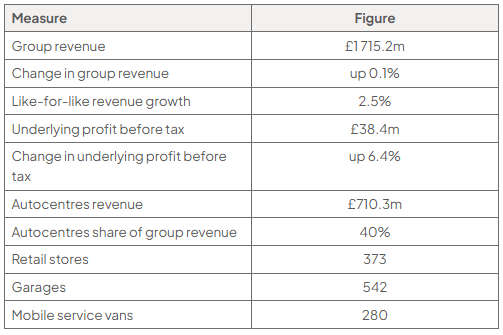
Halfords sells bikes, car parts and motoring products, and services and repairs cars. In the 52 weeks to 28 March 2025 group revenue was £1 715.2 million, almost flat on the year before but 2.5% ahead on a like-for-like basis, and underlying profit before tax rose 6.4% to £38.4 million. Customers reach it through 373 stores, 542 garages and 280 mobile service vans.

Two halves of the business pull in opposite directions through the year. Bikes sell in spring and summer; batteries, bulbs, wipers and screenwash sell in the dark and the cold. A wet April can take a third off cycling sales in a month, and the weather gives about a week's notice.

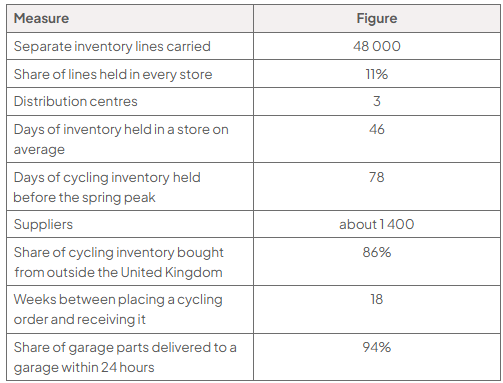
The buying does not work on a week's notice. Most cycling inventory is made outside the United Kingdom, and the gap between placing an order and having it in a store is about eighteen weeks. The season has to be bought before anybody knows what the weather will do, and whatever is left when the season ends gets marked down.

Against that, the garages have become the steadier half of the company. Servicing, maintenance and repair grew while retail stood still, and Halfords has begun putting stores and garages together on one site, where sales run about half again higher than in a standalone garage.

The decision in front of the buying team is how much of next year's cycling season to commit to before the spring.

Source: Halfords Group plc preliminary results for the 52 weeks to 28 March 2025

Appendix F: How inventory reaches the stores, garages and vans

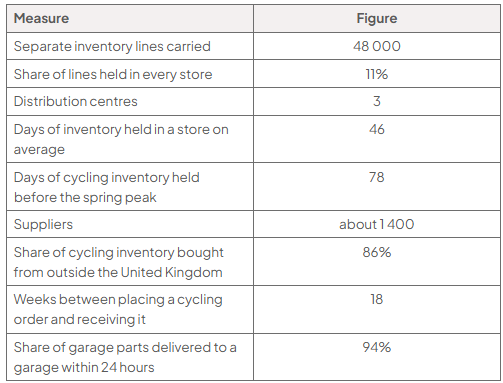
Table of how Halfords inventory reaches its stores, garages and vans: 48 000 separate inventory lines carried; 11% of lines held in every store; 3 distribution centres; 46 days of inventory held in a store on average; 78 days of cycling inventory held before the spring peak; about 1 400 suppliers; 86% of cycling inventory bought from outside the United Kingdom; 18 weeks between placing a cycling order and receiving it; 94% of garage parts delivered to a garage within 24 hours.

Source: Analyst

Analyse one way in which holding 78 days of cycling inventory before the spring peak might affect Halfords' costs.

6
6 marks

Source A: Thornbury Garden Products Ltd

Thornbury Garden Products Ltd makes peat-free compost, bark mulch and growing media at one site near Evesham. It fills about 4.1 million bags a year, employs 165 permanent people, and in the year to March 2025 had revenue of £24.8 million, cost of sales of £18.6 million and an operating profit of £1.6 million.

The whole business is shaped by three months. Fifty-eight per cent of the year's sales happen in March, April and May, because that is when people garden. In the peak the site fills 96 000 bags a week; in the quietest week of the year it fills 22 000. Nothing about the weather is known in advance, and a cold, wet April cannot be made up later in the year.

So the company builds inventory through the winter. By February it is holding about eleven weeks of finished bags, against three weeks in July. Compost is bulky and cheap: a lorry fills up long before it reaches its weight limit, the yard holds 620 000 bags and anything beyond that goes into rented outside storage. Bags left in sunlight begin to degrade after about nine months.

The other pressure is bark. Thornbury buys from six suppliers and 45% of its bark comes from one of them, on an annual bark spend of £5.4 million. Since peat was withdrawn from retail growing media, every maker in the country has been competing for the same bark, and the largest supplier knows it.

The operations director has to decide how to secure the bark before next winter's inventory build begins.

Source: Thornbury Garden Products Ltd

Appendix B: What Thornbury holds in inventory

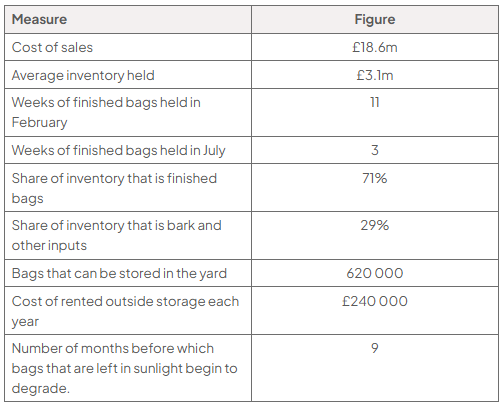
Table of inventory measures: cost of sales £18.6m; average inventory £3.1m; finished bags held 11 weeks in February and 3 in July; inventory split 71% finished bags and 29% bark and other inputs; yard capacity 620,000 bags; outside storage £240,000 yearly; degradation after 9 months.

Source: Analyst

Analyse one way in which holding eleven weeks of finished bags before the season starts might affect Thornbury Garden Products Ltd.

7
6 marks

Source B: Alderney Foods Ltd

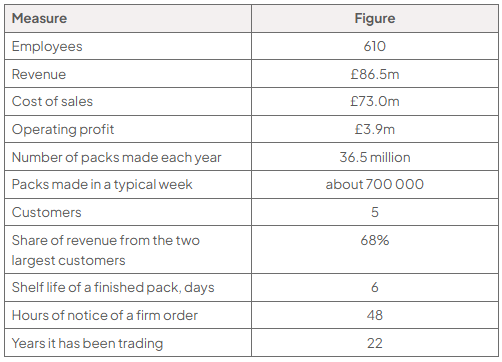
Alderney Foods Ltd makes chilled ready meals for supermarkets from one factory near Peterborough. It employs 610 people, makes about 36.5 million packs a year or roughly 700 000 a week, and in the year to March 2025 had revenue of £86.5 million, cost of sales of £73.0 million and an operating profit of £3.9 million. Five customers buy from it and the two largest provide 68% of revenue.

Everything about the business is decided by six days. That is how long a finished pack lasts, so nothing can be made early and nothing unsold can be held back. The company holds under half a million pounds of inventory against £73 million of cost of sales, and 44% of its ingredients are bought on the day they are used.

Demand is not steady and not knowable. Supermarkets confirm a firm order forty-eight hours before delivery, promotions move volumes without much warning, and a hot week takes about 18% off demand for hot meals. Last year the busiest week was 826 000 packs and the quietest 612 000, against a site that can make 840 000.

The two numbers that follow from all of this are the ones the board dislikes. Three per cent of everything made is thrown away, and 140 of the people on the lines are agency workers rather than employees.

Nobody is proposing to make the shelf life longer. The question is what to do about the waste.

Source: Alderney Foods Ltd

Appendix F: What Alderney holds, and what it throws away

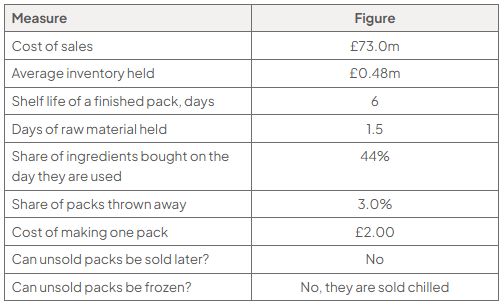
Table of inventory and waste data: cost of sales £73.0m; average inventory £0.48m; six-day shelf life; 1.5 days’ raw-material inventory; 44% bought same day; 3.0% wasted; pack cost £2.00; unsold packs cannot be sold or frozen.

Source: Analyst

Analyse one way in which a six-day shelf life might affect how much inventory Alderney Foods Ltd holds.

1
9 marks

Source B: Ocado Retail

Ocado Retail is the United Kingdom's only large supermarket that sells groceries online and has no shops at all. It is a joint venture owned half by Ocado Group and half by Marks and Spencer.

Instead of shops it runs seven customer fulfilment centres. These are huge automated warehouses in which thousands of robots travel across a grid above crates of groceries, lifting out the items each customer has ordered and passing them to packers. The centre at Erith has more than 3 500 robots and about 750 000 storage locations. A fleet of branded vans then delivers from these centres, and from smaller regional sites called spokes, to more than 80% of UK households.

The automation gives Ocado Retail very tight control of its inventory. It wastes 0.038% of the food it handles, which is roughly one product in every 2 600.

Trading has been strong. In the year to 6 April 2025 revenue rose 15.5% to £2 826.8 million, from £2 446.6 million. Active customers rose 14.6% to 1.2 million and orders rose 13% to 469 600 a week, while the average basket held steady and selling prices rose only 0.4%, well below inflation.

The business is also using its warehouses much harder than it was. Capacity utilisation across the fulfilment centres rose from 75% at the end of the 2023 financial year to as much as 94% by February 2025. Profitability improved with it: adjusted earnings before interest, tax, depreciation and amortisation rose 78.3% to £53.5 million, and the loss before tax narrowed from £121.7 million to £60.0 million.

Demand is not spread evenly. Orders peak sharply on Friday and Saturday, and again in the week before Christmas, and every order has to be picked, packed and delivered within a slot the customer has chosen.

Source: Ocado Retail and Ocado Group annual reports and trading statements, 2024 to 2026

Appendix E: Selected data for Ocado Retail

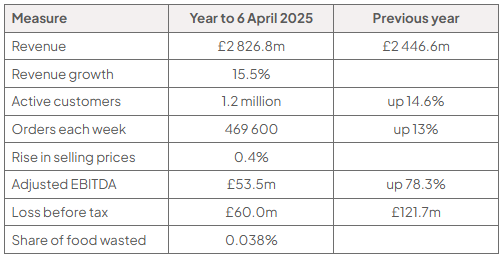
Table of selected Ocado Retail data for 2025 and the previous year: revenue £2,826.8m versus £2,446.6m; customers 1.2m, orders 469,600 weekly, EBITDA £53.5m and food waste 0.038%.

Source: Ocado Retail

Appendix H: Ocado Retail's inventory and suppliers

Table of Ocado Retail inventory data: 52,000 products, including 9,800 fresh; average inventory £47m; annual cost of sales £1 875m; inventory turnover marked “?”; about 1,400 suppliers; 41%, 36 hours and 0.038%.

Source: Analyst

Assess the impact of Ocado Retail's approach to inventory management on its profitability.

Calculate Ocado Retail's inventory turnover to support your answer.

2
9 marks

Source B: Screwfix

Screwfix sells tools, fixings, plumbing and electrical supplies to tradespeople. It is owned by Kingfisher, which also owns B&Q. Its branches are not really shops: most of the inventory sits in a warehouse behind a counter, and customers order on a phone or a screen and collect in minutes.

That speed is the product. A plumber halfway through a job cannot wait until tomorrow. Screwfix promises that what is ordered will be ready to collect in about a minute, and its Screwfix Sprint service delivers to a customer's door within an hour. Sprint sales grew by more than 40% in the year, and the service was extended to 151 more branches, so it now runs from 485 branches covering roughly 60% of the United Kingdom's population.

Trading has been solid in a difficult market for home improvement. Total sales rose 4.0% to £2 636 million in the year to 31 January 2025, with like-for-like sales up 1.0%. In the first half of 2025/26 sales rose 4.4% to £1 358 million, with like-for-like up 3%. The business is opening about 40 more branches and is working towards 1 000 across the United Kingdom and Ireland.

All of this depends on something invisible to the customer: having the right item within a few minutes of them. A branch is small, so it cannot hold everything, and what it does not hold has to come from a distribution centre fast enough to matter. Where those distribution centres sit, and how much inventory they hold, is the decision the business keeps returning to.

Source: Kingfisher plc results for the year to 31 January 2025 and the half year to 31 July 2025

Appendix E: Selected data for Screwfix

Table of selected Screwfix data: total sales in the year to 31 January 2025 £2 636m; growth in total sales 4.0%; like-for-like sales growth 1.0%; total sales in the half-year to 31 July 2025 £1 358m; growth in those sales 4.4%; like-for-like growth in that half year 3%; growth in Screwfix Sprint sales over 40%; 485 branches offering Sprint; Sprint reaches about 60% of the UK population; about 40 branches being opened in the coming year; branch target for the UK and Ireland 1 000.

Source: Kingfisher plc

Appendix G: What a Screwfix branch holds

Table of selected Screwfix data: branch holds 11 000 products; 38 000 available to order; 92% orders filled from inventory; cost of sales £1 845 million; average inventory £246 million; inventory turnover not provided.

Source: Analyst

Assess the importance of inventory management to Screwfix's profitability.

Calculate Screwfix's inventory turnover to support your answer.

3
9 marks

Source B: Greencore

Greencore is the largest sandwich manufacturer in the world and the biggest maker of pre-packed sandwiches in the United Kingdom. Almost nothing it makes carries its own name: it makes food to go for supermarkets and coffee chains, who sell it as their own.

In the financial year to 26 September 2025 revenue rose 7.7% to £1 947.0 million and adjusted operating profit rose 28.9% to £125.7 million. Food to go, which covers sandwiches, salads, sushi and chilled snacking, brought in £1 337.8 million. The company employs about 13 300 people.

What makes the business unusual is that it holds almost no finished goods inventory. A sandwich made on Tuesday night is in a shop on Wednesday morning and must be sold that day. There is no warehouse of sandwiches to draw on if demand is higher than expected, and nothing can be made in advance and held. Greencore makes close to exactly what its customers have ordered, every day, and the order changes daily.

Demand is also unpredictable in ways the company does not control. A sunny Thursday sells more sandwiches than a wet one. A train strike empties city centres. Customers send their orders the afternoon before, and the factories build the night's production plan around them.

Everything therefore depends on being able to change what is made, and how much, at very short notice, and on suppliers who can do the same.

Source: Greencore Group plc full year results for the year ended 26 September 2025

Appendix F: How little time there is

Two tables. When each stage happens: the customer sends the order the afternoon before; the production plan is built in the early evening; ingredients are called off from suppliers in the evening; sandwiches are made through the night; they are despatched before 5am; they are on the shelf by 7am; they must be sold by the end of that day. A table of measures: about 16 hours from order to shelf; finished inventory held under 4 hours of production; 12 hours' notice given to a supplier of a change in quantity; 64% of ingredients cannot be held more than three days.

Source: Analyst

Appendix G: What changes demand

Bar chart of demand as a percentage of plan: normal day 100%, sunny weekday 112%, wet weekday 91%, rail strike 77%, and heatwave 118%; vertical axis ranges from 0% to 130%.
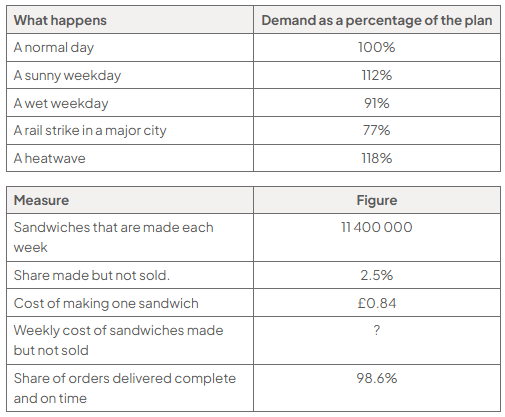
Two tables. Demand as a percentage of the plan: a normal day 100%; a sunny weekday 112%; a wet weekday 91%; a rail strike in a major city 77%; a heatwave 118%. A table of measures: sandwiches made each week 11 400 000; share made but not sold 2.5%; cost of making one sandwich £0.84; weekly cost of sandwiches made but not sold not provided; share of orders delivered complete and on time 98.6%.

Source: Analyst

Assess whether holding almost no inventory is the right approach for Greencore.

4
9 marks

Source A: Thornbury Garden Products Ltd

Thornbury Garden Products Ltd makes peat-free compost, bark mulch and growing media at one site near Evesham. It fills about 4.1 million bags a year, employs 165 permanent people, and in the year to March 2025 had revenue of £24.8 million, cost of sales of £18.6 million and an operating profit of £1.6 million.

The whole business is shaped by three months. Fifty-eight per cent of the year's sales happen in March, April and May, because that is when people garden. In the peak the site fills 96 000 bags a week; in the quietest week of the year it fills 22 000. Nothing about the weather is known in advance, and a cold, wet April cannot be made up later in the year.

So the company builds inventory through the winter. By February it is holding about eleven weeks of finished bags, against three weeks in July. Compost is bulky and cheap: a lorry fills up long before it reaches its weight limit, the yard holds 620 000 bags and anything beyond that goes into rented outside storage. Bags left in sunlight begin to degrade after about nine months.

The other pressure is bark. Thornbury buys from six suppliers and 45% of its bark comes from one of them, on an annual bark spend of £5.4 million. Since peat was withdrawn from retail growing media, every maker in the country has been competing for the same bark, and the largest supplier knows it.

The operations director has to decide how to secure the bark before next winter's inventory build begins.

Source: Thornbury Garden Products Ltd

Appendix A: Thornbury Garden Products Ltd selected data, year to March 2025

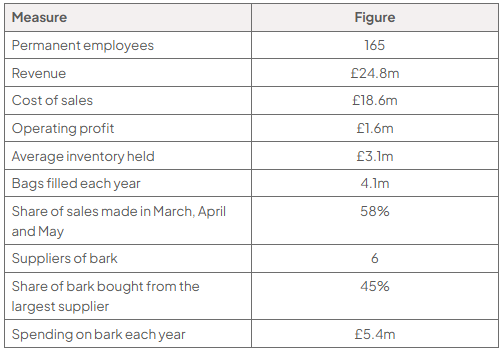
Table of Thornbury Garden Products Ltd selected data for the year to March 2025: 165 permanent employees; revenue £24.8m; cost of sales £18.6m; operating profit £1.6m; average inventory held £3.1m; 4.1m bags filled each year; 58% of sales made in March, April and May; 6 suppliers of bark; 45% of bark bought from the largest supplier; spending on bark each year £5.4m.

Source: Thornbury Garden Products Ltd

Appendix B: What Thornbury holds in inventory

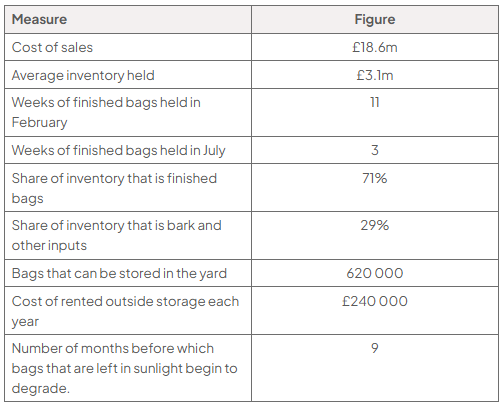
Two-column table of Thornbury’s inventory measures and figures, including costs, inventory levels, storage capacity, inventory shares and bag degradation period: cost of sales £18.6m, average inventory £3.1m, 11 weeks of finished bags held in February and 3 in July, 71% finished bags and 29% bark and other inputs, yard capacity 620 000 bags, rented outside storage £240 000 a year and degradation in sunlight after 9 months.

Source: Analyst

Assess how well Thornbury Garden Products Ltd manages its inventory.

Calculate its inventory turnover to support your answer.

5
9 marks

Source B: Alderney Foods Ltd

Alderney Foods Ltd makes chilled ready meals for supermarkets from one factory near Peterborough. It employs 610 people, makes about 36.5 million packs a year or roughly 700 000 a week, and in the year to March 2025 had revenue of £86.5 million, cost of sales of £73.0 million and an operating profit of £3.9 million. Five customers buy from it and the two largest provide 68% of revenue.

Everything about the business is decided by six days. That is how long a finished pack lasts, so nothing can be made early and nothing unsold can be held back. The company holds under half a million pounds of inventory against £73 million of cost of sales, and 44% of its ingredients are bought on the day they are used.

Demand is not steady and not knowable. Supermarkets confirm a firm order forty-eight hours before delivery, promotions move volumes without much warning, and a hot week takes about 18% off demand for hot meals. Last year the busiest week was 826 000 packs and the quietest 612 000, against a site that can make 840 000.

The two numbers that follow from all of this are the ones the board dislikes. Three per cent of everything made is thrown away, and 140 of the people on the lines are agency workers rather than employees.

Nobody is proposing to make the shelf life longer. The question is what to do about the waste.

Source: Alderney Foods Ltd

Appendix E: Alderney Foods Ltd selected data, year to March 2025

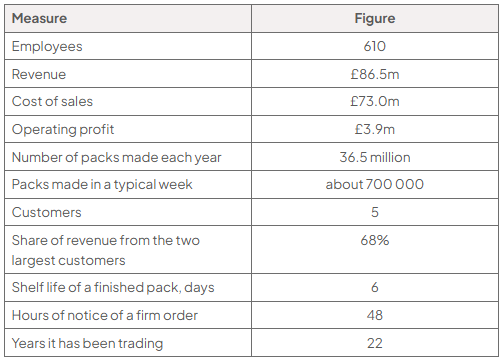
Table of Alderney Foods Ltd selected data: 610 employees; revenue £86.5m; cost of sales £73.0m; operating profit £3.9m; 36.5 million packs made each year, about 700 000 in a typical week; 5 customers, with 68% of revenue from the two largest; a finished pack has a shelf life of 6 days; firm orders give 48 hours' notice; trading for 22 years.

Source: Alderney Foods Ltd

Appendix F: What Alderney holds, and what it throws away

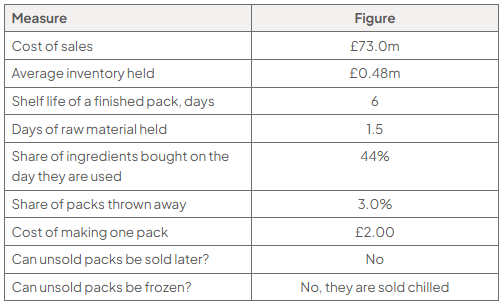
Inventory data table: cost of sales £73.0m; average inventory £0.48m; shelf life 6 days; raw materials 1.5 days; 44% bought same day; 3% discarded; pack cost £2; unsold packs cannot be sold or frozen.

Source: Analyst

Assess how well Alderney Foods Ltd manages its inventory.

Calculate Alderney Foods Ltd's inventory turnover to support your answer.

1
15 marks

Source B: Thaxted Seed Co Ltd

Thaxted Seed Co Ltd supplies vegetable and flower seed to garden centres and smallholdings across eastern England. It employs 28 people at a single site in Essex, and in the year to September 2025 it had revenue of £4.2 million and an operating profit of £310 000.

Almost everything it sells, it sells in eight weeks. Gardeners buy seed in March and April, and garden centres want their shelves full by the last week of February. Between May and January the warehouse is quiet. In the year to September 2025, 71% of the company's revenue came in March and April alone.

Seed cannot simply be made to order. It has to be grown, harvested, dried, tested for germination and packeted, and that work happens on a different timetable from the selling. Thaxted therefore buys and packets its seed through the autumn and holds it until spring. Seed also loses the ability to germinate as it ages, so anything unsold at the end of a season is worth far less the following year and is usually written off.

The company buys 62% of its seed from one Dutch grower, Verhoeven BV, which it has used since 1994. Verhoeven offers lower prices than anyone else and has never missed a delivery, but in August 2025 a wet harvest cut the quantity it could supply by a fifth, and Thaxted had to buy the shortfall elsewhere at short notice and at a higher price. The managing director, Tom Prideaux, has started asking whether depending on one supplier for most of what the company sells is wise.

Source: Thaxted Seed Co Ltd

Appendix E: Thaxted Seed Co Ltd revenue by period

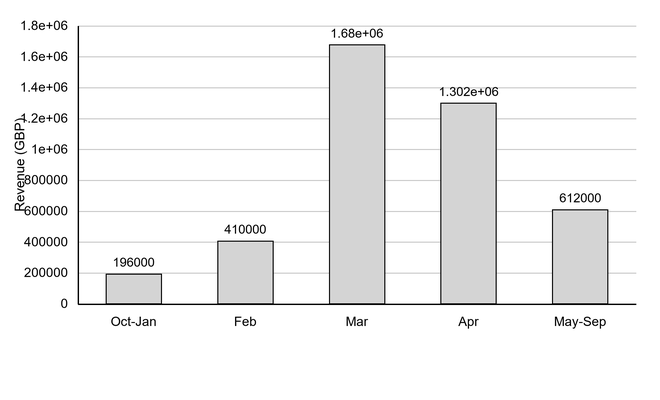
Bar chart of Thaxted Seed Co Ltd revenue by period: £196 000 October to January, £410 000 February, £1.68m March, £1.302m April and £612 000 May to September; vertical axis is revenue in GBP.
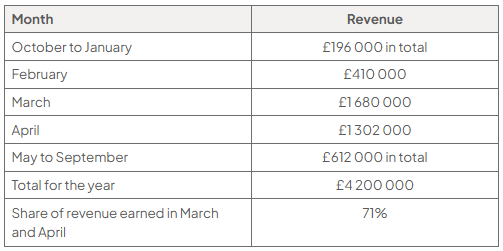
Table of Thaxted Seed Co Ltd revenue by period: £196 000 October to January, £410 000 February, £1.68m March, £1.302m April and £612 000 May to September; total £4.2m, with 71% earned in March and April.

Source: Thaxted Seed Co Ltd

Appendix F: Thaxted Seed Co Ltd inventory

Table of Thaxted Seed Co Ltd inventory: average inventory held across the year £690 000; inventory held at the end of January £1 940 000; inventory held at the end of May £141 000; cost of sales for the year £2 484 000; inventory turnover not provided; seed written off at the end of the season £118 000; fall in the value of seed held for a second year 60%; cost of renting and heating the warehouse each year £84 000.

Source: Analyst

Appendix H: Two ways of handling the spring peak

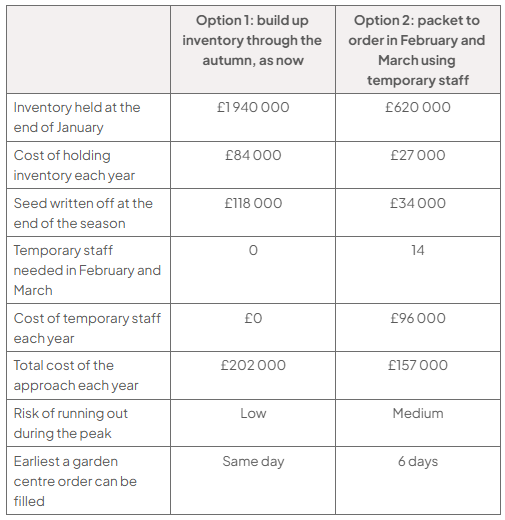
Table comparing Option 1, build up inventory through the autumn, as now, with Option 2, packet to order in February and March using temporary staff: inventory held at the end of January £1 940 000 and £620 000; cost of holding inventory each year £84 000 and £27 000; seed written off at the end of the season £118 000 and £34 000; temporary staff needed in February and March 0 and 14; cost of temporary staff each year £0 and £96 000; total cost of the approach each year £202 000 and £157 000; risk of running out during the peak low and medium; earliest a garden centre order can be filled, same day and 6 days.

Source: Analyst

Thaxted Seed Co Ltd is considering two ways of handling the spring peak:

Option 1: build up inventory through the autumn, as now

Option 2: packet to order in February and March using temporary staff

Evaluate both options and recommend which one Thaxted Seed Co Ltd should choose.

Calculate Thaxted Seed Co Ltd's inventory turnover to support your answer.

2
15 marks

Source B: Halfords

Halfords sells bikes, car parts and motoring products, and services and repairs cars. In the 52 weeks to 28 March 2025 group revenue was £1 715.2 million, almost flat on the year before but 2.5% ahead on a like-for-like basis, and underlying profit before tax rose 6.4% to £38.4 million. Customers reach it through 373 stores, 542 garages and 280 mobile service vans.

Two halves of the business pull in opposite directions through the year. Bikes sell in spring and summer; batteries, bulbs, wipers and screenwash sell in the dark and the cold. A wet April can take a third off cycling sales in a month, and the weather gives about a week's notice.

The buying does not work on a week's notice. Most cycling inventory is made outside the United Kingdom, and the gap between placing an order and having it in a store is about eighteen weeks. The season has to be bought before anybody knows what the weather will do, and whatever is left when the season ends gets marked down.

Against that, the garages have become the steadier half of the company. Servicing, maintenance and repair grew while retail stood still, and Halfords has begun putting stores and garages together on one site, where sales run about half again higher than in a standalone garage.

The decision in front of the buying team is how much of next year's cycling season to commit to before the spring.

Source: Halfords Group plc preliminary results for the 52 weeks to 28 March 2025

Appendix E: Halfords, published figures for the 52 weeks to 28 March 2025

Table of Halfords figures: group revenue £1,715.2m, up 0.1%; like-for-like growth 2.5%; underlying profit before tax £38.4m, up 6.4%; Autocentres revenue £710.3m (40%); 373 stores, 542 garages and 280 mobile vans.

Source: Halfords Group plc

Appendix F: How inventory reaches the stores, garages and vans

Table of Halfords inventory logistics: 48,000 inventory lines, 11% in every store, 3 distribution centres, 46 average inventory days, 78 cycling-inventory days before spring, about 1,400 suppliers, 86% imported, 18-week lead time, 94% garage parts within 24 hours.

Source: Analyst

Appendix H: Two ways of buying next year's cycling season

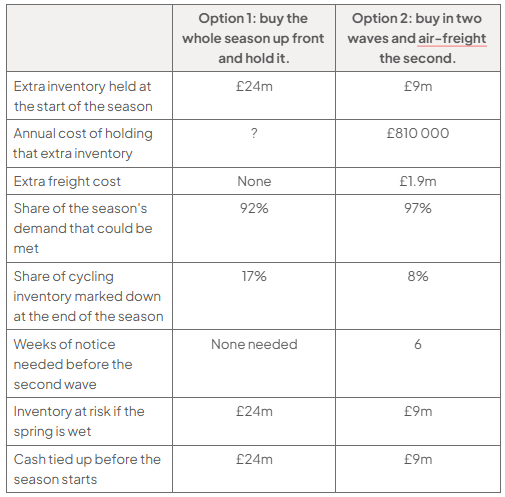
Holding inventory costs 9% of its value for a year.

Comparison table: Option 1 holds £24m inventory upfront; Option 2 holds £9m, with £810,000 holding cost and £1.9m freight. Demand met: 92% versus 97%; markdown: 17% versus 8%; wet-spring risk and cash tied up: £24m versus £9m.

Source: Analyst

Halfords is considering two ways of buying next year's cycling season:

Option 1: buy the whole season up front and hold it

Option 2: buy in two waves and air-freight the second

Evaluate both options and recommend which one Halfords should choose.

Calculate the annual cost of holding the extra inventory under Option 1 to support your answer.

3
15 marks

Source B: Alderney Foods Ltd

Alderney Foods Ltd makes chilled ready meals for supermarkets from one factory near Peterborough. It employs 610 people, makes about 36.5 million packs a year or roughly 700 000 a week, and in the year to March 2025 had revenue of £86.5 million, cost of sales of £73.0 million and an operating profit of £3.9 million. Five customers buy from it and the two largest provide 68% of revenue.

Everything about the business is decided by six days. That is how long a finished pack lasts, so nothing can be made early and nothing unsold can be held back. The company holds under half a million pounds of inventory against £73 million of cost of sales, and 44% of its ingredients are bought on the day they are used.

Demand is not steady and not knowable. Supermarkets confirm a firm order forty-eight hours before delivery, promotions move volumes without much warning, and a hot week takes about 18% off demand for hot meals. Last year the busiest week was 826 000 packs and the quietest 612 000, against a site that can make 840 000.

The two numbers that follow from all of this are the ones the board dislikes. Three per cent of everything made is thrown away, and 140 of the people on the lines are agency workers rather than employees.

Nobody is proposing to make the shelf life longer. The question is what to do about the waste.

Source: Alderney Foods Ltd

Appendix E: Alderney Foods Ltd selected data, year to March 2025

Table of Alderney Foods Ltd selected data: 610 employees, £86.5m revenue, £73.0m cost of sales and £3.9m operating profit. It also shows production, customers, revenue concentration, shelf life, order notice and trading history.

Source: Alderney Foods Ltd

Appendix H: Two ways of cutting the waste

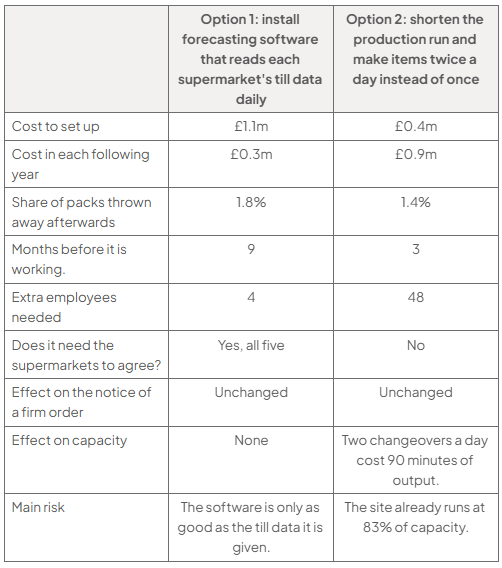
Alderney makes 36.5 million packs a year, throws away 3.0% of them, and each pack costs £2.00 to make.

Comparison table of two waste-cutting options: forecasting software versus twice-daily production. It compares costs, waste (1.8% versus 1.4%), lead time (9 versus 3 months), staffing, capacity, agreement needed and risks.

Source: Analyst

Alderney Foods Ltd is considering two ways of cutting the waste:

Option 1: install forecasting software that reads each supermarket's till data daily

Option 2: shorten the production run and make twice a day instead of once

Evaluate both options and recommend which one Alderney Foods Ltd should choose.

Calculate the return on investment for each option to support your answer.