Economies of Scale (AQA A Level Business): Revision Note
Syllabus Edition
First teaching 2026
First exams 2028
Exam code: 7132

Written by: Lisa Eades
Updated on
What are economies of scale?
Economies of scale are the cost advantages a business gains as it increases its scale of production, causing the average cost per unit to fall
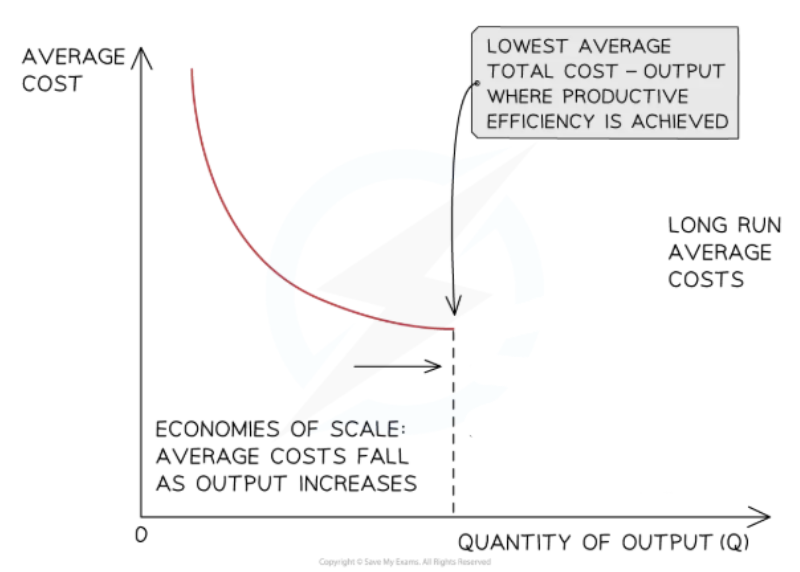
As a business produces more output, fixed costs can be spread over a larger number of units
The larger business can also access more efficient methods, discounts or finance options that are only available at a larger scale
Economies of scale help larger businesses either increase profit margins or lower prices to compete more effectively against smaller rivals
Example
A large supermarket chain can buy stock in much greater bulk than an independent corner shop, allowing it to negotiate lower prices per item and pass some of the savings on to customers
Technical economies
Technical economies are cost savings that arise from using large-scale machinery, equipment or production techniques that are only efficient or affordable at a high level of output
Large businesses can invest in specialised, high-capacity equipment or automated production lines that would be too expensive or underused if output were lower
Spreading the high cost of this equipment over a large number of units reduces the cost per unit
Example
A car manufacturer invests in a fully automated production line that can produce thousands of vehicles a week, reducing the labour cost per car, whereas a small manufacturer producing a handful of cars would find such equipment far too costly to justify
Purchasing economies
Purchasing economies are cost savings a business achieves by buying raw materials or supplies in large quantities, usually at a lower price per unit
They reduce a business's variable costs, helping to increase profit margins or allowing lower prices to be offered to customers
Purchasing economies are also known as bulk-buying economies
Suppliers often offer discounts for large orders
This reduces their own costs of processing, packaging and delivering the order
A business that buys in bulk can therefore negotiate a lower price per unit than a smaller buyer
Example
A large fast-food chain negotiates a lower price per kilogram of potatoes from its supplier because it orders enough to supply thousands of restaurants, compared with an independent café buying a much smaller quantity
Financial economies
Financial economies are the cost savings a large business achieves when borrowing money or raising finance, compared with a smaller business
Larger businesses are generally seen as lower risk by banks and investors, due to their size, assets and established trading history
This allows them to borrow at lower interest rates or raise finance on preferential terms
This cheaper access to the finance needed for expansion, investment, or coping with difficult trading periods is an advantage that smaller businesses often cannot access.
Examiner Tips and Tricks
When explaining economies of scale in an exam answer, always specify the type (technical, purchasing or financial) and link it clearly to how it reduces average unit cost for the specific business in the case study, rather than describing economies of scale in general terms.
Case Study
Bellcross Bakery
Bellcross Bakery began as a single high-street bakery but has grown into a chain of over 80 stores across Northern Ireland.
As it expanded, Bellcross invested in a large, automated bread-making facility capable of producing far more loaves per hour than its original ovens, significantly lowering the labour cost of each loaf.
Its size also allowed it to negotiate much lower prices for flour and other ingredients from suppliers, since it now orders in bulk far beyond what an independent bakery could manage.
When Bellcross wanted to fund a new distribution centre, banks offered it a lower rate of interest than it had received as a small business years earlier, reflecting its now well-established reputation and financial strength.
These cost savings allowed Bellcross to keep its prices competitive with supermarket bakery sections, while maintaining healthy profit margins.
However, some smaller independent bakeries in the areas Bellcross expanded into found it increasingly difficult to compete on price, as they could not access the same technical, purchasing or financial advantages.

Unlock more, it's free!
Join the 100,000+ Students that ❤️ Save My Exams
the (exam) results speak for themselves:

Was this revision note helpful?