What is the Political Environment? (AQA A Level Business): Revision Note
Syllabus Edition
First teaching 2026
First exams 2028
Exam code: 7132

Introduction to the political environment
The political environment refers to the actions, policies and decisions of governments and political institutions, both in the UK and internationally, that can affect how a business operates
This includes changes in government, new laws, taxation policy, trade agreements and international relations
Political change can be sudden, such as a new law coming into force, or gradual, such as a shift in government priorities over several years
Businesses can not control the political environment, but need to monitor and respond to it, since political decisions can create both opportunities and threats
Opportunities created by changes in the political environment
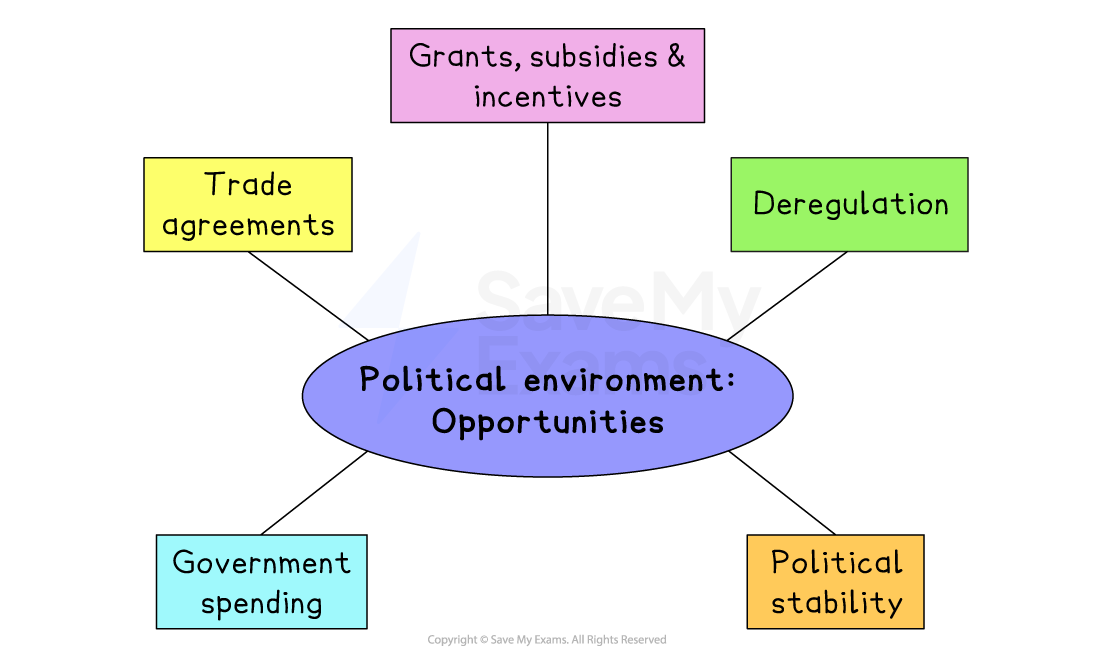
New trade agreements
Can open up access to new markets, allowing a business to sell to more customers or source materials more cheaply
Example
In 2024, the UK officially joined the CPTPP trade bloc, giving over 99% of UK goods exported to member countries like Japan, Australia and Vietnam access to zero tariffs, opening up new markets across the Asia-Pacific region worth £12 trillion
Government grants, subsidies or tax incentives
Can reduce costs or support investment in areas the government wants to encourage, such as renewable energy
Grant |
|
|---|---|
Subsidy |
|
Tax incentive |
|
Example
A renewable energy company may benefit from government subsidies designed to encourage investment in clean energy, reducing its costs and improving profitability
Deregulation
Fewer rules can make it easier and cheaper for a business to operate or enter a market
Example
In 2020, the UK government relaxed the law to allow rental e-scooter trials in towns and cities after years of e-scooters being illegal to ride on public roads. This allowed private companies such as Lime and Voi legally launch rental scooter schemes across many UK cities, creating a brand-new market that did not really exist before the rules changed
Political stability
Can increase investor confidence, making it easier for a business to raise finance or plan for the long term
Example
Ireland's stable political environment, combined with its low 12.5% corporation tax rate, has made it the top choice in Europe for US technology companies.
Apple, Google, Meta and Microsoft have all chosen to base their European headquarters there
Government spending on infrastructure or public services
Can create new demand for a business's products or services
Example
The UK's HS2 rail project has generated over £15 billion of contracts across more than 35 deals, creating significant work for construction and engineering firms
Threats created by changes in the political environment
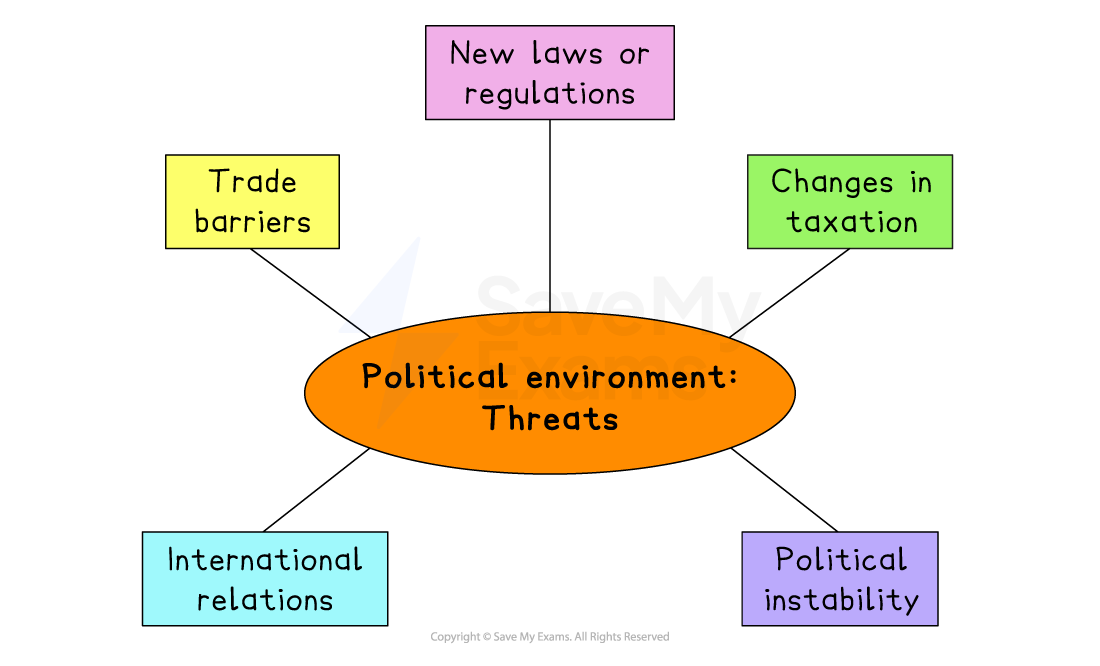
New laws or regulations
These can increase costs
For example through higher minimum wages, new safety standards or environmental rules
Example
Since October 2023, England has banned single-use plastic plates, cutlery and trays.
Cafes and takeaways have had to switch to more expensive alternatives like wooden or bamboo cutlery, adding to their costs
Changes in taxation
Such as higher corporation tax or increased National Insurance
Can reduce a business's profit
Example
In 2025, UK employers' National Insurance rate rose from 13.8% to 15%. This meant that employing someone on a £30,000 salary cost businesses around £866 more a year
Firms were expected to absorb about 40% of that extra cost themselves as lower profit, rather than passing it all on through higher prices
Trade barriers
Such as tariffs or new border checks
Can increase costs or reduce access to international markets
Example
In 2025, the US doubled its tariffs on imported steel and aluminium to 50%, making everyday products like cars, cans and building materials more expensive for American businesses that rely on these imported metals
Political instability
Such as a change in government or ongoing uncertainty
Can make businesses cautious about investing
Example
In September 2022, the UK government's "mini-budget" caused the pound to fall sharply and government borrowing costs to spike, forcing the Bank of England to step in to prevent pension funds collapsing. This created exactly the kind of uncertainty that makes businesses cautious about investing
Changes in international relations
Such as sanctions or conflict
Can disrupt supply chains or close off markets entirely
Example
Following Russia's invasion of Ukraine in 2022, international sanctions and pressure over the war led McDonald's to exit the Russian market entirely after more than 30 years, selling all 847 of its restaurants there.
Impact on functional areas
Functional area | Explanation | Example |
|---|---|---|
Marketing |
|
|
Finance |
|
|
Human resources |
|
|
Operations |
|
|
Examiner Tips and Tricks
Questions on the political environment often expect you to link to other external factors too - for example, a trade tariff (political) increasing a business's costs (economic) - since real-world political change rarely affects a business in isolation from other external factors.

Unlock more, it's free!
Join the 100,000+ Students that ❤️ Save My Exams
the (exam) results speak for themselves:

Was this revision note helpful?
