Producing Abroad (AQA A Level Business): Revision Note
Syllabus Edition
First teaching 2026
First exams 2028
Exam code: 7132

Reasons for producing abroad
Many UK businesses choose to base some or all of their production overseas rather than manufacturing everything domestically
UK companies' total investment in operations abroad, stood at £1,856 billion at the end of 2024
Around 90% of the clothing sold in the UK is imported from overseas factories
Countries such as Bangladesh and China supply a large share of this production
Deciding whether, and where, to produce abroad involves weighing up significant benefits against some serious risks
Choosing the right location requires far more thought than simply finding the cheapest option
Why do UK businesses produce abroad?
Lower labour costs
Significant wage differences between countries can substantially reduce production costs, particularly for labour-intensive industries
Example
Next and Marks & Spencer both manufacture a significant proportion of their clothing ranges in Vietnam, taking advantage of considerably lower labour costs than UK-based production
Access to raw materials
Producing close to the source of key materials can reduce transport costs and secure a more reliable supply
Example
Cargill operates cocoa processing facilities in Côte d'Ivoire and Ghana, close to where cocoa is actually grown, reducing transport costs and helping secure a more reliable supply than importing raw cocoa beans over long distances
Avoiding trade barriers
Establishing production within a target market can help a business avoid the tariffs that would apply to goods imported from elsewhere
Example
LG and Samsung both built washing machine factories in the United States in 2018, specifically to avoid new tariffs that had been placed on washing machines imported from overseas
Access to specialist skills or expertise
Some countries have developed particular clusters of skilled labour or industry expertise that make them well suited to certain types of production
Example
Much of the world's most advanced semiconductor manufacturing is concentrated in Taiwan, particularly through the company TSMC
Major technology firms such as Apple and Nvidia rely on production there because equivalent specialist expertise is not easily available elsewhere
Government incentives
Many countries offer tax breaks, grants or subsidies to attract foreign investment and production facilities
Example
Many major technology and pharmaceutical companies, including Apple and Pfizer, have based significant operations in Ireland
They are attracted partly by its low 12.5% rate of corporation tax and other government incentives to invest there
Proximity to target markets
Locating production closer to where products will actually be sold reduces transport costs and time, and allows a faster response to local demand
Example
Unilever operates factories within Brazil to supply its large South American consumer base directly, rather than exporting products from Europe
This reduces delivery times and transport costs to its customers there
Challenges of producing abroad
Quality control difficulties
Maintaining consistent standards is harder when production is managed at a distance, especially when different countries' laws differ
Ethical and reputational risks
Labour standards and working conditions abroad may not match expectations at home
Businesses producing abroad risk serious reputational damage if poor practices are exposed
Supply chain complexity and risk
Longer, more complex international supply chains are more vulnerable to disruption
Example
When the container ship Ever Given blocked the vital Suez Canal in 2021, it delayed a huge volume of goods being shipped from production sites in Asia to markets in Europe
Political and economic instability
Producing abroad exposes a business to risks such as political unrest, currency fluctuations or sudden changes in government policy
Cultural and communication barriers
Managing an overseas workforce or supplier relationship requires understanding different working practices and communication styles
This can slow down decision-making
Loss of direct control
Producing abroad, particularly through an external supplier, reduces a business's direct oversight of day-to-day operations compared with in-house domestic production
Case Study
Bramwell Toys

Bramwell Toys is a UK toy company that moved most of its production to a large overseas factory five years ago to reduce manufacturing costs.
Early in the arrangement, a batch of nearly 50,000 toy vehicles was found to contain small parts that did not meet UK safety standards, forcing an expensive product recall and a temporary loss of customer trust.
Around the same time, a journalist's investigation into conditions at the factory raised concerns about excessive overtime among workers, generating negative media coverage and criticism from customers on social media.
Communication between Bramwell's UK design team and the overseas factory managers was often slow, partly due to time zone differences and language barriers, making production issues harder to resolve quickly.
A sudden rise in shipping costs and a lengthy port delay then held up a major seasonal order ahead of Christmas, leaving UK retailers with empty shelves during the busiest sales period of the year.
Bramwell responded by appointing a dedicated quality control manager based permanently at the factory and introducing more frequent independent audits, but the combined cost of the recall, lost sales and reputational repair was significant.
Attractiveness of global production locations
Businesses assess potential production locations against several factors
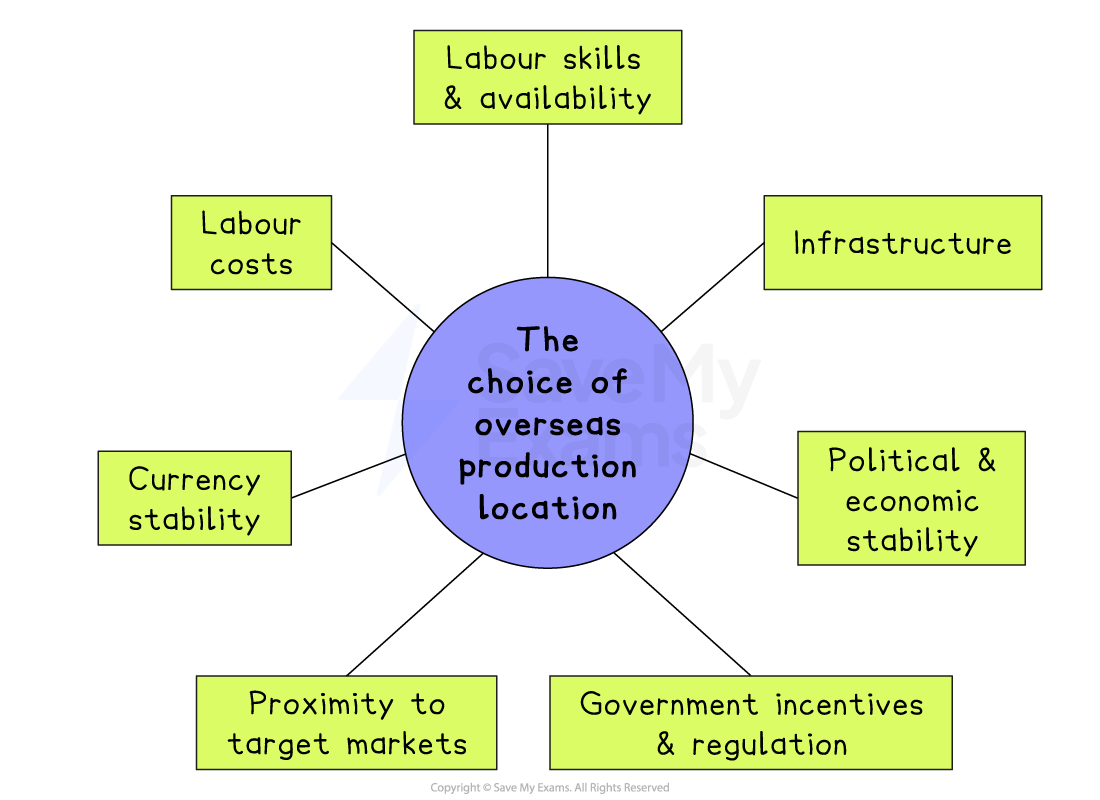
Factor | Explanation | Example |
|---|---|---|
Labour costs |
|
|
Labour skills and availability |
|
|
Infrastructure |
|
|
Political and economic stability |
|
|
Government incentives and regulation |
|
|
Proximity to target markets |
|
|
Currency stability |
|
|
Why are different production locations attractive to UK businesses?
Vietnam
Vietnam is attractive for its low labour costs, a large and increasingly skilled textile manufacturing workforce, and improving infrastructure
There is also a UK-Vietnam trade agreement that reduces tariffs on finished goods
Example
Next manufactures a significant share of its clothing range in Vietnam, taking advantage of these lower production costs while maintaining reasonable delivery times to the UK
Poland

Poland is also attractive for its lower labour costs relative to Western Europe
It also has a skilled industrial workforce, strong transport links across the EU and is close to major Western European markets such as Germany
Example
The British confectionery brand Cadbury, now owned by Mondelez, produces chocolate at a large factory in Poland, benefiting from lower production costs while remaining close to its major European markets
Mexico

Mexico is attractive due to relatively low labour costs and its trade agreement with the United States and Canada (USMCA), removing tariffs on many goods
It is also located in close proximity to the huge US market, reducing transport costs
Example
GKN Automotive, a British engineering business, operates manufacturing plants in Mexico, benefiting from lower costs and tariff-free access to supply major US car manufacturers

Unlock more, it's free!
Join the 100,000+ Students that ❤️ Save My Exams
the (exam) results speak for themselves:

Was this revision note helpful?
