Managing Uncertainty (AQA A Level Business): Revision Note
Syllabus Edition
First teaching 2026
First exams 2028
Exam code: 7132

Scenario planning
Scenario planning is a strategic planning method where a business develops several plausible future scenarios - a best-case, worst-case and most-likely case
It then considers in advance how it would respond to each
Genuine uncertainty means an outcome and its probability cannot be reliably estimated
A business cannot, therefore, forecast or insure against it in the way it can manage a calculable risk
Scenario planning instead prepares the business to respond well whatever actually happens, rather than trying to predict which single outcome will occur
Advantages of scenario planning
It prepares a business for a range of possible futures
Rather than relying on a single forecast that could turn out to be badly wrong
It encourages flexible, adaptable strategic thinking
Rather than a rigid plan built around one assumed outcome
It improves the speed of response if a scenario does occur
Some thinking and preparation has already been done in advance
It can reveal weaknesses or blind spots in current strategy that might not be obvious under normal, stable conditions
Example
Shell pioneered corporate scenario planning in the early 1970s, developing scenarios that considered a sudden oil price shock
When the 1973 oil crisis hit, Shell was able to respond faster than many rivals who had relied on a single forecast of stable oil prices
Disadvantages of scenario planning
It can be time-consuming and resource-intensive to develop multiple detailed scenarios properly
It can never cover every possible outcome
Genuine uncertainty means some events are simply unimaginable in advance
It may create false confidence that the business is prepared for the unknown
In reality only a limited number of scenarios are ever considered
Scenarios can be built on flawed assumptions or bias, reducing their effectiveness
Example
Northern Rock's collapse in 2007 showed the limits of scenario planning within the banking sector
The bank had modelled various risk scenarios, but none had properly anticipated a sudden, complete freeze in the markets it relied on for funding
When this specific scenario occurred during the global credit crunch, Northern Rock was left without a plan for it, resulting in the first bank run on a UK bank in over 140 years
What is an agile business?
An agile business is one that can respond quickly and flexibly to unexpected change, adapting its strategy, structure or processes rapidly rather than being slow and rigid
Agility manages uncertainty differently from scenario planning
Rather than trying to predict what might happen, an agile business focuses on building the organisational capability to respond fast to whatever actually happens, whenever it happens
Example
Zara's fast-fashion supply chain can design, produce and deliver new clothing lines to stores within around two weeks
This allows it to respond to real-time sales data and emerging trends rather than committing to designs many months in advance
Ways to develop an agile business
An agile business isn't built through one single change
It usually comes from several structural and cultural choices working together
Each of the following approaches removes a different barrier to fast decision-making
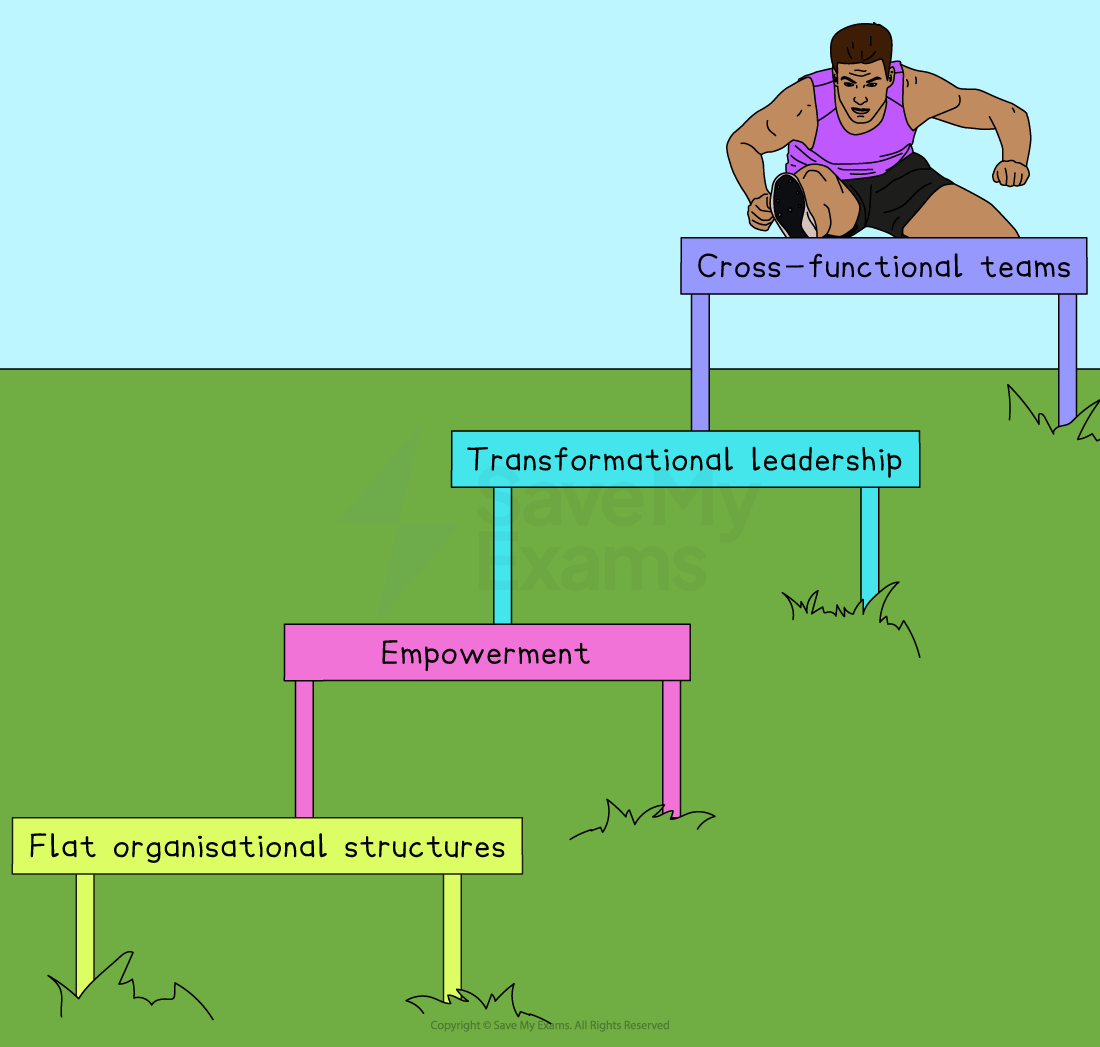
Implement a flat organisational structure
Reducing the number of management layers gives employees more direct access to decision-makers
This speeds up decision-making as messages have less distance to travel
Example
Spotify organises much of its engineering workforce into small, largely autonomous 'squads' with minimal hierarchy
This allows teams to make and act on decisions quickly rather than waiting for approval to move up and down a long chain of management
Empowerment
Empowerment involves giving employees the authority to make decisions within their own area, without needing constant senior approval
This speeds up response times and makes better use of front-line knowledge
Example
The Ritz-Carlton hotel chain empowers every member of staff to spend up to $2,000 resolving a guest's problem immediately, without needing manager approval
This means issues can be fixed on the spot
Transformational leadership
Recruiting or developing leaders who inspire staff towards a shared vision, rather than simply directing and controlling them
This can encourage the innovation and adaptability an agile business needs
Example
Jane Fraser became Citigroup's chief executive in 2021 and has led the bank's biggest shake-up in decades, simplifying how it's managed and giving staff a clearer shared direction to work towards
Rather than just giving orders, she has focused on inspiring change, which has helped reshape the bank's culture during a difficult few years of transformation
Cross-functional teams
Combining staff from different departments to work together on a specific project
This improves communication and produces faster, more informed decisions than departments working in isolation
Example
IKEA uses cross-functional teams combining design, supply chain and sustainability specialists when developing new product ranges
This helps it respond quickly to changing customer and environmental expectations
Other common features of agile businesses
Fast, iterative decision-making
Decisions are made and adjusted quickly, rather than through lengthy, rigid planning processes
Information flows quickly across the organisation, rather than being slowed down by a formal hierarchy
A tolerance for experimentation and failure
New ideas are tested and refined quickly
Mistakes are treated as a source of learning rather than something to be avoided at all costs
Strong use of real-time data and customer feedback
Decisions are informed by up-to-date information rather than outdated plans
Flexible processes
Systems and priorities can be quickly reorganised in response to new information or changing circumstances
A customer-focused culture
The business prioritises responding rapidly to changing customer needs over sticking rigidly to an existing plan
Advantages and disadvantages of developing an agile business
Advantages
Faster response to unexpected change
Since uncertainty cannot be predicted, the ability to react quickly once something happens is often more valuable than trying to forecast it in advance
Example
Burberry converted its trench coat factories to produce protective gowns and masks for the NHS within just a few weeks during the COVID-19 pandemic in 2020
This shows how quickly a business with the right flexibility can respond to a completely unforeseen situation
Better use of staff knowledge
Empowered staff closer to the customer or the problem can identify and solve issues faster than decisions having to pass through several layers of management
Encourages innovation
Flatter structures, empowerment and cross-functional collaboration create the conditions for creative solutions to genuinely new problems
Improves staff motivation
Greater autonomy and trust can increase job satisfaction, a key non-financial motivator
Example
Timpson is well known for its 'upside-down management' approach, giving store staff high levels of trust and autonomy, including the freedom to resolve customer complaints without head office approval
This has been linked to strong staff motivation and low employee turnover compared with many retail competitors
Disadvantages
Can create inconsistency
Decentralised decision-making across many empowered individuals or teams can lead to inconsistent standards or customers' brand experiences
Requires significant cultural and structural change
Shifting from a traditional hierarchical business to an agile one can be slow and may face resistance to change
Example
Long-established banks such as HSBC have found shifting away from decades of hierarchical, heavily regulated structures towards more agile working practices slow and difficult, given how deeply embedded their existing processes and culture are
Risk of reduced central control
Flat structures and empowerment can make it harder for senior management to maintain overall strategic direction and oversight
Example
Uber's early rapid expansion gave local city managers significant autonomy to grow the business quickly
However, this decentralised approach contributed to inconsistent practices and a series of scandals, prompting the company to strengthen central oversight under new leadership from 2017
Not suitable for every business
Highly regulated industries, such as pharmaceuticals or aviation safety, often require tighter centralised control, making full agility less appropriate
Case Study
Willowmere Garden Centres

Willowmere Garden Centres runs twenty stores across Wales. It operates in a sector highly exposed to unpredictable weather and shifting consumer trends.
Several years ago, the company used scenario planning to consider how it might respond to situations ranging from a prolonged drought to a sudden shift towards indoor and balcony gardening, developing rough response plans for each without knowing which, if any, would actually happen.
When an unusually wet spring unexpectedly reduced demand for outdoor plants while causing a surge in interest in houseplants, Willowmere was able to act quickly.
Store managers, empowered to adjust their own inventory orders without waiting for head office approval, shifted the available floor space towards houseplants within days
A cross-functional team combining buying, marketing and store operations staff coordinated a rapid national promotional campaign around indoor gardening, something a more hierarchical business would have taken weeks to approve
Sales for the season ultimately matched the previous year's, despite the disruption.
Examiner Tips and Tricks
Do not confuse scenario planning with building an agile business in an exam answer. Scenario planning is about thinking ahead to prepare responses to specific possible futures, while agility is about building the organisational capability to respond fast to whatever actually happens, even something nobody had specifically planned for

Unlock more, it's free!
Join the 100,000+ Students that ❤️ Save My Exams
the (exam) results speak for themselves:

Was this revision note helpful?
