The Impact of Disruptive & Digital Technological Change (AQA A Level Business): Revision Note
Syllabus Edition
First teaching 2026
First exams 2028
Exam code: 7132

The impact of disruptive technologies
Disruptive technology is any new technology that fundamentally changes how an industry operates
It often creates an entirely new market or makes existing products, services or business models obsolete faster than businesses can adapt
Unlike gradual technological improvements, disruptive technology tends to overturn an industry's existing rules altogether, rather than simply improving what already exists
Artificial intelligence (AI) is the clearest current example of a disruptive technology, alongside autonomous vehicles, robotics and blockchain
The impact on business
Entire business models can be made obsolete very quickly, sometimes within a few years, and others changed beyond recognition
Example
Since Uber launched in London in 2012, the number of licensed black cabs has fallen by more than 34 per cent, as the traditional taxi business model has struggled to compete with app-based ride-hailing
New markets can be created almost overnight, offering huge rewards to businesses that move early
Example
Wayve, a UK self-driving vehicle company, raised $1.2 billion in funding in February 2026, as investors backed an entirely new 'robotaxi' market that barely existed a few years earlier
Competitive advantage can shift rapidly from established, well-resourced businesses to smaller, more agile ones
Example
Revolut built up 13 million UK users by the time it received a full UK banking licence in 2026. Revolut and other neobanks now hold over 20 per cent of the market among customers who opened their main bank account in the last three years, taking market share directly from established high street banks
Regulation and law often lag behind disruptive technology, creating legal uncertainty for businesses operating in new areas
Example
E-scooters have been sold and used widely in the UK for years, yet privately owned e-scooters are still illegal to ride on public roads or pavements
Only government-approved rental trial schemes are legal, and these have been repeatedly extended, while the government continues to review the evidence before deciding on permanent rules
Impact on stakeholders
Stakeholder | Impact | Example |
|---|---|---|
Customers |
|
|
Employees |
|
|
Shareholders and investors |
|
|
Suppliers |
|
|
Competitors |
|
|
Government and regulators |
|
|
Impact by business size and sector
Business size
Small businesses and start-ups are often the source of disruption themselves
They can move quickly and are not tied to existing ways of working
They are, though, highly vulnerable if a larger, better-resourced rival adopts the same technology
Large, established businesses usually have far greater resources to invest in new technology
However, they can be slower to act due to their size, existing systems and organisational culture
They are also likely to suffer the innovator's dilemma
The challenge faced by successful, established businesses that risk being overtaken by disruptive innovation because they focus on improving existing products rather than pursuing new ones
Many large businesses respond by buying smaller disruptive start-ups rather than competing with them directly
Business sector
Creative and content industries have been hit hard by generative AI
There is, though, some indication that consumers are weary of AI and prefer the human touch
E.g. Coca-Cola faced backlash over its AI-generated Christmas adverts in both 2024 and 2025, with viewers calling the ads 'soulless' and 'digital slop'
Transport and logistics are being changed enormously by autonomous vehicles
E.g. Starship Technologies' small delivery robots operate in UK towns including Leeds, Manchester and Milton Keynes in partnership with Co-op and Just Eat
Financial services have been disrupted by fintech start-ups
E.g. Wise, the UK money transfer company, grew its customers by 21 per cent and the amount of money sent abroad through it by 25 per cent in 2026 – business that would traditionally have gone through banks instead
Sectors involving physical, hands-on and in-person work, such as personal care and construction, remain among the least exposed to AI disruption
In 2025 43 per cent of UK construction workers reported that they have no digital capabilities at all in their day-to-day work
Case Study
Larkspur Occasions and disruptive technology

Larkspur Occasions is a UK greetings card retailer with 30 stores and a small online shop.
For years, Larkspur relied on customers browsing racks of pre-printed cards in store. When a new AI-powered app launched, letting users generate a fully personalised card, complete with custom artwork, a handwritten-style message and even a short AI-created poem, in under a minute on their phone, customer habits shifted quickly. Many shoppers began sending instant digital or app-printed cards instead of buying from a shop, and Larkspur's in-store footfall began to fall, particularly among younger customers.
Rather than competing directly with the app, Larkspur partnered with a similar personalisation platform, installing in-store kiosks where customers could design a personalised card and have it printed within minutes, alongside its traditional range.
Within a year, average spend per customer had increased, as personalised cards were priced higher than standard ones, and younger customers began returning to stores again
The impact of digital technologies
Digital technologies are those based on computerised or internet-connected systems used to communicate, process information and carry out transactions
Examples include e-commerce, mobile apps, social media, cloud computing and digital payments
Digital technologies tend to change more gradually than disruptive technologies
They usually form the everyday infrastructure most businesses now rely on, rather than suddenly overturning an entire industry
Case Study
A cashless economy?
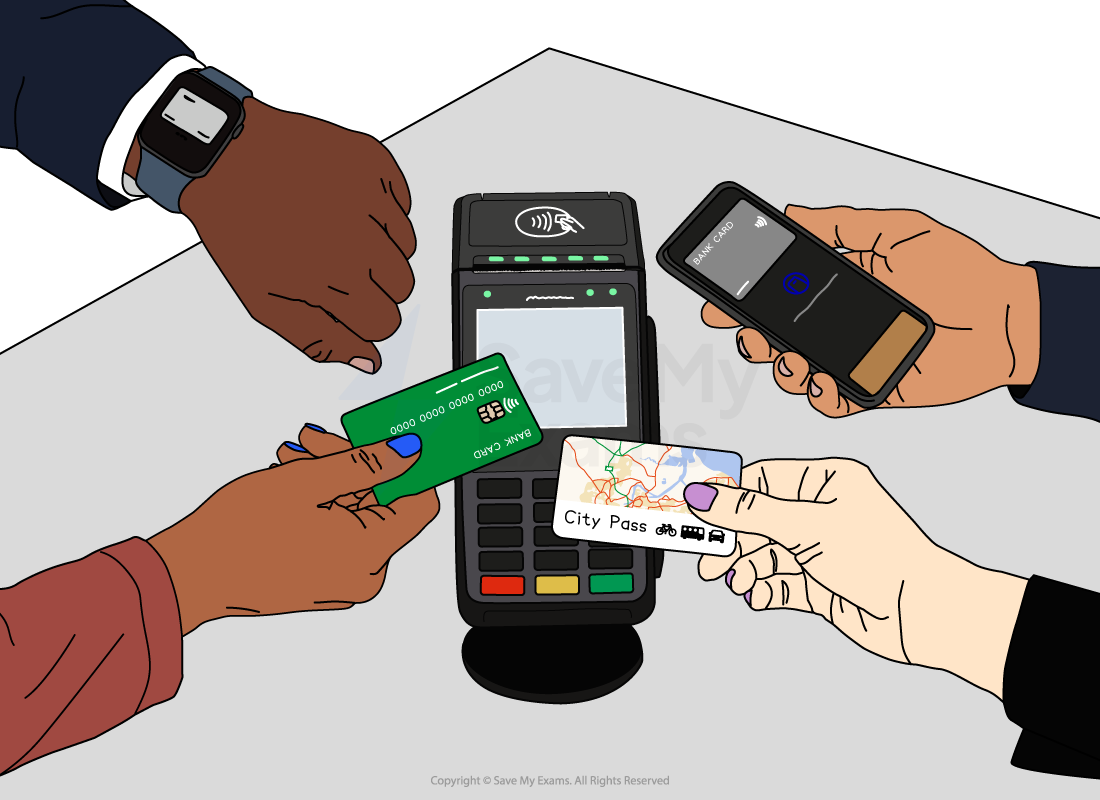
By February 2026, contactless payments accounted for 76 per cent of UK debit card transactions, mobile wallets were used by 57 per cent of UK adults, and cash had fallen below 10 per cent of all UK payments for the first time.
For businesses, these changes bring clear benefits. Digital payments are faster to process, reduce the time and cost of handling and banking cash, and make it easier to track sales in real time.
However, accepting card and mobile payments also means paying transaction fees on every sale, cutting into profit margins, particularly for smaller businesses with low profits already.
For customers, digital payments offer speed and convenience, removing the need to carry cash at all.
However, not everyone has benefited equally.
Around 70 per cent of UK consumers still believe it is important that cash remains available, and some groups, particularly older or lower-income customers, remain more reliant on cash and can feel excluded as fewer businesses accept it.
Impact on business
Businesses of any size can reach customers well beyond their local area, often at very low cost, through websites, apps and social media
Example
Gymshark started as a small UK startup selling fitness clothing, and grew into a billion-pound global brand largely through social media and fitness influencers, reaching customers worldwide without ever needing a large traditional retail presence
Digital systems allow much faster communication and data-driven decision-making across every function of a business
Example
easyJet uses dynamic pricing, adjusting ticket prices in real time based on demand, how many seats remain and booking trends
Pricing decisions are made automatically and continuously rather than set once in advance
Remote and flexible working has become far more practical, changing how and where employees work
Example
By 2025, around 28 per cent of UK workers were working in a hybrid pattern, splitting their time between home and the workplace
This way of working relies on digital tools such as video calls, cloud file-sharing and messaging apps
Reliance on digital systems significantly increases exposure to cyber-attacks and system failures
Example
In July 2024, a faulty software update from cybersecurity firm CrowdStrike caused a huge IT outage worldwide
Flights were grounded, banks were disrupted, and the FTSE 100 fell by around £21 billion in a single day
Impact on stakeholders
Stakeholder | Impact | Example |
|---|---|---|
Customers |
|
|
Employees |
|
|
Shareholders and investors |
|
|
Suppliers |
|
|
Government |
|
|
Case Study
Pemberton Crafts and digital technology

Pemberton Crafts is a small UK homeware business, originally run from a single workshop, selling handmade candles and home accessories.
For its first three years, Pemberton Crafts sold only at local markets and through a handful of independent shops, limiting its potential customer base and making growth slow and unpredictable.
The owner began selling through an online marketplace and building a following on social media, posting short videos showing products being made. Within eighteen months, online orders were reaching customers across the UK and overseas, and social media had become the business's main source of new customers, replacing word of mouth.
Growth brought new challenges. Pemberton Crafts had to invest in packaging and shipping systems it had never needed before, and the owner found managing digital payments, online reviews and social media alongside production increasingly difficult without additional staff.
Examiner Tips and Tricks
Strong answers on this topic explain how the same technological change can affect customers, employees, shareholders and government differently, and how the impact often depends on a business's size and sector. This kind of contextual, multi-stakeholder analysis is exactly what higher-level marks are looking for

Unlock more, it's free!
Join the 100,000+ Students that ❤️ Save My Exams
the (exam) results speak for themselves:

Was this revision note helpful?
