Stakeholder Impacts (AQA A Level Business): Revision Note
Syllabus Edition
First teaching 2026
First exams 2028
Exam code: 7132

How stakeholders affect business decisions
Stakeholders are individuals or groups with an interest in, or affected by, the activities and performance of a business
Information on the different types of stakeholders can be found here
Stakeholders do not simply hold different levels of power and interest
Many are able to take direct action to try to change a business's decisions
The type of action available differs between stakeholder groups, and the resulting impact on the business can be financial, non-financial, or both
Weighing up these possible actions and their consequences helps a business judge whether a decision is genuinely in its long-term interest
Actions stakeholders can take to influence business decisions
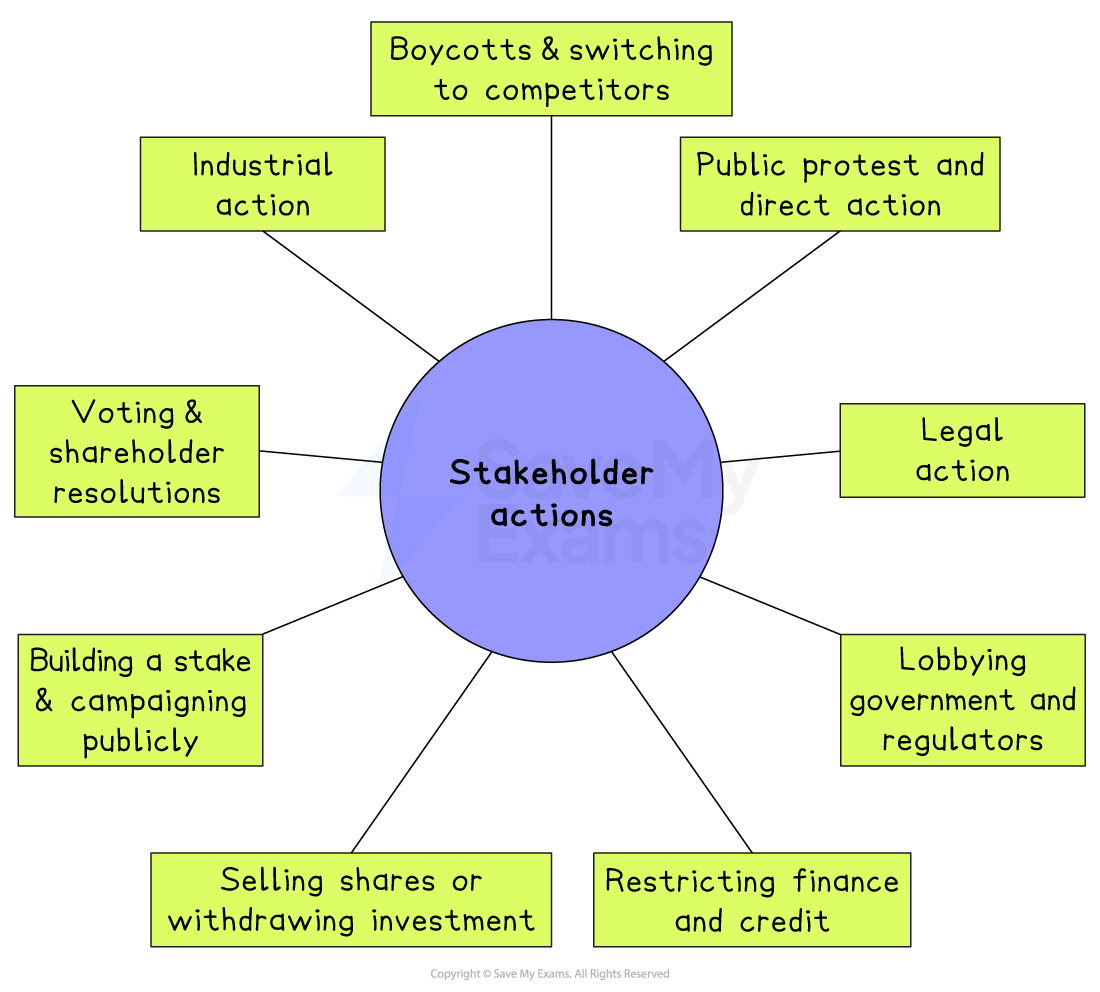
Voting and shareholder resolutions
Shareholders can vote against management proposals, or table their own resolutions at a company's Annual General Meeting (AGM)
Example
Shareholder campaign group Follow This has repeatedly tabled resolutions at Shell's AGM calling for tougher climate targets, forcing the board to publicly respond and justify its strategy
Building a stake and campaigning publicly
Large investors can buy shares specifically to gain influence and then use that position to pressure management for change
Example
Investment firm Trian Partners bought a large number of shares in Unilever from 2022, then publicly pushed the company to become simpler and more focused. This pressure contributed to Unilever's 2024 decision to separate its ice cream business, including brands such as Magnum and Ben & Jerry's, into its own company
Selling shares or withdrawing investment
Investors who disapprove of a decision can sell their shares, pushing down the share price, or refuse to provide further funding
Industrial action
Employees, with the support of trade unions, can strike, work to rule or refuse to work overtime, disrupting normal operations until demands are addressed
Example
The RMT and Nautilus International unions organised protests against P&O Ferries after the company dismissed around 800 seafarers without notice in March 2022
Boycotts and switching to competitors
A boycott is a deliberate refusal by consumers or groups to purchase from a business, used as a form of protest to pressure it into changing its behaviour
Customers can stop buying from a business, directly reducing its revenue, or switch loyalty to a rival brand
Example
Major stockists including Next, ASOS and Zalando dropped boohoo's brands in 2020 following reports of poor working conditions at supplier factories in Leicester, while many customers also chose to boycott the brand directly
Public protest and direct action
Pressure groups can stage demonstrations or disrupt operations to draw media attention to an issue
Example
Just Stop Oil activists disrupted BP and Shell forecourts, as well as sponsored sporting events such as the Grand National and Wimbledon, to pressure fossil fuel companies over climate policy
Legal action
Stakeholders can bring lawsuits or demand judicial reviews to block, delay or challenge a decision
Example
ClientEarth, an environmental law group that owns a small number of Shell shares, took legal action against Shell's board of directors in 2023
It argued that the directors were not doing enough to manage the risks that climate change poses to the company
Lobbying government and regulators
Stakeholders can pressure politicians or regulators to intervene through new legislation, fines or formal investigations
Example
Sustained public and political pressure over Thames Water's sewage discharges contributed to regulator Ofwat imposing record fines and increasing its enforcement action against the company
Restricting finance and credit
Lenders, suppliers and credit rating agencies can refuse further credit, call in existing loans, or downgrade a business's credit rating
Example
When the discount shop Wilko got into serious money trouble in 2023, the companies that insure supplier payments stopped covering it, so suppliers started asking to be paid upfront before sending any goods
At the same time, banks would not lend Wilko the emergency money it needed
This loss of financial support was a big reason why Wilko collapsed, and around 12,500 people lost their jobs
The impact of stakeholder actions
Financial impacts
Falling share price
Reduced investor confidence following stakeholder action can wipe significant value off a public limited company almost immediately
E.g. boohoo's share price fell sharply once the 2020 factory conditions scandal became public
Higher cost of finance
A lower credit rating, as with Thames Water, means lenders charge higher interest rates to compensate for increased perceived risk
This reduces future profit
Lost sales and revenue
Boycotts and lost stockists directly reduce the volume of sales a business can achieve, even if the underlying product has not changed
Increased costs
Compensation payments, legal fees and improved pay settlements agreed to end industrial action all raise a business's costs without increasing output
Reduced profit margins
The combined effect of lost revenue and higher costs can reduce profitability, even for a business that was previously performing well
Non-financial impacts
Reputational damage
Negative publicity can take years to repair, and may affect customer trust and staff recruitment long after the original incident
Diverted management time
Dealing with legal action, media enquiries and stakeholder complaints pulls senior managers away from long-term strategic priorities and into short-term crisis management
Delayed or blocked strategic decisions
Legal challenges can hold up major projects for years
E.g. Legal action temporarily halted Heathrow's third runway expansion
Industry-wide regulatory change
Strong stakeholder pressure can lead to new legislation affecting an entire sector, not just the business originally involved
E.g. The UK government introduced the Seafarers' Wages Act in 2023 in response to the P&O Ferries dismissals
Reduced staff morale
Employees who witness a business treating other stakeholders poorly may become less engaged or more likely to leave, even if they were not directly affected themselves
Case Study
P&O Ferries
In March 2022, P&O Ferries dismissed around 800 crew members with immediate effect, informing them by video call and replacing them with cheaper agency crew. The company calculated that this would save approximately £40 million a year, arguing it was necessary to remain competitive.
The reaction from stakeholders was immediate and wide-ranging.
Trade unions organised protests at ports across the UK
MPs on both sides of Parliament condemned the decision
The government's business secretary stated the dismissals may have broken employment law, since businesses must formally consult staff before large-scale redundancies
Some ferries were temporarily delayed by safety inspectors questioning whether the new crew were properly trained
To limit further legal claims, P&O paid enhanced redundancy packages well above the legal minimum.
The reputational damage was significant, and the case directly contributed to the UK government introducing the Seafarers' Wages Act 2023, requiring minimum wage protection for seafarers on regular UK routes.
Despite the backlash, P&O retained its cost savings and continued trading profitably.
Examiner Tips and Tricks
When evaluating a stakeholder-related decision, always weigh up the scale of the financial benefit against the scale and permanence of the non-financial cost
The examiner rewards a judgement on whether the trade-off was actually worth it for that specific business, not simply a list of the stakeholders affected

Unlock more, it's free!
Join the 100,000+ Students that ❤️ Save My Exams
the (exam) results speak for themselves:

Was this revision note helpful?
