Elements of Sustainability (AQA A Level Business): Revision Note
Syllabus Edition
First teaching 2026
First exams 2028
Exam code: 7132

Environmental sustainability
Environmental sustainability means minimising a business's negative impact on the natural environment while still meeting its operational and commercial needs
Elements of environmental sustainability
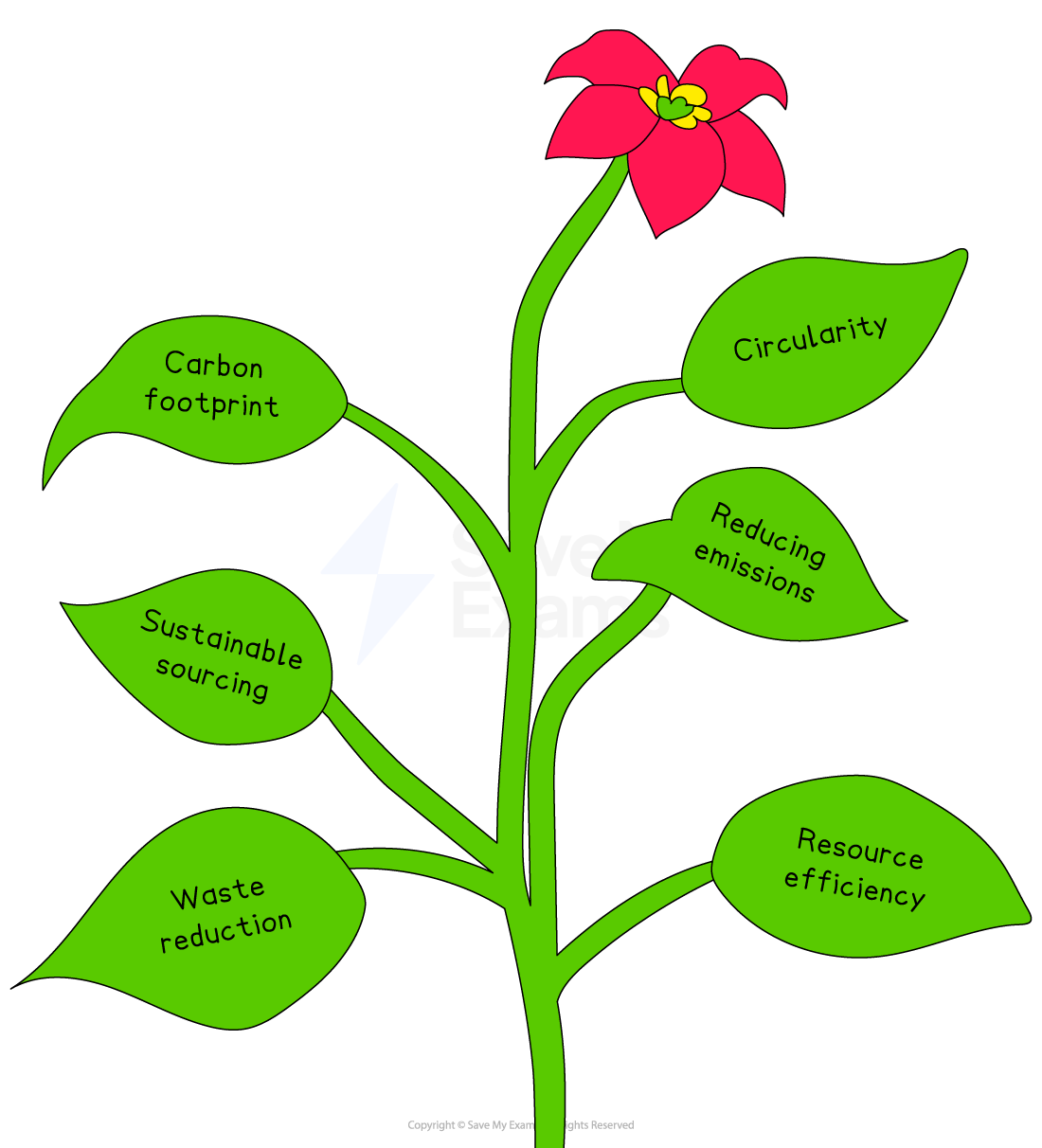
Businesses that address these areas reduce their exposure to risks such as rising costs, changing regulations and reputational risk
They often improve productive efficiency at the same time
Waste reduction
Cutting the amount of materials or products discarded during production or operations
Example
H&M launched the fashion industry's first global garment collecting scheme in 2013, letting customers return unwanted clothes of any brand to any store. The scheme has collected over 172,700 tonnes of textiles, with around 60% resold as second-hand rather than discarded
Resource efficiency
Using the minimum resources, such as energy, water or materials, needed in production
Example
Levi's "Water<Less" techniques cut the water used to produce a pair of jeans by up to 96%
The company estimates it has saved over 1 billion litres of water.
Reducing emissions
Lowering the harmful gases released into the atmosphere by a business's operations
Carbon footprint
The total greenhouse gases produced directly and indirectly by a business, including its supply chain
Example
Microsoft has pledged to become carbon negative by 2030, and by 2050 aims to remove from the atmosphere the equivalent of every tonne of carbon it has emitted since the company was founded in 1975
Sustainable sourcing
Buying materials from suppliers who meet recognised environmental and social standards
Circularity
Designing products and processes so materials are reused, repaired or recycled, rather than thrown away
Example
Renault strips down, cleans and rebuilds around 30,000 used engines and gearboxes a year, reselling them as certified parts rather than manufacturing everything new
Case Study
Fenwick Flooring
Fenwick Flooring manufactures carpet tiles for offices and commercial buildings across the UK.
After years of relying on virgin nylon and oil-based materials, the company invested in new recycling technology that allowed it to reclaim used carpet tiles from customers and turn them back into raw material for new products. The equipment was expensive, and it took over a year for staff to fine-tune the recycling process to match the quality of the company's original materials.
Energy use across the factory was also reduced through more efficient machinery and better insulation, cutting the carbon footprint of each tile produced.
Some long-standing customers were initially sceptical that recycled materials could match the durability of new ones, requiring Fenwick to offer extended guarantees to reassure them.
Within three years, Fenwick's recycled product range had become its best-selling line, and its lower energy costs had partly offset the initial investment.
Social sustainability
Social sustainability means a business operating in a way that treats people fairly, both within the organisation and across its supply chain and community
It protects a business from reputational and legal risks
It can also improve relationships with employees, communities and customers who increasingly expect fair treatment throughout a business's operations
Elements of social sustainability
Element | Examples |
|---|---|
Fair treatment of workers |
|
Supporting local communities |
|
Ethical sourcing |
|
Example
Divine Chocolate is co-owned by the Kuapa Kokoo cocoa farmers' cooperative in Ghana, which holds 20% of the company and a share of its profits.
It guarantees Fairtrade prices and funding for community programmes such as literacy courses, as fair treatment and community support is built into its ownership structure
Case Study
Redwing Coffee
Redwing Coffee is a UK coffee roasting business supplying independent cafes and supermarkets.
Concerned about reports of poor conditions among coffee growers, the company restructured its buying arrangements to guarantee farmers a fixed minimum price above the standard market rate, regardless of global price fluctuations.
It also began funding a training programme to help farming communities improve crop yields and diversify their income.
These commitments increased Redwing's costs, and some retailers questioned whether customers would pay more for coffee marketed this way.
To address this, Redwing began publishing detailed information about the farms it worked with and the impact of its funding, helping build trust with customers.
Sales of Redwing's ethically sourced range grew steadily, and the company was able to secure new contracts with retailers seeking to improve their own ethical credentials.
Economic sustainability
Economic sustainability means a business generating long-term profitability without exploiting the resources or people it depends on to do so
This differs from simply maximising short-term profit
A business focused only on quick profits may deplete resources, underpay workers, or damage relationships that its future success depends on
An economically sustainable business
Plans for the long term
Reinvests appropriately
Balances the interests of shareholders against the needs of employees, suppliers, customers and the environment
Economic sustainability supports a business's resilience
It helps it survive economic downturns, resource shortages or reputational shocks that a short-term approach would leave it vulnerable to
Example
In 2022, Patagonia's founder transferred 98% of the company's ownership, worth around $3 billion, into a trust dedicated to fighting climate change.
Rather than maximising profit for private shareholders, all future profits not reinvested in the business, around $100 million a year, are directed towards environmental causes, redefining what 'successful' looks like beyond pure financial returns.
Case Study
Perigrine Outdoor
Perigrine Outdoor designs and sells outdoor clothing and camping equipment.
Facing pressure from investors to increase short-term profits, the company was encouraged to switch to cheaper, lower-quality materials and reduce spending on staff training. The directors instead chose to maintain higher manufacturing standards and continue investing in staff development, arguing that cutting corners would damage product durability and the company's long-standing reputation for quality.
This decision meant Perigrine's profit margins remained lower than some competitors in the short term, and a small number of investors sold their shares in frustration.
However, Perigrine's products continued to be rated highly for durability, encouraging repeat purchases and reducing the volume of returns and complaints compared to rivals who had cut costs. Employee turnover also remained low, reducing recruitment and training costs over time.
Five years on, Perigrine's steady, if unspectacular, profit growth had outperformed several competitors who had prioritised short-term returns but later faced quality complaints and reputational damage.
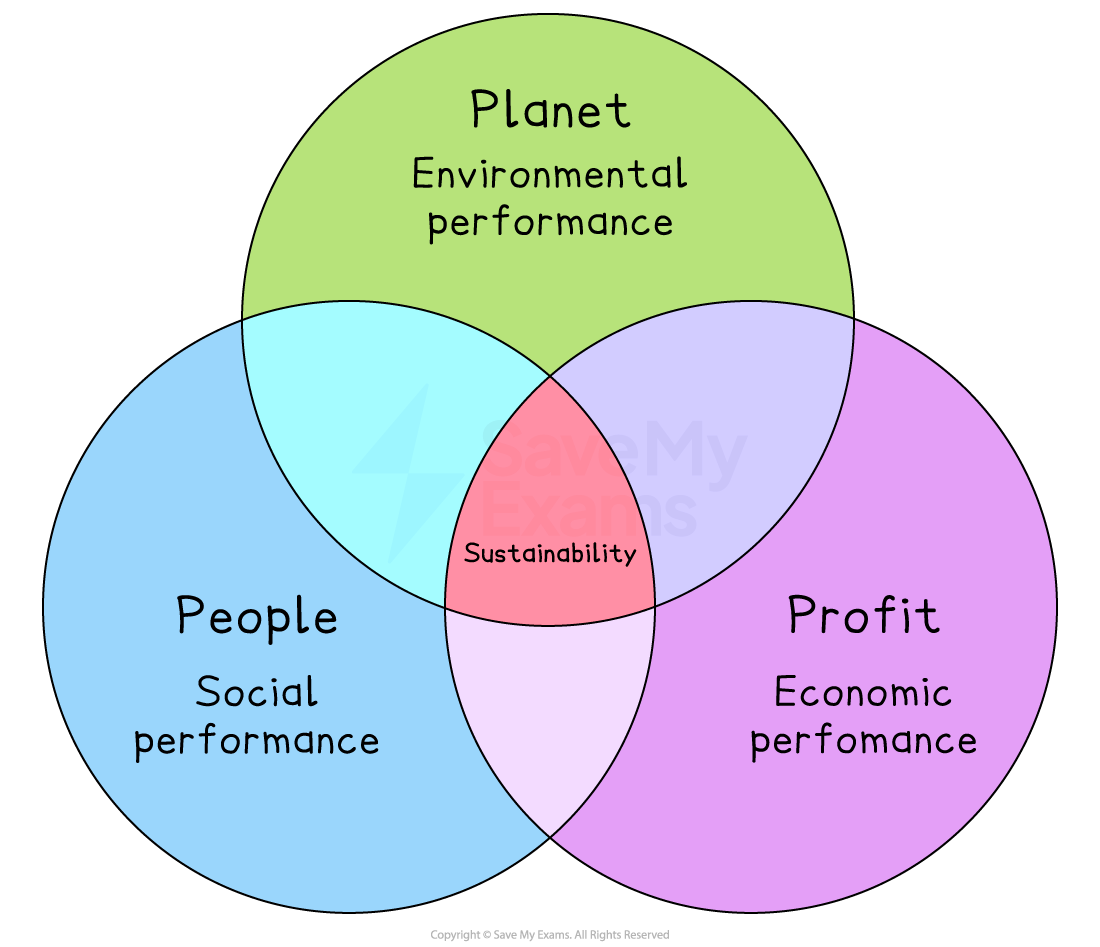
The Triple Bottom Line
The Triple Bottom Line model highlights that business performance may be measured in a number of ways:
Its finances (Profit)
Its environmental impact (Planet)
How socially responsible it is in relation to employees (People)
Elkington argued that only a company that was measuring performance in all three areas of people, profit and planet was considering the full costs of its activities
If all these areas are measured, business owners and employees are likely to pay attention to them and change their behaviour accordingly, rather than just focusing on profit
As a result, sustainability both within the business and, if adopted widely, across the economy as a whole, should be improved
Elkington's triple bottom line
Companies certified as B Corps, such as Ben & Jerry's and The Body Shop, are formally assessed against Triple Bottom Line standards
They have to demonstrate social and environmental performance alongside financial results in order to keep their certification
Benefits of using the Triple Bottom Line framework
Helps identify risks and opportunities across all three areas
Rather than encouraging a narrow focus on profit which can overlook social or environmental problems
Provides a consistent structure for measuring, reporting and comparing sustainability performance over time
Improves stakeholder trust
Businesses are now expected to be open about more than just their finances

Unlock more, it's free!
Join the 100,000+ Students that ❤️ Save My Exams
the (exam) results speak for themselves:

Was this revision note helpful?
