Retrenchment (AQA A Level Business): Revision Note
Syllabus Edition
First teaching 2026
First exams 2028
Exam code: 7132

Reasons for retrenchment
Retrenchment is when a business deliberately reduces the size or scope of its operations
This could involve closing unprofitable branches, cutting staff, selling off assets or withdrawing from certain markets
The aim is to lower costs, improve cash flow and focus on its strongest, most profitable activities
Common reasons for retrenchment
Financial strain or losses
When profits fall or debts rise too high, companies close unprofitable sites or cut back to save cash
Example
Thomas Cook shut many of its shops and flights before collapsing in 2019 due to mounting losses
Intense competition
If rivals undercut prices or offer better products, a firm may exit markets where it can’t compete
Example
Nokia scaled down its mobile-phone business when Apple and Samsung took most of the market
Refocusing on core activities
To improve efficiency, businesses sell off or close side-lines and concentrate on their strongest operations
Example
eBay sold PayPal so each company could focus on its own service - eBay on auctions and PayPal on digital payments
Economic downturn
Falling demand during a recession or crisis can force a business to scale back capacity to match reduced sales and preserve cash
Example
Rolls-Royce made significant job cuts and scaled back its civil aerospace operations from 2020, after the COVID-19 pandemic caused global air travel, and demand for its engines, to collapse
Challenges of retrenchment
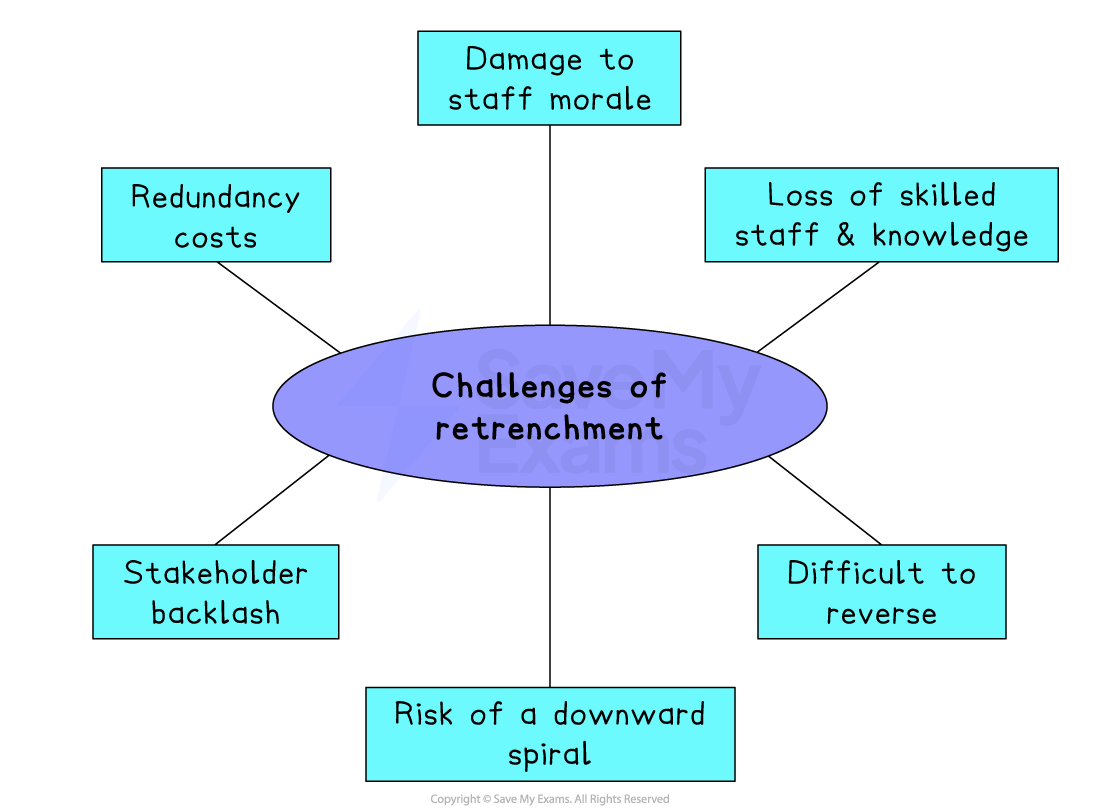
Redundancy costs
Severance payments and restructuring costs can be significant
Poor handling of the process can create additional legal costs
Example
P&O Ferries' mass dismissal of around 800 crew in 2022 without proper consultation illustrates how poorly managed retrenchment can create serious legal and reputational risk
Damage to staff morale
Employees who remain after redundancies may feel insecure or less motivated
This can reduce productivity at the exact time the business needs it most
Loss of skilled staff and knowledge
Redundancies can result in losing valuable expertise
This is slow and costly to rebuild if the business later wants to grow again
Difficult to reverse
Once sites, capacity or product lines have been cut, rebuilding them if market conditions later improve can be slow and expensive
Risk of a downward spiral
Retrenchment intended to cut costs can sometimes reduce revenue further
For example, if closing stores loses remaining loyal customers, creating a cycle of continued decline rather than stabilisation
Stakeholder backlash
Significant job losses or site closures can trigger strong reactions from employees, unions, local communities and government
The impact of retrenchment on functional areas
Functional area | Impact | Example |
|---|---|---|
Marketing |
|
|
Finance |
|
|
Human resources |
|
|
Operations |
|
|
Case Study
Thackers

Thackers is a mid-sized UK clothing retailer that expanded rapidly during the 2010s, eventually operating 85 high street stores.
As online shopping grew and footfall in many town centres declined, a third of its stores made a loss, and rising rents and wage costs added further pressure.
Rather than continuing to prop up its weakest sites, management decided to retrench, closing 30 stores over eighteen months and making around 400 redundancies.
The finance team had to fund substantial redundancy payments and pay fees to end leases early, temporarily reducing cash flow before the closures began reducing overheads.
HR carried out a formal consultation process with staff and trade union representatives, while also removing a layer of regional management no longer needed for a smaller store estate.
Marketing shifted a much larger share of its budget towards Thackers' website and app, repositioning the brand around online convenience rather than its high street presence.
Some local communities criticised the closures publicly, and a handful of experienced store managers left before the process was complete, taking valuable knowledge with them.
Within a year, Thackers' remaining stores and online business had returned to profit, though at a noticeably smaller scale than before

Unlock more, it's free!
Join the 100,000+ Students that ❤️ Save My Exams
the (exam) results speak for themselves:

Was this revision note helpful?
