Business Objectives (AQA A Level Business): Revision Note
Syllabus Edition
First teaching 2026
First exams 2028
Exam code: 7132

Purpose and value of setting objectives
Business objectives are specific, measurable targets that define what a business wants to achieve over a given time period
Financial objectives may include;
Achieving a target profit margin
Growing revenue by a certain percentage
Increasing market share
Non-financial objectives may include;
Improving customer satisfaction
Reducing environmental impact
Developing employee skills
Benefits of setting clear business objectives
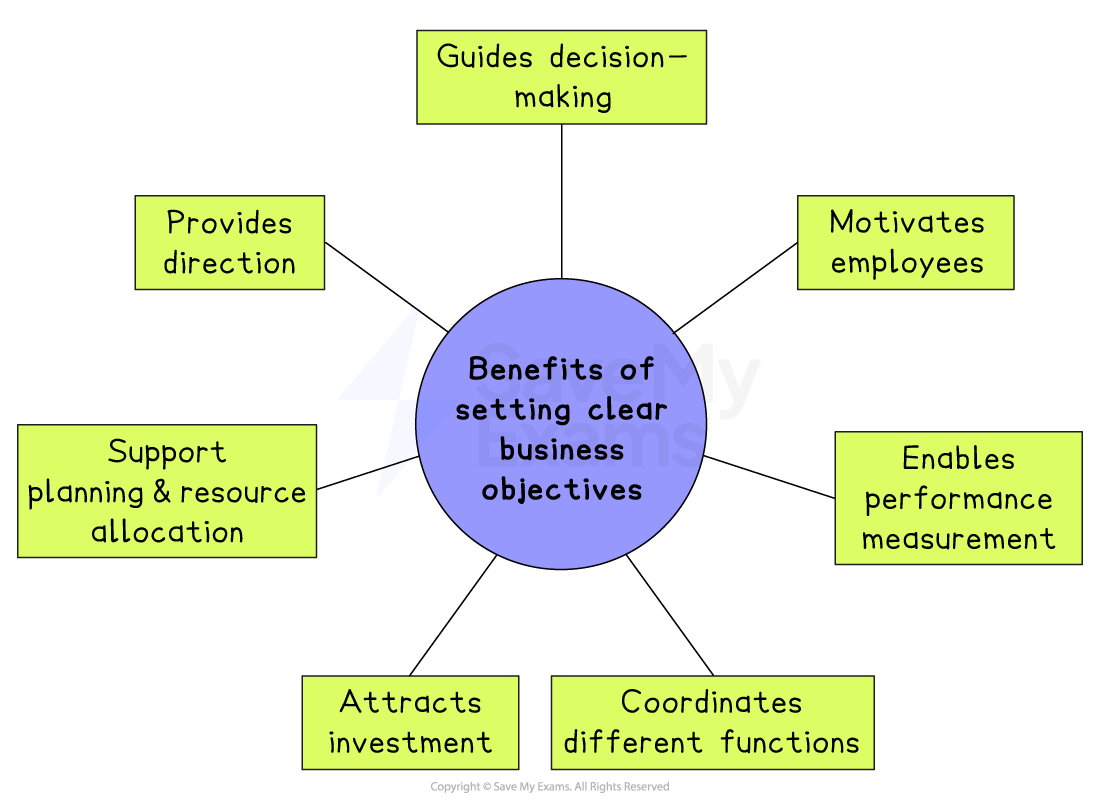
Provides direction
Clear objectives give the business and its employees a clear sense of where the organisation is heading, reducing uncertainty about priorities
E.g. a business with a market share objective knows it should focus on attracting new customers rather than maximising short-term profit margins
Guides decision-making
They can help managers at all levels make consistent choices that align with the overall strategy
Without clear objectives, decisions across different departments may pull in opposite directions
Motivates employees
Specific targets give employees something meaningful to work towards and a sense of achievement when goals are met
Vague or absent objectives make it difficult for employees to understand what success looks like
Enables performance measurement
Objectives provide benchmarks against which actual results can be compared, making it easier to identify where the business is succeeding and where improvement is needed
Coordinates different functions
Clear objectives ensure that marketing, finance, operations and HR are all working towards the same goals rather than pursuing conflicting priorities
Supports planning and resource allocation
They provide a framework for developing business plans, setting budgets and directing resources towards activities most likely to achieve the desired outcomes
Attracts investment
Clearly defined objectives demonstrate that the business has a coherent strategy
This increases the confidence of investors, lenders and other stakeholders
Case Study
Drift Clothing

When Drift Clothing's eco-friendly activewear went viral on social media in 2022, orders flooded in. But without clear objectives to guide the business, success quickly turned into chaos
The marketing team continued spending heavily on brand awareness while the finance team had been told to cut costs - with no shared objective, both departments were pulling in opposite directions
Operations had no output targets and failed to increase production quickly enough - delivery times doubled and customer complaints soared
With no measurable sales objectives, the business overstocked some lines and understocked others, tying up cash in unsold inventory
By the end of 2022, Drift had lost 30% of its repeat customers - a direct consequence of failing to set clear, coordinated objectives across the business
Examiner Tips and Tricks
Objectives are only valuable if they are well-designed and clearly communicated. A poorly set objective can be just as harmful as having none at all. In exam questions, consider whether the objectives described in the case study are likely to be effective: are they realistic given the business's resources? Are they aligned with what the business is actually trying to achieve? This kind of evaluative thinking will help you access the higher mark bands
Characteristics of effective objectives
For objectives to drive performance, they need to be carefully designed
A vague or unrealistic target is unlikely to motivate employees or produce meaningful results
The SMART framework
SMART is an acronym that describes the five characteristics of a well-designed business objective
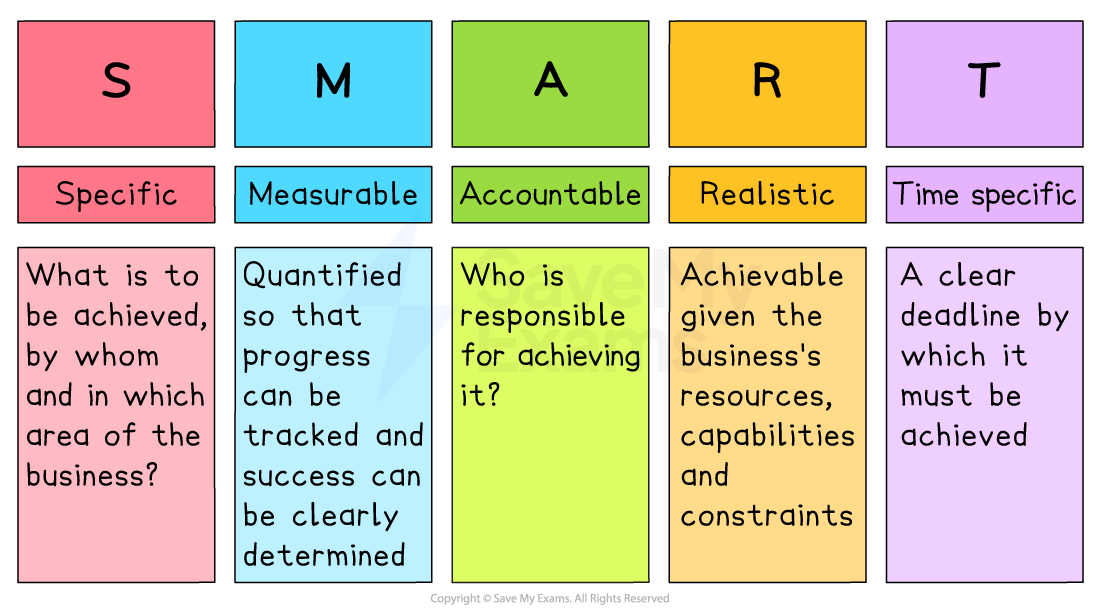
Specific
The objective clearly states what is to be achieved, by whom and in which area of the business
Vague objectives leave room for misinterpretation and make it difficult for employees to know what they are working towards
E.g. "grow the business" is not specific; "increase UK sales revenue by 15%" is
Measurable
The objective can be quantified so that progress can be tracked and success can be clearly determined
Without measurability, it is impossible to know whether the objective has been achieved
E.g. "improve customer satisfaction" is not measurable; "achieve a customer satisfaction score of 85% or above" is
Accountable
The objective identifies who is responsible for achieving it
Clear accountability ensures that specific individuals or teams take ownership of the goal and can be held responsible for outcomes
E.g. "increase market share" assigns no accountability; "the marketing team will increase market share to 20% by December 2026" does
Realistic
The objective is achievable given the business's resources, capabilities and constraints
An unrealistic target will demotivate employees and damage confidence when it is not met
E.g. a small start-up setting an objective to become the UK's largest retailer within one year is not realistic
Time specific
The objective has a clear deadline by which it must be achieved
Without a time frame, there is no urgency and no clear point at which performance can be evaluated
E.g. "improve profitability" has no time frame; "increase operating profit margin by 3% by 31 March 2027" is time specific
Limitations of SMART objectives
Limitation | Explanation |
|---|---|
Can become outdated |
|
May encourage a narrow focus |
|
Risk of gaming |
|
Examiner Tips and Tricks
AQA uses Accountable for the A in SMART, not "Achievable", which is used by some other exam boards and textbooks. Make sure you use the correct term. In exam questions, you may be asked to evaluate whether a business's objectives are effective - use the SMART criteria as your framework, and remember that an objective failing on even one criterion is likely to be less effective overall

Unlock more, it's free!
Join the 100,000+ Students that ❤️ Save My Exams
the (exam) results speak for themselves:

Was this revision note helpful?
