Involving Employees in Decision-Making (AQA A Level Business): Revision Note
Syllabus Edition
First teaching 2026
First exams 2028
Exam code: 7132

Why involve employees in decision-making?
Businesses have traditionally been managed on the assumption that decisions should be made by those at the top and carried out by those below
However, this approach has significant limitations
Managers do not always have the detailed knowledge needed to make the best decisions
Employees who have no say in how they work are less likely to be motivated, committed or willing to accept change
Involving employees in decision-making recognises that the people closest to the work often have the most valuable insights
When employees are genuinely consulted and their input is taken seriously, businesses tend to
Make better decisions
Implement change smoothly
Build a more engaged and loyal workforce
Benefits of involving employees in decision-making
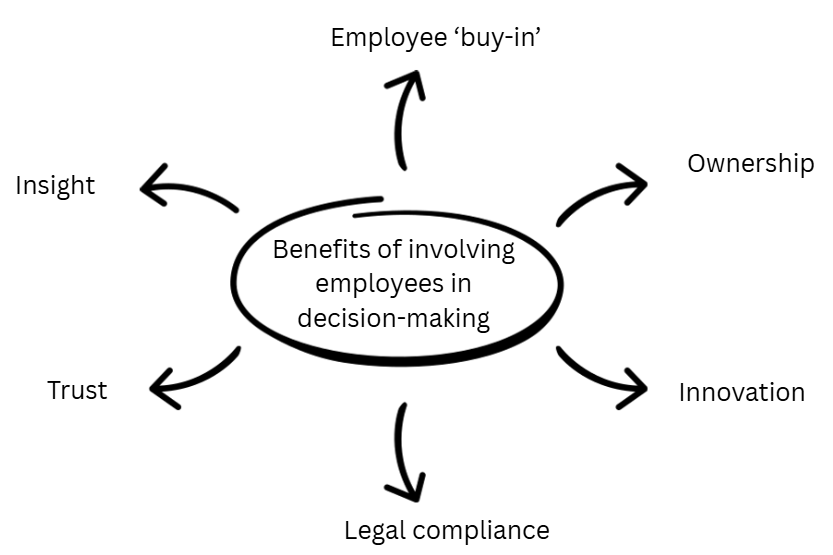
Insight
Employees have direct knowledge of operations, customers and processes that managers often lack
Including their input leads to better-informed decisions
Employee 'buy in'
Decisions that employees have helped shape are more likely to be accepted and implemented smoothly
Ownership
Involvement builds a sense of ownership and responsibility
This can increase commitment and reduce resistance to change
Innovation
It can bring about innovative ideas that management would not generate independently
Those closest to the work often identify the most practical improvements
Legal compliance
In certain situations, consultation is a legal requirement
For example, before redundancies or major changes to working conditions
Failure to consult can result in legal action and fines
Trust
It reduces the risk of industrial disputes by building trust and transparency between management and the workforce
Challenges of involving employees in decision-making
Time and cost
Meaningful consultation and representative structures require management and worker time and resources
Involving employees before every decision can slow the business's ability to respond to change
Risk of conflict and raised expectations
If employees are consulted but their input is not reflected in the final decision, trust can be damaged
Employees who expect their views to be taken into account may become disengaged if they feel they have been ignored
Varying levels of engagement
Not all employees want to be involved in decision-making
Some prefer clear direction from management rather than shared responsibility
Participation schemes can give unrepresentative input that does not genuinely reflect the views of the whole workforce
Ways to involve employees in decision-making
Trade unions and collective bargaining
A trade union is an organisation that represents the collective interests of a group of workers
They negotiate with employers on their behalf over pay, working conditions and other employment matters
Collective bargaining is the process by which trade union representatives negotiate with an employer to reach agreements that apply to all union members
This includes areas such as wages, hours, holiday entitlement and redundancy terms
Example
The Communication Workers Union (CWU) represents workers at Royal Mail and BT, negotiating pay agreements and working condition improvements on behalf of its members
Purpose and value
Gives employees a collective voice that carries significantly more weight than individual negotiation
Provides a formal, structured process for resolving disputes before they escalate
Protects employees, particularly those in lower-paid or less secure roles, from unfair treatment
Shop stewards
A shop steward is an elected trade union representative who works within the organisation and acts as the first point of contact between union members and management on a day-to-day basis
They handle individual grievances, represent members in disciplinary hearings and communicate union positions to the workforce
Their presence means employees always have a representative available at short notice
Advantages
Ensures employee interests are formally represented across an entire workplace or sector
Removes the need for individual employees to negotiate alone, which can be intimidating
Can secure improvements to pay and conditions that benefit large numbers of workers at the same time
Disadvantages
Negotiations can be slow and adversarial, particularly when employer and union positions are far apart
Industrial action (strikes, go-slows, work-to-rule) can be damaging and costly for both parties if talks break down
Trade union membership has declined sharply in the UK private sector, reducing collective bargaining power in many industries
Example
In 2022, the CWU called a series of strikes at Royal Mail after negotiations over pay and working conditions broke down
Thousands of postal workers took industrial action over several months, affecting mail delivery across the country
A deal was eventually reached, illustrating that collective bargaining, though sometimes adversarial, is an effective way to resolve workplace disputes
Employee forums
An employee forum is a formal body of elected employee representatives that meets regularly with management to discuss business matters, such as planned organisational changes, working conditions and strategic decisions, before those decisions are finalised
In large German companies, where employee forums called 'works councils' are popular, employees are entitled to seats on the board of directors
This gives the workforce formal influence over decisions about investment, production and restructuring
Purpose and value
Provides a structured channel for dialogue between management and employees
Gives employees genuine input into decisions before they are made, rather than simply being informed of changes after the fact
Builds trust and transparency, reducing the likelihood of industrial disputes
Advantages
Creates a collaborative approach to decision-making that can increase the chances of success
Employees who are consulted before a change is implemented are more likely to accept and support it
Can identify practical problems with proposed changes that management had not foreseen
Disadvantages
Can slow down decision-making if management must consult the works council before acting
Employee representatives may not always accurately reflect the views of the whole workforce
Less common in the UK than in mainland Europe
UK employees have fewer legal protections in this area
Example
BMW's works council is one of the most influential employee representative bodies in German industry
Representatives must be consulted on decisions ranging from factory automation to working time arrangements, and their agreement is required before major operational changes can proceed
BMW's management has credited the model with reducing industrial disputes and improving the quality of decisions by including employee expertise in planning
Quality circles
A quality circle is a small group of employees who meet regularly to identify, discuss and solve work-related problems, particularly those relating to quality and efficiency
Meetings are voluntary, structured and regular
Recommendations are presented formally to management
Quality circles originated in Japan in the 1960s and became widely adopted in manufacturing businesses
They are linked to the philosophy of kaizen - continuous, incremental improvement led by the people closest to the work
Purpose and value
Draws on the knowledge of employees, who are often best placed to spot practical problems and propose realistic solutions
Gives employees a direct role in improving the quality and efficiency of their own working environment
Advantages
Can generate significant improvements in quality and efficiency at relatively low cost
Increases employee engagement by giving workers direct influence over how their work is done
Builds teamwork and communication skills across the workforce
Disadvantages
Recommendations must be genuinely acted upon
If suggestions are consistently ignored, participation drops and cynicism grows
Time-consuming for employees who must attend meetings alongside their regular duties
Example
Toyota's production system is built around employee-led quality circles
Workers are expected to identify quality problems and raise them immediately
Quality circles then meet to propose, test and implement employees' solutions
Toyota credits this model with making its production processes among the most efficient and consistently high-quality in the global motor industry
Formal consultation
Consultation is the process of formally seeking employees' views before a decision is made
Genuine consultation requires management to actively consider employee input before finalising any business plans
Legal requirements for consultation in the UK
Consultation is mandatory where redundancies involve 20 or more employees within a 90-day period
Businesses must also consult employees about significant changes to employment terms, contracts and working conditions
Purpose and value
Identifies employee concerns or alternative approaches that can improve the final outcome
Demonstrates respect for employees' expertise and experience, increasing their willingness to accept change
Advantages
Can identify objections or risks that management had not identified
Employees who have been consulted are significantly less likely to resist or undermine the resulting decision
In legally required situations, proper consultation protects the business from employment tribunal claims
Disadvantages
Adds time and cost to decision-making processes
Employees may feel frustrated if they are consulted but their input is not reflected in the final decision
This can damage trust rather than build it
Example
When Tesco announced the closure of its defined-benefit pension scheme in 2015, the business was legally required to carry out a 60-day employee consultation
The process involved thousands of workers and was supported by trade union representatives
Employee feedback led Tesco to change the transition terms, reducing the risk of industrial action, showing that meaningful consultation can improve both the decision itself and its reception across the workforce
Examiner Tips and Tricks
Be precise about the difference between consultation and negotiation. Consultation means genuinely seeking employee input before a decision is made - management must consider the views expressed but does not have to act on them
Negotiation (typically through trade unions) involves both parties working towards an agreed outcome. Confusing the two in a high-mark answer will suggest a lack of technical precision that costs marks
Case Study
Verdant Foods Ltd
Verdant Foods is a UK food manufacturer with 400 employees across two production sites. In 2023, the business planned to introduce automated packaging equipment that would directly affect the roles of around 80 production workers.
Rather than simply announcing the change, senior management opened a 12-week consultation process. Employee representatives from each site joined a working group alongside operations managers. Workers raised concerns about job security and proposed a phased introduction that would allow time for retraining - a suggestion management had not originally considered.
As a result, Verdant committed to redeploying affected workers into quality control and maintenance roles rather than making redundancies. Staff turnover during the transition period was minimal, and the project was completed on schedule. A survey showed that 78% of affected employees felt the process had been handled fairly.

Unlock more, it's free!
Join the 100,000+ Students that ❤️ Save My Exams
the (exam) results speak for themselves:

Was this revision note helpful?
