Employer & Employee Relations (AQA A Level Business): Exam Questions

Exam code: 7132

Syllabus Edition

First teaching 2026

First exams 2028

2 hours15 questions
1
6 marks

Source A: Royal Mail

Royal Mail delivers letters and parcels to every address in the United Kingdom. It is part of International Distribution Services, which also owns the European parcel business GLS and which employed 153 552 people in 2024 and had revenue of £12 679 million. Around 85 000 of Royal Mail's people are postal delivery workers, and the business takes on about 16 000 extra temporary workers each year between late October and January to cope with the Christmas rush.

In June 2025 the company stopped being a public limited company listed on the stock market. EP Group, controlled by the Czech businessman Daniel Křetínský, completed a £3.6 billion takeover that the UK government had approved in December 2024 and that became unconditional on 30 April 2025.

Most of Royal Mail's people belong to the Communication Workers Union, and relations with that union have been difficult. Strikes ran from August to December 2022, and before the two sides returned to talks Royal Mail said it was losing up to £1 million a day. The dispute ended in July 2023 with a three-year deal worth a 10% pay increase and a £500 one-off payment, accepted by 76% of those who voted on a 67% turnout.

A second three-year deal followed on 3 July 2025: 4.2% in 2025, then increases linked to the Consumer Prices Index of at least 2% in 2026 and at least 2% in 2027, worth more than 8% in total and backdated to 1 April 2025. The company also promised no compulsory redundancies for the life of the deal.

Service quality remains a problem. In October 2025 the regulator Ofcom fined Royal Mail £21 million for missing its delivery targets in 2024/25, the third year in a row it had been fined. The fine was reduced from £30 million because the company admitted liability and settled. Royal Mail returned to profit in 2024/25, reporting £12 million.

Source: International Distribution Services, Ofcom and Communication Workers Union announcements, 2022 to 2026

Appendix A: Royal Mail and the Communication Workers Union, 2022 to 2025

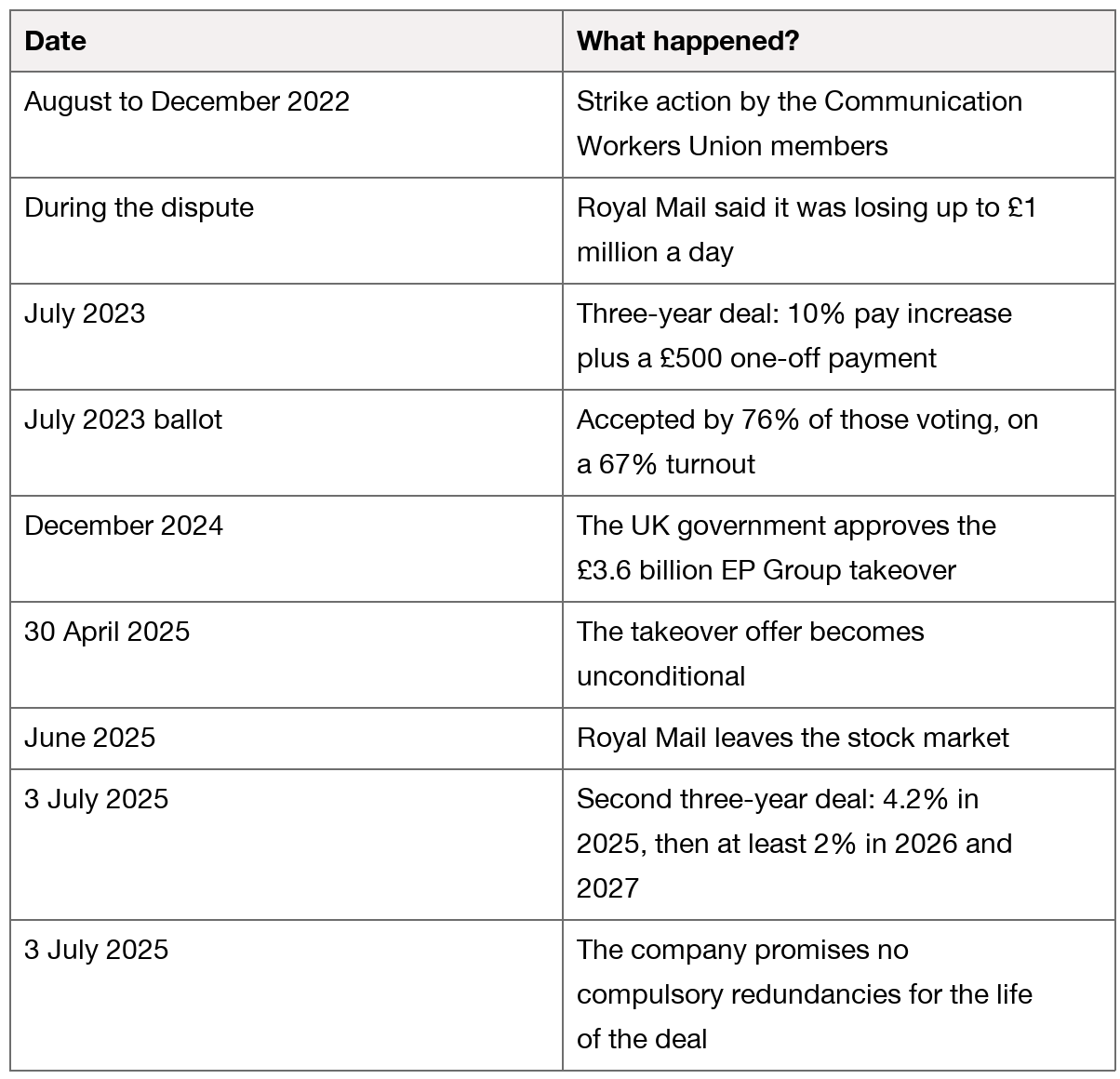
Timeline of Royal Mail and the Communication Workers Union: August to December 2022, strike action by Communication Workers Union members; during the dispute, Royal Mail said it was losing up to £1 million a day; July 2023, a three-year deal of a 10% pay increase plus a £500 one-off payment; July 2023 ballot, accepted by 76% of those voting on a 67% turnout; December 2024, the UK government approves the £3.6 billion EP Group takeover; 30 April 2025, the takeover offer becomes unconditional; June 2025, Royal Mail leaves the stock market; 3 July 2025, a second three-year deal of 4.2% in 2025, then at least 2% in 2026 and 2027; 3 July 2025, the company promises no compulsory redundancies for the life of the deal.

Source: company and union announcements
Analyse one way in which the three-year pay deal agreed in July 2025 might affect Royal Mail's ability to compete on price with other parcel companies.

2
6 marks

Source A: Harrowgate Mutual

Harrowgate Mutual sells home and motor insurance. It employs 300 people in Leeds, takes £86 million in premiums a year and made an operating profit of £4.2 million in the year to March 2025. It is a mutual, which means it has no shareholders and is owned by its policyholders.

Three years ago the regulator found that Harrowgate's telephone sales team had been selling add-on cover that many customers did not need and in some cases could never have claimed on. The company was fined £7.4 million and has paid £11.9 million back to customers.

Nobody at Harrowgate set out to mis-sell. What happened was that 68% of a salesperson's pay came from commission, the commission was paid on the number of add-ons sold rather than on whether the customer kept the policy, and the weekly sales table was read out every Monday morning. Managers were promoted on the same numbers. When one team leader raised concerns in 2021 she was told the figures were the figures.

The new chief executive, Ama Boateng, arrived in early 2025 from a larger insurer. She has cut commission to 15% of pay, stopped the Monday sales table, created a staff forum that meets the board twice a year, and rewritten the company's values so that the first one is now “sell only what the customer needs”.

Some of it has worked. Complaints upheld against Harrowgate by the Financial Ombudsman Service have fallen sharply. Some of it has not. Sales of add-ons have fallen further than expected, a third of the original sales team has left, and several long-serving managers say privately that the company has swung from one extreme to the other and that nobody is now willing to ask a customer for anything.

Source: Harrowgate Mutual

Appendix A: What happened at Harrowgate Mutual

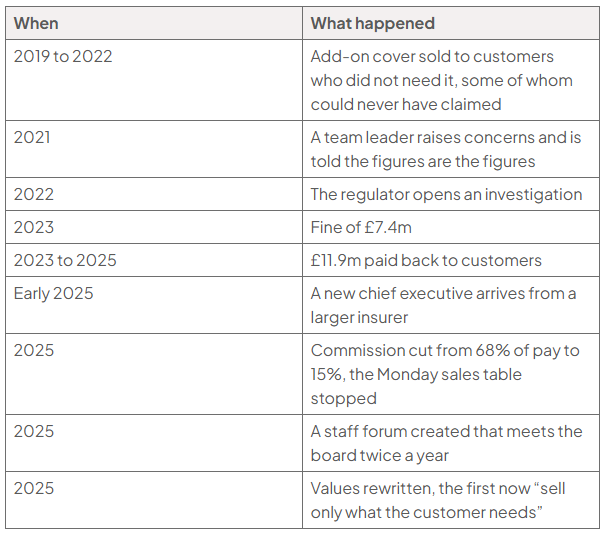
Timeline of what happened at Harrowgate Mutual: 2019 to 2022, add-on cover sold to customers who did not need it, some of whom could never have claimed; 2021, a team leader raises concerns and is told the figures are the figures; 2022, the regulator opens an investigation; 2023, a fine of £7.4m; 2023 to 2025, £11.9m paid back to customers; early 2025, a new chief executive arrives from a larger insurer; 2025, commission cut from 68% of pay to 15% and the Monday sales table stopped; 2025, a staff forum created that meets the board twice a year; 2025, values rewritten, the first now “sell only what the customer needs”.

Source: Harrowgate Mutual

Analyse one way in which creating a staff forum that meets the board might affect Harrowgate Mutual's costs.

3
6 marks

Source A: Pennine Transit Ltd

Pennine Transit Ltd runs local bus services across three Yorkshire towns under contract to the local transport authority. It employs 210 drivers and 38 engineers, cleaners and office staff. In the year to March 2025 it had revenue of £14.6 million and an operating profit of £520 000.

Drivers at Pennine are not all on the same terms. Anyone hired before 2021 is on what everybody calls the old contract: £16.00 an hour, 28 days of holiday and company sick pay from the first day. Anyone hired since is on the new contract: £13.60 an hour, 20 days of holiday and no company sick pay. The two sets of drivers do exactly the same job, often on the same route on the same day, and they know what each other earns.

There are now 94 drivers on the old contract and 116 on the new one. There are also 23 vacancies the company cannot fill, and services are cancelled most weeks because nobody is available to drive them.

In January the drivers asked the company to recognise the union Unite so that pay could be negotiated for everyone at once. The managing director, Gareth Whitcombe, refused, saying Pennine had always dealt with its drivers directly and that a union would make the business slower to respond. The drivers balloted anyway. On a 79% turnout, 71% voted for recognition.

Mr Whitcombe has not changed his position publicly, but he has asked for costings on closing the gap between the two contracts.

Source: Pennine Transit Ltd

Appendix C: The union recognition dispute

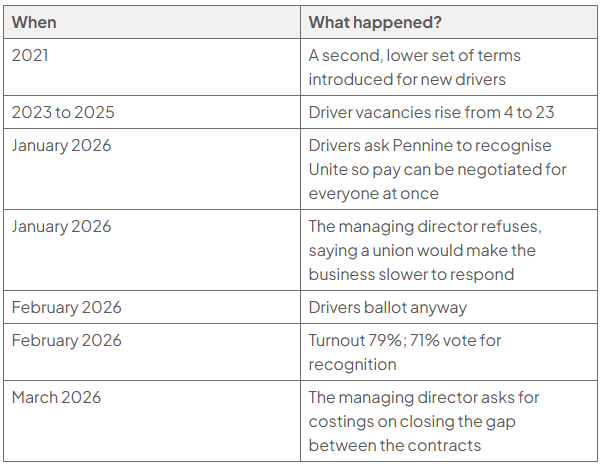
Timeline of the union recognition dispute: 2021, a second, lower set of terms introduced for new drivers; 2023 to 2025, driver vacancies rise from 4 to 23; January 2026, drivers ask Pennine to recognise Unite so pay can be negotiated for everyone at once; January 2026, the managing director refuses, saying a union would make the business slower to respond; February 2026, drivers ballot anyway; February 2026, turnout 79% and 71% vote for recognition; March 2026, the managing director asks for costings on closing the gap between the contracts.

Source: Pennine Transit Ltd and Unite

Analyse one way in which refusing to recognise the union might affect Pennine Transit Ltd's costs.

4
6 marks

Source A: Amazon UK

Amazon runs a network of fulfilment centres across the United Kingdom, where orders are picked, packed and despatched. One of the largest is BHX4 in Coventry, which employs about 3 000 people.

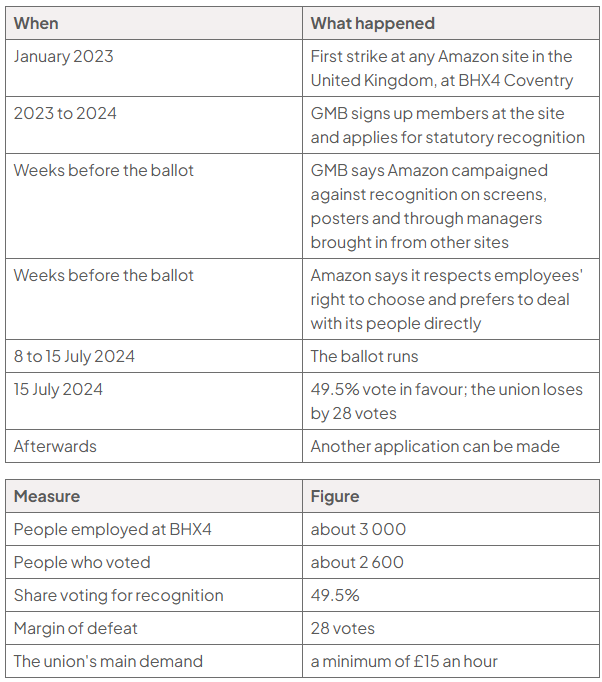
In January 2023 workers at BHX4 held the first strike at any Amazon site in the United Kingdom. Over the following eighteen months the GMB union signed up members there and applied for statutory recognition, which would have obliged Amazon to negotiate pay with the union rather than setting it alone. It would have been the first such agreement at any Amazon site in the country.

The ballot ran from 8 to 15 July 2024. Around 2 600 people voted. 49.5% voted in favour of recognition, and the union lost by 28 votes.

The weeks before the ballot were not quiet. The GMB said Amazon ran a sustained campaign against recognition: messages on screens around the site, posters in the toilets, managers brought in from other sites to talk to staff about what a union would mean, and QR codes in the canteens linking to a page for cancelling GMB membership. Amazon has said it respects employees' right to choose and prefers to deal with its people directly, pointing to its pay rates and the fact that it reviews them each year without being obliged to.

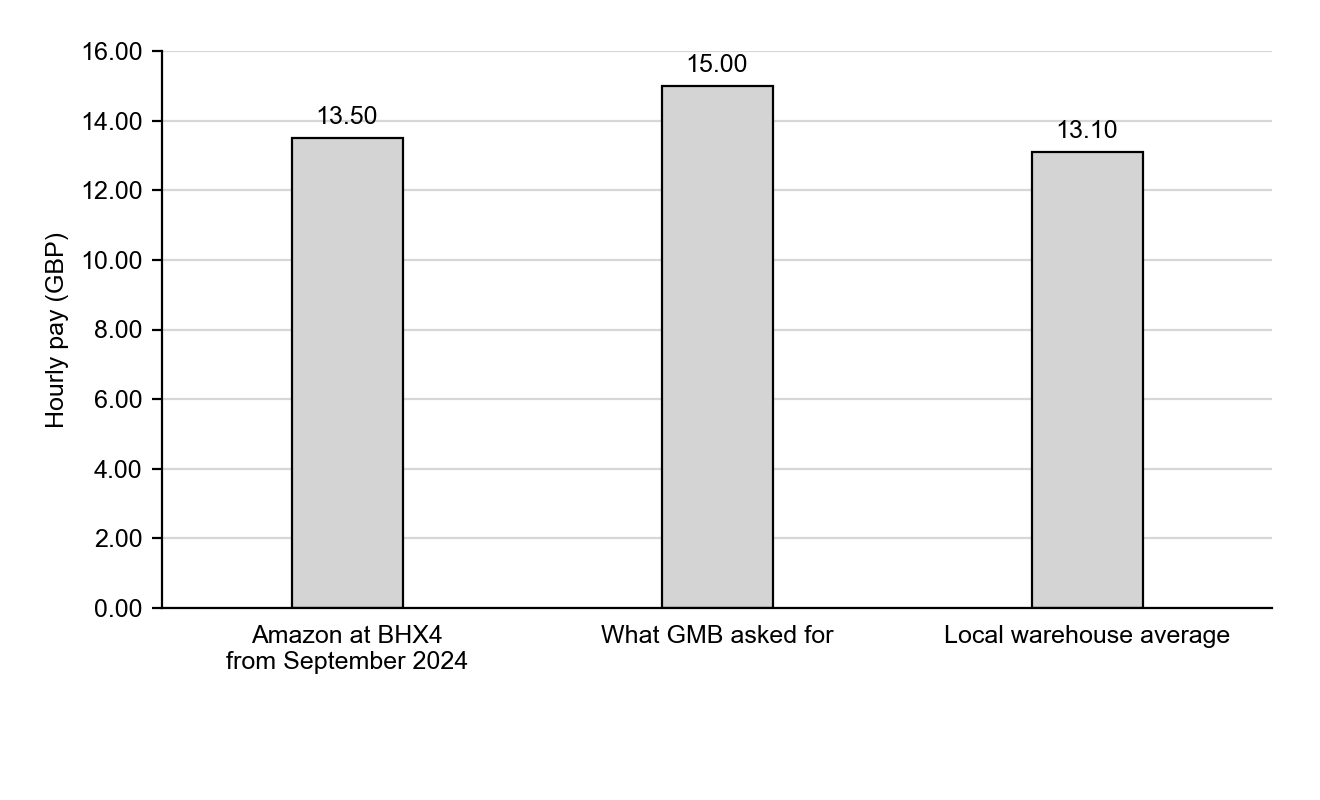
The union's main demand was a minimum of £15 an hour. Amazon's pay at the site at the time of the ballot was below that.

Amazon now has to decide what to do next, knowing that half the people who voted wanted a union and that another application can be made.

Source: GMB and Amazon statements and press reports, 2023 to 2026

Appendix A: The Coventry recognition ballot

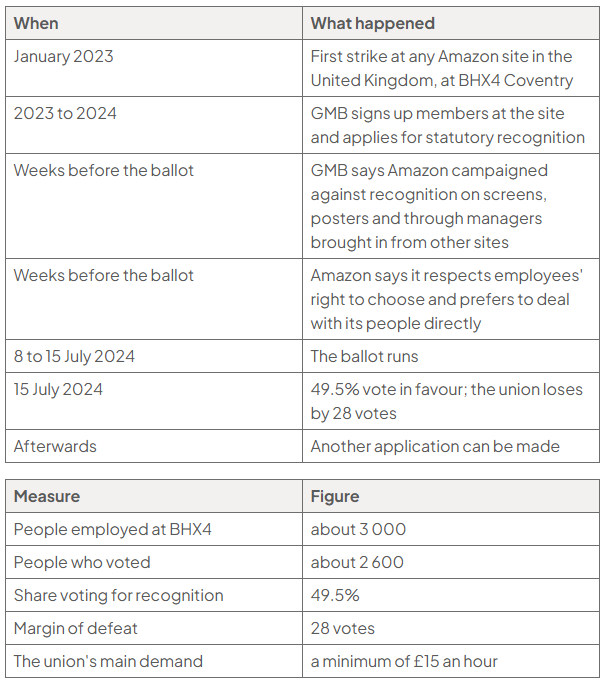
Two tables. A timeline: in January 2023 came the first strike at any Amazon site in the United Kingdom, at BHX4 Coventry; in 2023 to 2024 GMB signed up members at the site and applied for statutory recognition; in the weeks before the ballot GMB says Amazon campaigned against recognition on screens, posters and through managers brought in from other sites, while Amazon says it respects employees' right to choose and prefers to deal with its people directly; the ballot ran from 8 to 15 July 2024; on 15 July 2024 49.5% voted in favour and the union lost by 28 votes; afterwards another application can be made. A table of figures: about 3 000 people employed at BHX4; about 2 600 people voted; 49.5% voted for recognition; the margin of defeat was 28 votes; the union's main demand was a minimum of £15 an hour.

Source: GMB and Amazon statements and press reports

Analyse one way in which losing a recognition ballot by 28 votes might affect relations between Amazon and the people who work at the Coventry site.

5
6 marks

Source A: Amazon UK

Amazon runs a network of fulfilment centres across the United Kingdom, where orders are picked, packed and despatched. One of the largest is BHX4 in Coventry, which employs about 3 000 people.

In January 2023 workers at BHX4 held the first strike at any Amazon site in the United Kingdom. Over the following eighteen months the GMB union signed up members there and applied for statutory recognition, which would have obliged Amazon to negotiate pay with the union rather than setting it alone. It would have been the first such agreement at any Amazon site in the country.

The ballot ran from 8 to 15 July 2024. Around 2 600 people voted. 49.5% voted in favour of recognition, and the union lost by 28 votes.

The weeks before the ballot were not quiet. The GMB said Amazon ran a sustained campaign against recognition: messages on screens around the site, posters in the toilets, managers brought in from other sites to talk to staff about what a union would mean, and QR codes in the canteens linking to a page for cancelling GMB membership. Amazon has said it respects employees' right to choose and prefers to deal with its people directly, pointing to its pay rates and the fact that it reviews them each year without being obliged to.

The union's main demand was a minimum of £15 an hour. Amazon's pay at the site at the time of the ballot was below that.

Amazon now has to decide what to do next, knowing that half the people who voted wanted a union and that another application can be made.

Source: GMB and Amazon statements and press reports, 2023 to 2026

Appendix C: What each side said

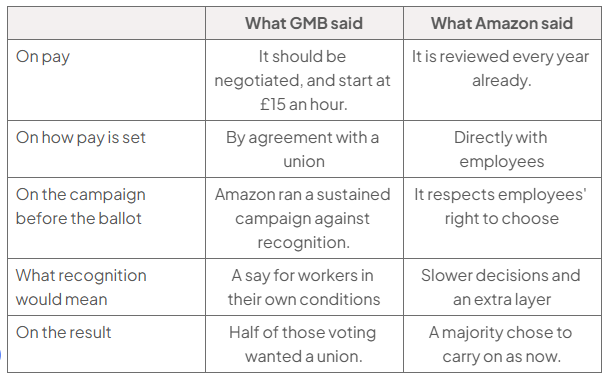
Table of what GMB and Amazon said. On pay, GMB said it should be negotiated and start at £15 an hour; Amazon said it is already reviewed every year. On how pay is set, GMB said by agreement with a union; Amazon said directly with employees. On the campaign before the ballot, GMB said Amazon ran a sustained campaign against recognition; Amazon said it respects employees' right to choose. On what recognition would mean, GMB said a say for workers in their own conditions; Amazon said slower decisions and an extra layer. On the result, GMB said half of those voting wanted a union; Amazon said a majority chose to carry on as now.

Source: GMB and Amazon statements

Analyse one way in which setting pay directly with employees rather than with a union might affect Amazon's costs.

6
6 marks

Source A: Caledon Rail Services Ltd

Caledon Rail Services Ltd maintains track, signalling cabling and lineside structures under nine contracts across central Scotland. It employs 260 people, had revenue of £31.4 million in the year to March 2025 and an operating profit of £1.18 million.

Of those 260, 196 work trackside, mostly at night and in all weathers. The other 64 are managers and office staff. The median trackside wage is £34 600 and the median management salary is £52 800, so a manager earns about one and a half times what the people on the track earn.

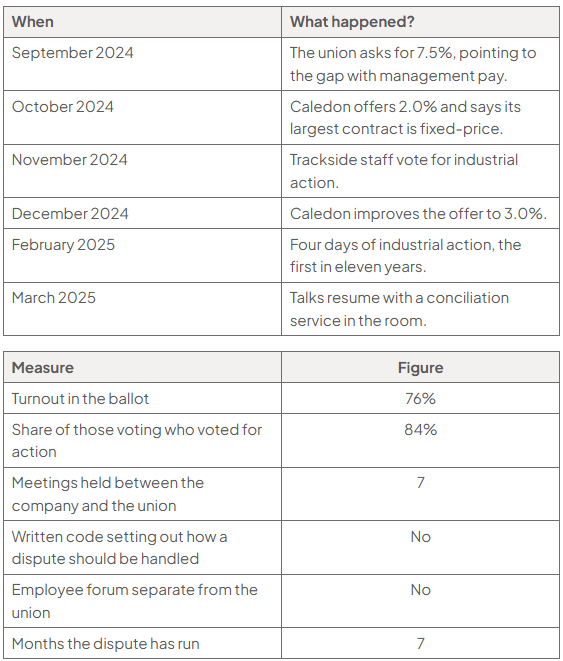
Last September the union asked for 7.5%. Caledon offered 2.0%, explaining that its largest contract is fixed-price and runs for two more years. In November the trackside staff voted for industrial action, and in December the company improved its offer to 3.0%. Neither side moved after that, and in February there were four days of industrial action, the first in eleven years.

What the union keeps returning to is not only the percentage. The trackside rate at Caledon is below the median for the sector while the management rate is above it, and the company has no written code setting out how a dispute should be handled and no employee forum separate from the union. Everything has gone through seven meetings and a ballot.

Talks resumed in March with a conciliation service in the room, and the board has to decide what it is prepared to pay.

Source: Caledon Rail Services Ltd

Appendix C: How the dispute has run

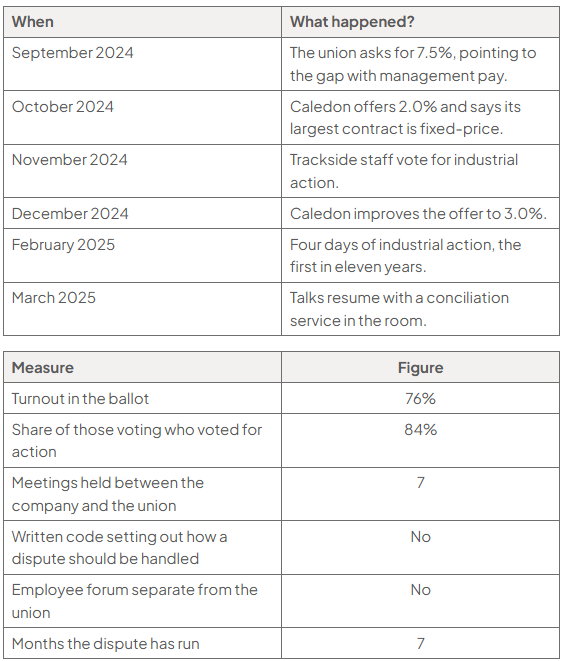
Two tables. A timeline: in September 2024 the union asks for 7.5%, pointing to the gap with management pay; in October 2024 Caledon offers 2.0% and says its largest contract is fixed-price; in November 2024 trackside staff vote for industrial action; in December 2024 Caledon improves the offer to 3.0%; in February 2025 there are four days of industrial action, the first in eleven years; in March 2025 talks resume with a conciliation service in the room. A table of measures: turnout in the ballot 76%; 84% of those voting voted for action; 7 meetings held between the company and the union; no written code setting out how a dispute should be handled; no employee forum separate from the union; the dispute has run for 7 months.

Source: Caledon Rail Services Ltd

Analyse one way in which having no employee forum separate from the union might affect Caledon Rail Services Ltd's relationship with its trackside staff.

7
6 marks

Source A: Linmoor Software Ltd

Linmoor Software Ltd writes scheduling software for care homes and veterinary practices. Two developers founded it in 2017, it now employs 70 people, and in the year to March 2025 it had revenue of £8.6 million and an operating profit of £940 000. It keeps one office in Leeds with 24 desks, and 58 of its 70 people work mainly from home.

For the first few years everybody could hear everybody else. Decisions were made in the room, the founders knew what every customer wanted, and nobody needed telling what the company was for. Twenty-eight of the current staff joined in the last twelve months, nine of them live outside the United Kingdom, and the company works across four time zones.

The annual survey has picked up what that has done. In 2022, when there were eighteen people, 88% said they knew who decided things. The same question now gets 44%. Only 32% have met most of their colleagues in person, and 37% have never met a founder.

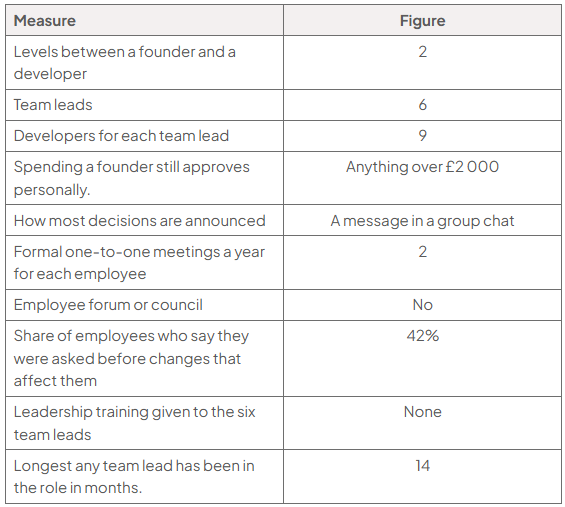
Nothing has been written down. There is no description of how the company works, no employee forum, and most decisions are still announced in a group chat. The six team leads have had no leadership training, and the longest any of them has been in the role is fourteen months. Both founders still personally approve any spending over £2 000.

The whole company is together in one place once a year. The board has been asked whether that is enough.

Source: Linmoor Software Ltd

Appendix C: How Linmoor is led and how decisions get made

Table headed “Measure” and “Figure”: two founder–developer levels, six team leads, nine developers per lead, spending approval over £2,000, group-chat decisions, two one-to-ones yearly, no forum, 42% consulted, no training and 14 months’ longest tenure.

Source: Analyst

Analyse one way in which announcing most decisions in a group chat might affect employee relations at Linmoor Software Ltd.

1
9 marks

Source A: Royal Mail

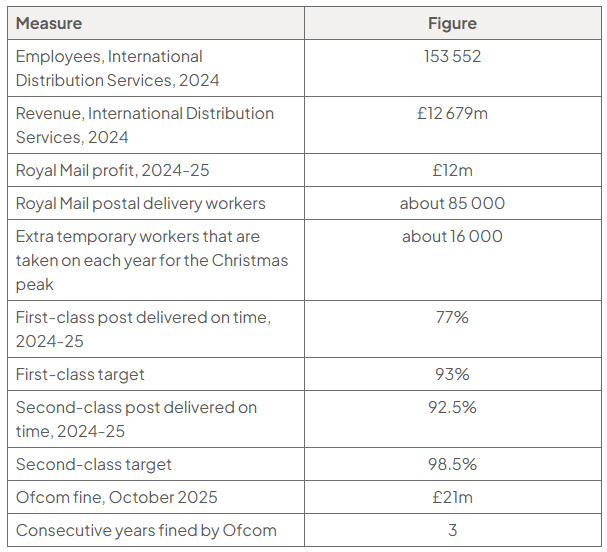
Royal Mail delivers letters and parcels to every address in the United Kingdom. It is part of International Distribution Services, which also owns the European parcel business GLS and which employed 153 552 people in 2024 and had revenue of £12 679 million. Around 85 000 of Royal Mail's people are postal delivery workers, and the business takes on about 16 000 extra temporary workers each year between late October and January to cope with the Christmas rush.

In June 2025 the company stopped being a public limited company listed on the stock market. EP Group, controlled by the Czech businessman Daniel Křetínský, completed a £3.6 billion takeover that the UK government had approved in December 2024 and that became unconditional on 30 April 2025.

Most of Royal Mail's people belong to the Communication Workers Union, and relations with that union have been difficult. Strikes ran from August to December 2022, and before the two sides returned to talks Royal Mail said it was losing up to £1 million a day. The dispute ended in July 2023 with a three-year deal worth a 10% pay increase and a £500 one-off payment, accepted by 76% of those who voted on a 67% turnout.

A second three-year deal followed on 3 July 2025: 4.2% in 2025, then increases linked to the Consumer Prices Index of at least 2% in 2026 and at least 2% in 2027, worth more than 8% in total and backdated to 1 April 2025. The company also promised no compulsory redundancies for the life of the deal.

Service quality remains a problem. In October 2025 the regulator Ofcom fined Royal Mail £21 million for missing its delivery targets in 2024/25, the third year in a row it had been fined. The fine was reduced from £30 million because the company admitted liability and settled. Royal Mail returned to profit in 2024/25, reporting £12 million.

Source: International Distribution Services, Ofcom and Communication Workers Union announcements, 2022 to 2026

Appendix A: Royal Mail and the Communication Workers Union, 2022 to 2025

Timeline of Royal Mail and the Communication Workers Union: August to December 2022, strike action by Communication Workers Union members; during the dispute, Royal Mail said it was losing up to £1 million a day; July 2023, a three-year deal of a 10% pay increase plus a £500 one-off payment; July 2023 ballot, accepted by 76% of those voting on a 67% turnout; December 2024, the UK government approves the £3.6 billion EP Group takeover; 30 April 2025, the takeover offer becomes unconditional; June 2025, Royal Mail leaves the stock market; 3 July 2025, a second three-year deal of 4.2% in 2025, then at least 2% in 2026 and 2027; 3 July 2025, the company promises no compulsory redundancies for the life of the deal.

Source: company and union announcements

Appendix B: Selected data for Royal Mail and International Distribution Services

Table of selected data for Royal Mail and International Distribution Services: 153 552 employees at International Distribution Services in 2024; International Distribution Services revenue in 2024 £12 679m; Royal Mail profit in 2024/25 £12m; about 85 000 Royal Mail postal delivery workers; about 16 000 extra temporary workers taken on each year for the Christmas peak; 77% of first-class post delivered on time in 2024/25, against a target of 93%; 92.5% of second-class post delivered on time in 2024/25, against a target of 98.5%; Ofcom fine in October 2025 £21m; fined by Ofcom for 3 consecutive years.

Source: International Distribution Services and Ofcom

Assess the impact of Royal Mail's relationship with the Communication Workers Union on its financial performance.

2
9 marks

Source A: Revolut

Revolut is a digital bank. It has no branches: customers open an account on their phone, usually in minutes, and use it to spend, send and exchange money. It was founded in London in 2015 by Nik Storonsky and has grown faster than almost any European business of its size.

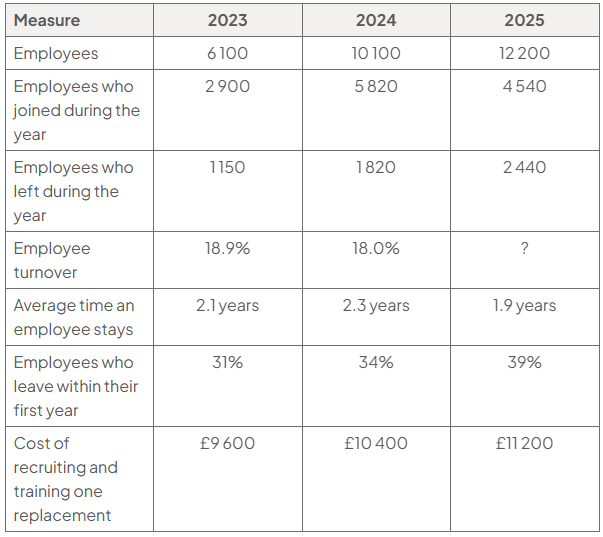
The numbers are remarkable. In 2024 it had 52.5 million retail customers, up 38%, revenue of £3.1 billion, up 72%, and net profit of £790 million. In 2025 customers rose another 30% to 68.3 million, group revenue rose 46% to 6.0 billion US dollars and profit before tax reached 2.3 billion US dollars, a profit margin of 38%. A fundraising in 2025 valued the company at 75 billion US dollars. The workforce passed 10 000 in April 2024 and reached 12 200 during 2025.

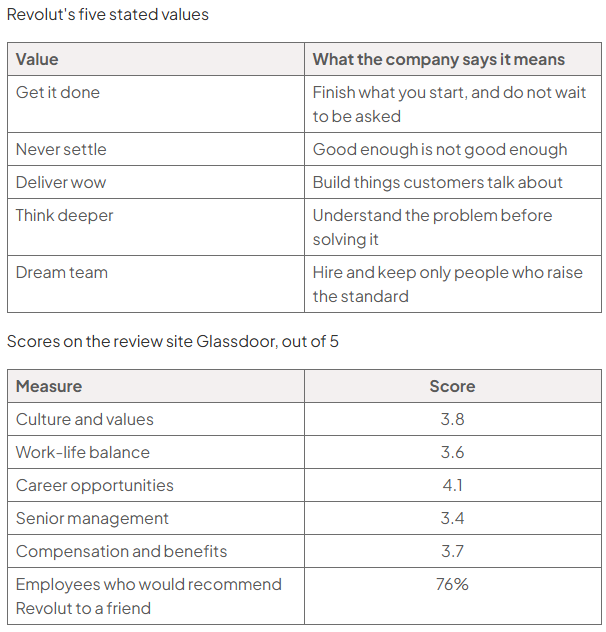
That growth has been built on a demanding set of stated values. Revolut tells its people to “get it done” and to “never settle”, alongside “deliver wow”, “think deeper” and “dream team”. Performance is measured against quarterly targets, and the company says the values are not posters on a wall but the basis on which people are hired, promoted and let go.

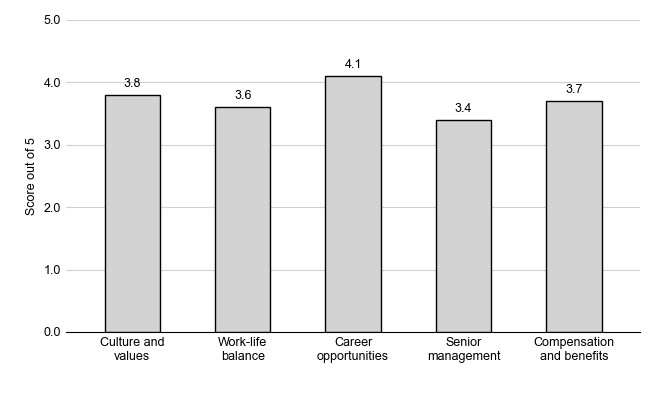
The culture that produces those results also attracts criticism. On the review site Glassdoor, 76% of employees say they would recommend Revolut to a friend, but the company scores 3.6 out of 5 for work-life balance and 3.8 for culture and values. A number of reviews describe meetings in which people are humiliated, managers who lack interpersonal skills, and so heavy a focus on quarterly targets that employees lose sight of anything else. Commentators have questioned whether people who are overworked and burnt out can be expected to be good colleagues, and the chief executive's management style has been criticised for creating long hours and high staff turnover.

Revolut has begun work on changing parts of its culture while insisting that the high-performance core of it stays.

Source: Revolut annual report 2024, Revolut results announcements 2025, and published reviews

Appendix B: Revolut's stated values and what employees say

Bar chart of Glassdoor employee scores out of 5: culture and values 3.8, work-life balance 3.6, career opportunities 4.1, senior management 3.4, and compensation and benefits 3.7.
Two tables. Revolut's five stated values and what the company says each means: get it done, finish what you start and do not wait to be asked; never settle, good enough is not good enough; deliver wow, build things customers talk about; think deeper, understand the problem before solving it; dream team, hire and keep only people who raise the standard. Scores on the review site Glassdoor, out of 5: culture and values 3.8; work-life balance 3.6; career opportunities 4.1; senior management 3.4; compensation and benefits 3.7; 76% of employees would recommend Revolut to a friend.

Source: Revolut and published reviews

Appendix C: Revolut's workforce

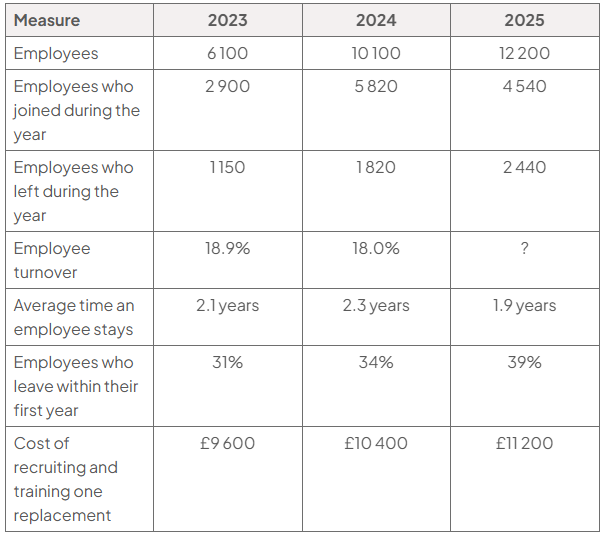
Table of Revolut workforce data for 2023 to 2025: employees 6 100, 10 100 and 12 200; leavers 1 150, 1 820 and 2 440; turnover 18.9%, 18.0% and unknown; replacement costs £9 600, £10 400 and £11 200.

Source: Analyst

Assess the impact of Revolut's relationship with its employees on its costs.

Calculate Revolut's employee turnover in 2025 to support your answer.

3
9 marks

Source A: Amazon UK

Amazon runs a network of fulfilment centres across the United Kingdom, where orders are picked, packed and despatched. One of the largest is BHX4 in Coventry, which employs about 3 000 people.

In January 2023 workers at BHX4 held the first strike at any Amazon site in the United Kingdom. Over the following eighteen months the GMB union signed up members there and applied for statutory recognition, which would have obliged Amazon to negotiate pay with the union rather than setting it alone. It would have been the first such agreement at any Amazon site in the country.

The ballot ran from 8 to 15 July 2024. Around 2 600 people voted. 49.5% voted in favour of recognition, and the union lost by 28 votes.

The weeks before the ballot were not quiet. The GMB said Amazon ran a sustained campaign against recognition: messages on screens around the site, posters in the toilets, managers brought in from other sites to talk to staff about what a union would mean, and QR codes in the canteens linking to a page for cancelling GMB membership. Amazon has said it respects employees' right to choose and prefers to deal with its people directly, pointing to its pay rates and the fact that it reviews them each year without being obliged to.

The union's main demand was a minimum of £15 an hour. Amazon's pay at the site at the time of the ballot was below that.

Amazon now has to decide what to do next, knowing that half the people who voted wanted a union and that another application can be made.

Source: GMB and Amazon statements and press reports, 2023 to 2026

Appendix A: The Coventry recognition ballot

Appendix A: two tables summarising the Coventry recognition ballot: a chronology from January 2023 to afterwards, and figures showing about 3 000 employees, 2 600 voters, 49.5% support, a 28-vote defeat and a £15 hourly demand.

Source: GMB and Amazon statements and press reports

Appendix B: Pay at the Coventry site

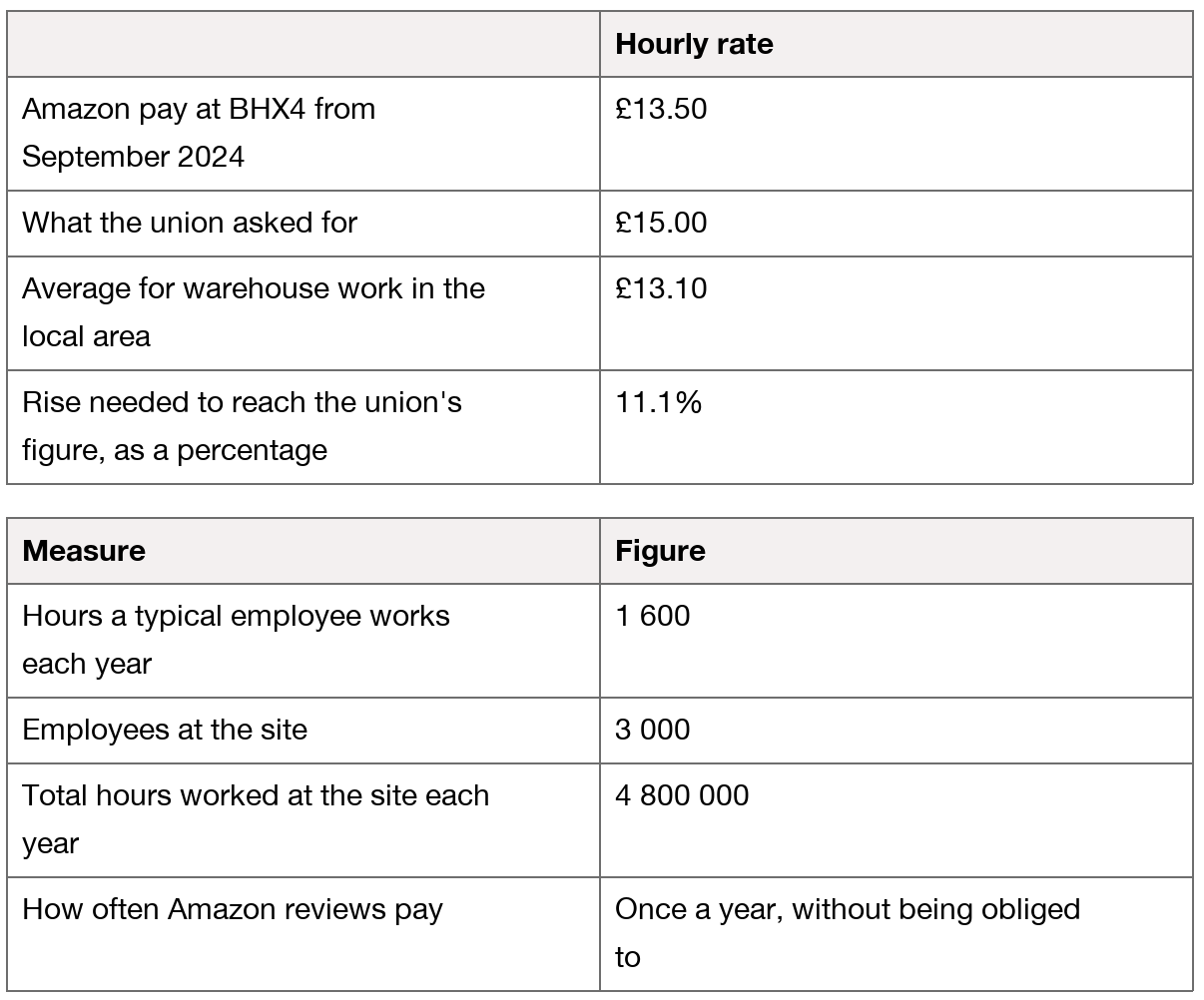
Bar chart of hourly pay in GBP: Amazon at BHX4 from September 2024 £13.50, GMB’s requested rate £15.00, and the local warehouse average £13.10. The vertical axis ranges from £0 to £16.
Two tables show hourly rates (£13.50 from September 2024, £15.00 requested, £13.10 local average) and workforce data: 1 600 hours per employee, 3 000 employees, 4 800 000 hours yearly; the percentage rise is 11.1%.

Source: Analyst

Assess the impact on Amazon of nearly half of those voting wanting a union at the Coventry site.

4
9 marks

Source A: Patagonia

Patagonia makes outdoor clothing and equipment, and has spent fifty years arguing that people should buy less of it. It employs about 4 000 people worldwide, repairs what it has already sold through its Worn Wear programme, and has given 1% of its sales to grassroots environmental groups every year since 1985.

In September 2022 its founder, Yvon Chouinard, gave the company away. All the voting shares, which are 2% of the company, went to the Patagonia Purpose Trust, which exists to hold the company to its values. All the non-voting shares, the other 98%, went to the Holdfast Collective, a non-profit organisation that uses the money to fight the environmental crisis. The company was valued at about 3 billion US dollars at the time. Patagonia's own statement was short: Earth is now our only shareholder.

The culture inside the company is as unusual as the ownership. There has been childcare on site at head office for more than thirty years. Employees may take time out of the working day when the surf is up or the snow is good, on the understanding that the work still gets done. Very few people leave: about four in every hundred each year, against roughly thirteen in a hundred across retail and consumer products.

None of this removes the contradiction at the centre of the business. Patagonia sells clothing, and making clothing uses materials and energy. One per cent of sales goes to protecting nature; the other ninety-nine per cent goes on running a clothing company that would rather its customers mended what they already own.

Source: Patagonia Works

Appendix B: Patagonia compared with its sector

Bar chart comparing Patagonia with retail and consumer products: percentage axis from 0 to 100. Patagonia: 4% leave yearly, 100% parents return, 91% say values are real; sector: 13%, 69% and 54%.
Patagonia tables: leave yearly 4% versus sector 13%; working parents returning 100% versus 69%; values real 91% versus 54%. Culture: childcare over 30 years; flexible sport hours; Worn Wear since 2012; about 4,000 employees; Earth shareholder since 2022.

Source: Analyst

Appendix C: What Patagonia stands for, and what cuts against it

Tables show Patagonia’s values and tensions: best product/materials and energy; no harm/1% donated, 99% clothing; protect nature/growth; unconventionality/profit. Employee figures: 78% consulted, 91% say values real, site forums yes, board 0, environmental leave 1 in 9.

Source: Analyst

Assess how well Patagonia involves its employees in the decisions that affect them.

5
9 marks

Source A: Dalmuir Shipworks Ltd

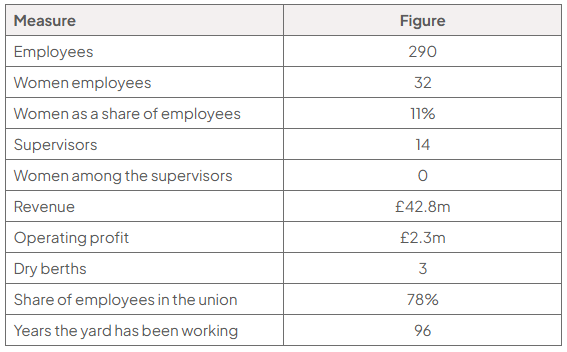
Dalmuir Shipworks Ltd repairs ships and offshore vessels in three dry berths on the Clyde. The yard has been working for ninety-six years, employs 290 people and had revenue of £42.8 million in the year to March 2025, with an operating profit of £2.3 million.

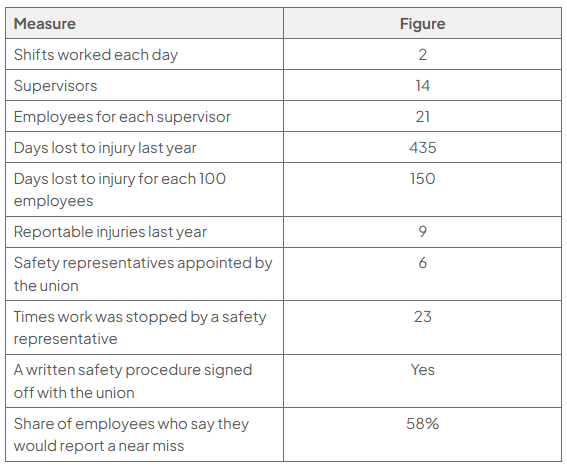
Seventy-eight per cent of the workforce is in the union, which appoints six safety representatives. They stopped work twenty-three times last year. There is a written safety procedure signed off with the union, nine reportable injuries were recorded, and 435 working days were lost to injury.

Because the yard employs more than 250 people it has to publish its gender pay gap, and the figures are uncomfortable reading. Thirty-two of the 290 employees are women, which is 11%. The median hourly rate for men is £19.20 and for women £16.32. Women make up 24% of the lowest-paid quarter of employees and 2% of the highest-paid quarter. None of the fourteen supervisors is a woman, and men are far more likely than women to receive a bonus.

The commercial problem is different and just as hard. The three berths are only full three days in four. A third of the yard's revenue comes from work that arrives at short notice, which is exactly the work that needs an empty berth, and the only ways of filling the gaps are to work through the night or to stop taking short-notice jobs at all.

The board is reviewing both the pay figures and the berths this spring.

Source: Dalmuir Shipworks Ltd

Appendix A: Dalmuir Shipworks Ltd selected data, year to March 2025

Table of selected Dalmuir Shipworks data: 290 employees, including 32 women (11%); 14 supervisors, none women; revenue £42.8m; operating profit £2.3m; 3 dry berths; 78% union membership; operating for 96 years.

Source: Dalmuir Shipworks Ltd

Appendix C: How the yard works, and what lost time costs

Table of safety data: 2 shifts daily; 14 supervisors, 21 employees per supervisor; 435 days lost to injury, or 150 per 100 employees; 9 reportable injuries; 6 union safety representatives; 23 stoppages; written procedure signed off; 58% would report a near miss.

Source: Analyst

Assess the value to Dalmuir Shipworks Ltd of recognising a union in its yard.

1
15 marks

Source A: Revolut

Revolut is a digital bank. It has no branches: customers open an account on their phone, usually in minutes, and use it to spend, send and exchange money. It was founded in London in 2015 by Nik Storonsky and has grown faster than almost any European business of its size.

The numbers are remarkable. In 2024 it had 52.5 million retail customers, up 38%, revenue of £3.1 billion, up 72%, and net profit of £790 million. In 2025 customers rose another 30% to 68.3 million, group revenue rose 46% to 6.0 billion US dollars and profit before tax reached 2.3 billion US dollars, a profit margin of 38%. A fundraising in 2025 valued the company at 75 billion US dollars. The workforce passed 10 000 in April 2024 and reached 12 200 during 2025.

That growth has been built on a demanding set of stated values. Revolut tells its people to “get it done” and to “never settle”, alongside “deliver wow”, “think deeper” and “dream team”. Performance is measured against quarterly targets, and the company says the values are not posters on a wall but the basis on which people are hired, promoted and let go.

The culture that produces those results also attracts criticism. On the review site Glassdoor, 76% of employees say they would recommend Revolut to a friend, but the company scores 3.6 out of 5 for work-life balance and 3.8 for culture and values. A number of reviews describe meetings in which people are humiliated, managers who lack interpersonal skills, and so heavy a focus on quarterly targets that employees lose sight of anything else. Commentators have questioned whether people who are overworked and burnt out can be expected to be good colleagues, and the chief executive's management style has been criticised for creating long hours and high staff turnover.

Revolut has begun work on changing parts of its culture while insisting that the high-performance core of it stays.

Source: Revolut annual report 2024, Revolut results announcements 2025, and published reviews

Appendix C: Revolut's workforce

Table of Revolut workforce measures in 2023, 2024 and 2025: employees 6 100, 10 100 and 12 200; employees who joined during the year 2 900, 5 820 and 4 540; employees who left during the year 1 150, 1 820 and 2 440; employee turnover 18.9%, 18.0% and not provided for 2025; average time an employee stays 2.1 years, 2.3 years and 1.9 years; employees who leave within their first year 31%, 34% and 39%; cost of recruiting and training one replacement £9 600, £10 400 and £11 200.

Source: Analyst

Appendix D: Two ways of changing Revolut's culture

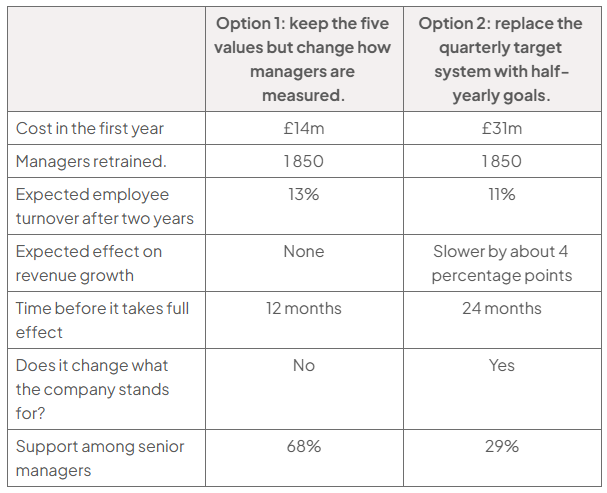
Comparison table of Revolut culture options: Option 1 keeps five values and changes manager measurement; Option 2 replaces quarterly targets with half-yearly goals. Costs £14m/£31m; turnover 13%/11%; effect in 12/24 months; senior-manager support 68%/29%.

Source: Analyst

Revolut is considering two ways of changing its culture:

Option 1: keep the five values but change how managers are measured

Option 2: replace the quarterly target system with half-yearly goals

Evaluate both options and recommend which one Revolut should choose.

Calculate the annual cost of replacing the employees who left in 2025 to support your answer.

2
15 marks

Source A: Patagonia

Patagonia makes outdoor clothing and equipment, and has spent fifty years arguing that people should buy less of it. It employs about 4 000 people worldwide, repairs what it has already sold through its Worn Wear programme, and has given 1% of its sales to grassroots environmental groups every year since 1985.

In September 2022 its founder, Yvon Chouinard, gave the company away. All the voting shares, which are 2% of the company, went to the Patagonia Purpose Trust, which exists to hold the company to its values. All the non-voting shares, the other 98%, went to the Holdfast Collective, a non-profit organisation that uses the money to fight the environmental crisis. The company was valued at about 3 billion US dollars at the time. Patagonia's own statement was short: Earth is now our only shareholder.

The culture inside the company is as unusual as the ownership. There has been childcare on site at head office for more than thirty years. Employees may take time out of the working day when the surf is up or the snow is good, on the understanding that the work still gets done. Very few people leave: about four in every hundred each year, against roughly thirteen in a hundred across retail and consumer products.

None of this removes the contradiction at the centre of the business. Patagonia sells clothing, and making clothing uses materials and energy. One per cent of sales goes to protecting nature; the other ninety-nine per cent goes on running a clothing company that would rather its customers mended what they already own.

Source: Patagonia Works

Appendix B: Patagonia compared with its sector

Grouped bar chart of employee percentages: Patagonia versus retail and consumer products. On a 0–100% scale, values are 4 vs 13 leaving, 100 vs 69 parents returning, and 91 vs 54 saying values are real.
Tables of Patagonia data: versus retail and consumer products, employees leaving 4%/13%, parents returning 100%/69%, values real 91%/54%. Culture: childcare over 30 years; flexible sport hours; Worn Wear since 2012; 4,000 employees; Earth shareholder since 2022.

Source: Analyst

Appendix C: What Patagonia stands for, and what cuts against it

Tables: Patagonia’s principles versus difficulties: best product/materials; no harm/1% donated, 99% clothing business; protect nature/growth; reject convention/profit. Measures: 78%, 91%, site forums yes, board members 0, paid leave 1 in 9.

Source: Analyst

Appendix D: Two ways of giving employees more say

Comparison table for about 4,000 employees: Option 1, an elected forum with two board seats, costs 420,000 yearly and makes 74% feel heard; Option 2, an annual vote on the 1% donation, costs 95,000 US dollars and makes 41% feel heard.

Source: Analyst

Patagonia is considering two ways of giving its employees more say:

Option 1: an elected employee forum with two seats on the board

Option 2: a yearly vote on how the 1% donation is spent

Evaluate both options and recommend which one Patagonia should choose.

Calculate the cost for each employee reached under Option 1 to support your answer.

3
15 marks

Source A: Caledon Rail Services Ltd

Caledon Rail Services Ltd maintains track, signalling cabling and lineside structures under nine contracts across central Scotland. It employs 260 people, had revenue of £31.4 million in the year to March 2025 and an operating profit of £1.18 million.

Of those 260, 196 work trackside, mostly at night and in all weathers. The other 64 are managers and office staff. The median trackside wage is £34 600 and the median management salary is £52 800, so a manager earns about one and a half times what the people on the track earn.

Last September the union asked for 7.5%. Caledon offered 2.0%, explaining that its largest contract is fixed-price and runs for two more years. In November the trackside staff voted for industrial action, and in December the company improved its offer to 3.0%. Neither side moved after that, and in February there were four days of industrial action, the first in eleven years.

What the union keeps returning to is not only the percentage. The trackside rate at Caledon is below the median for the sector while the management rate is above it, and the company has no written code setting out how a dispute should be handled and no employee forum separate from the union. Everything has gone through seven meetings and a ballot.

Talks resumed in March with a conciliation service in the room, and the board has to decide what it is prepared to pay.

Source: Caledon Rail Services Ltd

Appendix C: How the dispute has run

Two tables. A timeline: in September 2024 the union asks for 7.5%, pointing to the gap with management pay; in October 2024 Caledon offers 2.0% and says its largest contract is fixed-price; in November 2024 trackside staff vote for industrial action; in December 2024 Caledon improves the offer to 3.0%; in February 2025 there are four days of industrial action, the first in eleven years; in March 2025 talks resume with a conciliation service in the room. A table of measures: turnout in the ballot 76%; 84% of those voting voted for action; 7 meetings held between the company and the union; no written code setting out how a dispute should be handled; no employee forum separate from the union; the dispute has run for 7 months.

Source: Caledon Rail Services Ltd

Appendix D: Two ways of settling the dispute

Operating profit £1.18m. The union's claim is 7.5%.

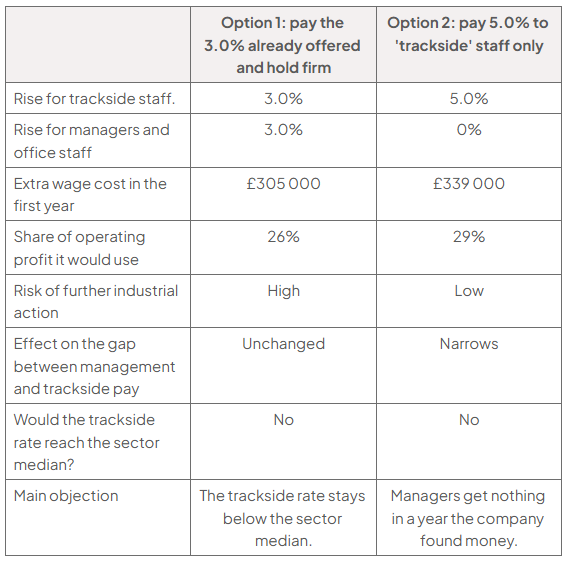
Comparison table of settlement options: Option 1 gives 3% to all, costs £305 000 and 26% of profit; Option 2 gives trackside staff 5%, costs £339 000 and 29%. Risk is high versus low; the pay gap is unchanged versus narrower.

Source: Analyst

Caledon Rail Services Ltd is considering two ways of settling the dispute:

Option 1: pay the 3.0% already offered and hold firm

Option 2: pay 5.0% to trackside staff only

Evaluate both options and recommend which one Caledon Rail Services Ltd should choose.

Calculate Caledon Rail Services Ltd's operating profit margin under Option 1 to support your answer.