Risk & Uncertainty (AQA A Level Business): Exam Questions

Exam code: 7132

Syllabus Edition

First teaching 2026

First exams 2028

3 hours18 questions
1
6 marks

Source A: The Body Shop

The Body Shop was founded by Anita Roddick, who opened its first shop in Brighton on 27 March 1976 with 25 products. From the start it sold products in refillable bottles. It became known for its campaigns: in 1987 it launched Community Trade, through which it buys ingredients directly from producer communities, and in 1989 it began campaigning against the testing of cosmetics on animals. In 2019 it was certified as a B Corporation. Much of its growth outside the UK came through franchising; by 1994, 89% of its shops were run by franchisees.

The business has had four owners since 2006:

  • L'Oréal bought it for £652.3 million in 2006.

  • Natura & Co bought it for £880 million in 2017, when it had about 3 200 stores in 66 countries.

  • Aurelius, an investment firm, bought it for £207 million in November 2023.

  • Auréa, a group led by Mike Jatania, bought the UK business and the brand from the administrators in September 2024 for at least £44.3 million.

In February 2024 the UK business entered administration owing £276 million. More than 80 UK stores closed and more than 800 jobs were lost. The company-run businesses in Germany and the United States closed all their stores, while shops run by franchisees in many other countries continued to trade.

Auréa has said that the business returned to profit after it "fundamentally changed the operating model" and cut costs quickly, including reducing the range from more than 800 products. It has said that The Body Shop is unlikely to open many more UK stores, and that it is considering selling its products through other retailers, such as Boots, and supplying miniature products to hotels. In January 2024 the company completed a move to make its entire range vegan; in August 2025 it reintroduced some products which are not vegan.

Source: The Body Shop, Auréa and press reports

Auréa bought The Body Shop's UK business and brand from the administrators in September 2024. The business had entered administration owing £276 million.

Analyse one way in which buying the business from the administrators might affect the risk to Auréa's investment in The Body Shop.

2
6 marks

Source A: Yeo Valley

Yeo Valley Farms (Production) Limited makes yogurts, desserts, ice cream, fruit products and soups, which it sells to UK retailers under the Yeo Valley Organic brand and other brands, including Tideford. The business traces its origins to 1961, when Roger and Mary Mead bought a farm in the Yeo Valley in Somerset. Yeo Valley is the third largest yogurt brand in the UK, and all Yeo Valley branded products are organic. Most of its products are chilled foods with a short shelf life. The company states its purpose as "To Nurture and Nourish People and Planet".

In the 53 weeks to 1 June 2025 turnover rose 17.6% to £424.6 million, mainly because of higher sales volumes rather than higher prices. Profit before tax fell from £6.4 million to £4.7 million. The company has a long-stated aim of a 5% profit before tax margin, and is in the second year of a five-year plan which runs to May 2028.

Demand grew faster than the company's factories could meet. Large investments in production capacity and automation came into use from spring 2025; until then, the additional volume was made using less efficient methods. During the year the company also:

  • raised the price it pays its organic dairy farmers by 16.5%, to give them the confidence to grow with the business and to attract new farmers into organic dairy;

  • completed its first acquisition, The Collective, a more premium yogurt brand with ranges for children and indulgent desserts;

  • launched products in new categories, including kefir, granola and an organic beef burger.

Five years ago employees became co-owners, when the company established an employee benefit trust which holds 20% of its shares on their behalf. The majority shareholder sits on the board as a non-executive director. Co-owners have a voice in decisions through Co-Ownership Forums, and the company measures their engagement through an annual survey, Yeo Voice.

The company identifies three principal risks:

  • Resilience of supply. The number of dairy farmers in the UK is falling, and few are converting to organic.

  • Availability of labour and skills, particularly in specialist technical roles.

  • Cyber security. A breach could make the company's business systems unavailable. It has detailed business continuity plans, which are kept under regular review.

Yeo Valley buys all its electricity from verifiable renewable sources and holds ISO 14001 environmental accreditation. During the year it began a programme to reuse waste heat from its cooling processes in its heating processes, and improved pipework across its sites to reduce the energy lost. Much of the emissions from farm to fork fall outside the emissions it is required to report, and it is registering for science-based targets in order to set a date for reaching net zero. The company has given surplus food to the charity FareShare since 2015, providing 121.5 tonnes in the year.

Source: Yeo Valley Farms (Production) Limited, Annual Report and Financial Statements 2025

Yeo Valley identifies cyber security as a principal risk. It has detailed business continuity plans, which are kept under regular review, and most of its products are chilled foods with a short shelf life.

Analyse one way in which business continuity planning might affect the impact of a cyber attack on Yeo Valley's revenue.

3
6 marks

Source A: Octopus Energy Group

Octopus Energy Group Limited is a privately owned company which supplies gas and electricity to households and businesses, installs low-carbon technology in homes, and owns Kraken, a software platform which manages energy customers' accounts. The group was founded in the UK in 2016. In the year to 30 April 2025 its revenue rose 10% to £13 683 million, and it supplied 9.94 million customers across eight countries, compared with 7.95 million a year earlier.

In January 2025 Octopus Energy became the largest household energy supplier in the UK, with 24% of the market measured by number of meters. Its UK customers reached 7.6 million, and it accounted for 42% of all switches between household energy suppliers during the year. It has been named a Which? Recommended Energy Supplier for eight consecutive years and holds a Trustpilot rating of 4.8 out of 5.

Every customer account in the group runs on Kraken. The platform combines data from customers' smart meters with weather data to forecast how much energy customers will use, and the group adjusts its purchases of gas and electricity each day as the forecast changes. Kraken is also licensed to other energy suppliers, including EDF Energy, and to water and broadband companies. In September 2025 the group announced its intention to demerge Kraken as a separate company.

The group buys energy in two ways:

  • Fixed price contracts. For each customer on a fixed price, it buys the gas and electricity it expects that customer to use, in advance, for the whole length of the contract.

  • The standard variable tariff. The maximum price is set by Ofgem, the energy regulator, every three months. The group buys energy for these customers on a rolling basis which follows the method Ofgem uses to set the price cap.

The group tests its finances against a range of shocks, including a period of cold weather combined with a rise in wholesale prices. The spring of 2025 was the warmest in the UK on record, and in April 2025 its UK customers used 25% less gas than normal for the time of year.

Octopus Energy supports customers who are struggling to pay. It employs social workers in every one of its UK locations, gave energy credit to more than 90 000 customers in financial hardship through its Octo Assist Fund, and made home visits to fit thermostats, timers and draught-proofing. Throughout the year it kept its standard variable tariff below the price cap by reducing standing charges, at a cost of £57 million.

The group's stated aim is to make energy greener, cheaper and fairer. It installs heat pumps, including its own Cosy range, together with solar panels, batteries and electric vehicle chargers, and offers smart tariffs which reward customers for using electricity when it is cheapest. Of the group's total emissions, 95% come from the gas its customers use. It has committed to reach net zero emissions across its whole value chain by 2040.

In the year to 30 April 2025 the group made a net loss of £255 million, compared with a profit of £83 million in the previous year.

Source: Octopus Energy Group Limited, Annual Report and Financial Statements 2025

For each customer on a fixed price contract, Octopus Energy Group buys the gas and electricity it expects that customer to use, in advance, for the whole length of the contract.

Analyse one way in which buying energy in advance might affect the risk to Octopus Energy Group's profit.

4
6 marks

Source B: Harbourne Joinery

Harbourne Joinery Limited makes timber windows, doors and staircases in a workshop near Totnes, Devon. The company was founded in 1994 by Martin Pryce and employs 48 people, including four apprentices. In the year to 31 March 2026 its sales came from three groups of customer:

  • Owners of listed buildings and of homes in conservation areas, 46% of sales.

  • Architects and building contractors, 34%.

  • Small housebuilders, 20%.

All of the company's timber is certified as coming from responsibly managed forests, and 80% of it is bought from a single importer in Bristol. In 2021, when timber was scarce, the importer supplied Harbourne Joinery ahead of smaller customers.

In April 2025 Martin Pryce sold the whole company to an employee ownership trust for £4.2 million. The trust holds the shares on behalf of all employees; no employee owns shares individually. £600 000 was paid on completion from the company's cash. The remaining £3.6 million is to be paid from the company's profits after tax, in six annual instalments of £600 000 beginning in 2026/27. Under the rules for employee-owned companies, each employee may receive bonuses of up to £3 600 a year free of income tax, and each received a bonus of £1 000 in December 2025. Martin Pryce remains chair until 2027. The former production manager, Sian Kerr, has become Managing Director.

In 2019 the company installed a biomass boiler which burns the offcuts and sawdust from the workshop to heat the building and to dry timber. Before then, it paid to have this waste collected and heated the workshop with oil. The boiler must be loaded and cleaned by staff each day.

Harbourne Joinery's windows cost more than windows made of uPVC, a plastic. Timber frames can be repaired rather than replaced. Owners of listed buildings usually need consent to replace their windows, and are normally expected to replace them like for like.

The company is considering how it can demonstrate its commitment to its employees, its community and the environment. It is assessing three possibilities: certification as a B Corporation, taking on more apprentices, and a service which repairs old timber windows rather than replacing them.

Source: Harbourne Joinery

Harbourne Joinery buys 80% of its timber from a single importer. In 2021, when timber was scarce, the importer supplied Harbourne Joinery ahead of smaller customers.

Analyse one way in which relying on one importer might affect the risk to Harbourne Joinery's production.

5
6 marks

Source B: Thornbury Mills

Thornbury Mills Limited is a private limited company which mills wheat into flour at a single site on the edge of Thornbury, South Gloucestershire. The business was founded in 1887 and is owned by the fourth generation of the Hale family. Its Managing Director is Clare Hale, and it employs 86 people. In the year to 31 July 2026 the mill processed 118 000 tonnes of wheat into 92 000 tonnes of flour and 25 000 tonnes of wheatfeed, the bran and other parts of the grain which are sold for animal feed. Most of the wheat is bought from farms in Gloucestershire, Wiltshire and Herefordshire.

The company sells flour to three types of customer:

  • Two large plant bakeries, which make sliced bread for supermarkets. Together they bought 58% of its flour in the year.

  • Biscuit and cake manufacturers.

  • Craft bakeries, which buy flour in 16 kilogram bags.

Flour for each plant bakery is milled to that bakery's own specification, and a bakery wishing to change supplier must first run baking trials with flour from the new mill. The price the plant bakeries pay is agreed every three months with reference to the market price of wheat.

Thornbury Mills buys about 70% of the wheat it needs on forward contracts, which fix the price up to twelve months before the wheat is delivered. It buys the remainder at the market price at the time of delivery.

From 13 December 2026 the law requires every miller producing more than 500 tonnes of flour a year to add folic acid to non-wholemeal wheat flour, at 250 micrograms for every 100 grams. Flour must already contain added calcium, iron, niacin and thiamin. Thornbury Mills has installed dosing equipment costing £85 000, and estimates that the folic acid and the additional testing will cost £0.55 for each tonne of flour.

In 2023 a fire in the mill's dust extraction system stopped production for nine days. During that time the company's customers were supplied by another flour miller, under an agreement by which each mill supplies the other's customers if either stops production. The agreement remains in place.

The mill operates 24 hours a day and uses large amounts of electricity. In 2024 the company installed solar panels on the roofs of the mill and its warehouse. It delivers flour in its own fleet of 14 diesel lorries. Since 2023 it has bought 8% of its wheat from farms using regenerative methods, such as reduced ploughing and the planting of cover crops, and pays those farmers a premium of £15 a tonne. In 2026 the larger of its two plant bakery customers asked each of its suppliers to cut the emissions linked to the products they supply by 30% by 2030.

Source: Thornbury Mills

Thornbury Mills operates from a single mill. It has an agreement with another flour miller that each will supply the other's customers if either mill stops production.

Analyse one way in which this agreement might affect the risk to Thornbury Mills' revenue.

6
6 marks

Source A: AstraZeneca

AstraZeneca plc is a global pharmaceutical company with its headquarters in Cambridge, UK. Its medicines treat cancer, heart, kidney and metabolic disease, respiratory disease and rare diseases. It had 16 "blockbuster" medicines, each with annual sales of more than $1 billion, in 2025. It is one of the largest companies in the FTSE 100, and since 2 February 2026 its shares have also traded on the New York Stock Exchange. It remains listed and headquartered in the UK.

In 2025 total revenue rose by 9% to $58.7 billion, with growth in every major region. AstraZeneca has set itself the ambition of reaching $80 billion of total revenue in 2030.

In July 2025 AstraZeneca announced plans to invest $50 billion in the United States by 2030, including a manufacturing plant in Virginia. In October 2025 it agreed with the US government to offer US patients lower prices, in return for three years' exemption from US tariffs on pharmaceuticals. In the UK, it dropped a planned £450 million vaccine plant at Speke, Merseyside, in 2025, and in September 2025 paused a £200 million expansion of its research centre in Cambridge.

Developing a new medicine takes many years, and most candidates fail in clinical trials. AstraZeneca also buys and licenses medicines discovered by other companies.

Source: AstraZeneca plc, results for the full year 2025 and the first half of 2026

Developing a new medicine takes many years, and most candidates fail in clinical trials. AstraZeneca has set itself the ambition of reaching $80 billion of total revenue in 2030.

Analyse one way in which AstraZeneca might reduce the risk that trial failures prevent it from achieving this ambition.

7
6 marks

Source B: Ravenshall Engineering

Ravenshall Engineering Limited is a private limited company, founded in Burnley, Lancashire, in 1978. It makes aluminium body frames, floors and battery housings for buses and coaches, which bus makers use to build complete vehicles. It employs 240 people. Its customers are:

  • three UK bus makers

  • five bus and coach makers in Poland, the Netherlands and Spain, whom it invoices in euros

Its products can be sold to EU customers without tariffs if they meet the rules of origin in the UK-EU trade agreement, but every shipment needs a customs declaration and delivery takes four days.

In 2025 revenue rose to £38.6 million, helped by growing exports to the European Union. The gross profit margin was 21%, compared with 22% in 2024.

The company faces three main pressures:

  • One large customer. 44% of its sales go to one UK bus maker, up from 39% in 2024. That customer has reduced its workforce and sites in the last two years.

  • Government grants. Most of its UK customers' orders are for buses bought with the help of government grants, which do not require buses to be built in the UK.

  • Chinese competition. Chinese bus makers such as Yutong ship complete buses to the UK, built with their own frames and battery housings.

Ravenshall's board is considering two investments:

  • An automated welding line in Burnley. It would reduce labour costs and rework, with 30 fewer welding jobs and 6 new technician roles.

  • A new factory in Poland, close to its EU customers.

Source: Ravenshall Engineering

44% of Ravenshall Engineering's sales go to one UK bus maker.

Analyse one way in which Ravenshall Engineering could reduce the risk of depending on one customer.

8
6 marks

Source B: Kelsmere Community Trust

Kelsmere Community Trust is a registered charity founded in 2003 on the Kelsmere estate in Middlesbrough. It employs 15 staff and is supported by 96 volunteers. Its founder and chief executive, who has led the charity for 23 years, will retire in December 2026. It runs:

  • a food bank

  • a youth club

  • a café that trains young people for work; in 2026, 15 of its 22 trainees found work

Most of Kelsmere's income comes from a five-year National Lottery grant, which is its largest single source of income, and a contract with the local council to run youth services. Eleven local businesses now support the charity with money, food or staff time, up from seven. In the year to March 2026, income from local business partners and income from café and room hire both rose.

The charity faces four main pressures:

  • Demand. Use of the food bank is rising.

  • Council funding. The council cut the youth services contract by £30 000 in 2025/26, and the youth club has closed on Fridays since September 2025 because of the cut. The council proposes a further 20% cut from April 2027.

  • Lottery funding. The National Lottery grant ends in March 2027. A new application must show evidence of the charity's impact.

  • Volunteers. Volunteers agreeing "I feel listened to" fell from 81% to 63%.

The trustees are considering whether to merge with Northgate Family Centre, a charity 1.5 miles away that provides family support and debt advice.

Source: Kelsmere Community Trust

Kelsmere Community Trust's five-year National Lottery grant ends in March 2027.

Analyse one way in which Kelsmere Community Trust could manage the risk of losing this income.

1
9 marks

Source A: Finlay's Farm Ltd

Finlay's Farm Ltd is a small family-owned farm in Scotland. It has a herd of 130 cows, and their milk is used to make:

  • Cheese. This is sold both online and through various retail stores.

  • Ice cream. This is sold through retailers.

The company's founders are David and Wilma Finlay. They have built strong long-term relationships with its customers. There are two other employees. The dairy industry has been restructuring in recent years with bigger farms buying up smaller ones.

The company:

  • has high gearing but has also used crowdfunding to raise finance

  • receives government agricultural grants and subsidies

  • exports some of its products; although since the UK left the European Union exporting regulations have been complex.

The farm is organic. Organic farming aims to ensure that it uses processes that do not harm the environment, plant health or animal welfare. This is important to David and Wilma and its other employees. For example, the cows are fed an organic and natural diet as opposed to animal feed which has been genetically modified. The company aims to reduce energy use and greenhouse emissions and reduce the use of chemicals in farming as much as it can, even if this impacts on productivity. David and Wilma have been asked to speak at a number of environmental events and have been awarded an Outstanding Achievement award for their environmentally friendly practices.

The company has a good brand image and charges a premium price for its products. Its customers value its niche position in the market. It is said to be operating close to capacity. To increase scale, it would need to buy more cows and invest in new production facilities.

The farm has a small visitor centre which:

  • sells its products

  • offers food workshops such as ice cream making

  • organises visits for people who want to know more about organic farming and look around the farm.

Analysts say the key risks facing the company are:

  • changes in market conditions if customers become more price sensitive

  • the retirement of the founders

  • IT issues with its online sales business such as data theft.

One possible growth option for the business is to open a glamping campsite.

Source: Information sourced from Finlay's Farm Ltd

Appendix A: Glamping

Glamping is a form of camping for those who want more luxury than a traditional outdoor camping experience. It involves outdoor accommodation such as yurts, treehouses or eco-lodges (environmentally friendly huts). Glamping usually involves proper beds, electricity, private bathrooms and kitchen areas.

  • The UK glamping market had sales of approximately £350 million in 2023. It has been growing at an annual rate of around 12 to 15% in recent years.

  • Demand tends to be seasonal. Peak season: May to September.

  • Many glamping sites emphasise eco-friendly practices and sustainable tourism. They are often independently owned.

Appendix B: Forecast financial data for the first year if Finlay's Farm Ltd decides to set up a glamping site

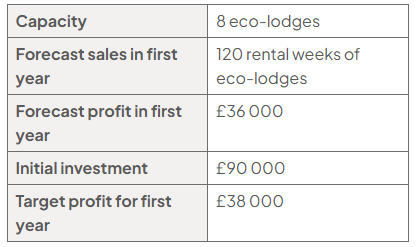
Forecast glamping data: capacity 8 eco-lodges; first-year sales 120 rental weeks; forecast profit £36,000; initial investment £90,000; target profit £38,000.

Assess whether diversifying into glamping would be a good decision for Finlay's Farm Ltd.

2
9 marks

Source A: Trainline

Trainline plc, which is listed on the London Stock Exchange, sells rail and coach tickets through its app and website in the UK and across Europe. It also provides ticketing technology to train operators and to travel management companies, which book travel for businesses. Its app is the most downloaded rail app in Europe.

Trainline earns its revenue mainly as commission on the tickets it sells. In April 2025 its commission on UK online ticket sales fell from 5.0% to 4.5%, under a rail industry agreement announced in 2022.

In the year to 28 February 2026:

  • it sold tickets worth £6 319 million, up 7%, to 27 million customers, 18 million of them in the UK

  • revenue rose by 2% to £453 million, while UK revenue fell by 2%

  • adjusted EBITDA was 2.80% of the value of tickets sold; the target for the year to February 2027 is about 2.9%

Growth in the UK slowed in the second half of the year. Trainline identified three causes:

  • Contactless payment. Transport for London is expanding contactless payment, which lets passengers travel by tapping a bank card without buying a ticket.

  • Operators' websites. Train operators have encouraged customers to use their own websites, including by offering automatic delay compensation, which independent retailers such as Trainline were not allowed to offer.

  • Fares. The government has frozen regulated rail fares until March 2027.

The government is creating Great British Railways to run most of the railway; its online retailer is expected eventually to replace the operators' websites. In March 2026 the government announced that passengers will then be able to claim delay compensation wherever they bought their ticket, including through Trainline.

In the first half of the year, sales to foreign travellers fell after Google changed its search results page. Trainline has made its app available within ChatGPT and introduced artificial intelligence features which help customers when trains are disrupted. Young people are among its most important customers: 45% of railcard holders aged 16 to 30 use a Trainline digital railcard, held on their phone.

Source: Trainline plc, Results for the twelve months ended 28 February 2026

Appendix A: Trainline selected data

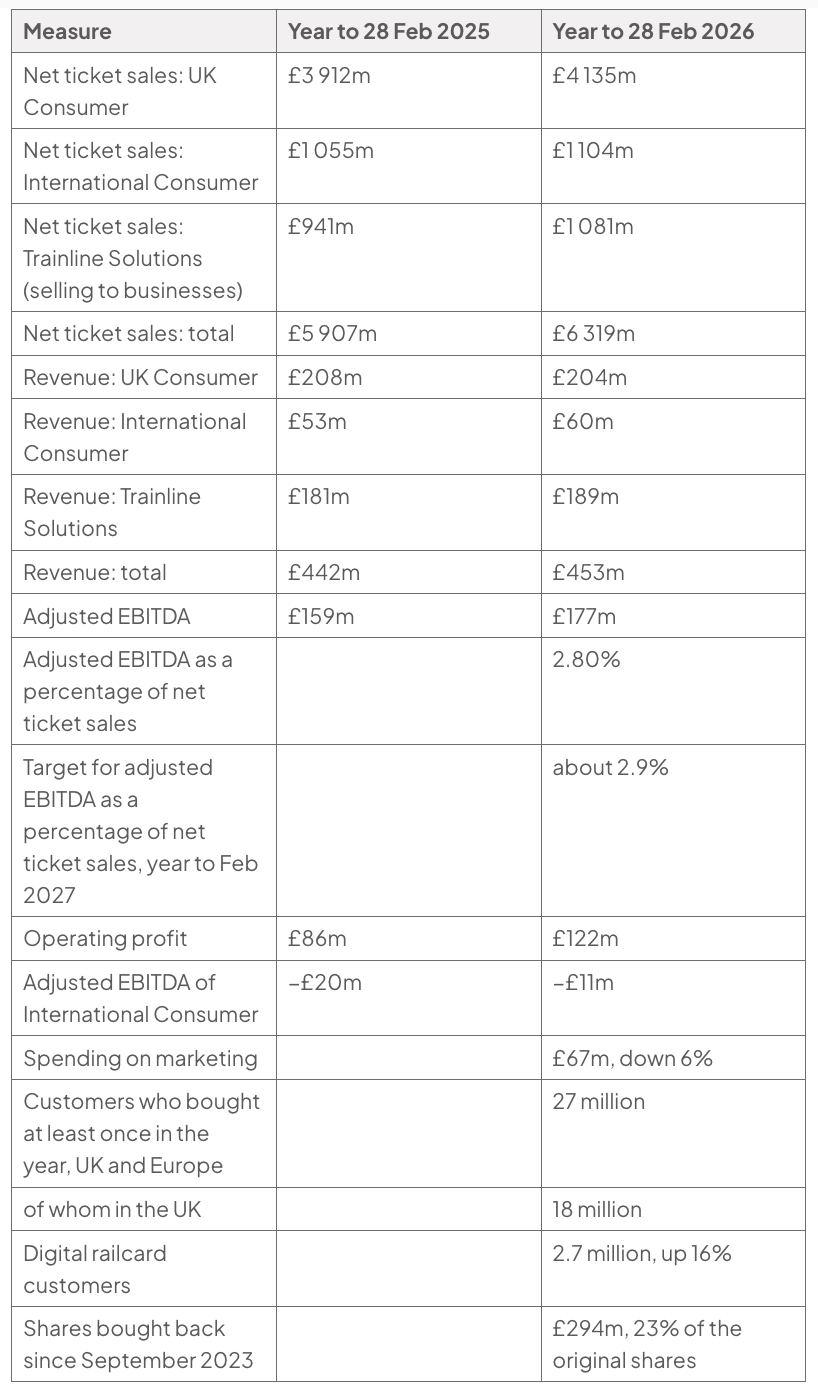
Table of Trainline data for years to 28 February 2025 and 2026. For 2026, net ticket sales were £4 135 million for UK Consumer and £6 319 million in total; other financial and customer measures are also listed.

Net ticket sales are the total value of tickets sold. The three segments do not add exactly to the total because of rounding.

Source: Trainline plc

Appendix B: Changes in the UK rail market

  • Commission. The commission on online ticket sales in the UK fell from 5.0% to 4.5% in April 2025, under an agreement announced in 2022.

  • Contactless payment. Transport for London is extending pay-as-you-go contactless payment to more stations outside London.

  • Train operators' own websites. Operators have offered their customers automatic compensation for delays, which independent retailers were not allowed to offer.

  • Great British Railways. The government is creating Great British Railways. Its online retailer is expected eventually to replace the operators' own websites. In March 2026 the government said that once it is established, passengers will be able to claim delay compensation wherever they bought their ticket. Trainline's legal and public affairs costs rose as it engaged with the process.

  • Fares and refunds. Regulated fares are frozen until March 2027. Rules on refunds were tightened from April 2026, which Trainline expects to reduce its income from refund fees.

  • Contracts. Trainline lost its contract to run CrossCountry's ticket website during the year and expects to lose its contract with ScotRail.

Source: Analyst, using Trainline plc

Appendix C: Technology and Europe

  • AI features. Travel Forecast warns customers of likely disruption to their journey; an AI Travel Assistant answers questions and helps with refunds; customers are prompted to claim delay compensation.

  • Search. Trainline has the largest share of mentions in answers from generative AI tools among rail retailers, and its app can be used within ChatGPT. Sales to foreign travellers fell in the first half of the year after Google changed its search results page, and recovered in the second half as more customers arrived through generative AI.

  • Competition in Europe. In markets where new train operators compete with the national operator, Trainline sells tickets for all of them. Sales on the South-East France network grew 26% after Trenitalia expanded services there. The routes Trainline expects to sell in France and Italy are expected to be worth €10 billion by 2030.

  • Profitability. International Consumer is expected to break even in the year to February 2027 for the first time.

Source: Analyst, using Trainline plc

Assess whether growing its business in Europe is likely to reduce the risk Trainline faces from changes to the UK rail industry.

Calculate Trainline's operating profit margin in the year to 28 February 2026 to support your answer. Give your answer to one decimal place.

3
9 marks

Source A: Octopus Energy Group

Octopus Energy Group Limited is a privately owned company which supplies gas and electricity to households and businesses, installs low-carbon technology in homes, and owns Kraken, a software platform which manages energy customers' accounts. The group was founded in the UK in 2016. In the year to 30 April 2025 its revenue rose 10% to £13 683 million, and it supplied 9.94 million customers across eight countries, compared with 7.95 million a year earlier.

In January 2025 Octopus Energy became the largest household energy supplier in the UK, with 24% of the market measured by number of meters. Its UK customers reached 7.6 million, and it accounted for 42% of all switches between household energy suppliers during the year. It has been named a Which? Recommended Energy Supplier for eight consecutive years and holds a Trustpilot rating of 4.8 out of 5.

Every customer account in the group runs on Kraken. The platform combines data from customers' smart meters with weather data to forecast how much energy customers will use, and the group adjusts its purchases of gas and electricity each day as the forecast changes. Kraken is also licensed to other energy suppliers, including EDF Energy, and to water and broadband companies. In September 2025 the group announced its intention to demerge Kraken as a separate company.

The group buys energy in two ways:

  • Fixed price contracts. For each customer on a fixed price, it buys the gas and electricity it expects that customer to use, in advance, for the whole length of the contract.

  • The standard variable tariff. The maximum price is set by Ofgem, the energy regulator, every three months. The group buys energy for these customers on a rolling basis which follows the method Ofgem uses to set the price cap.

The group tests its finances against a range of shocks, including a period of cold weather combined with a rise in wholesale prices. The spring of 2025 was the warmest in the UK on record, and in April 2025 its UK customers used 25% less gas than normal for the time of year.

Octopus Energy supports customers who are struggling to pay. It employs social workers in every one of its UK locations, gave energy credit to more than 90 000 customers in financial hardship through its Octo Assist Fund, and made home visits to fit thermostats, timers and draught-proofing. Throughout the year it kept its standard variable tariff below the price cap by reducing standing charges, at a cost of £57 million.

The group's stated aim is to make energy greener, cheaper and fairer. It installs heat pumps, including its own Cosy range, together with solar panels, batteries and electric vehicle chargers, and offers smart tariffs which reward customers for using electricity when it is cheapest. Of the group's total emissions, 95% come from the gas its customers use. It has committed to reach net zero emissions across its whole value chain by 2040.

In the year to 30 April 2025 the group made a net loss of £255 million, compared with a profit of £83 million in the previous year.

Source: Octopus Energy Group Limited, Annual Report and Financial Statements 2025

Appendix A: Octopus Energy Group selected data

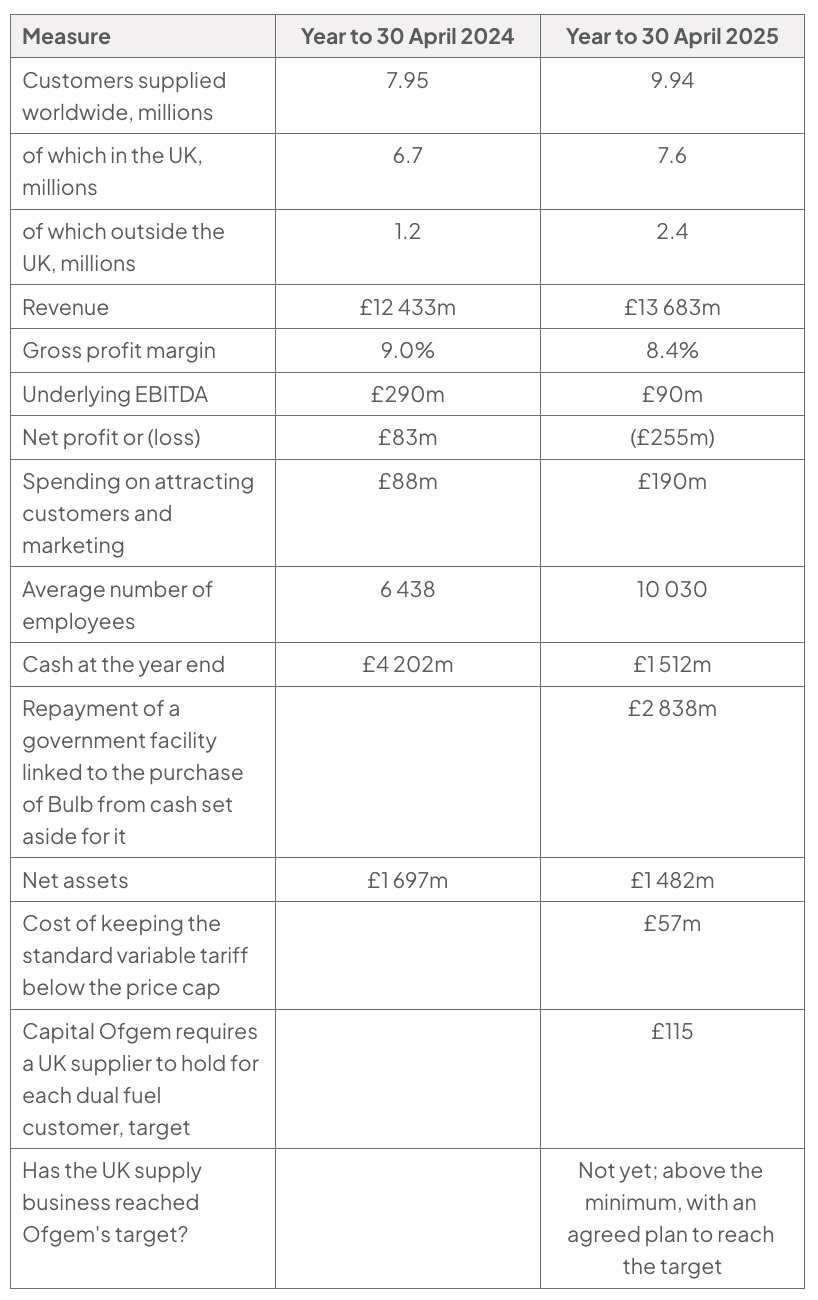
Table of Octopus Energy Group data for years to 30 April 2024 and 2025: underlying EBITDA falls from £290m to £90m; cash falls from £4 202m to £1 512m. It also records a £255m net loss in 2025, and shows that the UK supply business has not yet reached Ofgem's capital target of £115 for each dual fuel customer, although it is above the minimum.

Underlying EBITDA is profit before interest, tax, depreciation and amortisation, excluding one-off items.

Source: Octopus Energy Group Limited

Appendix B: Weather, gas and the move to low-carbon homes

The warm spring of 2025. UK customers used less energy than normal for the time of year: gas use was 11% lower in March and 25% lower in April, and electricity use was 1% lower in March and 7% lower in April. The warm weather reduced the group's EBITDA by about £103 million, of which about 90% arose in the UK. The group's stress tests model the effect of a cold winter combined with a rise in wholesale prices.

Moving homes away from gas.

  • Installations. The group installed about 903 000 smart meters, against 749 000 the year before, and 65 000 heat pumps, electric vehicle chargers, solar panels and batteries, against 30 000.

  • Revenue from the work. Revenue from metering services rose from £83 million to £164 million, and revenue from installation and other services from £72 million to £222 million.

  • Smart tariffs. Intelligent Octopus, a tariff which runs customers' electric vehicle chargers and heat pumps when electricity is cheapest, grew by more than 70%. It now controls about 1.7 gigawatts of customers' equipment.

  • Zero Bills homes. The group guarantees no energy bills for up to ten years in homes fitted with solar panels, a battery and a heat pump to its specification. It aims to deliver 100 000 such homes by 2030.

  • Insulation. Under government schemes, energy suppliers must fund energy efficiency improvements in the homes of low-income customers.

  • Emissions. 95% of the group's total emissions come from the gas its customers use. Its target is net zero across its whole value chain by 2040.

Source: Analyst, using Octopus Energy Group Limited Annual Report 2025

Assess whether holding large cash reserves is likely to protect Octopus Energy Group from the risks created by unusual weather.

Calculate Octopus Energy Group's profit for the year margin in the year to 30 April 2025 to support your answer. Give your answer to one decimal place.

4
9 marks

Source B: Thornbury Mills

Thornbury Mills Limited is a private limited company which mills wheat into flour at a single site on the edge of Thornbury, South Gloucestershire. The business was founded in 1887 and is owned by the fourth generation of the Hale family. Its Managing Director is Clare Hale, and it employs 86 people. In the year to 31 July 2026 the mill processed 118 000 tonnes of wheat into 92 000 tonnes of flour and 25 000 tonnes of wheatfeed, the bran and other parts of the grain which are sold for animal feed. Most of the wheat is bought from farms in Gloucestershire, Wiltshire and Herefordshire.

The company sells flour to three types of customer:

  • Two large plant bakeries, which make sliced bread for supermarkets. Together they bought 58% of its flour in the year.

  • Biscuit and cake manufacturers.

  • Craft bakeries, which buy flour in 16 kilogram bags.

Flour for each plant bakery is milled to that bakery's own specification, and a bakery wishing to change supplier must first run baking trials with flour from the new mill. The price the plant bakeries pay is agreed every three months with reference to the market price of wheat.

Thornbury Mills buys about 70% of the wheat it needs on forward contracts, which fix the price up to twelve months before the wheat is delivered. It buys the remainder at the market price at the time of delivery.

From 13 December 2026 the law requires every miller producing more than 500 tonnes of flour a year to add folic acid to non-wholemeal wheat flour, at 250 micrograms for every 100 grams. Flour must already contain added calcium, iron, niacin and thiamin. Thornbury Mills has installed dosing equipment costing £85 000, and estimates that the folic acid and the additional testing will cost £0.55 for each tonne of flour.

In 2023 a fire in the mill's dust extraction system stopped production for nine days. During that time the company's customers were supplied by another flour miller, under an agreement by which each mill supplies the other's customers if either stops production. The agreement remains in place.

The mill operates 24 hours a day and uses large amounts of electricity. In 2024 the company installed solar panels on the roofs of the mill and its warehouse. It delivers flour in its own fleet of 14 diesel lorries. Since 2023 it has bought 8% of its wheat from farms using regenerative methods, such as reduced ploughing and the planting of cover crops, and pays those farmers a premium of £15 a tonne. In 2026 the larger of its two plant bakery customers asked each of its suppliers to cut the emissions linked to the products they supply by 30% by 2030.

Source: Thornbury Mills

Appendix E: Thornbury Mills selected data

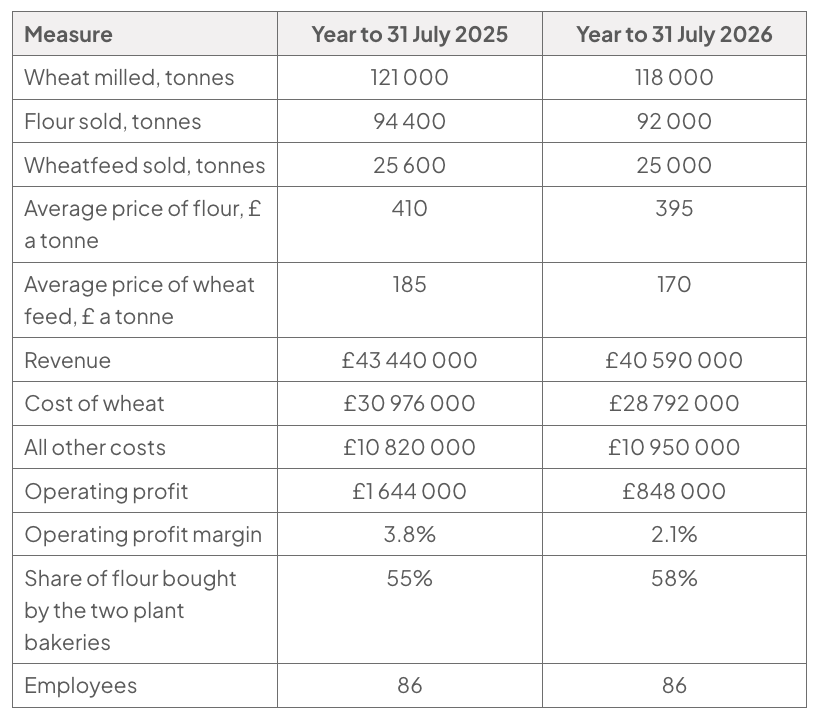
Table comparing Thornbury Mills’ selected data for years to 31 July 2025 and 2026: production and prices, revenue and costs, operating profit and margin, bakery share, and employee numbers.

Source: Thornbury Mills

Appendix F: What Thornbury Mills paid for its wheat

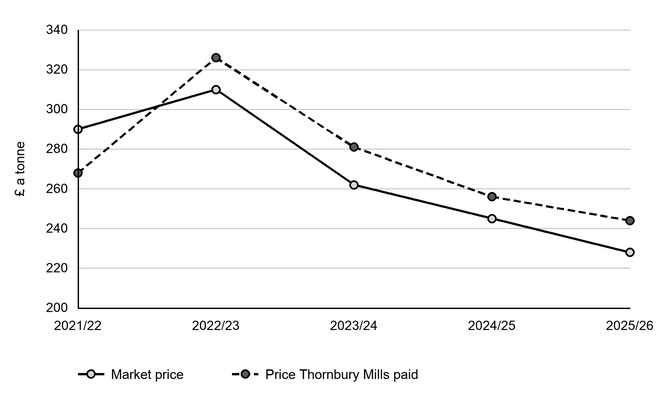
Line graph of bread-making wheat prices, £ per tonne, from 2021/22 to 2025/26: market prices are 290, 310, 262, 245 and 228; Thornbury Mills paid 268, 326, 281, 256 and 244.

Price of a tonne of bread-making wheat, £

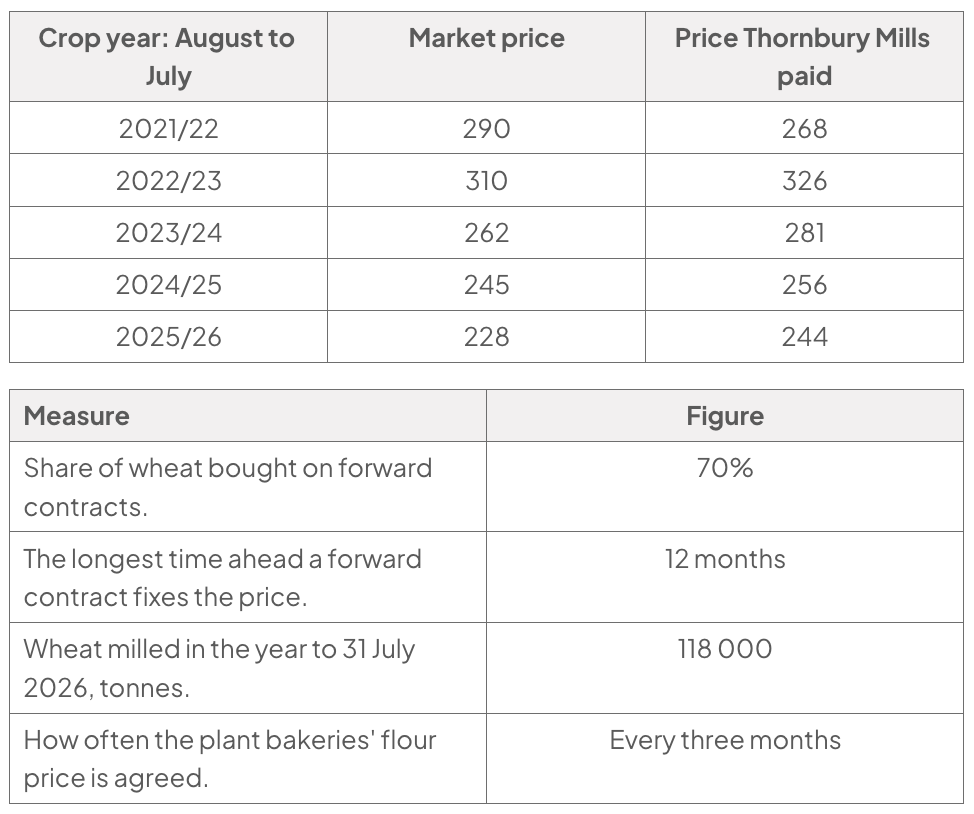
Two tables: the first compares market and Thornbury Mills’ wheat prices for crop years 2021/22 to 2025/26; the second lists forward-contract share, fixing period, wheat milled and flour-price review frequency.

Thornbury Mills' financial year runs from August to July, the same as the crop year.

Source: Thornbury Mills

Assess whether buying most of its wheat on forward contracts is likely to protect Thornbury Mills' profit.

Calculate what Thornbury Mills' operating profit margin would have been in the year to 31 July 2026 if it had paid the market price for all its wheat, to support your answer. Give your answer to one decimal place.

5
9 marks

Source A: Glastonbury Festival

Glastonbury Festival Events Limited organises the Glastonbury Festival of Contemporary and Performing Arts at Worthy Farm, a working dairy farm in Pilton, Somerset, where the festival has been held since 1970. The company is owned by Emily Eavis, who replaced her father, the festival's founder Michael Eavis, as the person with significant control in October 2024. Both are directors. The company employs an average of 105 people.

The company's objective is "to host an event that joyfully celebrates music and culture". It aims to keep ticket prices "as low as possible" so that the festival remains accessible, and it supports charities including Oxfam, Greenpeace and WaterAid.

The festival's licence allows up to 210 000 people on site. Tickets are sold online under three rules:

  • Registration. Everyone aged 13 or over must register before buying a ticket.

  • Photo tickets. Each ticket carries the holder's photo and cannot be transferred.

  • One ticket agent. Tickets are sold only through See Tickets and are "not available for sale on any secondary sales sites".

Every five or six years the festival takes a fallow year, with no festival, so that the farmland can recover. 2026 is a fallow year, and the company expects "a significant cost". Tickets for the 2027 festival went on sale in October 2026.

The company finances its operations through retained profits and paid no dividends. It describes its main risk as cancellation because of "extremely bad weather or a global pandemic". In the year to March 2025 it spent £3.5 million buying land to "protect the future of the Festival".

Source: Glastonbury Festival Events Limited, annual report and financial statements for the year ended 31 March 2025, and press reports

Appendix A: Glastonbury Festival financial data

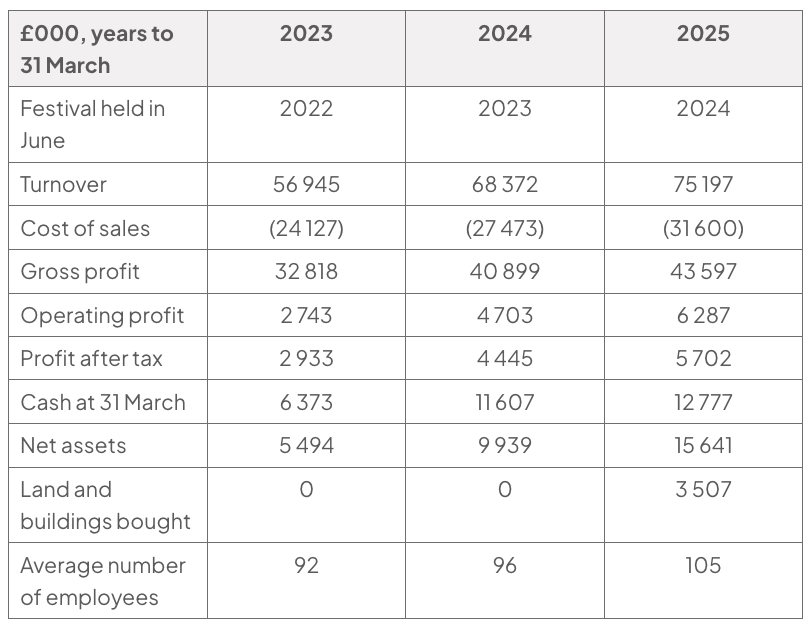
Table of Glastonbury's financial data in £000 for years ending 31 March 2023 to 2025, including turnover, cost of sales, gross profit, operating profit, profit after tax, cash, net assets, land and buildings bought and average employees.
  • Charitable donations: £1.9m in 2023, £5.2m in 2024 (including £2m to NHS Somerset) and over £2.7m in 2025.

  • Cash. Since 2009 the company has kept its profits "to provide a float for the next year's Festival as well as mitigate the potential impact of unforeseen events". All tickets are paid for in advance, and most ticket money is held in a separate account until after the festival.

  • Covid. The festival was cancelled in 2020 and could not be held in 2021. The company says "the cash reserves were significantly depleted post COVID".

Source: Glastonbury Festival Events Limited

Appendix B: Tickets and the UK festival market

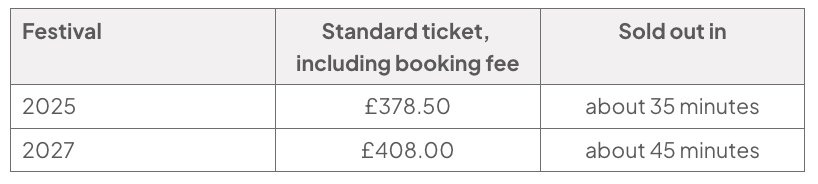
Table comparing Glastonbury standard ticket prices and sell-out times: 2025, £378.50 and about 35 minutes; 2027, £408.00 and about 45 minutes.
  • 2027 tickets went on sale on 4 October 2026, before any performers were announced. Buyers paid a £100 deposit, with the balance due in April 2027.

  • Capacity. The festival's licence allows up to 210 000 people on site, including staff and performers. The company describes "demand for tickets far outweighing supply".

  • Scale. Over 4 000 performances on more than 100 stages, and nearly 900 traders.

  • Performers' fees. Rod Stewart said he was paid about £120 000 to perform in 2025, and that bringing his band and equipment from America cost him about £300 000.

  • Other festivals. The Association of Independent Festivals reported in June 2025 that 39 UK festivals had been cancelled, postponed or closed that year, and 249 since 2019. Festival Republic, majority-owned by Live Nation, runs Reading & Leeds, Latitude and Wireless.

Source: Analyst, using Glastonbury Festival Events Limited, the Association of Independent Festivals and press reports

Assess whether Glastonbury is well protected against the risk of a festival being cancelled.

Calculate Glastonbury's profit for the year margin for the year to 31 March 2025 to support your answer. Give your answer to one decimal place.

6
9 marks

Source B: Thistleden Kitchens

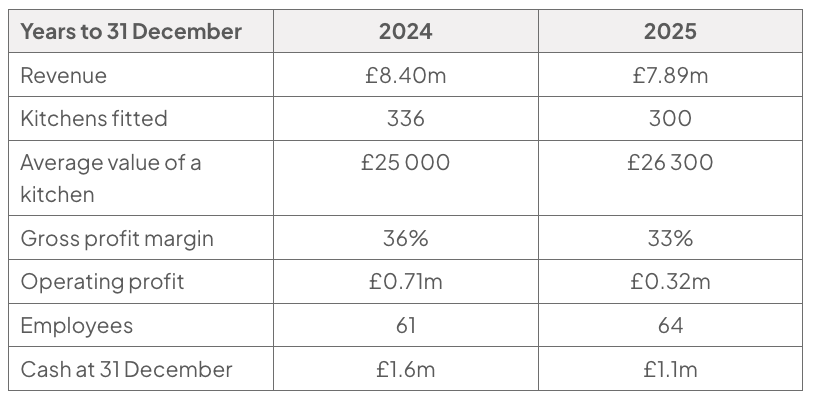
Thistleden Kitchens Limited is a private limited company, founded in Penrith, Cumbria, in 2003. It designs, makes and fits hand-built painted timber kitchens, each designed for the individual customer, and employs 64 people. In 2025 its kitchens sold for an average of £26 300.

It sells through four showrooms:

  • Penrith, Kendal and Carlisle, in Cumbria

  • Newcastle upon Tyne, opened in February 2025, its first outside Cumbria

Kitchens are made in its workshop in Penrith and fitted either by its own team of fitters or by subcontractors. Customers pay a 40% deposit when they order, and the balance when the kitchen is fitted.

Thistleden uses timber certified as coming from responsibly managed forests, trains four apprentices a year, and passes customers' old kitchens that can be reused to a local charity.

The company faces three main pressures:

  • Competition. National kitchen retailers offer free design visits and online booking.

  • Demand. Its order book fell in both 2024 and 2025, and its revenue and operating profit fell in 2025.

  • Fitting. In 2025 a higher share of kitchens was finished later than promised than in 2024, and about a third of kitchens were fitted by subcontractors.

In 2026 Thistleden introduced new software to schedule its fitters. A regional housebuilder has offered it a three-year contract to supply kitchens for new homes.

Source: Thistleden Kitchens

Appendix D: Thistleden Kitchens selected data

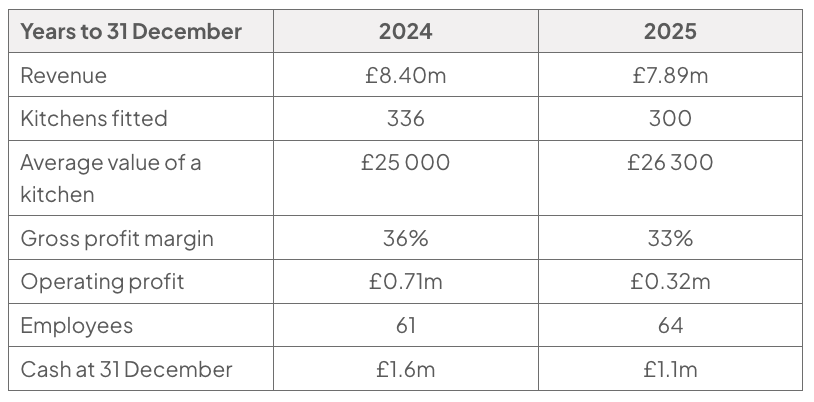
Table comparing Thistleden Kitchens’ 2024 and 2025 figures: revenue £8.40m/£7.89m; kitchens fitted 336/300; average value £25 000/£26 300; gross margin 36%/33%; operating profit £0.71m/£0.32m; employees 61/64; cash £1.6m/£1.1m.

Source: Thistleden Kitchens

Appendix F: Risks

Table of Thistleden Kitchens’ order book at 31 December: £3.7m in 2023, £3.4m in 2024 and £2.1m in 2025.
  • Deposits. At 31 December 2025 Thistleden held £0.84m of customers' deposits for kitchens not yet fitted.

  • Suppliers. All its hand-painted doors are finished by one specialist business.

  • Competition. National kitchen retailers offer free design visits and online booking.

  • Capacity. The workshop can make up to 420 kitchens a year.

Source: Thistleden Kitchens

Assess whether the fall in its order book is the biggest risk facing Thistleden Kitchens.

Calculate Thistleden Kitchens' operating profit margin in 2025 to support your answer. Give your answer to one decimal place.

1
15 marks

Source A: Finlay's Farm Ltd

Finlay's Farm Ltd is a small family-owned farm in Scotland. It has a herd of 130 cows, and their milk is used to make:

  • Cheese. This is sold both online and through various retail stores.

  • Ice cream. This is sold through retailers.

The company's founders are David and Wilma Finlay. They have built strong long-term relationships with its customers. There are two other employees. The dairy industry has been restructuring in recent years with bigger farms buying up smaller ones.

The company:

  • has high gearing but has also used crowdfunding to raise finance

  • receives government agricultural grants and subsidies

  • exports some of its products; although since the UK left the European Union exporting regulations have been complex.

The farm is organic. Organic farming aims to ensure that it uses processes that do not harm the environment, plant health or animal welfare. This is important to David and Wilma and its other employees. For example, the cows are fed an organic and natural diet as opposed to animal feed which has been genetically modified. The company aims to reduce energy use and greenhouse emissions and reduce the use of chemicals in farming as much as it can, even if this impacts on productivity. David and Wilma have been asked to speak at a number of environmental events and have been awarded an Outstanding Achievement award for their environmentally friendly practices.

The company has a good brand image and charges a premium price for its products. Its customers value its niche position in the market. It is said to be operating close to capacity. To increase scale, it would need to buy more cows and invest in new production facilities.

The farm has a small visitor centre which:

  • sells its products

  • offers food workshops such as ice cream making

  • organises visits for people who want to know more about organic farming and look around the farm.

Analysts say the key risks facing the company are:

  • changes in market conditions if customers become more price sensitive

  • the retirement of the founders

  • IT issues with its online sales business such as data theft.

One possible growth option for the business is to open a glamping campsite.

Source: Information sourced from Finlay's Farm Ltd

Finlay's Farm Ltd faces many risks.

Evaluate two ways the business could reduce the risks it faces and recommend which one Finlay's Farm Ltd should implement first.

2
15 marks

Source B: Elmsworth Recycling

Elmsworth Recycling Limited recycles plastic packaging at a plant in Telford, Shropshire. The company was founded in 2009 by Dev Sharma, its Managing Director, and is owned by him and an investment firm. It employs 160 people. One in eight of them joined through a resettlement programme for people leaving prison, and each is given a mentor for their first six months.

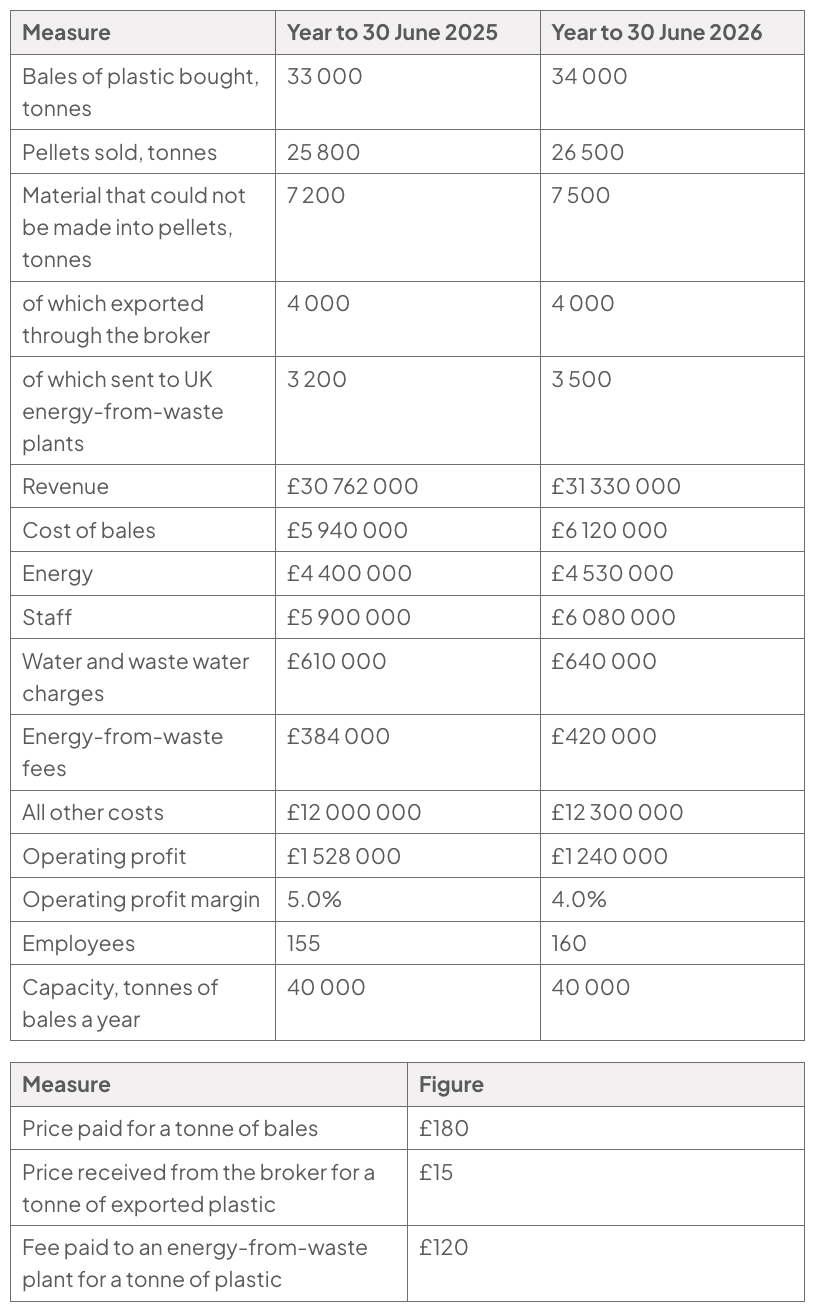
The company buys bales of plastic pots, tubs and trays which households have put out for recycling, from the facilities that sort councils' collections. It shreds, washes and sorts the plastic, then melts it into pellets of recycled polypropylene, which it sells to manufacturers of plastic packaging. In the year to 30 June 2026 it bought 34 000 tonnes of bales and sold 26 500 tonnes of pellets. The plant can handle 40 000 tonnes of bales a year.

The material that cannot be made into pellets, such as labels, food residue and mixed plastics, is dealt with in two ways:

  • 4 000 tonnes a year is sold to a broker, which ships it to Turkey.

  • The remainder is sent to energy-from-waste plants in the UK, which charge a fee to burn it.

In 2024 the company installed a closed-loop system which cleans and reuses the water used to wash the plastic, cutting its use of mains water by three quarters. The system uses electricity to pump and filter the water. The remaining waste water is discharged to the public sewer, for which the company pays its water company a charge.

Packaging manufacturers can buy virgin polypropylene, made from oil, instead of Elmsworth Recycling's pellets. Since April 2022 the government has charged Plastic Packaging Tax on plastic packaging which contains less than 30% recycled plastic.

Source: Elmsworth Recycling

Appendix D: The UK market for recycled plastic

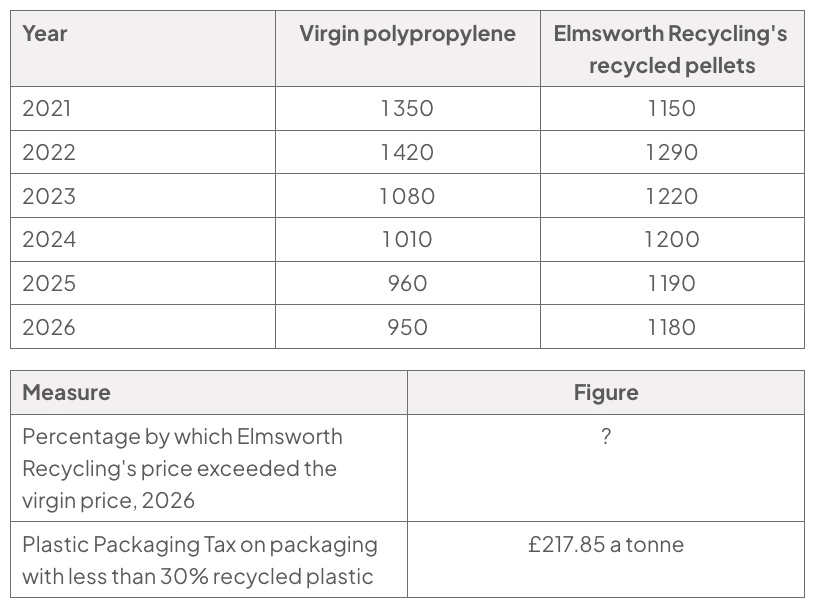
  • Plastic Packaging Tax. Charged on plastic packaging made in or imported into the UK which contains less than 30% recycled plastic. The rate from 1 April 2025 is £217.85 a tonne of packaging. Packaging with 30% or more recycled plastic pays no tax.

  • Extended Producer Responsibility. Since 2025, businesses that supply packaging pay fees towards the cost of collecting and recycling it.

  • Closures. Several UK plastic recycling plants closed in 2024 and 2025. Their owners blamed low prices for virgin plastic and imports of cheaper recycled plastic.

  • Imports. UK recyclers say that some imported plastic sold as recycled is difficult to verify.

  • Food packaging. Recycled plastic used in contact with food must be produced by a process approved by the food safety regulator.

  • Exports. In 2021 an investigation by Greenpeace found plastic waste from the UK dumped and burned at sites in Turkey.

Source: Analyst

Appendix E: Elmsworth Recycling selected data

Appendix E: two data tables for Elmsworth Recycling, comparing the years to 30 June 2025 and 2026, followed by figures for bale and waste-processing prices.

Source: Elmsworth Recycling

Appendix F: The price of polypropylene

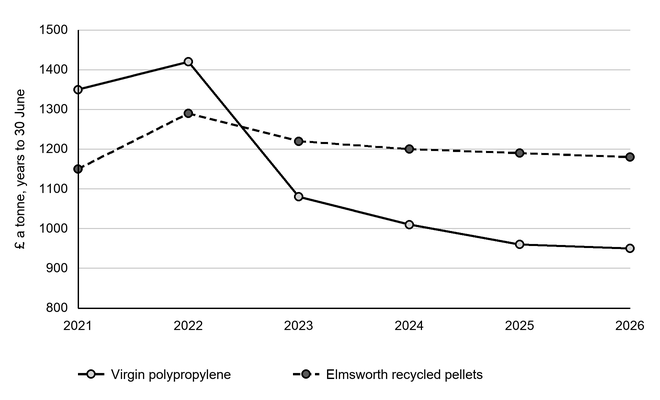
Line chart comparing prices per tonne from 2021–2026: virgin polypropylene rises then falls sharply to £950, while recycled pellets peak at £1,290 before gradually declining to £1,180.

Price of a tonne, £, years to 30 June

Data tables: virgin polypropylene and Elmsworth recycled pellet prices (£ per tonne) for 2021–2026: 1,350/1,150; 1,420/1,290; 1,080/1,220; 1,010/1,200; 960/1,190; 950/1,180. 2026 percentage difference is blank; tax is £217.85 per tonne.

Source: Elmsworth Recycling

Appendix G: Elmsworth Recycling and the environment

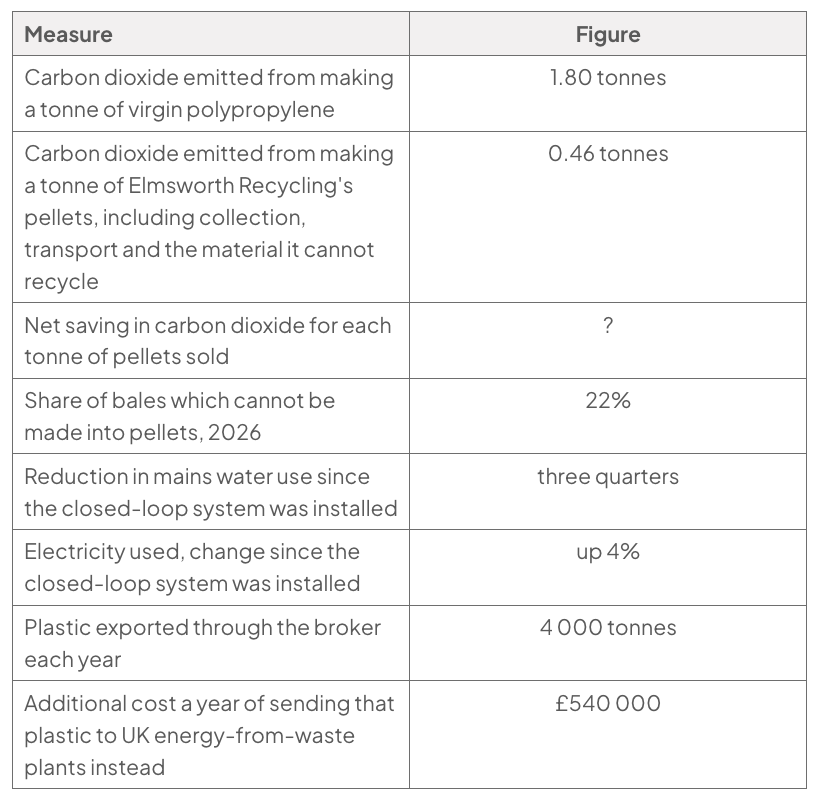
Appendix G environmental data table; the net carbon dioxide saving per tonne of pellets is the only blank entry, marked with a question mark.

Source: Analyst

Appendix H: Three ways to reduce exposure to the price of virgin plastic

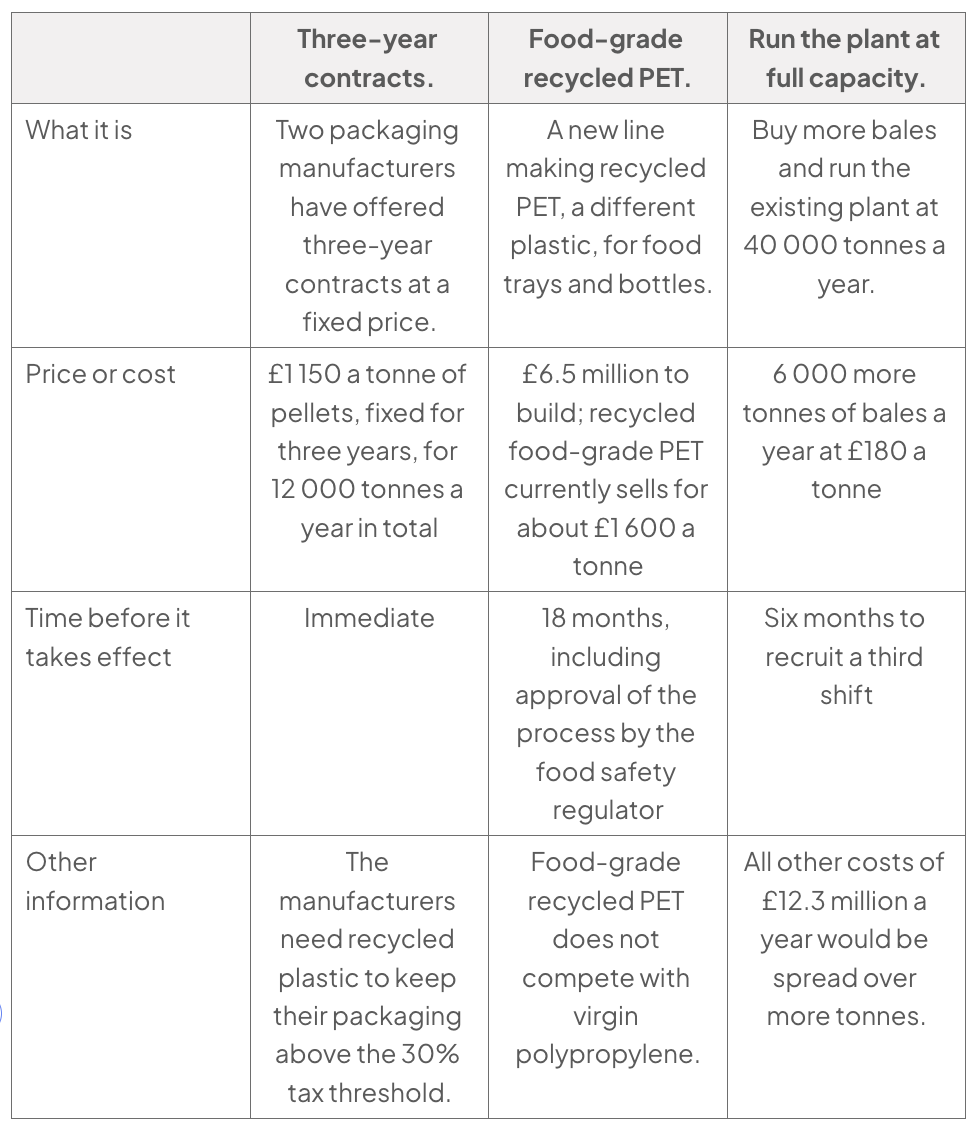
Table comparing three options: three-year contracts at £1,150 per tonne fixed; food-grade recycled PET costing £6.5 million; or running at full capacity, processing 40,000 tonnes a year.

Source: Elmsworth Recycling

The price of virgin polypropylene has been lower than the price of Elmsworth Recycling's pellets in every year since 2023.

Evaluate two ways Elmsworth Recycling could reduce its exposure to changes in the price of virgin plastic and recommend which one it should do first.

Use information from Appendices D to H to support your answer.

3
15 marks

Source B: Thistleden Kitchens

Thistleden Kitchens Limited is a private limited company, founded in Penrith, Cumbria, in 2003. It designs, makes and fits hand-built painted timber kitchens, each designed for the individual customer, and employs 64 people. In 2025 its kitchens sold for an average of £26 300.

It sells through four showrooms:

  • Penrith, Kendal and Carlisle, in Cumbria

  • Newcastle upon Tyne, opened in February 2025, its first outside Cumbria

Kitchens are made in its workshop in Penrith and fitted either by its own team of fitters or by subcontractors. Customers pay a 40% deposit when they order, and the balance when the kitchen is fitted.

Thistleden uses timber certified as coming from responsibly managed forests, trains four apprentices a year, and passes customers' old kitchens that can be reused to a local charity.

The company faces three main pressures:

  • Competition. National kitchen retailers offer free design visits and online booking.

  • Demand. Its order book fell in both 2024 and 2025, and its revenue and operating profit fell in 2025.

  • Fitting. In 2025 a higher share of kitchens was finished later than promised than in 2024, and about a third of kitchens were fitted by subcontractors.

In 2026 Thistleden introduced new software to schedule its fitters. A regional housebuilder has offered it a three-year contract to supply kitchens for new homes.

Source: Thistleden Kitchens

Appendix D: Thistleden Kitchens selected data

Table reproducing Appendix D: Thistleden Kitchens’ selected data for 2024 and 2025, covering revenue, kitchens fitted, average kitchen value, gross margin, operating profit, employees and cash.

Source: Thistleden Kitchens

Appendix F: Risks

Table of Thistleden Kitchens’ order book at 31 December: £3.7m in 2023, £3.4m in 2024 and £2.1m in 2025.
  • Deposits. At 31 December 2025 Thistleden held £0.84m of customers' deposits for kitchens not yet fitted.

  • Suppliers. All its hand-painted doors are finished by one specialist business.

  • Competition. National kitchen retailers offer free design visits and online booking.

  • Capacity. The workshop can make up to 420 kitchens a year.

Source: Thistleden Kitchens

Appendix G: The housebuilder contract

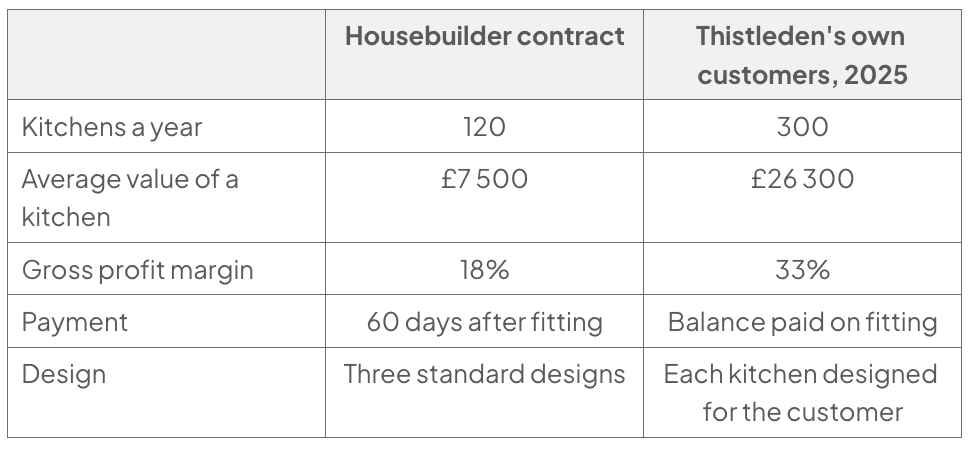
Comparison table of the housebuilder contract and Thistleden’s 2025 customers: 120 versus 300 kitchens, £7 500 versus £26 300 average value, 18% versus 33% margin, delayed versus on-fitting payment, and standard versus bespoke designs.
  • The contract runs for three years. The housebuilder may reduce its orders with three months' notice if its house sales fall.

  • The kitchens would be sold under the housebuilder's name, not Thistleden's.

Source: Thistleden Kitchens

A regional housebuilder has offered Thistleden Kitchens a three-year contract to supply 120 kitchens a year.

Evaluate whether Thistleden Kitchens should accept the housebuilder contract or focus on winning more orders from its own customers.

Use information from Appendices D, F and G to support your answer.

4
15 marks

Source A: Just Eat Takeaway

Just Eat Takeaway.com (JET) runs online food delivery platforms in Europe, including Just Eat in the UK and Ireland, Lieferando in Germany and Thuisbezorgd in the Netherlands. Its headquarters are in Amsterdam. JET was formed in 2020 when Just Eat merged with Takeaway.com. In October 2025 JET was bought by Prosus, a Dutch-listed technology investor, for about €4.1 billion, and its shares were removed from the stock market. Roberto Gandolfo replaced the founder, Jitse Groen, as chief executive in January 2026.

Customers order from restaurants and shops through JET's apps and websites. Some orders are delivered by the restaurant itself and some by couriers working through JET.

JET has changed in three main ways:

  • Acquisitions. In 2021 it bought Grubhub, a US delivery business, for $7.3 billion; it sold Grubhub in January 2025.

  • Countries. Since 2022 it has left Norway, Portugal, New Zealand, France, Australia, Denmark and Bulgaria, and it now operates in 14 countries. When it left Denmark in April 2026, its customers there were directed to Uber Eats.

  • Technology. About 450 jobs were cut in September 2025, partly by automating customer service. An AI voice assistant was launched across Europe in August 2026; early UK users found what they wanted about 40% faster than with the text assistant.

In the UK, JET competes with Uber Eats and with Deliveroo, which DoorDash, a US delivery business, bought in October 2025.

Prosus wants JET to become "a true European tech champion" and says it is "trading short-term profitability" for growth.

Source: Just Eat Takeaway.com, results for 2024 and the half year to June 2025; Prosus; and press reports

Appendix A: Just Eat Takeaway financial data

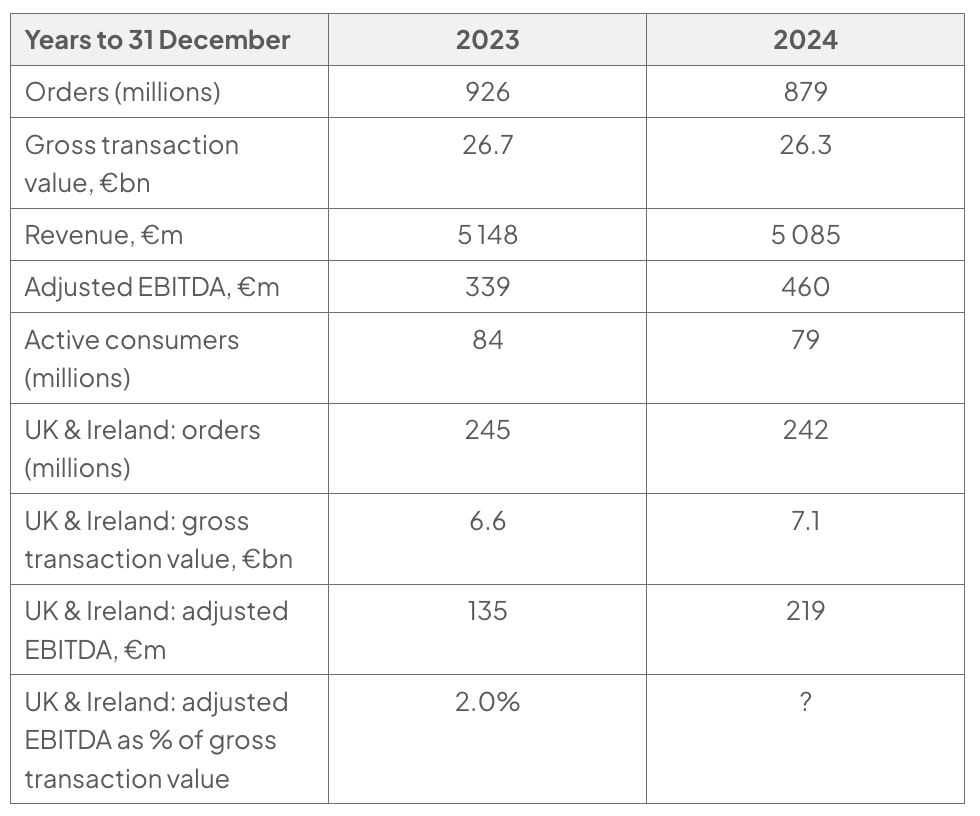
Two-column table comparing JET’s 2023 and 2024 financial data; the UK and Ireland adjusted EBITDA percentage is 2.0% for 2023 and marked with a question mark for 2024.
  • Gross transaction value is the total value of orders placed through JET's platforms. Adjusted EBITDA is profit before interest, tax, depreciation and amortisation, excluding one-off items.

  • 2023 and 2024 include Grubhub. In 2024 JET reduced the value of Grubhub in its accounts by €1 002m.

  • Half year to June 2025. Orders 308 million, down from 330 million. UK & Ireland orders 114 million, down from 120 million, while UK & Ireland gross transaction value rose from €3.4bn to €3.6bn.

  • After the takeover. JET's orders fell for 55 months in a row before rising 0.1% in September 2026.

Source: Just Eat Takeaway.com and Prosus

Appendix B: Couriers and the law

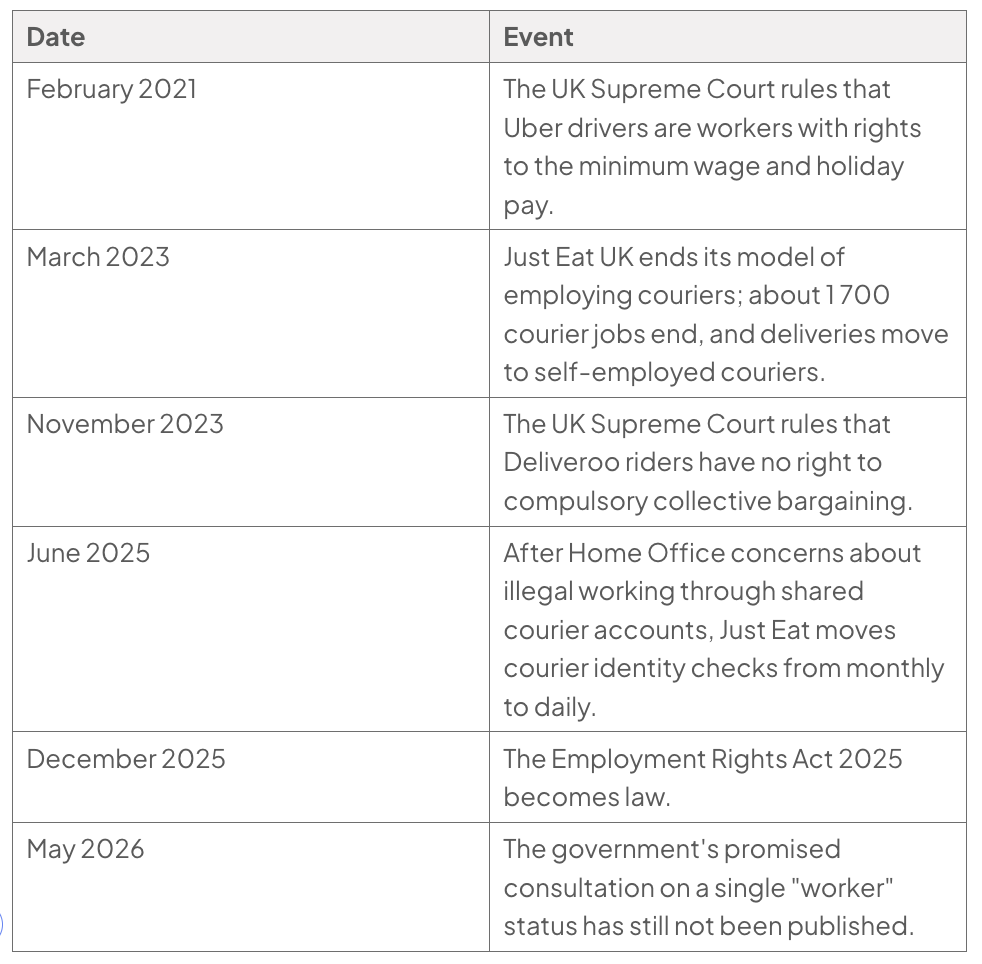
Two-column chronological table headed “Date” and “Event”, covering February 2021 to May 2026. It lists six UK legal and policy developments affecting Uber, Deliveroo and Just Eat couriers.
  • Rising living costs reduced how often UK customers ordered.

Source: Analyst, using UK court judgments, UK government announcements and press reports

Appendix C: Strategy, technology and competition

  • Digital. An AI voice assistant launched across Europe in August 2026; early UK users found what they wanted about 40% faster than with the text assistant. JET became the first in Europe to take orders through WhatsApp, in trials in the Netherlands and Spain in 2026. About 450 jobs, under 5% of staff, were cut in September 2025, partly by automating customer service.

  • Membership. Just Eat+ launched in the UK in July 2025 at £5.99 for 90 days of free delivery.

  • Groceries. UK grocery orders doubled in 2024. Partners include Tesco Whoosh and Superdrug.

  • Countries left. Norway and Portugal (2022), New Zealand and France (2024), Australia (2025), Denmark (April 2026, with customers directed to Uber Eats) and Bulgaria (September 2026).

  • Competition. DoorDash, a US delivery business, completed its £2.9bn purchase of Deliveroo in October 2025. Uber Eats also operates in the UK.

Source: Analyst, using Just Eat Takeaway.com, Prosus and press reports

Evaluate whether Just Eat Takeaway.com should focus its spending on cutting prices to win customers or on new digital services such as Just Eat+ and AI ordering.