Sole Traders & Private Limited Companies (AQA A Level Business): Revision Note
Syllabus Edition
First teaching 2026
First exams 2028
Exam code: 7132

Sole traders
A sole trader is a business owned and run by a single individual, who has complete personal responsibility for all aspects of the business
Sole traders are the most common form of business in the UK, typically small owner-managed businesses
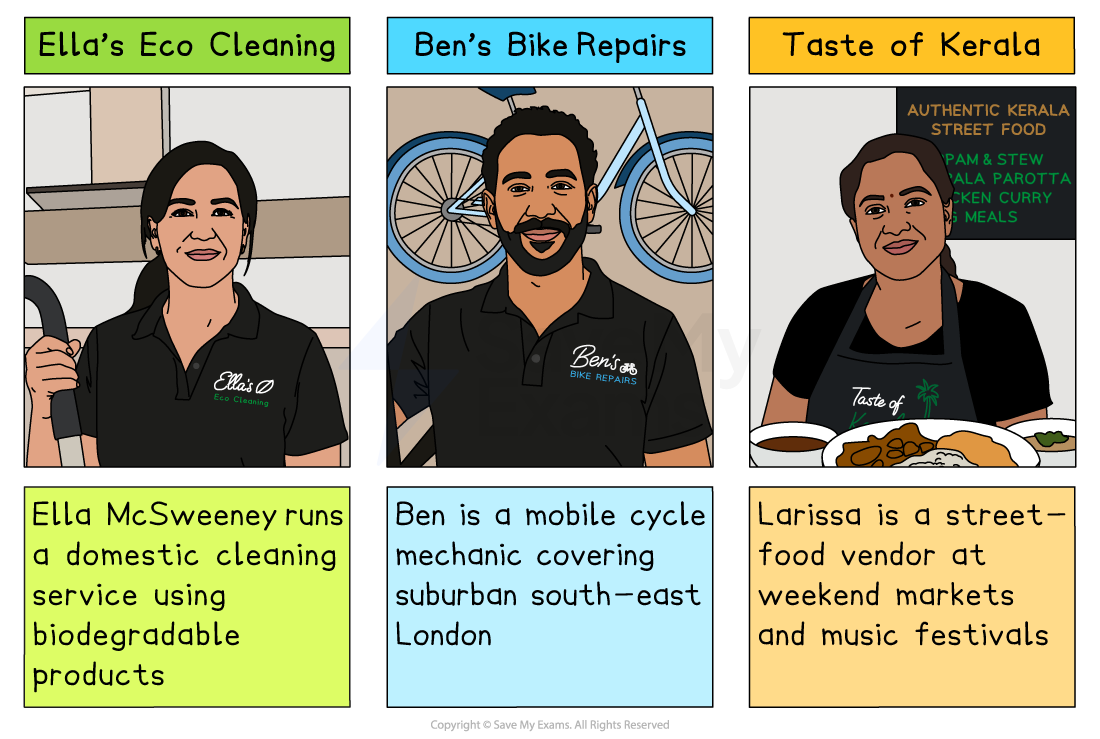
Examples of sole trader businesses
Key issues and characteristics
Control | Objectives |
|---|---|
|
|
Sources of finance | Distribution of profits |
|
|
The problem of unlimited liability
Sole traders have unlimited liability, which means they are personally responsible for any debts incurred by their business
If the business cannot pay debts, the owner's personal assets, including savings, possessions and property, may be seized to settle them
E.g. if a sole trader's business fails with £30,000 of unpaid debts, creditors can pursue the owner's personal savings or home to recover what they are owed
Unlimited liability is one of the most significant risks of operating as a sole trader
As a business grows, owners often consider converting to a private limited company (Ltd) to gain the protection of limited liability
Advantages and disadvantages of sole trader businesses
Advantages
Easy and inexpensive to set up
The owner has complete control over the business
All profits belong to the owner
Simple tax arrangements
Decisions can be made very quickly so the business can react swiftly to market change
High levels of personal satisfaction
Disadvantages
Unlimited liability, meaning the owner is personally responsible for any debts the business incurs
Limited access to finance and capital
Limited skill sets
Difficult to take time off from the business
Examiner Tips and Tricks
In exam questions comparing forms of business, unlimited liability is almost always a key evaluative point. Consider the context carefully - for a small, low-risk business a sole trader structure is simple and appropriate, but for a business taking on significant debt or investment, the personal financial risk of unlimited liability may outweigh the advantages of simplicity and total control
Private limited companies
A private limited company (Ltd) is a business that is incorporated
It has a legal identity separate from its owners, so the company itself can own assets, enter contracts and be sued in its own name
Ownership is divided into shares, held by a limited group of private investors
Shares cannot be sold to the general public on a stock exchange
Private limited companies must be registered with Companies House and include "Ltd" in their name
Examples of private limited companies
Example | Description |
|---|---|
Gymshark Ltd |
|
Monzo Bank Ltd |
|
Key issues and characteristics
Control | Objectives |
|---|---|
|
|
Sources of finance | Distribution of profits |
|
|
The benefits of limited liability
Shareholders in a private limited company benefit from limited liability
If the company fails, shareholders can only lose the value of their original investment
Personal assets such as savings, possessions and property are fully protected
This is because the company is a separate legal entity - its debts belong to the company, not to its owners
E.g. if a Ltd company fails with £100,000 of outstanding debts, a shareholder who invested £10,000 loses only their £10,000 - creditors cannot pursue their personal assets
Limited liability makes it significantly easier to attract investment than is the case for a sole trader with unlimited liability
Advantages and disadvantages of private limited companies
Advantages
Shareholders benefit from limited liability for debts incurred by the company
Access to greater finance from investors and lenders who consider limited companies to be less risky
Ownership can be easily transferred by selling shares
Business continuity, as the business does not die with its original owner
Disadvantages
More expensive and time-consuming to set up than a sole trader, as legal advice is often required
More complex operational rules than sole traders or partnerships
Annual financial reporting and auditing are required
Shareholders may have little control over the company, as the founder usually imposes their own agenda
Case Study
From sole trader to private limited company: FitCore Ltd

Sofia Mendes spent three years building a successful personal training business as a sole trader, working with 40 regular clients from a rented studio space
When she decided to open her own gym, she quickly realised her business structure would have to change
The lease and fit-out costs for a commercial premises would require £50,000 - far beyond what Sofia could raise from personal savings alone
As a sole trader, any debt would be her personal liability
If the gym failed, her savings and home would be at risk
She approached a business contact, Marcus, who agreed to invest £25,000 in exchange for a 40% shareholding in the business
To formalise the arrangement and gain limited liability protection for both investors, they incorporated as FitCore Ltd
The Ltd structure also made it easier to secure a bank loan for the remaining costs, as lenders viewed the incorporated business as lower risk
Examiner Tips and Tricks
The key advantage of a private limited company over a sole trader is limited liability combined with greater access to finance. However, in exam questions, consider the trade-offs: the original owner must share both control and profits with other shareholders, and running a private limited company involves greater administrative and legal responsibilities than operating as a sole trader. The right structure depends on the size, ambitions and risk profile of the business

Unlock more, it's free!
Join the 100,000+ Students that ❤️ Save My Exams
the (exam) results speak for themselves:

Was this revision note helpful?
