Integration (AQA A Level Business): Revision Note

Syllabus Edition

First teaching 2026

First exams 2028

Exam code: 7132

Lisa Eades

Written by: Lisa Eades

Reviewed by: Bridgette Barrett

Updated on

Vertical integration

  • Vertical integration is a merger or takeover of another firm in the supply chain or different stage of the production process

    • E.g. An ice cream manufacturer merges with a dairy farm or an ice cream cafe chain

Examples of vertical integration
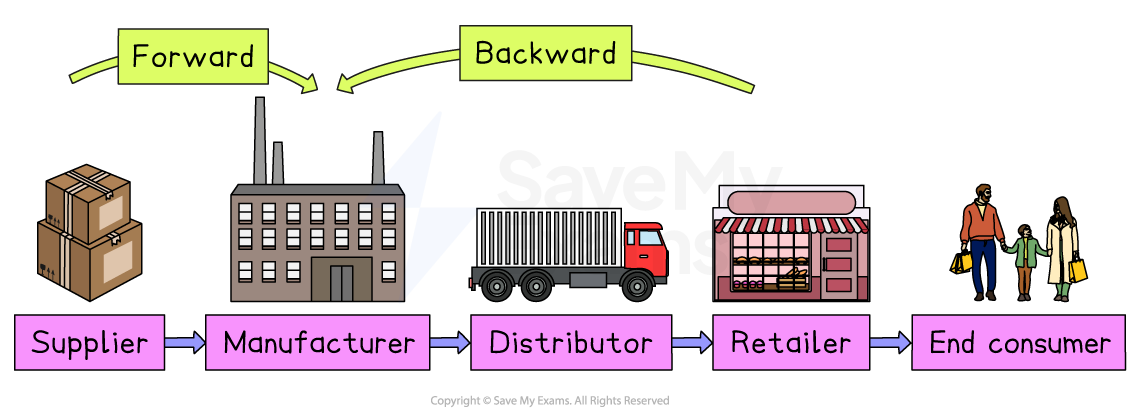
Diagram of a supply chain showing forward and backward flow between supplier, manufacturer, distributor, retailer and the final end consumer
  • Forward vertical integration involves a merger with or acquisition of a business further forward in the supply chain

    • E.g. A dairy farmer merges with an ice cream manufacturer

  • Backward vertical integration involves a merger or takeover with a firm further backwards in the supply chain

    • E.g. An ice cream retailer takes over an ice cream manufacturer

Evaluating vertical integration

Advantages

  • Reduces the cost of production as middleman profits are eliminated

  • Lower costs make the firm more competitive

  • Greater control over the supply chain reduces risk as access to raw materials is more certain

  • The quality of raw materials can be controlled

  • Forward integration adds additional profit as the profits from the next stage of production are now included

  • Forward integration can increase brand visibility

Disadvantages

  • Diseconomies of scale occur as costs increase, e.g. unnecessary duplication of management roles

  • There can be a culture clash between the two firms that have merged

  • Possibly little expertise in running the new firm results in inefficiencies

  • The price paid for the new firm may take a long time to earn back

Horizontal integration

  • This is a merger or takeover of a firm at the same stage of the production process

    • E.g. An ice cream manufacturer buys another ice cream manufacturer

Evaluating horizontal integration

Advantages

  • A rapid increase of market share

  • Reductions in the cost per unit due to economies of scale

  • Reduces competition

  • Existing knowledge of the industry means the merger is more likely to be successful

  • The firm may gain new knowledge or expertise

Disadvantages

  • Diseconomies of scale may occur as costs increase, e.g. unnecessary duplication of management roles

  • There can be a culture clash between the two firms that have merged

Conglomerate integration

  • This is a merger or takeover between firms in entirely different industries

    • E.g. An ice cream manufacturer buys a clothing company

Evaluating conglomerate integration

Advantages

  • Spreads risk across industries

  • Uses surplus cash and skills elsewhere

  • Key expertise, such as strong financial management or marketing know-how, can be shared with all part of the business

Disadvantages

  • Limited management know-how in unfamiliar sectors

  • Research may be required to understand trends and customer needs

  • Greater organisational complexity

Mergers and takeovers

What is a merger?

  • A merger occurs when two or more companies combine to form a new company

    • The original companies cease to exist and their assets and liabilities are transferred to the newly created entity

  • Firms merge to become stronger together than they would be apart

    • That strength comes from lower costs, more customers, new capabilities or less competition

Examples of recent UK mergers

Merger

Explanation

Logos of Vodafone in red with a circle design and Three in a stylised black number.
  • Both companies said the cost of rolling out 5G was too big for them to handle alone

  • By joining forces they can

    • Pool their money to pay for new 5G masts and fibre cables

    • Save £700 million a year by sharing towers, shops and support staff instead of running two separate networks

    • Become a strong brand that can compete on price and coverage with the two bigger rivals, BT’s EE and Virgin Media O2

Logos of Virgin Media with a red infinity symbol and O2 with a large white "O" on a blue background, arranged vertically.
  • Virgin Media had the fastest home broadband, while O2 had one of the biggest mobile networks

  • Putting them together allows the new firm to

    • Sell bundles that give customers fast home internet and mobile service on one bill

    • Share the cost of upgrades to cables and 5G over several years

    • Increase profit by £540 million a year within five years by using the same call centres, shops and marketing

What is a takeover?

  • A takeover occurs when one company purchases another company, often against its will

    • The acquiring company buys a controlling stake in the target company's shares (>50%) and gains control of its operations

Reasons for mergers and takeovers

Reason

Explanation

Example

Economies of scale

  • Joining two firms lets them combine production facilities, networks, and support functions

  • Fixed costs are spread over more units and duplicated activities are eliminated

  • The result is a lower average cost per unit and higher profit potential

  • The 2020 T-Mobile and Sprint merger created synergies of at least $43 billion by merging networks and closing down duplicate sites

  • This made it cheaper to roll out its nationwide 5G service

Rapid entry into new markets or segments

  • Instead of building a presence from scratch, a firm can acquire another that already has customers, stores, or distribution channels in the desired market

  • This saves time and reduces risk

  • The Amazon and Whole Foods merger in 2017 instantly created a physical retail presence for Amazon and a premium grocery brand

Acquire capabilities or technology

  • A merger can secure specialist know-how, patents or ways of working that improve a business's product without time-consuming in-house R&D

  • In 2006 Disney paid about $7.4 billion to bring Pixar’s cutting-edge computer-animation talent in-house

  • The merger increased Disney’s animation output and boosted its box-office performance

Reduce competitive pressure

  • Absorbing a fast-growing rival can protect a business's market share and reduce future price competition

  • Facebook merged with Instagram in 2012, preventing a potential challenger from attracting its users

Increased market power

  • A larger market share can improve bargaining strength with suppliers and retailers

  • It may allow the firm to set prices more confidently (within legal limits)

  • Anheuser-Busch's 2016 takeover of SABMiller means that the business produces 30% of all beer sold worldwide, far more than its next largest rival, Heineken

Common issues with mergers and takeovers

  • Mergers and takeovers can look attractive, but business leaders must also plan for culture clashes, higher debt and the real possibility that regulators will refuse the merger

Hard-to-blend cultures and systems

  • When two very different organisations join together, employees may clash over ways of working and IT systems may be incompatible

  • Managers can spend months fixing problems instead of improving products

  • Expected cost savings and new ideas can stall, leading to poorer performance and lower staff morale

Example

Kraft Foods and Heinz's merger in 2015 led to significant cost-cutting which left some brands under-funded and less able to compete

Heavier debt burden

  • Mergers are often paid for with borrowed money

  • High interest payments use cash that could alternatively fund research, marketing or new factories

  • If profits fall, the enlarged business may be forced to cut dividends, sell assets or issue new shares

Example

Dell borrowed $48 billion in 2016 to finance its purchase of rival EMC, which affected cash flow for years and was a key reason Dell had to raise finance by selling shares on the stock market in 2018

Regulation

  • Competition watchdogs such as the UK's Competition and Markets Authority (CMA) can delay a merger for years, demand that parts of the business be sold off, or block the deal entirely if they think it will hurt consumers

  • Companies can spend years and millions of pounds on planning a merger that is never approved

Example

The CMA stopped the planned £12 bn merger of Sainsbury's and Asda in 2019, saying it would push up prices for groceries and fuel and limit competition

Franchising

  • Franchising is a business model where an individual (franchisee) buys the rights to operate a business model, branding, and support from a larger company (franchisor) in exchange for an initial lump sum plus ongoing fees

    • The franchisee operates the business under the franchisor's established system and receives training, marketing support, and ongoing assistance

Evaluating franchise growth

Advantages

  • Rapid expansion with little capital

    • Franchisees pay most start-up costs, so the parent company can open many outlets without large new loans

  • Motivated local owners

    • Each franchisee has money at stake, so they work hard and know their local customers better than head-office managers might

  • Stronger joint marketing

    • National advertising, brand guidelines and bulk purchasing negotiated by the franchisor give every outlet a bigger presence than it could afford alone

  • Lighter day-to-day management workload

    • The franchisor focuses on branding, supply chains and support while franchisees run daily operations

Disadvantages

  • Less direct control

    • If a franchisee cuts corners, product or service quality can fall and damage the whole brand

  • Shared profits

    • A share of each outlet’s revenue stays with the franchisee, so the franchisor earns less per unit than from company-owned stores

  • Risk of conflict

    • Disputes over fees, franchise territories or new policies can arise and may require costly legal or management time to resolve

  • Ongoing training and support costs

    • The franchisor must provide initial training, audits and continual guidance to keep standards consistent across all outlets

Unlock more, it's free!

Join the 100,000+ Students that ❤️ Save My Exams

the (exam) results speak for themselves:

Lisa Eades

Author: Lisa Eades

Expertise: Curriculum Expert

Lisa has taught A Level, GCSE, BTEC and IBDP Business for over 20 years and is a senior Examiner for Edexcel. Lisa has been a successful Head of Department in Kent and has offered private Business tuition to students across the UK. Lisa loves to create imaginative and accessible resources which engage learners and build their passion for the subject.

Bridgette Barrett

Reviewer: Bridgette Barrett

Expertise: Development Editor

After graduating with a degree in Geography, Bridgette completed a PGCE over 30 years ago. She later gained an MA Learning, Technology and Education from the University of Nottingham focussing on online learning. At a time when the study of geography has never been more important, Bridgette is passionate about creating content which supports students in achieving their potential in geography and builds their confidence.
