Price (AQA A Level Business): Revision Note
Syllabus Edition
First teaching 2026
First exams 2028
Exam code: 7132

Introduction to price
Price is the amount a customer pays for a product or service
In the marketing mix, price is uniquely important
It is the only element that generates revenue
Every other element (product, place, and promotion) represents a cost to the business
Getting price right is one of a business's most critical marketing decisions
Set the price too high and customers will turn to cheaper rivals
Set it too low and profit margins suffer, or the product is perceived as poor quality
Set it inconsistently with the rest of the marketing mix and the brand's credibility is damaged
Price also acts as a powerful signal of value
Customers use price as a cue about quality and status
A premium price suggests a premium product
A low price may attract bargain-hunters, but deter customers seeking quality
For this reason, pricing decisions must always be made in the context of the whole marketing mix
E.g. a high-quality product, sold in exclusive outlets and promoted through aspirational advertising, must be priced at a level that reinforces that positioning
Influences on price
Several factors shape the pricing decisions a business makes
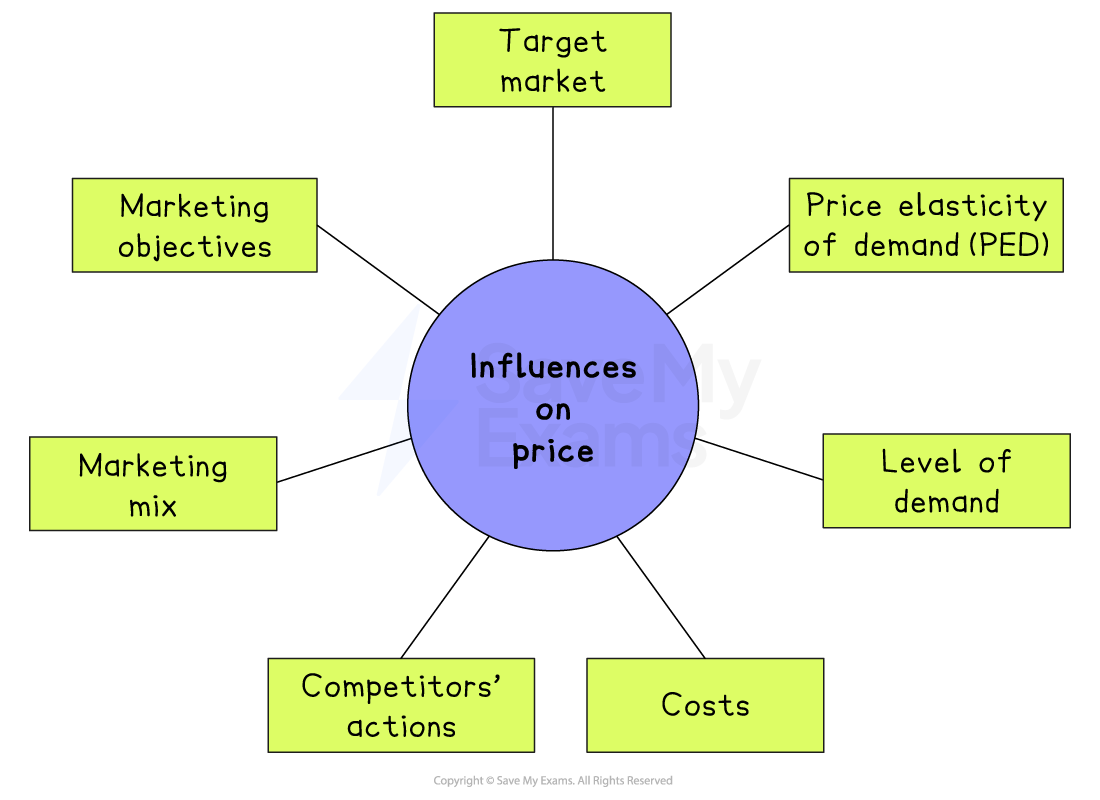
Marketing objectives
The price a business sets should reflect what it is trying to achieve
A business pursuing rapid market share growth may set a low price to attract as many customers as possible
A business focused on profit maximisation will aim for the price point that generates the highest total profit, not necessarily the highest sales volume
A business building a premium brand image will maintain a high price to reinforce quality and exclusivity - even if this limits the number of customers it attracts
Target market
The characteristics of the target market directly determine what price is viable
A high-income target market with low price sensitivity can sustain premium prices
A price-sensitive mass market requires competitive or low prices to attract and retain customers
Understanding the target customer's willingness to pay is fundamental to effective pricing
Level of demand
When demand is high - for example, during peak season or after a product goes viral - businesses can often charge more without losing significant sales
When demand is low, reducing the price may be necessary to stimulate purchases
Demand can fluctuate significantly, which is why some businesses adjust prices in real time to reflect current conditions
Price elasticity of demand (PED)
Price elasticity of demand measures how sensitive customer demand is to a change in price:
If demand is price inelastic (PED less than 1), a price increase leads to only a small fall in demand - total revenue rises
This applies to products with few substitutes or where customers have strong brand loyalty
If demand is price elastic (PED greater than 1), a price increase causes a significant fall in demand - total revenue falls
This is common in competitive markets where customers can easily switch to alternatives
Understanding PED helps a business predict the likely impact of a price change on revenue before making it
Costs
A business must cover its costs to make a profit
The cost of producing a unit sets a floor - a minimum price below which the business would sell at a loss
When costs rise (for example, due to higher raw material prices or increased energy costs), businesses face pressure to raise prices to protect their profit margin
Competitors' actions
In competitive markets, a business cannot set prices in isolation from what rivals are charging
If a competitor lowers its price significantly, the business may need to respond to avoid losing market share
Monitoring and responding to competitors' pricing is an ongoing part of marketing management
Marketing mix
Price must be consistent with every other element of the marketing mix
A product positioned as premium cannot be sold at a discounted price without confusing customers and damaging the brand
A budget product sold at a high price will fail to attract its intended target market
Price is part of a coherent positioning strategy
It either reinforces or undermines the message sent by the product, place and promotion decisions
Examiner Tips and Tricks
In case study questions, always identify which influences on price are most relevant to the specific business. A new market entrant faces very different pricing pressures than an established luxury brand - avoid listing every influence without linking it clearly to the context
Price, revenue and profit
Price has a direct and significant impact on a business's revenue and profit
However, the relationship is not straightforward
Price and revenue
Revenue is the total income a business earns from sales
It is calculated using the formula:
A change in price does not simply translate into a proportional change in revenue, because changing the price also changes the quantity customers are willing to buy
Price | Demand | Impact on revenue |
|---|---|---|
 | Price inelastic |
|
Price elastic |
| |
 | Price inelastic |
|
Price elastic |
|
Find out more about price elasticity of demand
Price and profit margins
A profit margin measures how much profit a business makes as a proportion of its revenue, expressed as a percentage
Profit margins are calculated using the formula:
A higher price (assuming costs stay constant) increases profit margin per unit sold
A lower price reduces profit margin per unit - the business earns less profit on each sale
However, a lower price may increase volume sold, which could raise total profit even if the margin per unit falls - this depends on price elasticity of demand
Businesses must therefore consider the combined effect of price changes on both the profit margin and the volume of sales, rather than focusing on one in isolation
Examiner Tips and Tricks
A common mistake is assuming that raising prices always increases profit. If demand is price elastic, a price rise reduces revenue more than it saves in production costs - total profit may actually fall. Always bring PED into your analysis of pricing and profit decisions
Methods of pricing
Cost-based pricing
Cost-plus pricing involves calculating the total cost of producing one unit and adding a fixed mark-up (profit margin) on top
Example
If a product costs £10 to produce and the business applies a 40% mark-up, the selling price is set at £14
Advantages and disadvantages of cost-based pricing
Advantages | Disadvantages |
|---|---|
|
|
Demand-based pricing
Demand-based pricing methods set a price according to what customers are willing to pay, rather than what the product costs to make.
Penetration pricing
This involves setting a deliberately low price when entering a market or launching a new product
It aims to attract customers quickly, build market share and establish the brand
The price may be raised gradually once a loyal customer base is established
It sacrifices short-term profit margin in exchange for long-term market position
However, customers attracted by a low price may leave if and when the price rises
Price skimming
This involves setting a high initial price for a new or innovative product, targeting early adopters who are willing to pay a premium
The price is gradually reduced over time to attract increasingly price-sensitive customer segments in turn
It allows the business to maximise revenue from each segment before moving to the next
It is most effective when the product is genuinely innovative with no close substitutes - for example, new consumer technology
Dynamic pricing
Prices are adjusted in real time based on current levels of demand, time of day, availability, or customer profile
It is common in airlines, hotels, sports venues, and ride-hailing apps - prices rise when demand is high and fall when capacity is unfilled
It allows the business to maximise revenue at any given moment
However, it can frustrate or alienate customers who feel they are being charged unfairly compared to others
Advantages and disadvantages of demand-based pricing
Advantages | Disadvantages |
|---|---|
|
|
Competition-based pricing
Competition-based pricing methods set the price in relation to what competitors are charging
Premium pricing
This involves setting a price deliberately above competitors to signal superior quality, exclusivity or brand prestige
It reinforces a premium brand image and appeals to customers who associate a higher price with higher value
It requires a strong USP and sustained customer loyalty
Customers must believe the higher price is justified
It is common in luxury goods, premium technology, and specialist services
Going rate pricing
This involves setting prices broadly in line with competitors, matching the market average
It is appropriate in markets where products are similar and competing on price would reduce margins for all firms
It reduces the risk of triggering a price war but offers no price-based competitive advantage
It is common in commodity markets such as fuel, utilities and agricultural produce
Discount pricing
This involves setting prices below competitors to attract price-sensitive customers and undercut rivals
It can build market share quickly and appeal to a wide target market
However, it puts pressure on profit margins and may trigger a price war
Rivals respond by lowering their prices, eroding margins across the industry
It may also damage brand image if customers begin to associate a low price with low quality
Advantages and disadvantages of competition-based pricing
Advantages | Disadvantages |
|---|---|
|
|
Examiner Tips and Tricks
No pricing method is universally right - the best approach depends on the business's objectives, target market, cost structure, and competitive environment. In evaluation questions, weigh the trade-offs: penetration pricing builds market share but sacrifices short-term profit; premium pricing maximises margin but limits volume. Always link your answer to the specific business in the case study

Unlock more, it's free!
Join the 100,000+ Students that ❤️ Save My Exams
the (exam) results speak for themselves:

Was this revision note helpful?
