Improving Efficiency (AQA A Level Business): Revision Note
Syllabus Edition
First teaching 2026
First exams 2028
Exam code: 7132

Improving capacity utilisation
Improving capacity utilisation means making better use of the productive resources already available to the business
It involves getting closer to the maximum output the business is capable of producing
As capacity utilisation rises, fixed costs are spread across more units, reducing the unit cost and improving overall efficiency
The most efficient level of utilisation for most businesses is considered to be around 85–95%
High enough to minimise unit costs, but with sufficient spare capacity to remain flexible
Ways of improving capacity utilisation
Stimulating demand
Through marketing activity or price reductions to increase orders
Taking on subcontract work
Using spare capacity to produce goods for other businesses
Rationalising
Permanently reducing capacity to match a lower but stable level of demand, eliminating the cost of maintaining underused resources
Advantages |
|
|---|---|
Disadvantages |
|
Lean production
Lean production is an approach to operations management that aims to minimise waste in all forms while maximising value delivered to the customer
It was originally developed by Toyota in Japan and has since been adopted across manufacturing and service industries worldwide
Key elements of lean production
Reducing inventory
Holding as little inventory as possible by ordering materials only when needed
This is called 'Just-in-Time' (JIT)
It reduces storage costs and eliminates waste from obsolete or damaged inventory
Example
A car manufacturer orders components to arrive hours before they are needed on the production line, rather than storing weeks of stock in a warehouse
Reducing re-works
Minimising defects that require correction after production
Reworking a faulty product adds cost and time without adding value for the customer
Reducing waiting times
Eliminating delays between production stages
Any time a product is waiting to move to the next stage, it is non-productive and adds to lead times
Reducing transportation times
Minimising unnecessary movement of materials and products within the production facility
Unnecessary movement is a form of waste that adds time and cost without improving the product
Kaizen
A Japanese term meaning continuous improvement
The principle that all employees at every level should constantly look for small, incremental ways to improve their work and processes
Kaizen empowers workers to contribute ideas rather than waiting for management to drive change
Standardised processes
Performing every task in the same way each time, using documented methods
Standardisation reduces variation, lowers the risk of errors and makes training faster and more consistent
Advantages |
|
|---|---|
Disadvantages |
|
Reducing waste, recycling and reusing materials
Any material or resource that does not become part of the finished product is waste
Waste is a direct financial cost to a business
Reducing waste
Better production planning reduces overproduction and the resulting disposal of unsold goods
Tighter quality control reduces defective output that must be scrapped or reworked
Precise measurement and cutting of materials reduces offcuts and material wastage
Example
A textile manufacturer optimises the layout of pattern pieces on fabric to minimise offcuts reduces material waste and lowers the cost per garment
Recycling
Sending waste materials for reprocessing rather than disposal reduces waste removal costs
It can also generate revenue from materials that would otherwise be thrown away
Example
A food manufacturer that sells vegetable offcuts to animal feed producers recovers value from material that would otherwise go to waste
Reusing materials
Using materials, packaging or components again within the production process before they become waste
This reduces the need to purchase new raw materials or components
Advantages |
|
|---|---|
Disadvantages |
|
Effective scheduling
Scheduling involves planning when and in what sequence production tasks will be completed
It helps ensure that resources – workers, machinery and materials – are used in the most efficient order
Effective scheduling prevents workers and machines from sitting idle while waiting for earlier tasks to finish, and ensures the business meets customer deadlines
Key scheduling tools
Gantt charts
Visual timelines that display tasks, their duration and their sequence
Gantt charts allow managers to see at a glance which tasks are running in parallel, which depend on others and where delays might occur
Critical Path Analysis (CPA)
A technique for identifying the sequence of tasks that determines the minimum time needed to complete a project
Tasks on the critical path cannot be delayed without pushing back the overall completion date
Just-in-Time scheduling
Coordinating production and material deliveries so that inputs arrive exactly when needed
Done well, this can eliminate unnecessary storage and waiting time
Advantages |
|
|---|---|
Disadvantages |
|
Improving employee productivity
Improving employee productivity means increasing the output generated per worker
This directly reduces unit costs and improves overall operational efficiency
Ways of improving employee productivity
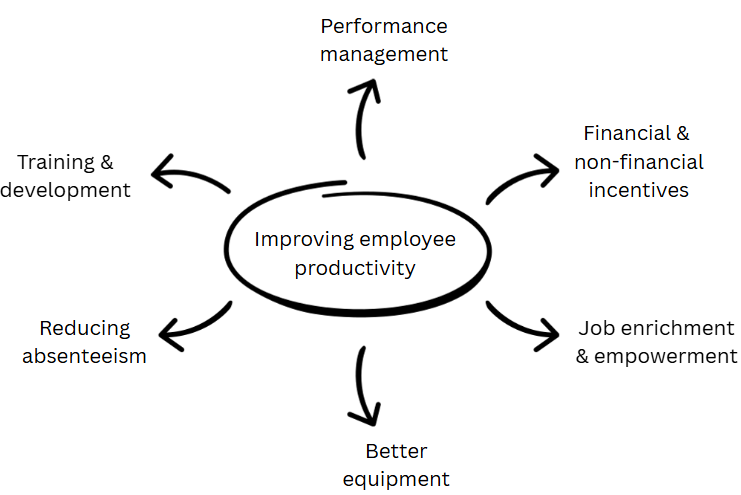
Training and development
Better-trained employees work more accurately and efficiently, reducing errors and wasted time
Performance management
Setting clear targets, holding regular appraisals and providing ongoing feedback focuses employee effort on the areas that matter most
Financial and non-financial incentives
Performance-related pay, recognition schemes and flexible working increase motivation and the effort employees invest in their work
Job enrichment and empowerment
Giving employees greater responsibility and autonomy increases engagement and encourages them to find more efficient ways of working
Better equipment
Providing employees with up-to-date, well-maintained resources allows them to work more effectively and reduces time lost to equipment failure
Reducing absenteeism
Improving employee wellbeing and addressing the causes of stress reduces sick days, maintaining consistent output levels
Advantages |
|
|---|---|
Disadvantages |
|
Improving cost control
Cost control means monitoring and managing business costs to ensure they do not exceed budgeted levels, and identifying areas where spending can be reduced without compromising quality or output
Methods of improving cost control
Budgeting
Setting planned spending limits for each area of the business in advance
This gives managers a clear target and a basis for measuring actual performance
Variance analysis
Comparing actual costs against budgeted costs at regular intervals and investigating significant differences
E.g. If energy costs are 20% above budget, the business investigates whether this reflects inefficiency, a price increase or an error
Supplier management
Renegotiating contracts, consolidating purchasing with a small number of suppliers, or switching suppliers to secure better terms on materials, components and services
Energy management
Monitoring and reducing energy consumption through more efficient equipment, scheduling energy-intensive processes when energy costs are lower (e.g. at night) and investment in renewable sources
Reducing labour costs
Improving shift scheduling to eliminate unnecessary overtime, reducing absenteeism and carefully managing how labour time is used
Advantages |
|
|---|---|
Disadvantages |
|
Case Study
Cranford Foods

Cranford Foods is a UK manufacturer of chilled ready meals, supplying major supermarkets from its factory in the East Midlands. By 2024, rising ingredient costs and increasing competition had squeezed the business's profit margins significantly.
A production review identified three main sources of inefficiency
Capacity utilisation was running at just 61%
Material waste accounted for 9% of total ingredient costs
Poor scheduling was causing frequent idle time between production runs.
The business introduced a structured improvement programme. A revised scheduling system reduced idle time between runs by 35%. JIT ingredient ordering cut average inventory levels by 40%, freeing £180,000 in working capital. A waste reduction initiative – including more precise portioning and selling vegetable offcuts to a local farm – reduced material waste from 9% to 4%.
Within 18 months, capacity utilisation had risen to 79% and unit costs fell by 12%. The CEO explained that tackling efficiency across multiple areas simultaneously delivered significant reductions in costs and improvements in operational performance.
Examiner Tips and Tricks
When a question asks about improving efficiency, do not simply list methods – select the approach most appropriate for the business described and explain why.
A manufacturing business with a supply chain problem might benefit most from lean production; a service business with high staff turnover might focus on employee productivity. Matching the solution to the context is essential for higher-mark answers

Unlock more, it's free!
Join the 100,000+ Students that ❤️ Save My Exams
the (exam) results speak for themselves:

Was this revision note helpful?
