Mission, Values & Objectives (AQA A Level Business): Revision Note
Syllabus Edition
First teaching 2026
First exams 2028
Exam code: 7132

Mission and values
Before a business can choose a strategy, it needs a clear sense of what it exists to do and what it stands for
A business's mission and values shape its culture and identity and guide decision-making at every level
Mission statements, vision statements and values
A mission statement is a brief statement of a business's core purpose
It explains why it exists beyond simply making a profit
Example
Tesla's mission is "to accelerate the world's transition to sustainable energy".
This mission drove its decision to open-source some of its patents so other manufacturers could develop electric vehicles more quickly
A vision statement describes what the business aspires to become in the future, giving it a long-term sense of direction to aim towards
Example
IKEA's vision is "to create a better everyday life for the many people".
This vision has guided its strategy of keeping prices low through flat-pack design and self-assembly, rather than competing on luxury or exclusivity
Values are the principles and standards of behaviour that guide how a business operates and treats its stakeholders
Examples include honesty, sustainability or fairness to staff
Example
The John Lewis Partnership's value of treating staff as co-owners of the business determines its decisions on pay, profit-sharing and working conditions across the whole company
The purpose and value of mission, vision and values
They guide decision-making
Senior managers can use the mission and values as a reference point when facing difficult strategic choices
This helps to keep decisions consistent even as circumstances change
They can build staff motivation and shared purpose
Employees who understand and believe in a business's mission may find their work more meaningful
This links to Herzberg's view that a sense of achievement and purpose is a genuine motivator, not just pay
They communicate identity to external stakeholders
A clear mission and set of values can help customers and investors understand what a business stands for, helping it stand out from competitors
Example
Patagonia's mission is "We're in business to save our home planet".
This prompted its 'Worn Wear' scheme, encouraging customers to repair rather than replace clothing and reinforced its identity as an environmentally responsible brand
They build trust and reputation
Values that are consistently upheld, rather than just stated, can strengthen a business's reputation and support charging premium prices
A mission or set of values that is not genuinely reflected in business behaviour can damage trust and reputation
Stakeholders may see it as insincere rather than a real guide to decision-making
The importance of objectives
Corporate objectives are the overall, business-wide goals set by senior management that guide the direction of every department within an organisation
The SMART framework
Corporate objectives are often set using the SMART framework
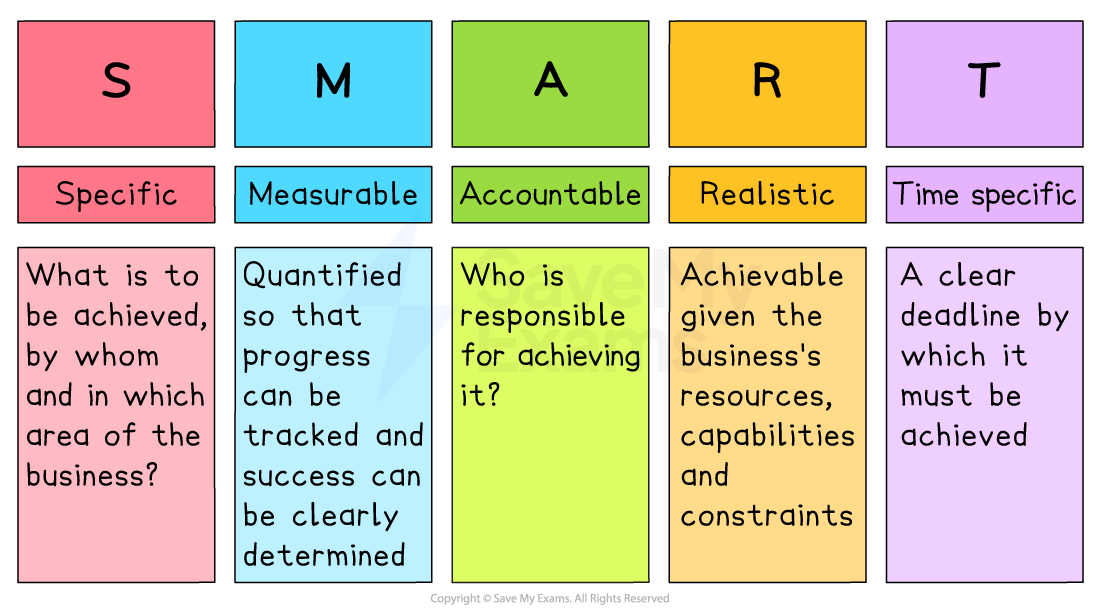
They can take several forms, and different businesses (or the same business at different points in time) may prioritise different ones
Profit
Maximising financial return for shareholders
Growth
Increasing sales, market share or the size of the business
Survival
A short-term priority during difficult trading conditions, prioritised over profit or growth
Market share
Increasing the proportion of total industry sales the business controls
Social or environmental objectives
Targets relating to sustainability, ethical sourcing or community impact, alongside financial goals
Objectives change over time as circumstances change
For example a business may shift from a growth objective to a survival objective during a recession
Mission and corporate objectives
The mission states why the business exists and who it serves today
Corporate objectives translate that purpose into specific, measurable targets for the whole organisation
Example
Tesco’s mission: To serve shoppers a little better every day
Corporate objective: Increase UK market share from 27% to 30% within two years
Corporate objectives and strategy
Corporate strategy outlines how the firm will achieve those targets, allocating resources and choosing markets or products
It balances risks, costs and expected benefits over the medium to long term
Example
To hit its 30% market share objective, Tesco’s strategy might include
Build a faster online-ordering system and 100 new convenience stores
Guarantee the lowest prices on key grocery staples
Strategy and functional objectives
Each department sets its own objectives to deliver the strategy
Those objectives are shorter-term and more detailed than corporate goals
Example:
Marketing: Sign up 3 million new Clubcard members in 12 months
Operations: Open 100 new Tesco Express sites by 2026
Finance: Reduce supply-chain costs by 5% by negotiating bulk-buy discounts
Functional objectives
Managers and supervisors decide daily or weekly actions that drive functional objectives forward
These decisions are highly specific and easily adjusted
Example:
Marketing team: Launch a two-week 'double points' Clubcard promotion, starting on Monday
Operations team: Schedule extra delivery vans in high-demand zones every Friday
Finance team: Approve a one-off advance payment to a key supplier for a 2% discount
The value of setting objectives:
They provide clear, measurable targets
Turning a broad mission into a specific figure, such as a percentage growth in revenue, gives managers something concrete to plan and work towards
They allow performance to be assessed
Objectives create a benchmark against which actual results can be measured, making it possible to judge whether a strategy is succeeding
Example
Greggs' publicly stated objective to open around 3,500 UK stores gives investors and analysts a clear measure against which to judge the success of its expansion strategy each year
They motivate employees and managers
A clear, achievable target can encourage staff to focus their effort, particularly when linked to performance-related pay or bonus schemes
They help co-ordinate activity across functional areas
When marketing, finance, HR and operations are all working towards the same stated objective, decisions in each area are more likely to support one another rather than conflict

Unlock more, it's free!
Join the 100,000+ Students that ❤️ Save My Exams
the (exam) results speak for themselves:

Was this revision note helpful?
