Motivation Theory (AQA A Level Business): Revision Note
Syllabus Edition
First teaching 2026
First exams 2028
Exam code: 7132

Why motivate employees?
Motivation refers to the internal drive that encourages individuals to take action, sustain effort and pursue goals
It describes the factors that influence how hard employees work and how committed they are to their role and employer
A motivated workforce is widely regarded as one of a business's most valuable assets for several reasons
Benefits of motivated employees
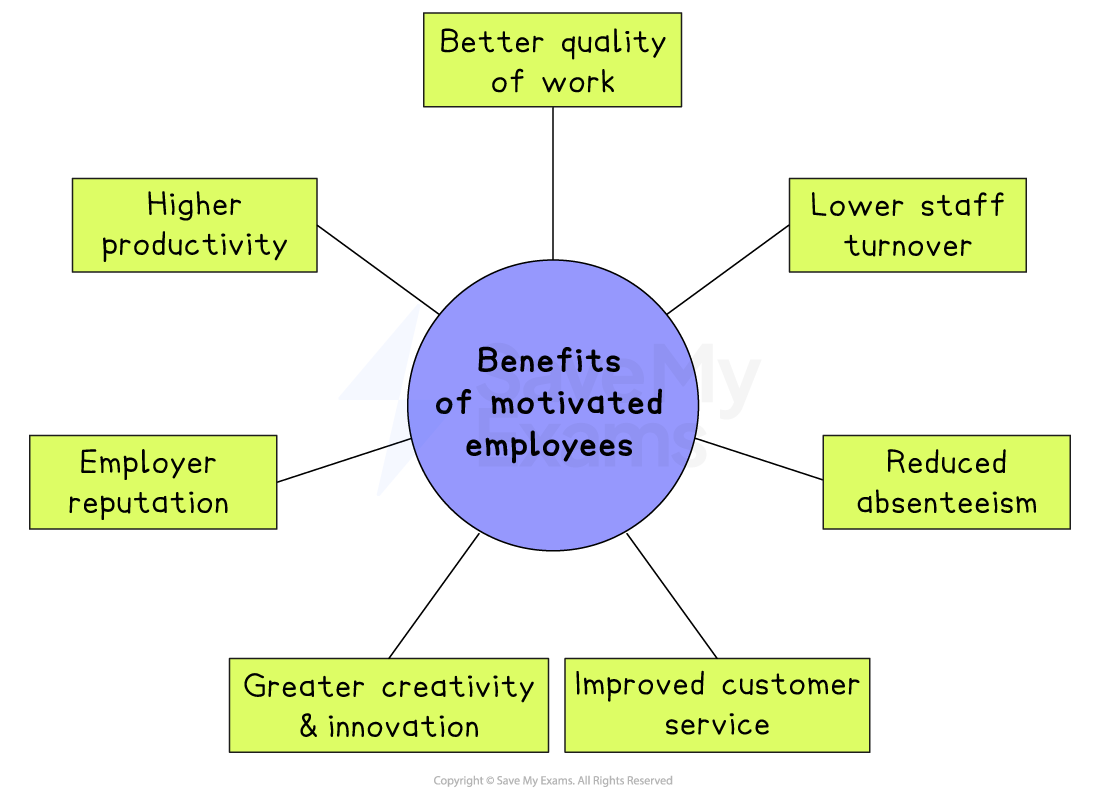
Higher productivity
Motivated employees tend to work harder and more efficiently, increasing output per worker and reducing unit costs
Better quality of work
Engaged employees take greater care with their tasks, leading to fewer errors, less waste and higher standards of output
Lower staff turnover
Employees who feel valued and fulfilled in their roles are less likely to leave, reducing the costs of recruitment and training
Reduced absenteeism
Motivated workers are less likely to take unnecessary absence
This helps maintain output levels and reduces pressure on their colleagues
Improved customer service
Employees who are engaged with their work tend to deliver a good experience to customers, leading to repeat business and brand loyalty
Greater creativity and innovation
Motivated employees are more likely to contribute ideas, take the initiative and suggest improvements
Positive employer reputation
A business known for its motivated, engaged workforce attracts stronger job applicants and builds a long-term competitive advantage in the labour market
Challenges of motivating employees
Challenge | Explanation |
|---|---|
Individual differences |
|
Cost |
|
Changing expectations |
|
Difficulty measuring motivation |
|
Remote and hybrid working |
|
Short-term vs long-term motivation |
|
Economic constraints |
|
Examiner Tips and Tricks
When discussing the challenges of motivating employees, think beyond cost alone. High-mark answers recognise the complexity of motivation — for example, that the same reward may motivate one employee and have no effect on another, or that motivation is difficult to measure and therefore difficult to manage effectively. Showing awareness of this complexity will strengthen your analysis
Motivation theory: Taylor
The scientific management theory was developed by Frederick Winslow Taylor in the early 20th century
It focuses on breaking down complex tasks into simpler ones, standardising work processes and providing workers with clear instructions and training to achieve maximum efficiency
Many manufacturing businesses use Taylor's principles to structure their staff benefits, e.g. piece-rate pay
Production lines involving human labour are often set up based on these principles
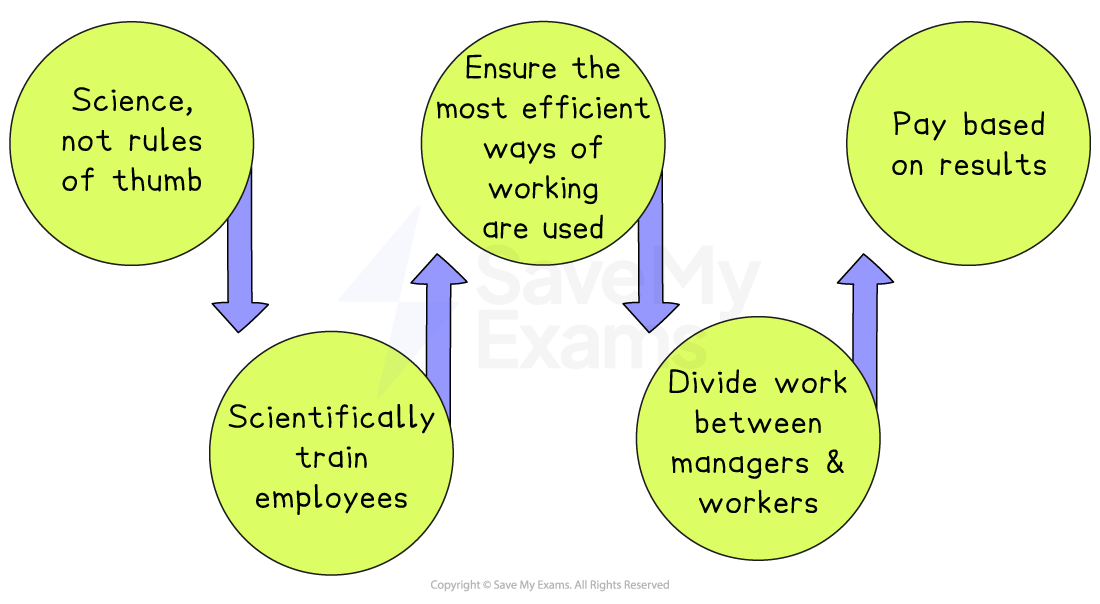
1. Study and analyse the work process
Carefully analyse each step of the work process
Break down complex tasks into simpler ones, and identify the most efficient and effective way to perform each task
2. Standardise the work process
This involves creating detailed procedures and instructions for each task so that workers can follow these procedures consistently
3. Select and train the workers
Workers should be carefully selected based on their skills and abilities
Train workers to perform their tasks efficiently and effectively
This training includes both technical skills and the proper attitudes and behaviours required to be successful (e.g. patience in a repetitive task)
4. Provide incentives for performance
Scientific management emphasises the use of incentives to motivate workers
This may include bonuses or piece-rate pay
Evaluating the use of Taylor's scientific management
How businesses use Taylor's approach | Advantages | Disadvantages |
|---|---|---|
|
|
|
Motivation theory: Maslow
Maslow's hierarchy of needs is a theory of human motivation that outlines five tiers of human needs that must be met for individuals to reach their full potential
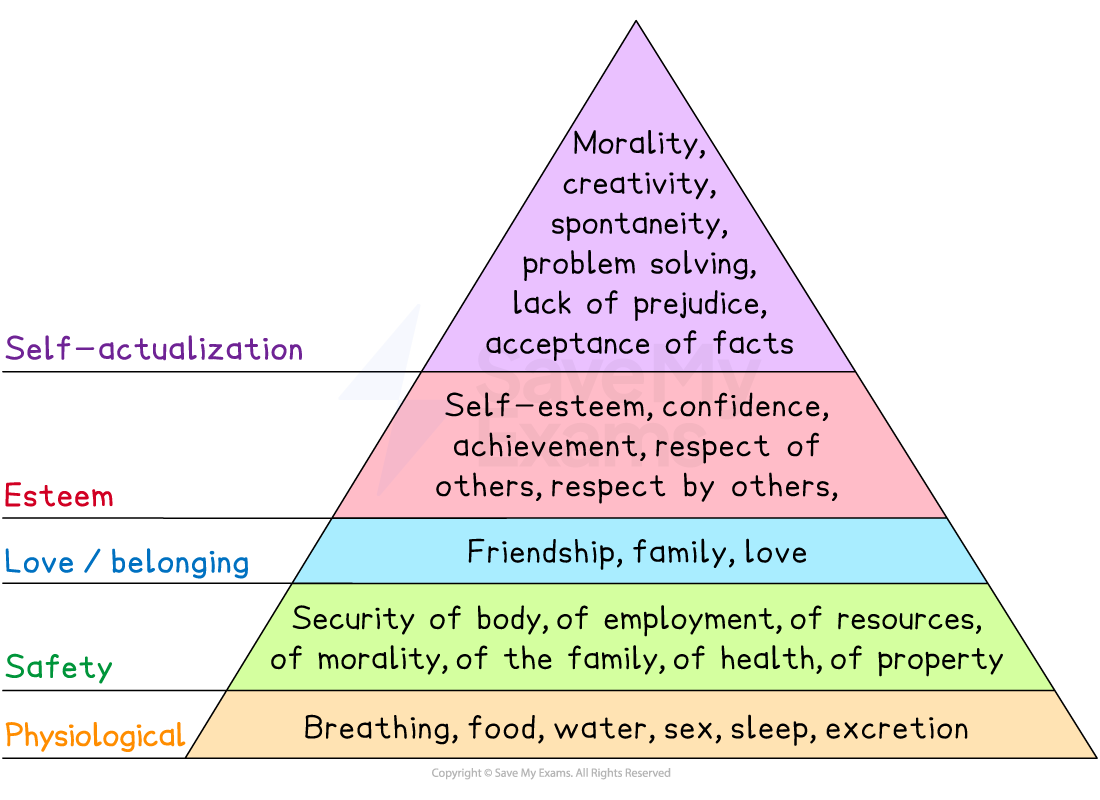
Maslow's hierarchy of needs applied to business
Physiological needs
Businesses can provide necessities for their employees
E.g. a comfortable work environment, access to clean water and food, and adequate rest breaks
Safety needs
Businesses can provide job security, fair pay, benefits and safe working conditions for their employees
Love and belonging needs
Businesses can encourage teamwork and generate a sense of community and belonging within the workplace
Esteem needs
Businesses can provide recognition for employees' accomplishments and a positive work culture that values individual contributions
Self-actualisation needs
Businesses can help employees achieve this need by offering opportunities for employees to pursue their passions and interests
E.g. Barclays is known for supporting elite sportspeople by allowing them time off work during the day to continue their training
Evaluating the use of Maslow's hierarchy
Advantages | Disadvantages |
|---|---|
|
|
Examiner Tips and Tricks
When talking about motivation theories, match the theory to the situation - don’t just name-drop Taylor or Maslow
Motivation theory: Herzberg
Herzberg's theory suggests that there are two factors that affect employee motivation and job satisfaction
Hygiene factors
Elements that do not necessarily lead to job satisfaction, but their absence can cause dissatisfaction, which decreases motivation
E.g. poor teamwork in the workplace
Motivators
Elements that lead to job satisfaction and motivation
E.g. increased responsibility
Herzberg's two-factor theory
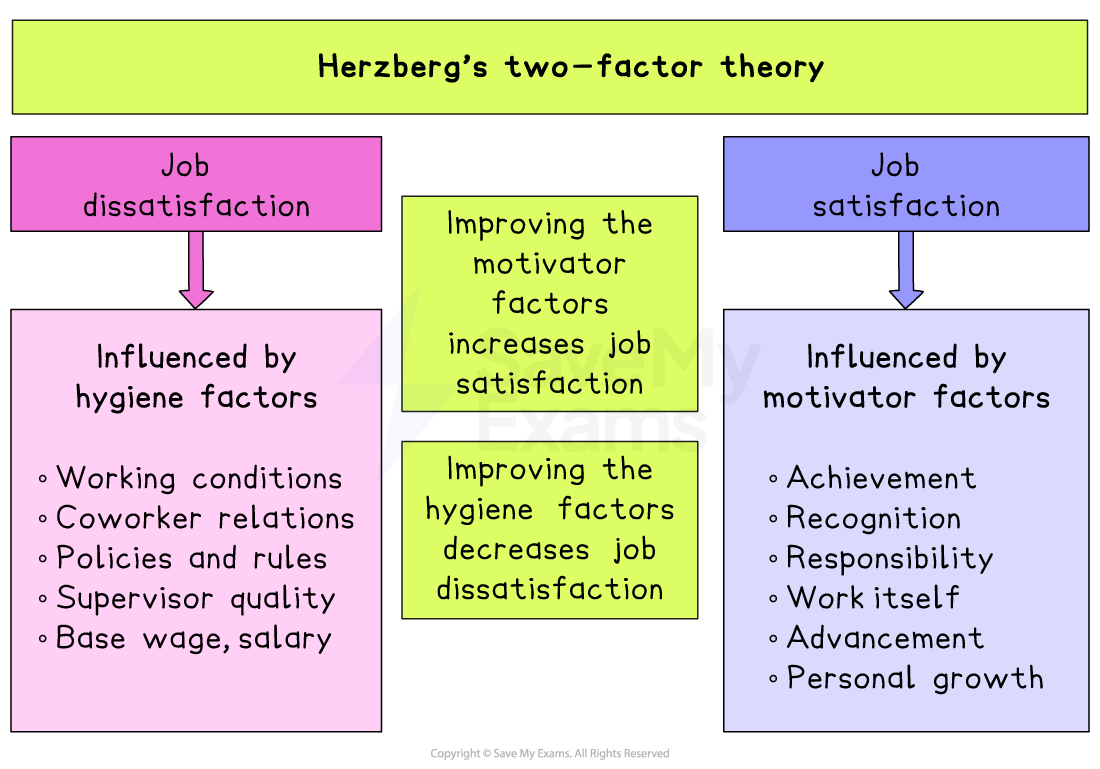
How businesses can use hygiene factors to decrease dissatisfaction
Pay fair wages/salaries
If an employee is not paid a fair wage for their work, they may become dissatisfied and demotivated
Offer excellent working conditions
If the workplace is dirty, unsafe or uncomfortable, employees may become dissatisfied and demotivated
E.g. Google has a reputation for providing amazing workplaces, which include gourmet restaurants, laundry services and even dog care
Offer employment contracts which provide job security
If employees feel that their job is not secure, they may become anxious and demotivated and contribute less to the business goals
How businesses can use motivating factors to increase satisfaction
Build a recognition and rewards culture
When employees are recognised and rewarded for their hard work, they are motivated to continue performing well
E.g. salesperson-of-the-month award
Offer opportunities for growth and development
When employees are given opportunities to learn new skills and advance in their careers, they are motivated to continue working for the company
E.g. by putting in place a three-year growth plan that helps the worker move towards a higher job role
Provide challenging work that requires problem-solving
When employees are given challenging work that allows them to use their skills and abilities, they are motivated to continue performing well
Examiner Tips and Tricks
Case studies often contain clues to the motivational approach adopted by a business
Consider how much or how little control over their working patterns employees have
Weigh up which needs are - or are not - being met
Look for indications of how challenging or engaging the work is likely to be

Unlock more, it's free!
Join the 100,000+ Students that ❤️ Save My Exams
the (exam) results speak for themselves:

Was this revision note helpful?
