Motivation (AQA A Level Business): Exam Questions

Exam code: 7132

Syllabus Edition

First teaching 2026

First exams 2028

2 hours15 questions
1
6 marks

Source A: Linneth Hotels Ltd

Linneth Hotels Ltd owns four hotels on the Northumberland coast. Between them they have 268 rooms and 160 employees, and in the year to October 2025 the company had revenue of £8.9 million and an operating profit of £0.62 million.

The business lives and dies by the seasons. In July and August the hotels are almost full. In January and February they are more than half empty, and the company cuts shifts to match. Most of its people are therefore taken on for the season rather than the year, and many of them do not come back.

Until last year the hotels were run by Gerald Linneth, who founded the company in 1998. His way of managing was simple: he made the decisions, he told people what to do, and he checked that it had been done. Rotas were posted on a Friday for the following week and arguing with them was not encouraged. He believed hospitality was too fast-moving for discussion.

In November 2025 he handed the running of the hotels to a new general manager, Priya Raman, who had previously managed a single large hotel in Edinburgh. She has started doing things differently. Housekeeping and kitchen teams now set their own rotas within rules the company agrees. Every hotel holds a short meeting at the start of each shift where any member of staff can raise a problem. She has promised that anyone who stays a full season will be offered training towards a recognised hospitality qualification.

Not everyone is convinced. Two of the four hotel managers have worked for Gerald Linneth for over twenty years and think the new approach is slow and soft. Gerald Linneth still owns the company and still visits every week.

Source: Linneth Hotels Ltd

Appendix B: What Linneth Hotels Ltd employees say

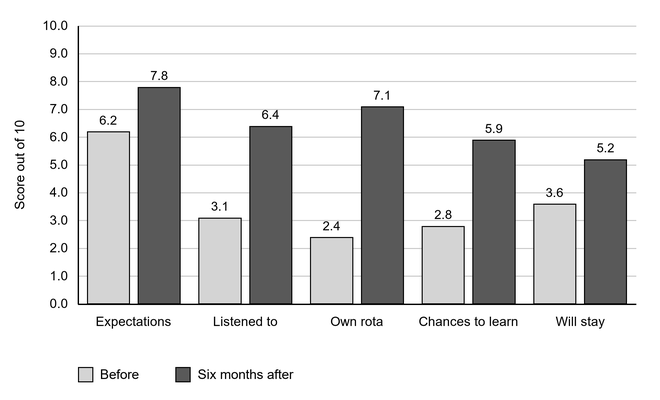
Grouped bar chart of employee scores out of 10 before and six months after the management change: expectations 6.2/7.8, listened to 3.1/6.4, own rota 2.4/7.1, chances to learn 2.8/5.9, will stay 3.6/5.2.

Scores out of 10, averaged across all four hotels

Table of employee scores out of 10 before and six months after the general manager changed: expectations 6.2/7.8, manager listens 3.1/6.4, rota influence 2.4/7.1, learning opportunities 2.8/5.9, and staying next season 3.6/5.2.

Employees who responded: 118 of 160

Source: Linneth Hotels Ltd staff survey
Analyse one way in which letting teams set their own rotas might affect Linneth Hotels Ltd's costs.

2
6 marks

Source A: John Lewis Partnership

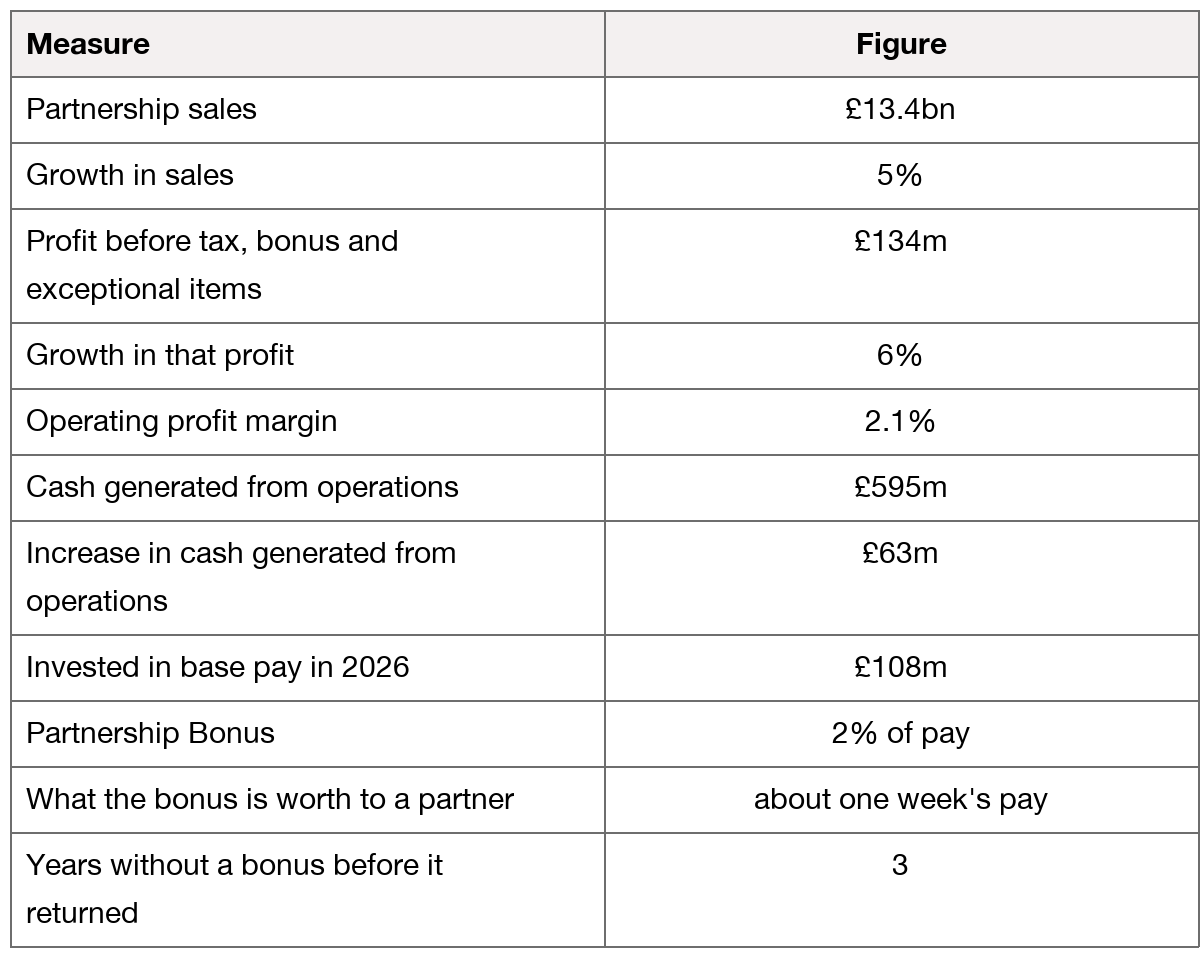
The John Lewis Partnership owns the John Lewis department stores and the Waitrose supermarkets. It is not owned by shareholders. It is owned by the people who work in it, who are called Partners rather than employees, and who share in the profits through an annual Partnership Bonus paid as a percentage of pay.

For most of its history that bonus was the thing everybody knew about the business. It was announced each March, it was the same percentage for the chief executive as for a shelf stacker, and it was how the Partnership said what it believed: that the people who do the work should own the business and share what it earns.

Then it stopped. The Partnership paid no bonus for three years. In March 2025 it reported that profits had tripled and still did not pay one, because the money was needed to invest in the business. For the year to January 2026 the bonus came back at 2%, worth about one week's pay, the first since 2022.

The underlying business improved. Partnership sales rose 5% to £13.4 billion and profit before tax, bonus and exceptional items rose 6% to £134 million. Cash generated from operations reached £595 million, up £63 million. The Partnership is investing £108 million in base pay in 2026.

The two halves of the Partnership are very different. Waitrose grew sales 7% to £8.5 billion with an adjusted operating profit of £256 million. John Lewis grew sales 3% to £4.9 billion with an adjusted operating profit of £58 million.

The Partnership is also run differently. It has a written constitution, Partners elect representatives who can question the chief executive, and a Partner can raise a concern through an elected body rather than through their line manager.

Source: John Lewis Partnership full year results, 2025 and 2026

Appendix A: Selected data for the John Lewis Partnership

Table of selected John Lewis Partnership data: Partnership sales £13.4bn, up 5%; profit before tax, bonus and exceptional items £134m, up 6%; operating profit margin 2.1%; cash generated from operations £595m, up £63m; £108m invested in base pay in 2026; Partnership Bonus 2% of pay, worth about one week's pay; 3 years without a bonus before it returned.

Source: John Lewis Partnership

Analyse one way in which paying no Partnership Bonus for three years might have affected the service Partners gave customers.

3
6 marks

Source A: Ashcombe Academy Trust

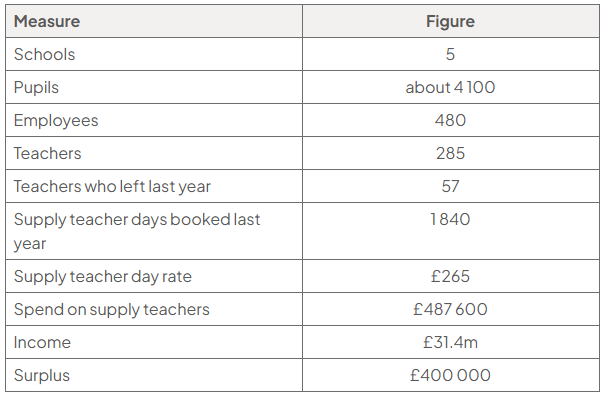
Ashcombe Academy Trust runs five secondary schools in the south west of England. It employs 480 people, of whom 285 are teachers, and teaches about 4 100 pupils. Its income last year was £31.4 million, almost all of it from government funding, and it finished the year with a surplus of £400 000.

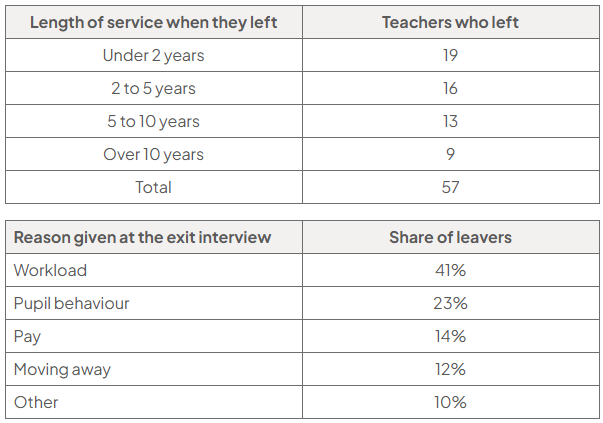
Its problem is keeping teachers. Fifty-seven left last year. Most did not go to another school: they left teaching. When a class has no teacher the trust books a supply teacher through an agency, at a day rate that has risen every year, and supply teachers rarely mark work or know the pupils.

The chief executive, Dr Helena Marsh, cannot pay more. Teachers' pay is set nationally and the trust has no power to change it. What she can change is everything else: how teachers are appraised, how much notice they get of a timetable change, whether they have time in the school day to plan and mark, and how decisions are taken in each school.

At present every teacher is appraised once a year against three targets, two of which are pupil examination results. Heads of department set the targets in September and review them the following July. Teachers say the appraisal is about proving they are doing their job rather than helping them do it better, and that the parts of the job they find hardest, such as behaviour and workload, are not what they are measured on.

Dr Marsh has two proposals in front of her. Neither of them is more pay, because more pay is not available.

Source: Ashcombe Academy Trust

Appendix B: When teachers leave Ashcombe

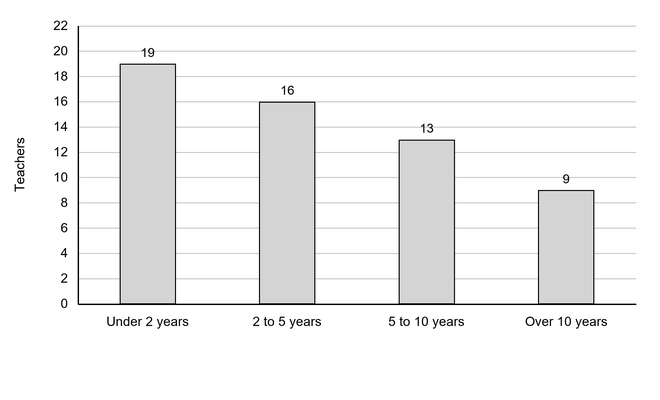
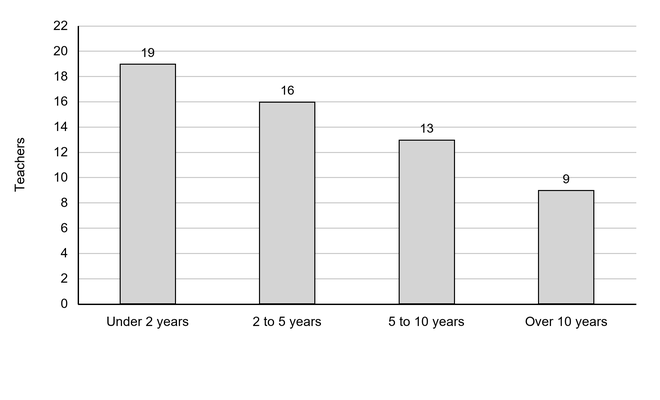
Bar chart of teachers leaving by length of service: under 2 years, 19; 2 to 5 years, 16; 5 to 10 years, 13; over 10 years, 9. The vertical axis shows teachers, from 0 to 22.
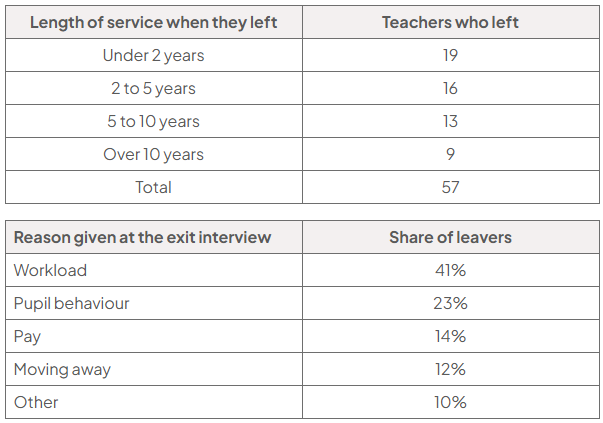
Two tables show 57 teachers leaving: under 2 years 19, 2 to 5 16, 5 to 10 13, over 10 9; reasons were workload 41%, pupil behaviour 23%, pay 14%, moving away 12% and other 10%.

Source: Ashcombe Academy Trust

Analyse one way in which workload being the most common reason teachers give for leaving might affect Ashcombe Academy Trust's costs.

4
6 marks

Source A: Saltmarsh Soft Drinks Ltd

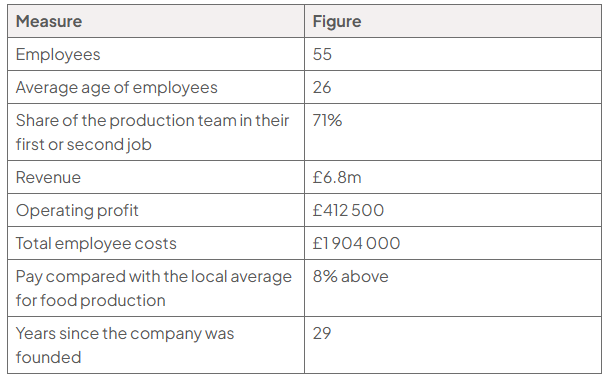
Saltmarsh Soft Drinks Ltd makes pressed apple juice, elderflower cordial and ginger beer at a small plant in Somerset. It employs 55 people, had revenue of £6.8 million in the year to March 2025 and an operating profit of £412 500.

Pauline Saltmarsh started the company in 1996 with one press and a van. She still knows every employee's name, still tastes every batch, and until this year she signed off every decision that cost more than £500. The workforce is young: the average age is 26, and most of the production team are in their first or second job.

In January she told the board she is reducing to two days a week, and that the business needs to be able to run without her. She has promoted two people from the production floor, Ciara Nolan and Dan Beckworth, to lead production and sales, and has told them she will not overrule them in front of their teams.

It has not been straightforward. Both new leaders have spent their whole working lives being told what to do by Pauline, and both have said they find it difficult to know how much they are allowed to decide. Several of the younger staff have asked who they should now go to, and two have said the company feels less personal than it did.

The board has asked for proposals on keeping people motivated as the founder steps back. Pay at Saltmarsh is already above the local average for food production, so raising it further is not obviously the answer.

Source: Saltmarsh Soft Drinks Ltd

Appendix B: What Saltmarsh employees say

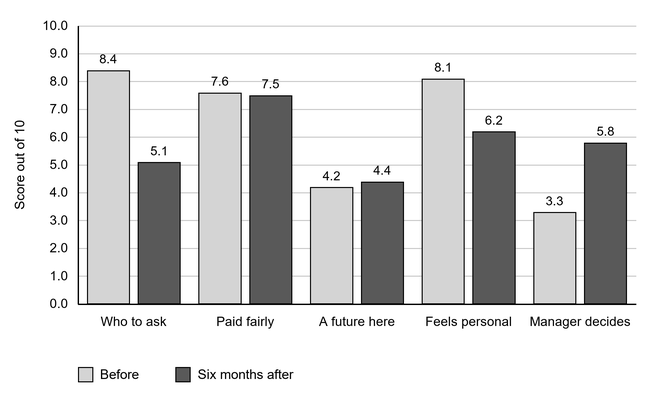
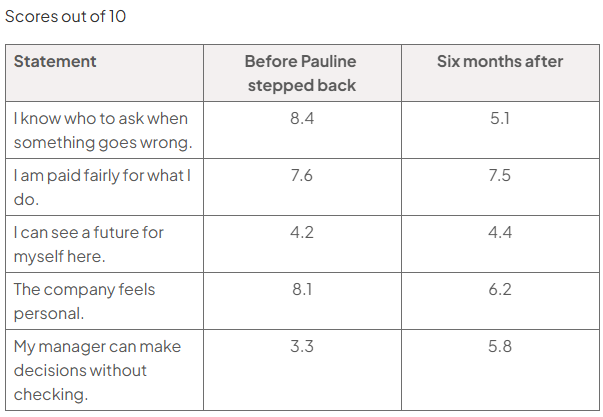
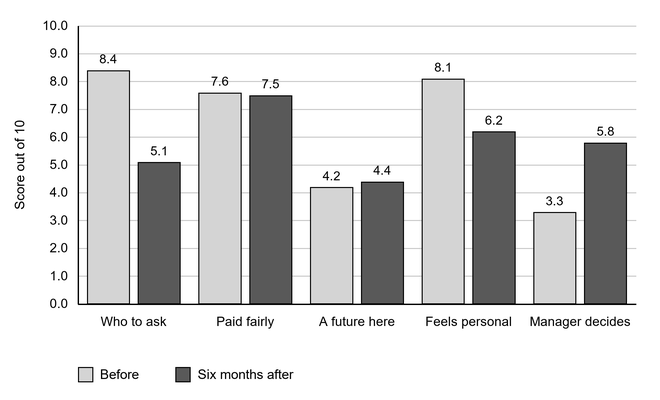
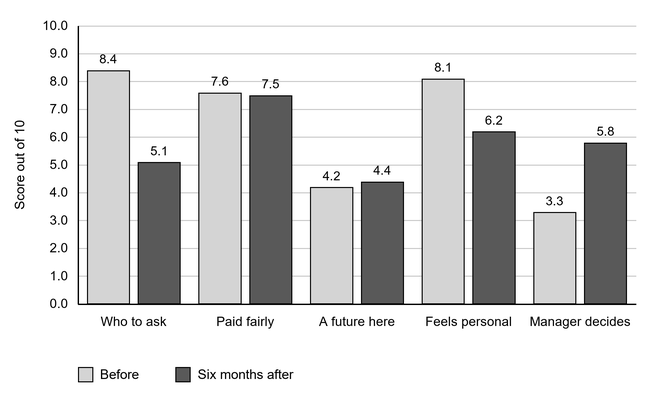
Grouped bar chart of employee survey scores on a 0–10 scale, before and six months after Pauline stepped back. “Who to ask” falls from 8.4 to 5.1 and “Feels personal” from 8.1 to 6.2; “Manager decides” rises from 3.3 to 5.8.
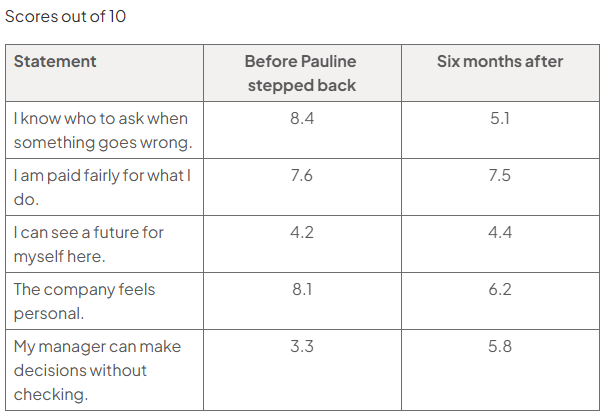
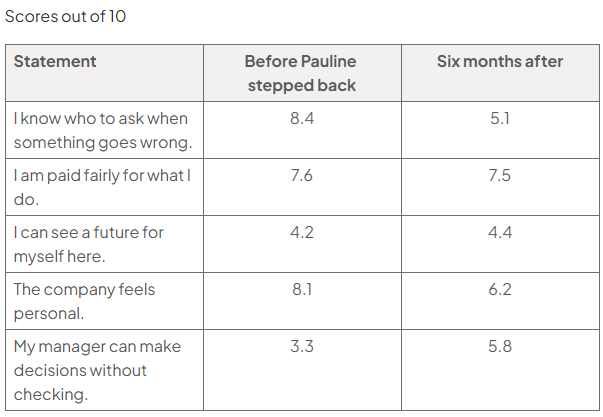
Table of employee survey scores out of 10 before and six months after Pauline stepped back: who to ask, 8.4 to 5.1; paid fairly, 7.6 to 7.5; future here, 4.2 to 4.4; feels personal, 8.1 to 6.2; manager decides, 3.3 to 5.8.

Employees who responded: 48 of 55

Source: Saltmarsh Soft Drinks Ltd staff survey

Analyse one way in which employees no longer knowing who to ask might affect Saltmarsh Soft Drinks Ltd's productivity.

5
6 marks

Source A: Richer Sounds

Richer Sounds sells hi-fi, televisions and home cinema equipment from 51 stores and a website. It has always been unusual in how it treats the people who work in it, and in 2019 it did something almost no company of its size has done.

On 10 May 2019 the founder, Julian Richer, transferred 60% of his shares, worth £9.2 million, into an Employee Ownership Trust. The colleagues now own the majority of the business they work in. He also paid every colleague other than the directors a thank-you bonus of £1 000 for every year they had worked there. The average length of service was eight years, and the bill came to about £4 million.

He stepped back from running it. The day-to-day business was left with the existing management board, and a colleagues' advisory council was set up, chaired by a trustee, to put colleagues' views in front of the people making decisions.

The rest of the Richer approach has been in place for far longer. Colleagues get a share of the profit, free use of the company's holiday homes, interest-free loans and a hardship fund they can apply to. Almost nobody leaves. Most vacancies are filled from inside the business, and the shortest time any member of the management board has served is twenty-five years.

That last figure is the one the company is now asked about. A business where everybody stays and everybody is promoted from within has deep knowledge of how it does things, and very little experience of how anybody else does them.

Source: Richer Sounds and Co-operative News

Appendix B: Richer Sounds compared with specialist electrical retail

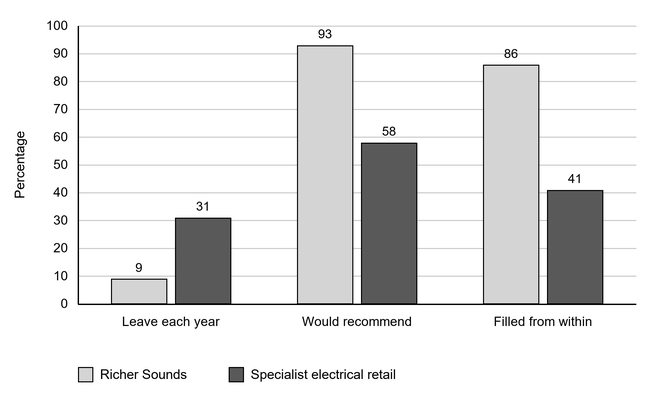
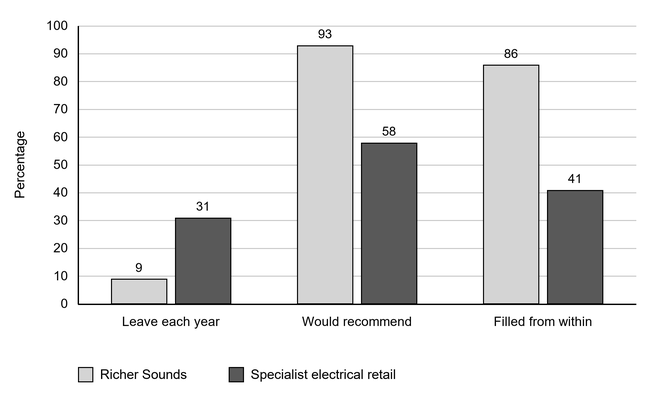
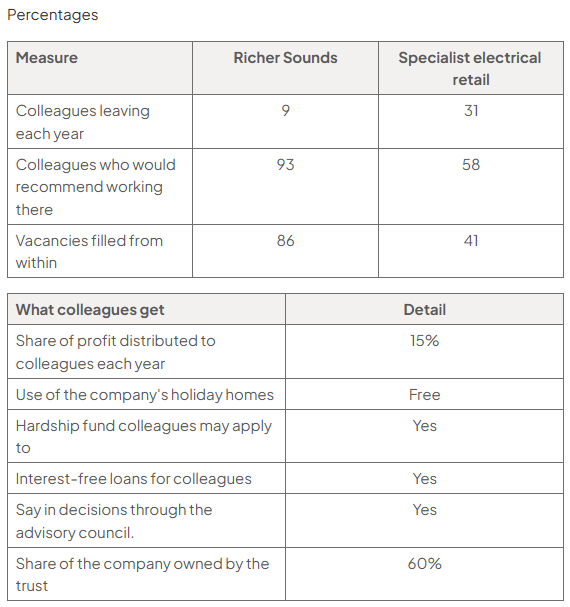
Grouped bar chart comparing Richer Sounds with specialist electrical retail: colleagues leaving each year, 9% versus 31%; recommending work there, 93% versus 58%; vacancies filled from within, 86% versus 41%.
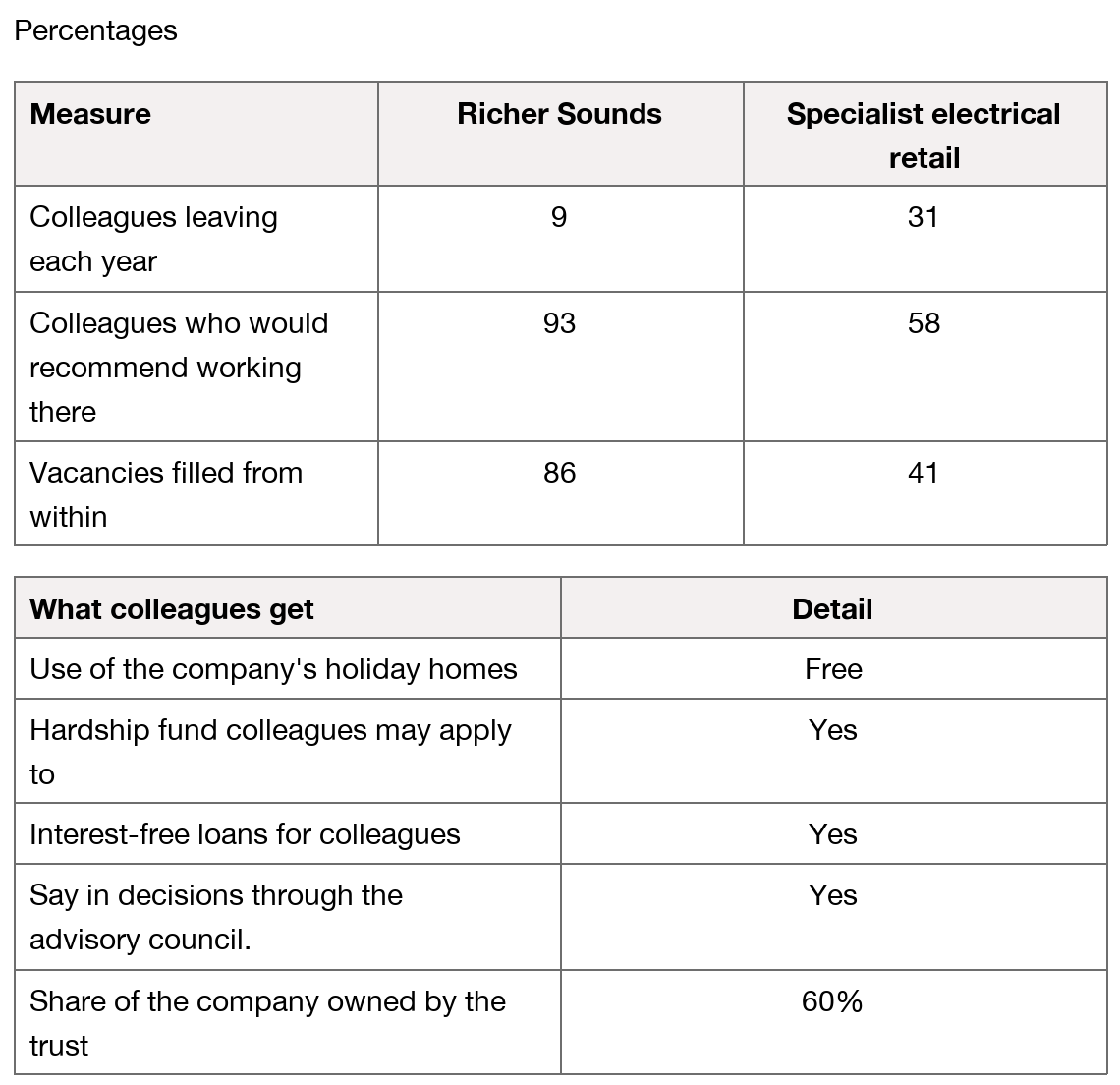
Percentage tables compare Richer Sounds/specialist electrical retail: leaving 9%/31%, recommend working there 93%/58%, internal vacancies 86%/41%. Benefits: free holiday homes, hardship fund, interest-free loans, advisory council, 60% trust ownership.

Source: Analyst

Analyse one way in which employee ownership through a trust might affect motivation at Richer Sounds.

6
6 marks

Source A: Ellerby & Sons Plumbing Ltd

Ellerby & Sons Plumbing Ltd installs and repairs boilers and bathrooms around Doncaster. Mick Ellerby started it twenty-two years ago and still goes out on jobs himself. There are seven people in all: Mick and four other qualified engineers, one apprentice and one administrator who answers the phone and books the work. Revenue in the year to March 2025 was £685 000 and operating profit was £78 000.

Between them the engineers complete about 140 jobs a week, and almost three quarters of the work comes from customers who have used the firm before. They are paid an hourly rate, which is unusual locally: most of the firms Ellerby competes with pay by the job.

That difference shows up in two places. An engineer at one of those firms typically earns £48 300 a year against £41 600 at Ellerby, and completes more jobs a week. It also shows up in the work: at Ellerby about 4% of jobs need a return visit, and at the firms paying by the job it is nearer 11%.

Two engineers have left in the past two years and both went to firms paying by the job. Mick has no training budget, has never written an appraisal, and teaches the apprentice himself in the van between calls. Of the eight hours in an engineer's day, about six and a half are charged to a customer; the rest goes on travelling, stocking the van and paperwork.

Mick is sixty-one and wants the firm to work without him in it every day.

Source: Ellerby & Sons Plumbing Ltd

Appendix B: What each engineer does in a week, and what they are paid

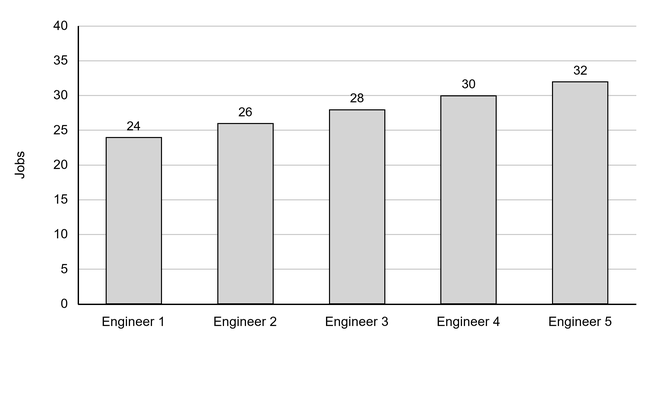
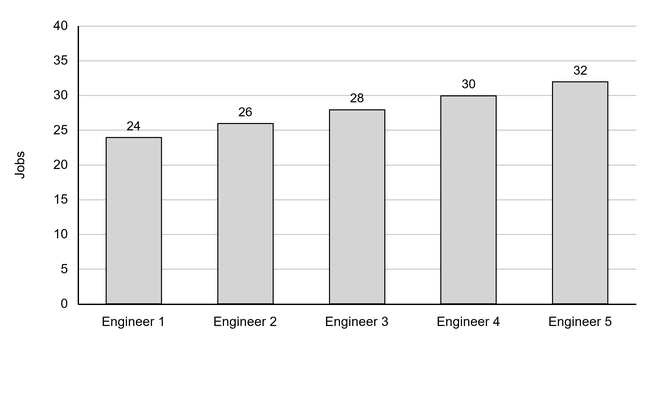
Bar chart of jobs completed by five engineers, with jobs on a zero-to-40 vertical axis: the bars increase steadily from Engineer 1 (24) to Engineer 5 (32), with Engineers 2–4 in between.
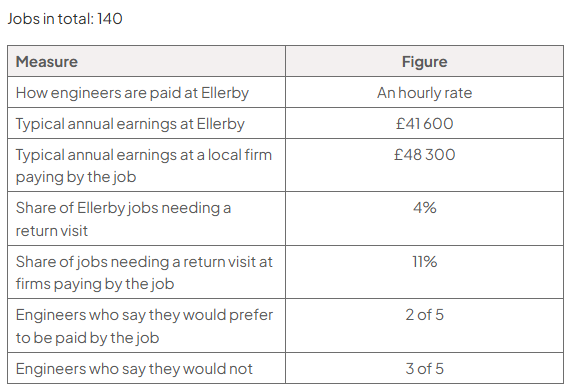
Table of engineer pay and outcomes: 140 jobs in total; paid hourly at Ellerby; annual earnings £41 600 versus £48 300 at local job-paid firms; return visits 4% versus 11%; 2 of 5 prefer job pay and 3 of 5 do not.

Source: Analyst

Analyse one way in which paying an hourly rate rather than by the job might affect motivation at Ellerby & Sons Plumbing Ltd.

7
6 marks

Source A: Ellerby & Sons Plumbing Ltd

Ellerby & Sons Plumbing Ltd installs and repairs boilers and bathrooms around Doncaster. Mick Ellerby started it twenty-two years ago and still goes out on jobs himself. There are seven people in all: Mick and four other qualified engineers, one apprentice and one administrator who answers the phone and books the work. Revenue in the year to March 2025 was £685 000 and operating profit was £78 000.

Between them the engineers complete about 140 jobs a week, and almost three quarters of the work comes from customers who have used the firm before. They are paid an hourly rate, which is unusual locally: most of the firms Ellerby competes with pay by the job.

That difference shows up in two places. An engineer at one of those firms typically earns £48 300 a year against £41 600 at Ellerby, and completes more jobs a week. It also shows up in the work: at Ellerby about 4% of jobs need a return visit, and at the firms paying by the job it is nearer 11%.

Two engineers have left in the past two years and both went to firms paying by the job. Mick has no training budget, has never written an appraisal, and teaches the apprentice himself in the van between calls. Of the eight hours in an engineer's day, about six and a half are charged to a customer; the rest goes on travelling, stocking the van and paperwork.

Mick is sixty-one and wants the firm to work without him in it every day.

Source: Ellerby & Sons Plumbing Ltd

Appendix B: What each engineer does in a week, and what they are paid

Bar chart of jobs completed by five engineers, with jobs on a zero-to-40 vertical axis: the bars increase steadily from Engineer 1 (24) to Engineer 5 (32), with Engineers 2–4 in between.
Table of engineer pay and outcomes: 140 jobs in total; paid hourly at Ellerby; annual earnings £41 600 versus £48 300 at local job-paid firms; return visits 4% versus 11%; 2 of 5 prefer job pay and 3 of 5 do not.

Source: Analyst

Analyse one way in which engineers at Ellerby & Sons Plumbing Ltd earning £6,700 a year less than at local firms paying by the job might affect the business.

1
9 marks

Source A: Linneth Hotels Ltd

Linneth Hotels Ltd owns four hotels on the Northumberland coast. Between them they have 268 rooms and 160 employees, and in the year to October 2025 the company had revenue of £8.9 million and an operating profit of £0.62 million.

The business lives and dies by the seasons. In July and August the hotels are almost full. In January and February they are more than half empty, and the company cuts shifts to match. Most of its people are therefore taken on for the season rather than the year, and many of them do not come back.

Until last year the hotels were run by Gerald Linneth, who founded the company in 1998. His way of managing was simple: he made the decisions, he told people what to do, and he checked that it had been done. Rotas were posted on a Friday for the following week and arguing with them was not encouraged. He believed hospitality was too fast-moving for discussion.

In November 2025 he handed the running of the hotels to a new general manager, Priya Raman, who had previously managed a single large hotel in Edinburgh. She has started doing things differently. Housekeeping and kitchen teams now set their own rotas within rules the company agrees. Every hotel holds a short meeting at the start of each shift where any member of staff can raise a problem. She has promised that anyone who stays a full season will be offered training towards a recognised hospitality qualification.

Not everyone is convinced. Two of the four hotel managers have worked for Gerald Linneth for over twenty years and think the new approach is slow and soft. Gerald Linneth still owns the company and still visits every week.

Source: Linneth Hotels Ltd

Appendix A: Linneth Hotels Ltd selected data, year to October 2025

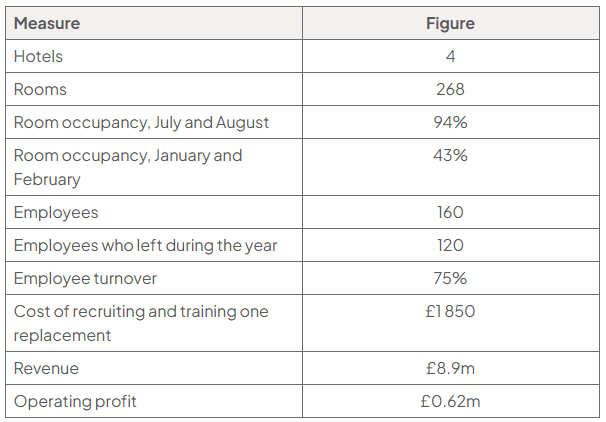
Table of Linneth Hotels Ltd data: 4 hotels, 268 rooms, occupancy of 94% in July and August and 43% in January and February, 160 employees, 120 leavers, 75% turnover, £1,850 replacement cost, £8.9m revenue and £0.62m operating profit.

Source: Linneth Hotels Ltd

Appendix B: What Linneth Hotels Ltd employees say

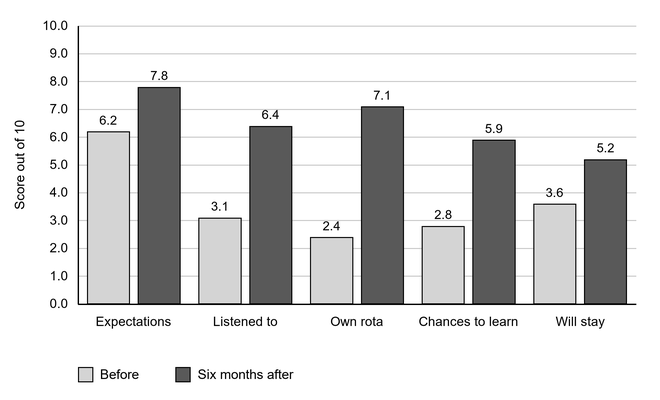
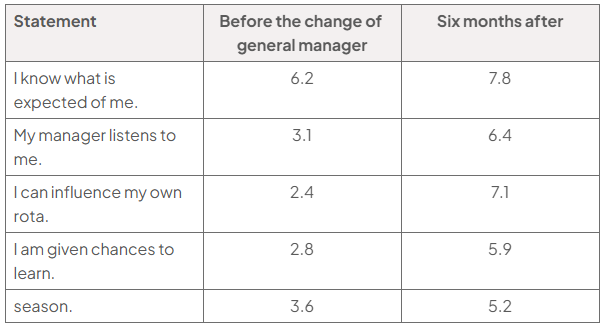
Grouped bar chart of employee survey scores out of 10 before and six months after the management change: expectations 6.2 to 7.8; listening 3.1 to 6.4; rota influence 2.4 to 7.1; learning 2.8 to 5.9; staying 3.6 to 5.2.

Scores out of 10, averaged across all four hotels

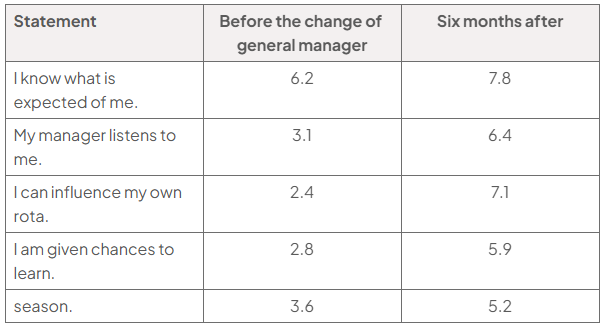
Table comparing employee survey scores out of 10 before and six months after the management change: expectations 6.2 to 7.8, listening 3.1 to 6.4, rota influence 2.4 to 7.1, learning 2.8 to 5.9, and staying 3.6 to 5.2.

Employees who responded: 118 of 160

Source: Linneth Hotels Ltd staff survey
Assess the impact of low employee motivation on Linneth Hotels Ltd's profit.

Calculate the annual cost to Linneth Hotels Ltd of replacing the employees who leave to support your answer.

2
9 marks

Source A: Ashcombe Academy Trust

Ashcombe Academy Trust runs five secondary schools in the south west of England. It employs 480 people, of whom 285 are teachers, and teaches about 4 100 pupils. Its income last year was £31.4 million, almost all of it from government funding, and it finished the year with a surplus of £400 000.

Its problem is keeping teachers. Fifty-seven left last year. Most did not go to another school: they left teaching. When a class has no teacher the trust books a supply teacher through an agency, at a day rate that has risen every year, and supply teachers rarely mark work or know the pupils.

The chief executive, Dr Helena Marsh, cannot pay more. Teachers' pay is set nationally and the trust has no power to change it. What she can change is everything else: how teachers are appraised, how much notice they get of a timetable change, whether they have time in the school day to plan and mark, and how decisions are taken in each school.

At present every teacher is appraised once a year against three targets, two of which are pupil examination results. Heads of department set the targets in September and review them the following July. Teachers say the appraisal is about proving they are doing their job rather than helping them do it better, and that the parts of the job they find hardest, such as behaviour and workload, are not what they are measured on.

Dr Marsh has two proposals in front of her. Neither of them is more pay, because more pay is not available.

Source: Ashcombe Academy Trust

Appendix A: Ashcombe Academy Trust selected data

Table of selected data for Ashcombe Academy Trust: 5 schools, about 4,100 pupils, 480 employees, 285 teachers, 57 leavers, 1,840 supply-teacher days, £265 daily rate, £487,600 spend, £31.4 million income and £400,000 surplus.

Source: Ashcombe Academy Trust

Appendix B: When teachers leave Ashcombe

Bar chart of teachers leaving by length of service: under 2 years, 19; 2 to 5 years, 16; 5 to 10 years, 13; over 10 years, 9. The number leaving decreases as service length increases.
Two tables of Ashcombe leavers: service length: under 2 years 19, 2 to 5 years 16, 5 to 10 years 13, over 10 years 9 (total 57); exit reasons: workload 41%, pupil behaviour 23%, pay 14%, moving away 12%, other 10%.

Source: Ashcombe Academy Trust

Assess the impact of low teacher motivation on Ashcombe Academy Trust's finances.

Calculate Ashcombe Academy Trust's teacher turnover to support your answer.

3
9 marks

Source A: Saltmarsh Soft Drinks Ltd

Saltmarsh Soft Drinks Ltd makes pressed apple juice, elderflower cordial and ginger beer at a small plant in Somerset. It employs 55 people, had revenue of £6.8 million in the year to March 2025 and an operating profit of £412 500.

Pauline Saltmarsh started the company in 1996 with one press and a van. She still knows every employee's name, still tastes every batch, and until this year she signed off every decision that cost more than £500. The workforce is young: the average age is 26, and most of the production team are in their first or second job.

In January she told the board she is reducing to two days a week, and that the business needs to be able to run without her. She has promoted two people from the production floor, Ciara Nolan and Dan Beckworth, to lead production and sales, and has told them she will not overrule them in front of their teams.

It has not been straightforward. Both new leaders have spent their whole working lives being told what to do by Pauline, and both have said they find it difficult to know how much they are allowed to decide. Several of the younger staff have asked who they should now go to, and two have said the company feels less personal than it did.

The board has asked for proposals on keeping people motivated as the founder steps back. Pay at Saltmarsh is already above the local average for food production, so raising it further is not obviously the answer.

Source: Saltmarsh Soft Drinks Ltd

Appendix A: Saltmarsh Soft Drinks Ltd selected data, year to March 2025

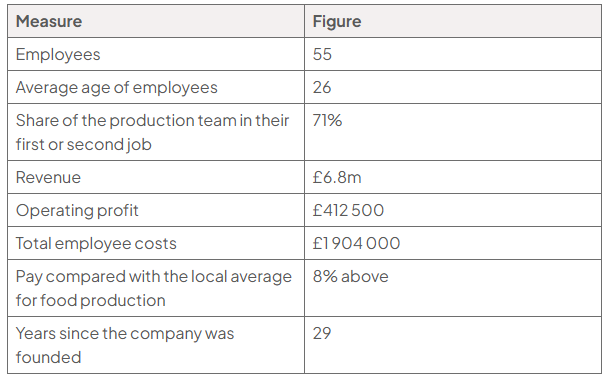
Selected data table: 55 employees, average age 26, 71% of the production team in their first or second job, revenue £6.8m, operating profit £412 500, employee costs £1 904 000, pay 8% above local average, and 29 years since founding.

Source: Saltmarsh Soft Drinks Ltd

Appendix B: What Saltmarsh employees say

Bar chart of employee survey scores out of 10 before and six months after Pauline stepped back: who to ask 8.4 to 5.1, paid fairly 7.6 to 7.5, future 4.2 to 4.4, personal 8.1 to 6.2, manager decides 3.3 to 5.8.
Table of employee survey scores out of 10, before Pauline stepped back and six months after: I know who to ask when something goes wrong, 8.4 and 5.1; I am paid fairly for what I do, 7.6 and 7.5; I can see a future for myself here, 4.2 and 4.4; the company feels personal, 8.1 and 6.2; my manager can make decisions without checking, 3.3 and 5.8.

Employees who responded: 48 of 55

Source: Saltmarsh Soft Drinks Ltd staff survey

Assess whether pay is the right way for Saltmarsh Soft Drinks Ltd to motivate its young workforce.

Calculate employee costs as a share of Saltmarsh Soft Drinks Ltd's revenue to support your answer.

4
9 marks

Source A: Richer Sounds

Richer Sounds sells hi-fi, televisions and home cinema equipment from 51 stores and a website. It has always been unusual in how it treats the people who work in it, and in 2019 it did something almost no company of its size has done.

On 10 May 2019 the founder, Julian Richer, transferred 60% of his shares, worth £9.2 million, into an Employee Ownership Trust. The colleagues now own the majority of the business they work in. He also paid every colleague other than the directors a thank-you bonus of £1 000 for every year they had worked there. The average length of service was eight years.

He stepped back from running it. The day-to-day business was left with the existing management board, and a colleagues' advisory council was set up, chaired by a trustee, to put colleagues' views in front of the people making decisions.

The rest of the Richer approach has been in place for far longer. Colleagues get a share of the profit, free use of the company's holiday homes, interest-free loans and a hardship fund they can apply to. Almost nobody leaves. Most vacancies are filled from inside the business, and the shortest time any member of the management board has served is twenty-five years.

That last figure is the one the company is now asked about. A business where everybody stays and everybody is promoted from within has deep knowledge of how it does things, and very little experience of how anybody else does them.

Source: Richer Sounds and Co-operative News

Appendix A: What happened at Richer Sounds in May 2019

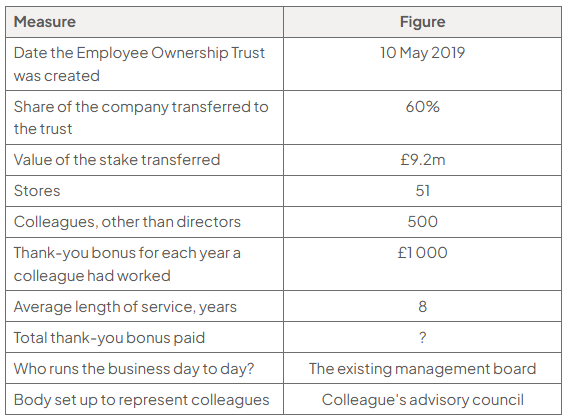
Table of Richer Sounds’ May 2019 changes: trust created 10 May; 60% (£9.2m) transferred; 51 stores; 500 non-director colleagues; £1,000 per year worked; average service 8 years; total bonus “?”; management board runs business; advisory council represents colleagues.

Source: Richer Sounds and Co-operative News

Appendix B: Richer Sounds compared with specialist electrical retail

Bar chart comparing Richer Sounds with specialist electrical retail: annual leaving 9% versus 31%, would recommend 93% versus 58%, and vacancies filled internally 86% versus 41%; vertical axis shows percentages from 0 to 100.
Compared with specialist electrical retail, Richer Sounds has leaving 9%/31%, recommendation 93%/58%, and internal vacancies 86%/41%. Benefits include 15% profit share, free holidays, hardship help, interest-free loans, an advisory council and 60% trust ownership.

Source: Analyst

Assess whether the move to employee ownership is likely to keep Richer Sounds' colleagues motivated.

Calculate the total thank-you bonus paid in May 2019 to support your answer.

5
9 marks

Source A: Ellerby & Sons Plumbing Ltd

Ellerby & Sons Plumbing Ltd installs and repairs boilers and bathrooms around Doncaster. Mick Ellerby started it twenty-two years ago and still goes out on jobs himself. There are seven people in all: Mick and four other qualified engineers, one apprentice and one administrator who answers the phone and books the work. Revenue in the year to March 2025 was £685 000 and operating profit was £78 000.

Between them the engineers complete about 140 jobs a week, and almost three quarters of the work comes from customers who have used the firm before. They are paid an hourly rate, which is unusual locally: most of the firms Ellerby competes with pay by the job.

That difference shows up in two places. An engineer at one of those firms typically earns £48 300 a year against £41 600 at Ellerby, and completes more jobs a week. It also shows up in the work: at Ellerby about 4% of jobs need a return visit, and at the firms paying by the job it is nearer 11%.

Two engineers have left in the past two years and both went to firms paying by the job. Mick has no training budget, has never written an appraisal, and teaches the apprentice himself in the van between calls. Of the eight hours in an engineer's day, about six and a half are charged to a customer; the rest goes on travelling, stocking the van and paperwork.

Mick is sixty-one and wants the firm to work without him in it every day.

Source: Ellerby & Sons Plumbing Ltd

Appendix A: Ellerby & Sons Plumbing Ltd selected data, year to March 2025

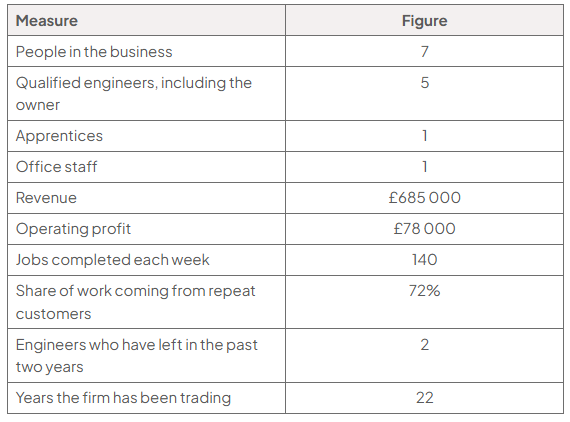
Table of Ellerby & Sons Plumbing Ltd selected data: 7 people in the business; 5 qualified engineers, including the owner; 1 apprentice; 1 member of office staff; revenue £685 000; operating profit £78 000; 140 jobs completed each week; 72% of work from repeat customers; 2 engineers have left in the past two years; trading for 22 years.

Source: Ellerby & Sons Plumbing Ltd

Appendix B: What each engineer does in a week, and what they are paid

Bar chart of jobs completed per week by five engineers: Engineer 1, 24; Engineer 2, 26; Engineer 3, 28; Engineer 4, 30; Engineer 5, 32. The jobs axis ranges from 0 to 40.
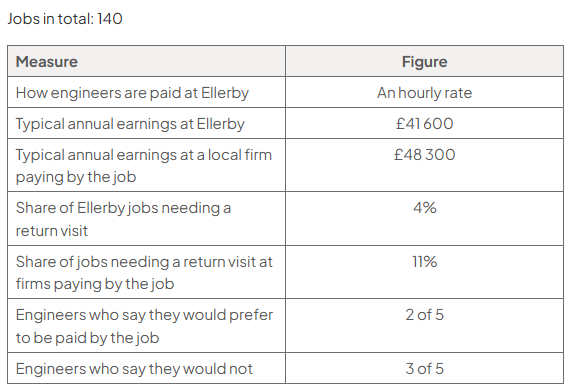
Jobs in total: 140. Table of how engineers are paid: engineers at Ellerby are paid an hourly rate; typical annual earnings are £41 600 at Ellerby, against £48 300 at a local firm paying by the job; 4% of Ellerby jobs need a return visit, against 11% at firms paying by the job; 2 of 5 engineers say they would prefer to be paid by the job and 3 of 5 say they would not.

Source: Analyst

Assess whether higher pay is the best way for Ellerby & Sons Plumbing Ltd to keep its engineers.

1
15 marks

Source B: Netflix

Netflix is one of the world's leading entertainment services. It employs around 13 000 people. The company has over 430 million shares. It has never paid a dividend. It has more than 247 million paid memberships in over 190 countries. Members enjoy TV series, films and games across a wide variety of genres and in over 30 languages. Members can play, pause and resume watching Netflix's content as much as they want: anytime and anywhere. Netflix's competitors include Disney+, Amazon Prime, HBO and Paramount.

The use of advanced digital technology affects all aspects of Netflix's operations. For example, it:

  • enables the smooth streaming of content

  • adjusts the quality of the video for the platform it is viewed on

  • enables the production of high-quality content

  • enhances users' experience on the Netflix site through features such as efficient search functions and personalised recommendations of content.

Netflix aims for diversity in its workforce. Its employees are paid top rates for what they do. Netflix claims it has a unique culture. Netflix's leaders highlight the importance of collaboration and creativity. 3% of Netflix employees work remotely compared to a national average of 14%. There are very few rules at the business because Netflix trusts employees to make the right choices. Employees are empowered and given the freedom to decide what to do and delegation is high but, in return, must take responsibility for their actions. The company expects employees to be high performers and excellent team players. Underperformers are asked to leave. For every significant decision, Netflix identifies an "informed captain of the ship". This person is an expert in their area and is responsible for listening to other people's views and then making a judgment call on the right way forward.

Source: information sourced from Netflix, 2024

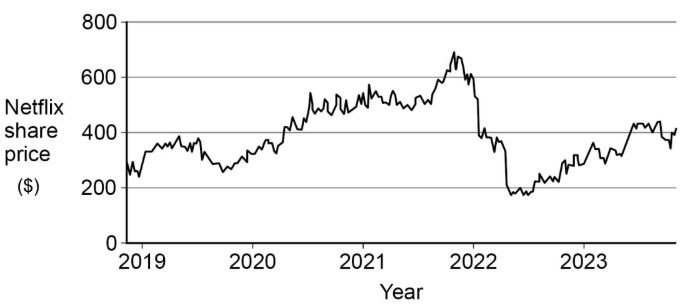
Appendix D: Netflix share price 2019–2023 ($)

Line chart of Netflix share price from 2019 to 2023, in dollars, with the vertical axis from 0 to 800. It peaks at about $700 in late 2021, falls to about $170 in 2022, then recovers to about $450.

Evaluate two ways Netflix could increase employees' motivation and recommend which one it should choose.

2
15 marks

Source A: John Lewis Partnership

The John Lewis Partnership owns the John Lewis department stores and the Waitrose supermarkets. It is not owned by shareholders. It is owned by the people who work in it, who are called Partners rather than employees, and who share in the profits through an annual Partnership Bonus paid as a percentage of pay.

For most of its history that bonus was the thing everybody knew about the business. It was announced each March, it was the same percentage for the chief executive as for a shelf stacker, and it was how the Partnership said what it believed: that the people who do the work should own the business and share what it earns.

Then it stopped. The Partnership paid no bonus for three years. In March 2025 it reported that profits had tripled and still did not pay one, because the money was needed to invest in the business. For the year to January 2026 the bonus came back at 2%, worth about one week's pay, the first since 2022.

The underlying business improved. Partnership sales rose 5% to £13.4 billion and profit before tax, bonus and exceptional items rose 6% to £134 million. Cash generated from operations reached £595 million, up £63 million. The Partnership is investing £108 million in base pay in 2026.

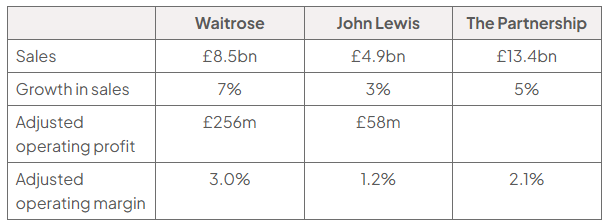
The two halves of the Partnership are very different. Waitrose grew sales 7% to £8.5 billion with an adjusted operating profit of £256 million. John Lewis grew sales 3% to £4.9 billion with an adjusted operating profit of £58 million.

The Partnership is also run differently. It has a written constitution, Partners elect representatives who can question the chief executive, and a Partner can raise a concern through an elected body rather than through their line manager.

Source: John Lewis Partnership full year results, 2025 and 2026

Appendix A: Selected data for the John Lewis Partnership

Table of selected John Lewis Partnership data: Partnership sales £13.4bn, up 5%; profit before tax, bonus and exceptional items £134m, up 6%; operating profit margin 2.1%; cash generated from operations £595m, up £63m; £108m invested in base pay in 2026; Partnership Bonus 2% of pay, worth about one week's pay; 3 years without a bonus before it returned.

Source: John Lewis Partnership

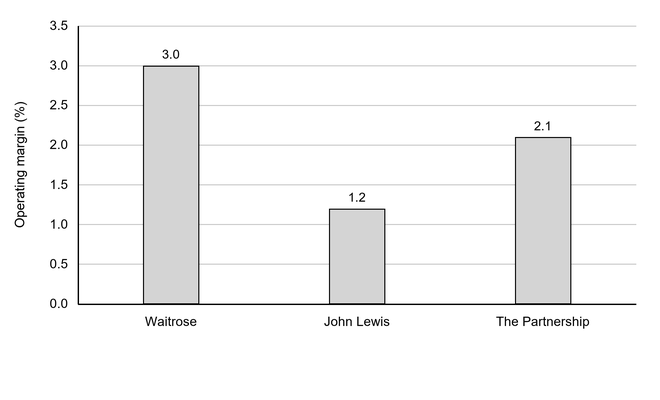
Appendix B: Sales and profitability of the two brands

Bar chart of adjusted operating margins, from 0 to 3.5%. Waitrose is highest at 3.0%, followed by the Partnership at 2.1%; John Lewis is lowest at 1.2%.
Table comparing Waitrose, John Lewis and the Partnership: sales £8.5bn, £4.9bn and £13.4bn; sales growth 7%, 3% and 5%; adjusted profit £256m and £58m; margins 3.0%, 1.2% and 2.1%.

Source: John Lewis Partnership

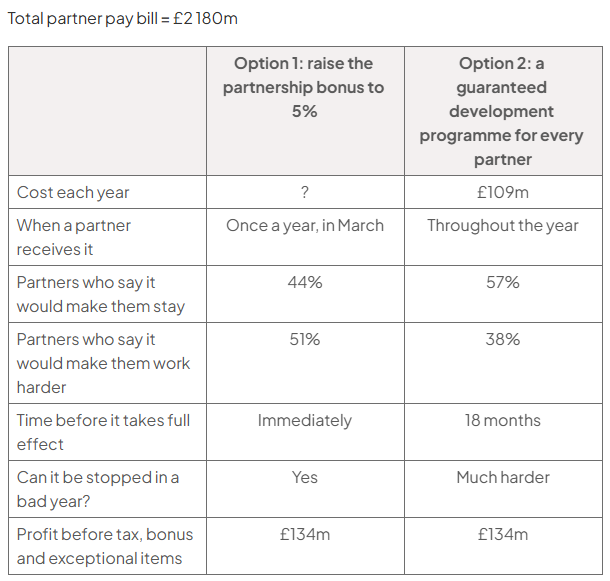
Appendix D: Two ways of rewarding Partners

Comparison table: total Partner pay bill £2 180m. Option 1, 5% bonus: annual cost ?, paid in March; 44% stay, 51% work harder; immediate effect, stoppable. Option 2: £109m yearly; 57%, 38%; 18 months, harder to stop.

Source: Analyst

The John Lewis Partnership is considering two ways of rewarding its Partners:

Option 1: raise the Partnership Bonus to 5% of pay

Option 2: a guaranteed development programme for every Partner

Evaluate both options and recommend which one the John Lewis Partnership should choose.

Calculate the cost of raising the Partnership Bonus to 5% to support your answer.

3
15 marks

Source A: Saltmarsh Soft Drinks Ltd

Saltmarsh Soft Drinks Ltd makes pressed apple juice, elderflower cordial and ginger beer at a small plant in Somerset. It employs 55 people, had revenue of £6.8 million in the year to March 2025 and an operating profit of £412 500.

Pauline Saltmarsh started the company in 1996 with one press and a van. She still knows every employee's name, still tastes every batch, and until this year she signed off every decision that cost more than £500. The workforce is young: the average age is 26, and most of the production team are in their first or second job.

In January she told the board she is reducing to two days a week, and that the business needs to be able to run without her. She has promoted two people from the production floor, Ciara Nolan and Dan Beckworth, to lead production and sales, and has told them she will not overrule them in front of their teams.

It has not been straightforward. Both new leaders have spent their whole working lives being told what to do by Pauline, and both have said they find it difficult to know how much they are allowed to decide. Several of the younger staff have asked who they should now go to, and two have said the company feels less personal than it did.

The board has asked for proposals on keeping people motivated as the founder steps back. Pay at Saltmarsh is already above the local average for food production, so raising it further is not obviously the answer.

Source: Saltmarsh Soft Drinks Ltd

Appendix A: Saltmarsh Soft Drinks Ltd selected data, year to March 2025

Table of selected data: 55 employees; average age 26; 71% of production staff in first or second job; revenue £6.8m; operating profit £412 500; employee costs £1 904 000; pay 8% above local average; founded 29 years.

Source: Saltmarsh Soft Drinks Ltd

Appendix B: What Saltmarsh employees say

Grouped bar chart of employee survey scores out of 10, before Pauline stepped back and six months after: who to ask 8.4 and 5.1; paid fairly 7.6 and 7.5; a future here 4.2 and 4.4; feels personal 8.1 and 6.2; manager decides 3.3 and 5.8. The vertical axis runs from 0 to 10.
Table of employee survey scores out of 10 before Pauline stepped back and six months after: who to ask 8.4 to 5.1; paid fairly 7.6 to 7.5; future 4.2 to 4.4; personal 8.1 to 6.2; manager decides 3.3 to 5.8.

Employees who responded: 48 of 55

Source: Saltmarsh Soft Drinks Ltd staff survey

Appendix D: Two ways of motivating the team as the founder steps back

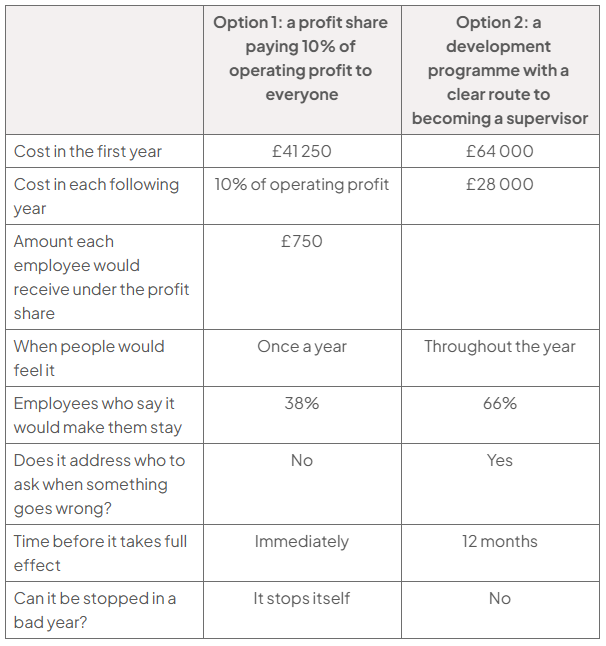
Comparison table of motivation options: profit share (10% profit) versus supervisor development. First-year costs £41 250 and £64 000; £750 for each employee under the profit share; later costs 10% profit and £28 000; employee support 38% and 66%. Profit share is immediate, annual and self-stopping.

55 employees, operating profit £412 500

Source: Analyst

Saltmarsh Soft Drinks Ltd is considering two ways of motivating its team as the founder steps back:

Option 1: a profit share paying 10% of operating profit to everyone

Option 2: a development programme with a clear route to supervisor

Evaluate both options and recommend which one Saltmarsh Soft Drinks Ltd should choose.

Calculate Saltmarsh Soft Drinks Ltd's employee costs as a percentage of revenue under Option 1 to support your answer.