Business Values & Culture (AQA A Level Business): Exam Questions

Exam code: 7132

Syllabus Edition

First teaching 2026

First exams 2028

2 hours15 questions
1
6 marks

Source A: Revolut

Revolut is a digital bank. It has no branches: customers open an account on their phone, usually in minutes, and use it to spend, send and exchange money. It was founded in London in 2015 by Nik Storonsky and has grown faster than almost any European business of its size.

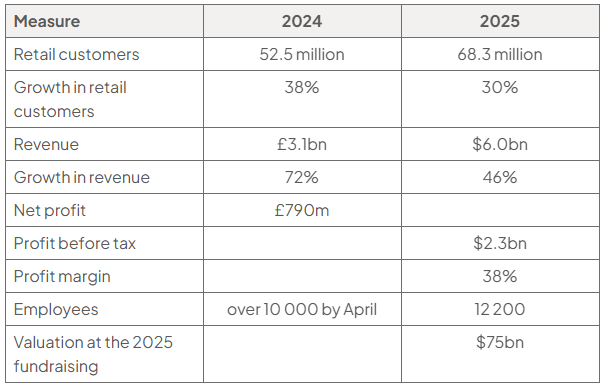
The numbers are remarkable. In 2024 it had 52.5 million retail customers, up 38%, revenue of £3.1 billion, up 72%, and net profit of £790 million. In 2025 customers rose another 30% to 68.3 million, group revenue rose 46% to 6.0 billion US dollars and profit before tax reached 2.3 billion US dollars, a profit margin of 38%. A fundraising in 2025 valued the company at 75 billion US dollars. The workforce passed 10 000 in April 2024 and reached 12 200 during 2025.

That growth has been built on a demanding set of stated values. Revolut tells its people to “get it done” and to “never settle”, alongside “deliver wow”, “think deeper” and “dream team”. Performance is measured against quarterly targets, and the company says the values are not posters on a wall but the basis on which people are hired, promoted and let go.

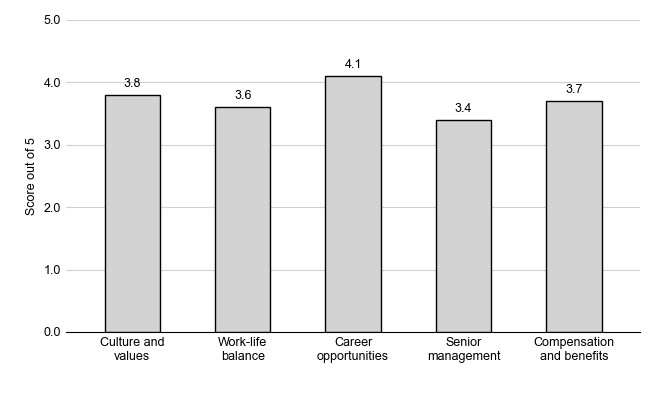
The culture that produces those results also attracts criticism. On the review site Glassdoor, 76% of employees say they would recommend Revolut to a friend, but the company scores 3.6 out of 5 for work-life balance and 3.8 for culture and values. A number of reviews describe meetings in which people are humiliated, managers who lack interpersonal skills, and so heavy a focus on quarterly targets that employees lose sight of anything else. Commentators have questioned whether people who are overworked and burnt out can be expected to be good colleagues, and the chief executive's management style has been criticised for creating long hours and high staff turnover.

Revolut has begun work on changing parts of its culture while insisting that the high-performance core of it stays.

Source: Revolut annual report 2024, Revolut results announcements 2025, and published reviews

Appendix B: Revolut's stated values and what employees say

Bar chart of Revolut Glassdoor scores out of 5: culture and values 3.8, work-life balance 3.6, career opportunities 4.1, senior management 3.4, and compensation and benefits 3.7.
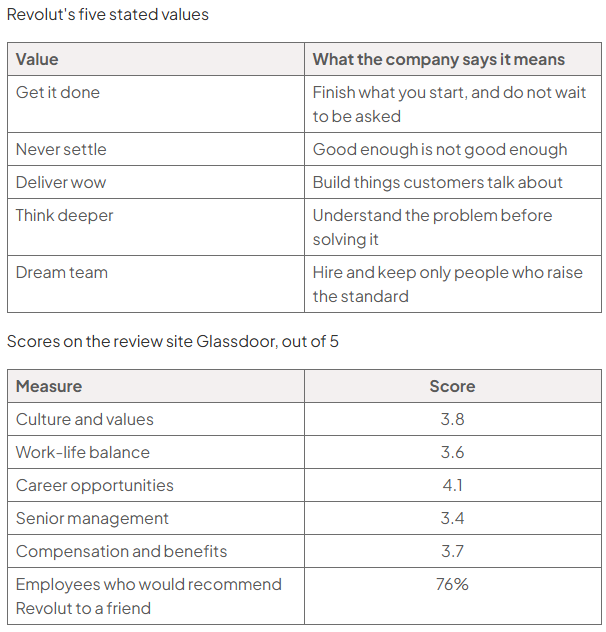
Two tables. Revolut's five stated values and what the company says each means: get it done, finish what you start and do not wait to be asked; never settle, good enough is not good enough; deliver wow, build things customers talk about; think deeper, understand the problem before solving it; dream team, hire and keep only people who raise the standard. Scores on the review site Glassdoor, out of 5: culture and values 3.8; work-life balance 3.6; career opportunities 4.1; senior management 3.4; compensation and benefits 3.7; 76% of employees would recommend Revolut to a friend.

Source: Revolut and published reviews
Analyse one way in which Revolut's value of “get it done” might affect the speed at which it brings new products to its customers.

2
6 marks

Source A: Harrowgate Mutual

Harrowgate Mutual sells home and motor insurance. It employs 300 people in Leeds, takes £86 million in premiums a year and made an operating profit of £4.2 million in the year to March 2025. It is a mutual, which means it has no shareholders and is owned by its policyholders.

Three years ago the regulator found that Harrowgate's telephone sales team had been selling add-on cover that many customers did not need and in some cases could never have claimed on. The company was fined £7.4 million and has paid £11.9 million back to customers.

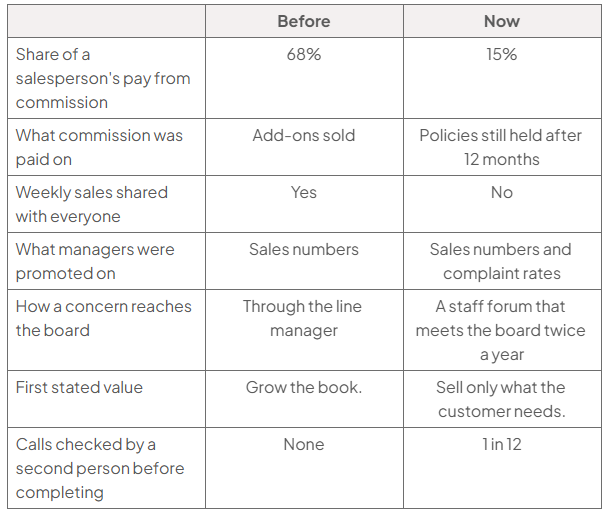
Nobody at Harrowgate set out to mis-sell. What happened was that 68% of a salesperson's pay came from commission, the commission was paid on the number of add-ons sold rather than on whether the customer kept the policy, and the weekly sales table was read out every Monday morning. Managers were promoted on the same numbers. When one team leader raised concerns in 2021 she was told the figures were the figures.

The new chief executive, Ama Boateng, arrived in early 2025 from a larger insurer. She has cut commission to 15% of pay, stopped the Monday sales table, created a staff forum that meets the board twice a year, and rewritten the company's values so that the first one is now “sell only what the customer needs”.

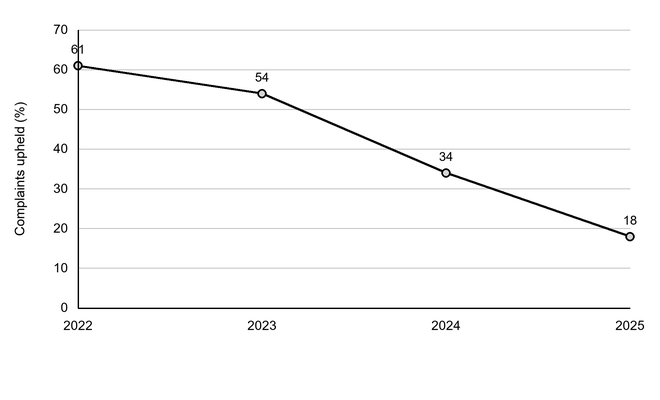
Some of it has worked. Complaints upheld against Harrowgate by the Financial Ombudsman Service have fallen sharply. Some of it has not. Sales of add-ons have fallen further than expected, a third of the original sales team has left, and several long-serving managers say privately that the company has swung from one extreme to the other and that nobody is now willing to ask a customer for anything.

Source: Harrowgate Mutual

Appendix C: How Harrowgate's sales team was managed, before and now

Table of how Harrowgate's sales team was managed before and now: share of a salesperson's pay from commission, 68% before and 15% now; what commission was paid on, add-ons sold before and policies still held after 12 months now; weekly sales shared with everyone, yes before and no now; what managers were promoted on, sales numbers before and sales numbers and complaint rates now; how a concern reaches the board, through the line manager before and a staff forum that meets the board twice a year now; first stated value, grow the book before and sell only what the customer needs now; calls checked by a second person before completing, none before and 1 in 12 now.

Source: Harrowgate Mutual

Analyse one way in which reading out a weekly sales table might have shaped the culture at Harrowgate Mutual.

3
6 marks

Source A: Patagonia

Patagonia makes outdoor clothing and equipment, and has spent fifty years arguing that people should buy less of it. It employs about 4 000 people worldwide, repairs what it has already sold through its Worn Wear programme, and has given 1% of its sales to grassroots environmental groups every year since 1985.

In September 2022 its founder, Yvon Chouinard, gave the company away. All the voting shares, which are 2% of the company, went to the Patagonia Purpose Trust, which exists to hold the company to its values. All the non-voting shares, the other 98%, went to the Holdfast Collective, a non-profit organisation that uses the money to fight the environmental crisis. The company was valued at about 3 billion US dollars at the time. Patagonia's own statement was short: Earth is now our only shareholder.

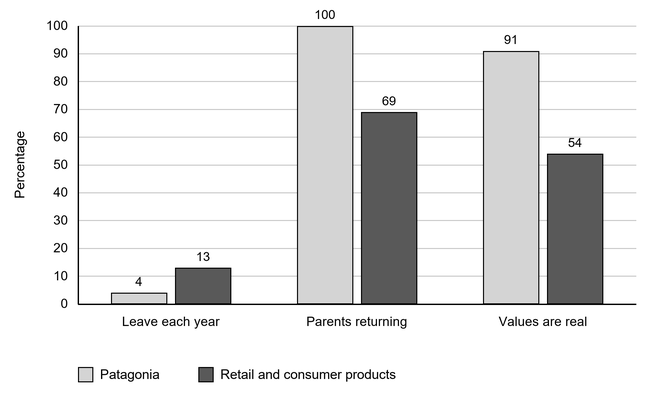
The culture inside the company is as unusual as the ownership. There has been childcare on site at head office for more than thirty years. Employees may take time out of the working day when the surf is up or the snow is good, on the understanding that the work still gets done. Very few people leave: about four in every hundred each year, against roughly thirteen in a hundred across retail and consumer products.

None of this removes the contradiction at the centre of the business. Patagonia sells clothing, and making clothing uses materials and energy. One per cent of sales goes to protecting nature; the other ninety-nine per cent goes on running a clothing company that would rather its customers mended what they already own.

Source: Patagonia Works

Appendix B: Patagonia compared with its sector

Grouped bar chart comparing Patagonia with retail and consumer products: percentages for leaving each year (4 vs 13), parents returning (100 vs 69), and saying values are real (91 vs 54); vertical axis 0 to 100%.
Tables compare Patagonia with its sector: annual departures 4% versus 13%, returning working parents 100% versus 69%, and staff saying values are lived 91% versus 54%. Other details include 30+ years’ childcare, flexible sports hours, Worn Wear and 4 000 staff.

Source: Analyst

Analyse one way in which only four employees in every hundred leaving each year might affect Patagonia's costs.

4
6 marks

Source A: Patagonia

Patagonia makes outdoor clothing and equipment, and has spent fifty years arguing that people should buy less of it. It employs about 4 000 people worldwide, repairs what it has already sold through its Worn Wear programme, and has given 1% of its sales to grassroots environmental groups every year since 1985.

In September 2022 its founder, Yvon Chouinard, gave the company away. All the voting shares, which are 2% of the company, went to the Patagonia Purpose Trust, which exists to hold the company to its values. All the non-voting shares, the other 98%, went to the Holdfast Collective, a non-profit organisation that uses the money to fight the environmental crisis. The company was valued at about 3 billion US dollars at the time. Patagonia's own statement was short: Earth is now our only shareholder.

The culture inside the company is as unusual as the ownership. There has been childcare on site at head office for more than thirty years. Employees may take time out of the working day when the surf is up or the snow is good, on the understanding that the work still gets done. Very few people leave: about four in every hundred each year, against roughly thirteen in a hundred across retail and consumer products.

None of this removes the contradiction at the centre of the business. Patagonia sells clothing, and making clothing uses materials and energy. One per cent of sales goes to protecting nature; the other ninety-nine per cent goes on running a clothing company that would rather its customers mended what they already own.

Source: Patagonia Works

Appendix C: What Patagonia stands for, and what cuts against it

Two stacked two-column tables: the first compares Patagonia’s stated principles with difficulties; the second lists five employee measures and figures, including 78%, 91%, Yes, 0 and 1 in 9.

Source: Analyst

Analyse one way in which asking customers to buy less clothing might affect Patagonia's revenue.

5
6 marks

Source A: Patagonia

Patagonia makes outdoor clothing and equipment, and has spent fifty years arguing that people should buy less of it. It employs about 4 000 people worldwide, repairs what it has already sold through its Worn Wear programme, and has given 1% of its sales to grassroots environmental groups every year since 1985.

In September 2022 its founder, Yvon Chouinard, gave the company away. All the voting shares, which are 2% of the company, went to the Patagonia Purpose Trust, which exists to hold the company to its values. All the non-voting shares, the other 98%, went to the Holdfast Collective, a non-profit organisation that uses the money to fight the environmental crisis. The company was valued at about 3 billion US dollars at the time. Patagonia's own statement was short: Earth is now our only shareholder.

The culture inside the company is as unusual as the ownership. There has been childcare on site at head office for more than thirty years. Employees may take time out of the working day when the surf is up or the snow is good, on the understanding that the work still gets done. Very few people leave: about four in every hundred each year, against roughly thirteen in a hundred across retail and consumer products.

None of this removes the contradiction at the centre of the business. Patagonia sells clothing, and making clothing uses materials and energy. One per cent of sales goes to protecting nature; the other ninety-nine per cent goes on running a clothing company that would rather its customers mended what they already own.

Source: Patagonia Works

Appendix C: What Patagonia stands for, and what cuts against it

Two stacked two-column tables: the first compares Patagonia’s stated principles with difficulties; the second lists five employee measures and figures, including 78%, 91%, Yes, 0 and 1 in 9.

Source: Analyst

Analyse one way in which 91% of employees saying the values are real rather than marketing might affect Patagonia's ability to recruit.

6
6 marks

Source A: Linmoor Software Ltd

Linmoor Software Ltd writes scheduling software for care homes and veterinary practices. Two developers founded it in 2017, it now employs 70 people, and in the year to March 2025 it had revenue of £8.6 million and an operating profit of £940 000. It keeps one office in Leeds with 24 desks, and 58 of its 70 people work mainly from home.

For the first few years everybody could hear everybody else. Decisions were made in the room, the founders knew what every customer wanted, and nobody needed telling what the company was for. Twenty-eight of the current staff joined in the last twelve months, nine of them live outside the United Kingdom, and the company works across four time zones.

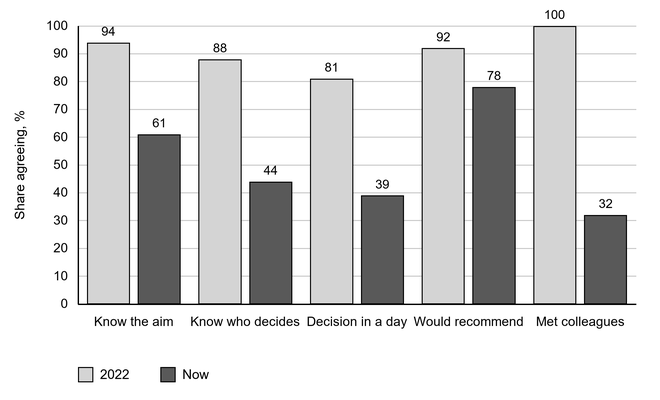
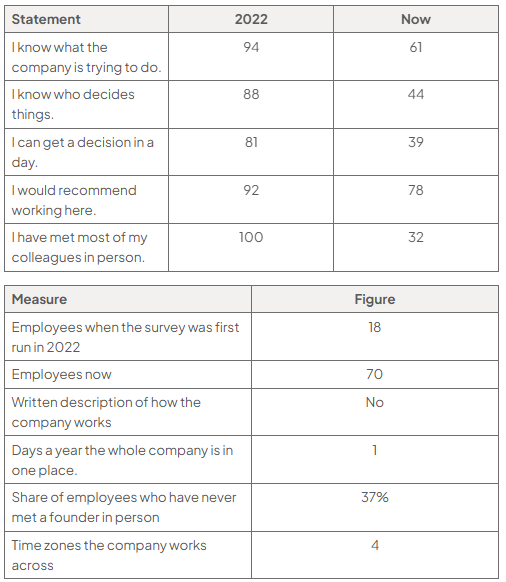
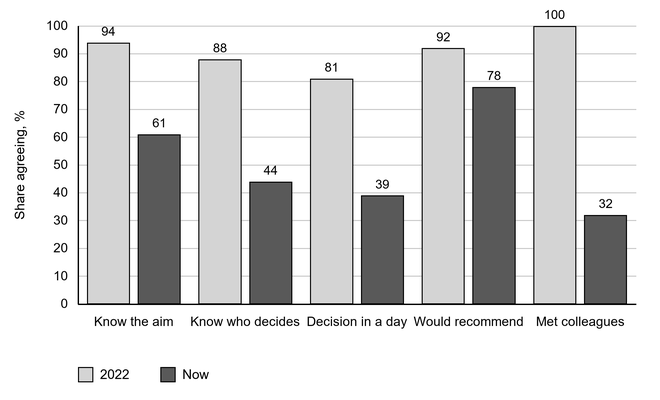
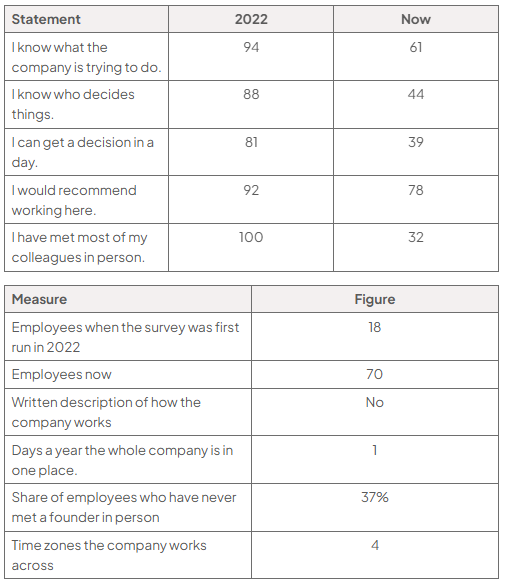
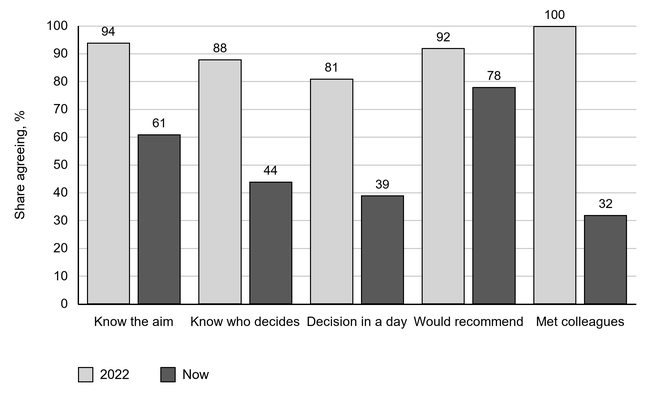
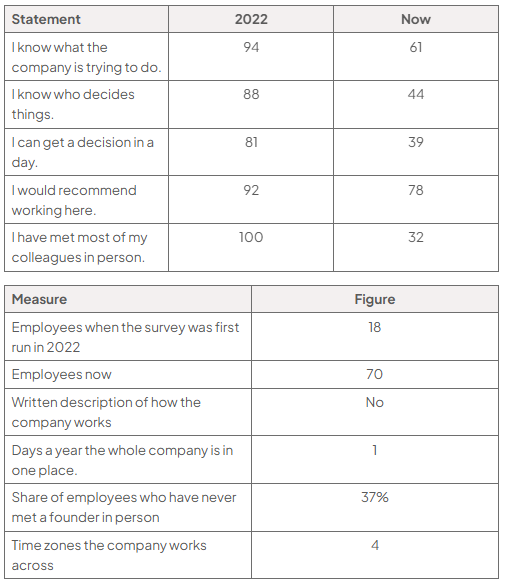
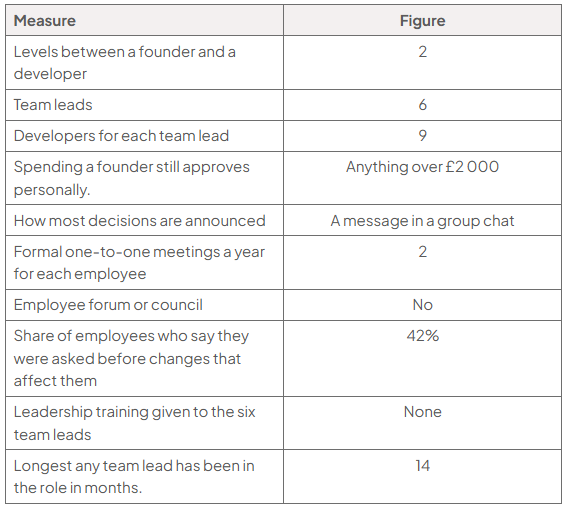
The annual survey has picked up what that has done. In 2022, when there were eighteen people, 88% said they knew who decided things. The same question now gets 44%. Only 32% have met most of their colleagues in person, and 37% have never met a founder.

Nothing has been written down. There is no description of how the company works, no employee forum, and most decisions are still announced in a group chat. The six team leads have had no leadership training, and the longest any of them has been in the role is fourteen months. Both founders still personally approve any spending over £2 000.

The whole company is together in one place once a year. The board has been asked whether that is enough.

Source: Linmoor Software Ltd

Appendix B: What Linmoor's people said in 2022, and what they say now

Bar chart of employees agreeing with five statements: 2022 versus now. Shares fall from 94% to 61% knowing the aim, 88% to 44% who decides, 81% to 39% decisions in a day, 92% to 78% recommending, and 100% to 32% meeting colleagues.
Two tables show Linmoor survey data: 2022 versus now for knowing the aim (94%, 61%), who decides (88%, 44%), decisions in a day (81%, 39%), recommending work (92%, 78%) and meeting colleagues (100%, 32%); the second lists company measures.

Source: Analyst

Analyse one way in which the share of employees who say they know who decides things falling from 88% to 44% might affect Linmoor Software Ltd.

7
6 marks

Source A: Monzo

Monzo is a digital bank with no branches. In the year to 31 March 2025 revenue passed £1 billion for the first time, rising 48% to £1.2 billion, and adjusted profit before tax went from £13.9 million to £113.9 million. It now has more than 12 million customers, including about 625 000 business customers. Of the 2.4 million customers who joined during the year, more than two thirds came by word of mouth.

It grew up on an unusually open way of working. Most internal channels could be read by anybody in the company, decisions were argued out where everyone could see them, and employees were expected to say when they thought something was wrong. That was straightforward when there were a few hundred people.

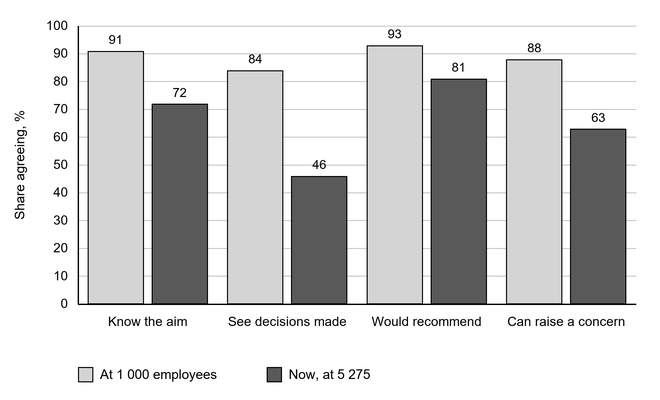
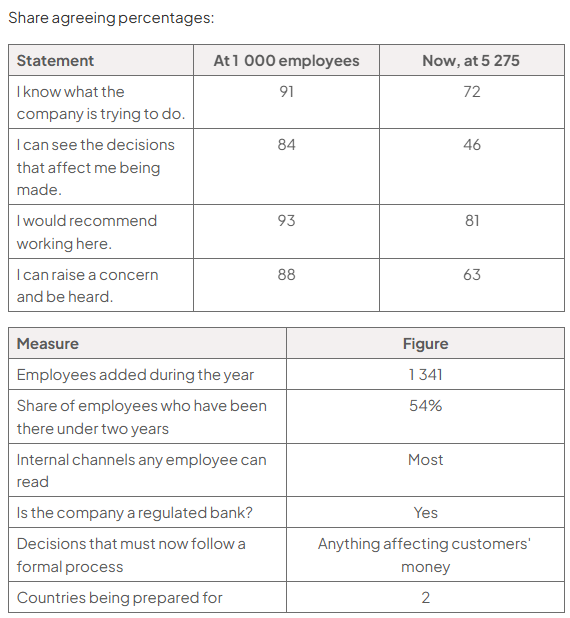
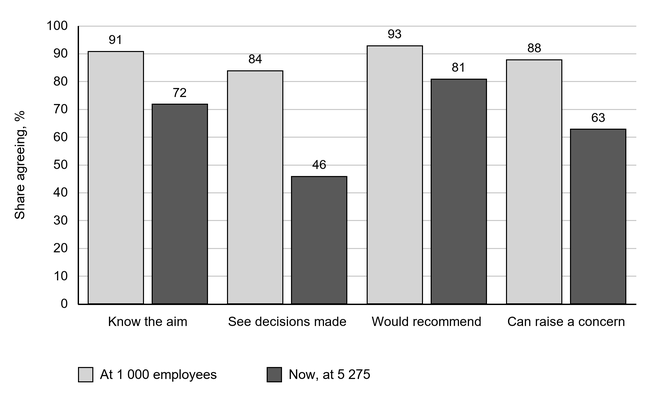
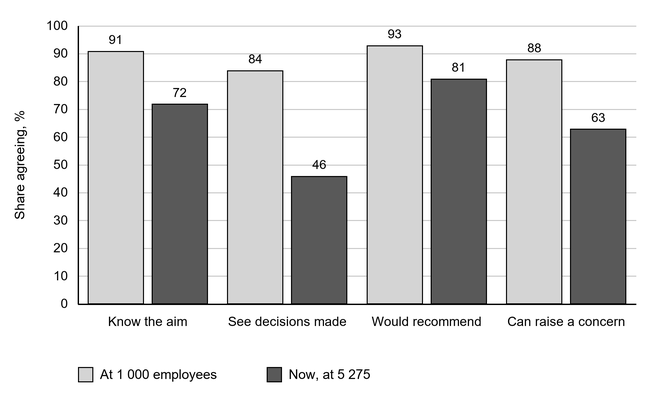
There are now 5 275, a rise of 34% in a year, and more than half of them have been there under two years. The culture survey has moved with the size. The share who say they can see the decisions that affect them being made has fallen from 84% to 46%, and the share who say they can raise a concern and be heard from 88% to 63%.

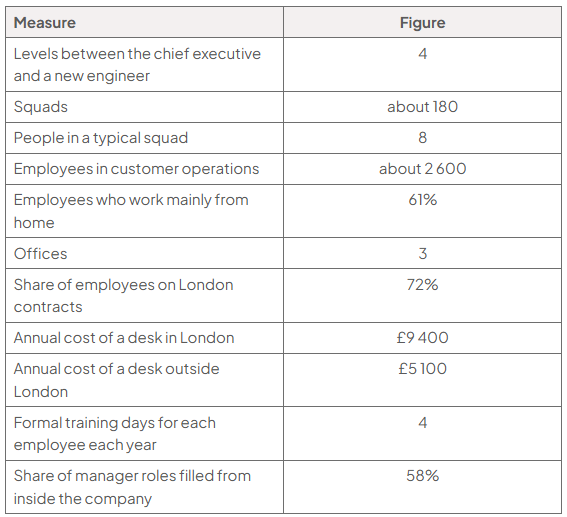
Two other things have changed. Monzo is a regulated bank, so anything affecting customers' money now has to follow a formal process rather than a conversation in a channel, and some information cannot be visible to 5 275 people at all. And 61% of employees work mainly from home, across three offices, with 72% on London contracts.

The board is preparing to launch in two more countries and wants to know what it is prepared to change.

Source: Monzo Bank Limited Annual Report for the year ended 31 March 2025

Appendix B: What Monzo's people said at 1 000 employees, and what they say now

Bar chart of employee agreement at 1 000 and 5 275 employees. Percentages fall from 91 to 72 (aim), 84 to 46 (decisions), 93 to 81 (recommend), and 88 to 63 (concern).
Two tables. Share agreeing, at 1 000 employees and now at 5 275: I know what the company is trying to do, 91 and 72; I can see the decisions that affect me being made, 84 and 46; I would recommend working here, 93 and 81; I can raise a concern and be heard, 88 and 63. A table of measures: 1 341 employees added during the year; 54% of employees have been there under two years; most internal channels can be read by any employee; the company is a regulated bank; anything affecting customers' money must now follow a formal process; 2 countries being prepared for.

Source: Analyst

Analyse one way in which the share of employees who say they can see decisions being made falling from 84% to 46% might affect Monzo.

1
9 marks

Source B: Netflix

Netflix is one of the world's leading entertainment services. It employs around 13 000 people. The company has over 430 million shares. It has never paid a dividend. It has more than 247 million paid memberships in over 190 countries. Members enjoy TV series, films and games across a wide variety of genres and in over 30 languages. Members can play, pause and resume watching Netflix's content as much as they want: anytime and anywhere. Netflix's competitors include Disney+, Amazon Prime, HBO and Paramount.

The use of advanced digital technology affects all aspects of Netflix's operations. For example, it:

  • enables the smooth streaming of content

  • adjusts the quality of the video for the platform it is viewed on

  • enables the production of high-quality content

  • enhances users' experience on the Netflix site through features such as efficient search functions and personalised recommendations of content.

Netflix aims for diversity in its workforce. Its employees are paid top rates for what they do. Netflix claims it has a unique culture. Netflix's leaders highlight the importance of collaboration and creativity. 3% of Netflix employees work remotely compared to a national average of 14%. There are very few rules at the business because Netflix trusts employees to make the right choices. Employees are empowered and given the freedom to decide what to do and delegation is high but, in return, must take responsibility for their actions. The company expects employees to be high performers and excellent team players. Underperformers are asked to leave. For every significant decision, Netflix identifies an "informed captain of the ship". This person is an expert in their area and is responsible for listening to other people's views and then making a judgment call on the right way forward.

Source: information sourced from Netflix, 2024

Assess how important the culture of Netflix is likely to be in determining its competitiveness.

2
9 marks

Source A: Revolut

Revolut is a digital bank. It has no branches: customers open an account on their phone, usually in minutes, and use it to spend, send and exchange money. It was founded in London in 2015 by Nik Storonsky and has grown faster than almost any European business of its size.

The numbers are remarkable. In 2024 it had 52.5 million retail customers, up 38%, revenue of £3.1 billion, up 72%, and net profit of £790 million. In 2025 customers rose another 30% to 68.3 million, group revenue rose 46% to 6.0 billion US dollars and profit before tax reached 2.3 billion US dollars, a profit margin of 38%. A fundraising in 2025 valued the company at 75 billion US dollars. The workforce passed 10 000 in April 2024 and reached 12 200 during 2025.

That growth has been built on a demanding set of stated values. Revolut tells its people to “get it done” and to “never settle”, alongside “deliver wow”, “think deeper” and “dream team”. Performance is measured against quarterly targets, and the company says the values are not posters on a wall but the basis on which people are hired, promoted and let go.

The culture that produces those results also attracts criticism. On the review site Glassdoor, 76% of employees say they would recommend Revolut to a friend, but the company scores 3.6 out of 5 for work-life balance and 3.8 for culture and values. A number of reviews describe meetings in which people are humiliated, managers who lack interpersonal skills, and so heavy a focus on quarterly targets that employees lose sight of anything else. Commentators have questioned whether people who are overworked and burnt out can be expected to be good colleagues, and the chief executive's management style has been criticised for creating long hours and high staff turnover.

Revolut has begun work on changing parts of its culture while insisting that the high-performance core of it stays.

Source: Revolut annual report 2024, Revolut results announcements 2025, and published reviews

Appendix A: Selected data for Revolut

Table comparing Revolut’s selected customer, revenue, profit, employee and valuation data for 2024 and 2025: retail customers 52.5 million and 68.3 million, growth in retail customers 38% and 30%, revenue £3.1bn and 6.0bn US dollars, growth in revenue 72% and 46%, net profit £790m in 2024, profit before tax 2.3bn US dollars and profit margin 38% in 2025, employees over 10 000 by April 2024 and 12 200 in 2025, and a valuation of 75bn US dollars at the 2025 fundraising.

Source: Revolut

Appendix B: Revolut's stated values and what employees say

Bar chart of Glassdoor scores out of 5: culture and values 3.8, work-life balance 3.6, career opportunities 4.1, senior management 3.4, and compensation and benefits 3.7. Career opportunities score highest; senior management lowest.
Two tables. Revolut's five stated values and what the company says each means: get it done, finish what you start and do not wait to be asked; never settle, good enough is not good enough; deliver wow, build things customers talk about; think deeper, understand the problem before solving it; dream team, hire and keep only people who raise the standard. Scores on the review site Glassdoor, out of 5: culture and values 3.8; work-life balance 3.6; career opportunities 4.1; senior management 3.4; compensation and benefits 3.7; 76% of employees would recommend Revolut to a friend.

Source: Revolut and published reviews

Assess whether Revolut's culture has been the main reason for its financial success.

3
9 marks

Source A: Harrowgate Mutual

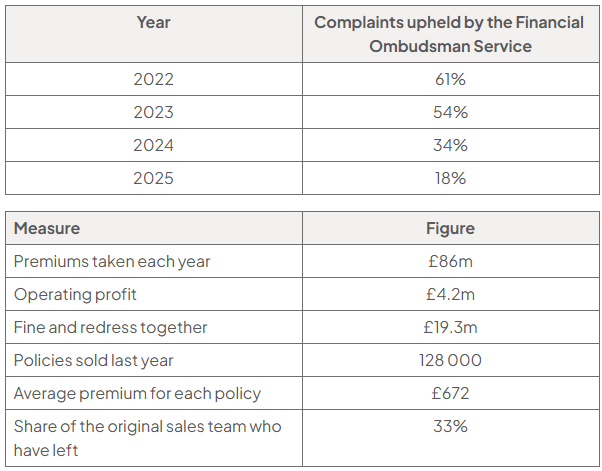
Harrowgate Mutual sells home and motor insurance. It employs 300 people in Leeds, takes £86 million in premiums a year and made an operating profit of £4.2 million in the year to March 2025. It is a mutual, which means it has no shareholders and is owned by its policyholders.

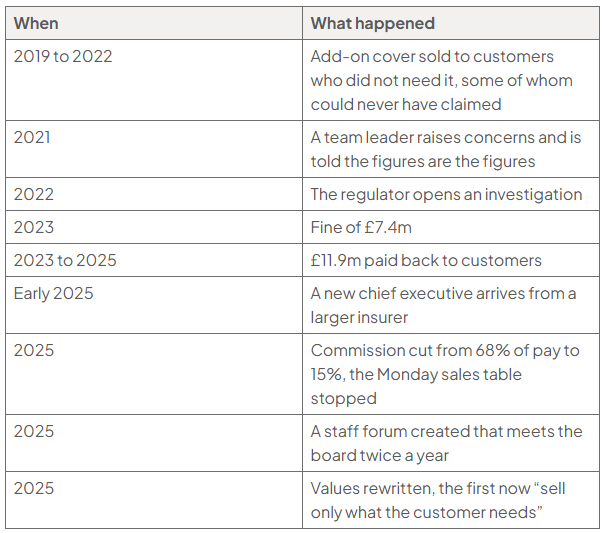
Three years ago the regulator found that Harrowgate's telephone sales team had been selling add-on cover that many customers did not need and in some cases could never have claimed on. The company was fined £7.4 million and has paid £11.9 million back to customers.

Nobody at Harrowgate set out to mis-sell. What happened was that 68% of a salesperson's pay came from commission, the commission was paid on the number of add-ons sold rather than on whether the customer kept the policy, and the weekly sales table was read out every Monday morning. Managers were promoted on the same numbers. When one team leader raised concerns in 2021 she was told the figures were the figures.

The new chief executive, Ama Boateng, arrived in early 2025 from a larger insurer. She has cut commission to 15% of pay, stopped the Monday sales table, created a staff forum that meets the board twice a year, and rewritten the company's values so that the first one is now “sell only what the customer needs”.

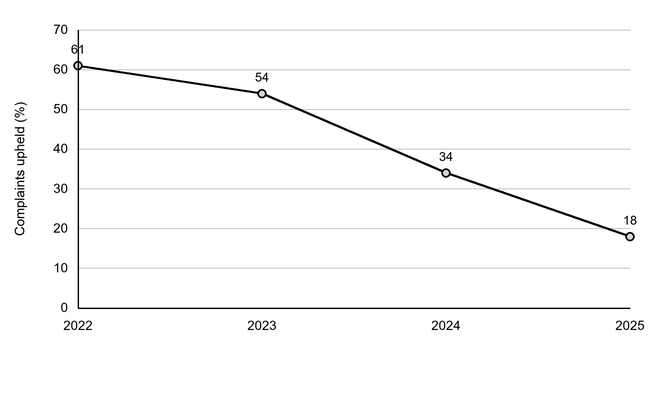
Some of it has worked. Complaints upheld against Harrowgate by the Financial Ombudsman Service have fallen sharply. Some of it has not. Sales of add-ons have fallen further than expected, a third of the original sales team has left, and several long-serving managers say privately that the company has swung from one extreme to the other and that nobody is now willing to ask a customer for anything.

Source: Harrowgate Mutual

Appendix A: What happened at Harrowgate Mutual

Timeline table of Harrowgate Mutual: 2019 to 2022, add-on cover sold to customers who did not need it, some of whom could never have claimed; 2021, concerns raised; 2022, investigation; 2023, £7.4m fine; 2023 to 2025, £11.9m repaid; early 2025, new chief executive; 2025, commission cut from 68% to 15%, sales table stopped, staff forum created, and values rewritten.

Source: Harrowgate Mutual

Appendix B: Complaints and sales at Harrowgate Mutual

Line graph of complaints upheld by the Financial Ombudsman Service, 2022 to 2025: percentage falls from 61% in 2022 to 54% in 2023, 34% in 2024 and 18% in 2025. y-axis 0 to 70%.
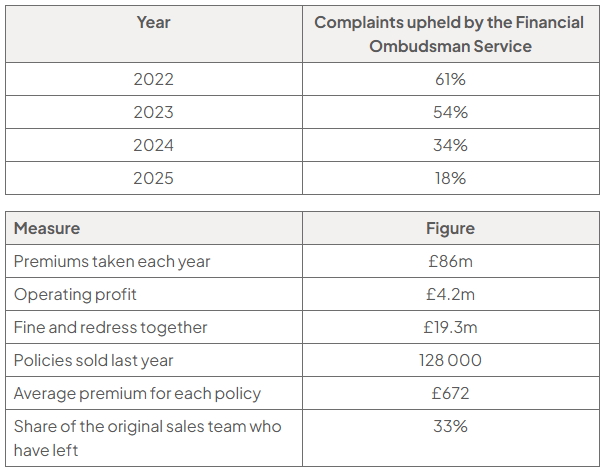
Two tables: complaints upheld fall from 61% in 2022 to 18% in 2025; figures include annual premiums £86m, operating profit £4.2m, fine and redress £19.3m, 128 000 policies, £672 average premium and 33% staff leaving.

Source: Harrowgate Mutual

Assess the cost to Harrowgate Mutual of the culture that led to the mis-selling.

Calculate Harrowgate Mutual's operating profit margin to support your answer.

4
9 marks

Source A: Linmoor Software Ltd

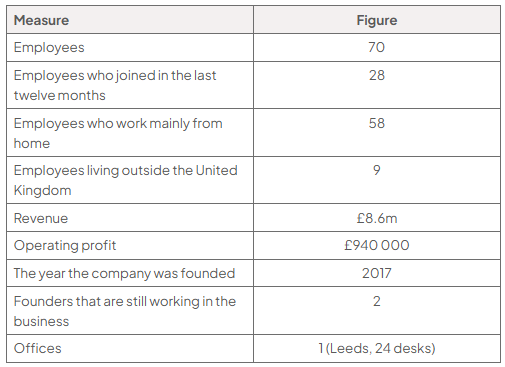
Linmoor Software Ltd writes scheduling software for care homes and veterinary practices. Two developers founded it in 2017, it now employs 70 people, and in the year to March 2025 it had revenue of £8.6 million and an operating profit of £940 000. It keeps one office in Leeds with 24 desks, and 58 of its 70 people work mainly from home.

For the first few years everybody could hear everybody else. Decisions were made in the room, the founders knew what every customer wanted, and nobody needed telling what the company was for. Twenty-eight of the current staff joined in the last twelve months, nine of them live outside the United Kingdom, and the company works across four time zones.

The annual survey has picked up what that has done. In 2022, when there were eighteen people, 88% said they knew who decided things. The same question now gets 44%. Only 32% have met most of their colleagues in person, and 37% have never met a founder.

Nothing has been written down. There is no description of how the company works, no employee forum, and most decisions are still announced in a group chat. The six team leads have had no leadership training, and the longest any of them has been in the role is fourteen months. Both founders still personally approve any spending over £2 000.

The whole company is together in one place once a year. The board has been asked whether that is enough.

Source: Linmoor Software Ltd

Appendix A: Linmoor Software Ltd selected data, year to March 2025

Table of Linmoor’s selected data: 70 employees; 28 joined in the last 12 months; 58 mainly work from home; 9 live outside the UK; revenue £8.6m; operating profit £940,000; founded 2017; 2 founders; 1 Leeds office with 24 desks.

Source: Linmoor Software Ltd

Appendix B: What Linmoor's people said in 2022, and what they say now

Bar chart of staff survey responses, showing lower agreement now than in 2022: know the aim 94% to 61%, who decides 88% to 44%, decision in a day 81% to 39%, recommend 92% to 78%, met colleagues 100% to 32%.

Share agreeing, percentages

Two tables compare staff survey agreement in 2022 and now, showing declines across five statements, and list growth from 18 to 70 employees, no written description, one company-wide day, 37% never meeting a founder, and four time zones.

Source: Analyst

Assess the effect that growing from 18 employees to 70 has had on Linmoor Software Ltd's culture.

Calculate Linmoor Software Ltd's sales per employee to support your answer.

5
9 marks

Source A: Monzo

Monzo is a digital bank with no branches. In the year to 31 March 2025 revenue passed £1 billion for the first time, rising 48% to £1.2 billion, and adjusted profit before tax went from £13.9 million to £113.9 million. It now has more than 12 million customers, including about 625 000 business customers. Of the 2.4 million customers who joined during the year, more than two thirds came by word of mouth.

It grew up on an unusually open way of working. Most internal channels could be read by anybody in the company, decisions were argued out where everyone could see them, and employees were expected to say when they thought something was wrong. That was straightforward when there were a few hundred people.

There are now 5 275, a rise of 34% in a year, and more than half of them have been there under two years. The culture survey has moved with the size. The share who say they can see the decisions that affect them being made has fallen from 84% to 46%, and the share who say they can raise a concern and be heard from 88% to 63%.

Two other things have changed. Monzo is a regulated bank, so anything affecting customers' money now has to follow a formal process rather than a conversation in a channel, and some information cannot be visible to 5 275 people at all. And 61% of employees work mainly from home, across three offices, with 72% on London contracts.

The board is preparing to launch in two more countries and wants to know what it is prepared to change.

Source: Monzo Bank Limited Annual Report for the year ended 31 March 2025

Appendix A: Monzo, published figures for the year to 31 March 2025

Table of Monzo measures: four levels between chief executive and new engineer; about 180 squads of eight; about 2 600 customer-operations employees; 61% mainly home-based; three offices; 72% on London contracts. Desk costs: £9 400 London, £5 100 elsewhere; four training days; 58% of managers appointed internally.

Source: Monzo Bank Limited

Appendix B: What Monzo's people said at 1 000 employees, and what they say now

Grouped bar chart of employee agreement at 1 000 and 5 275 employees: know the aim 91% vs 72%; see decisions made 84% vs 46%; recommend working there 93% vs 81%; raise a concern 88% vs 63%.
Two tables. Share agreeing, at 1 000 employees and now at 5 275: I know what the company is trying to do, 91 and 72; I can see the decisions that affect me being made, 84 and 46; I would recommend working here, 93 and 81; I can raise a concern and be heard, 88 and 63. A table of measures: 1 341 employees added during the year; 54% of employees have been there under two years; most internal channels can be read by any employee; the company is a regulated bank; anything affecting customers' money must now follow a formal process; 2 countries being prepared for.

Source: Analyst

Assess how far Monzo's culture has been a cause of its growth.

Calculate Monzo's sales per employee to support your answer.

1
15 marks

Source A: Harrowgate Mutual

Harrowgate Mutual sells home and motor insurance. It employs 300 people in Leeds, takes £86 million in premiums a year and made an operating profit of £4.2 million in the year to March 2025. It is a mutual, which means it has no shareholders and is owned by its policyholders.

Three years ago the regulator found that Harrowgate's telephone sales team had been selling add-on cover that many customers did not need and in some cases could never have claimed on. The company was fined £7.4 million and has paid £11.9 million back to customers.

Nobody at Harrowgate set out to mis-sell. What happened was that 68% of a salesperson's pay came from commission, the commission was paid on the number of add-ons sold rather than on whether the customer kept the policy, and the weekly sales table was read out every Monday morning. Managers were promoted on the same numbers. When one team leader raised concerns in 2021 she was told the figures were the figures.

The new chief executive, Ama Boateng, arrived in early 2025 from a larger insurer. She has cut commission to 15% of pay, stopped the Monday sales table, created a staff forum that meets the board twice a year, and rewritten the company's values so that the first one is now “sell only what the customer needs”.

Some of it has worked. Complaints upheld against Harrowgate by the Financial Ombudsman Service have fallen sharply. Some of it has not. Sales of add-ons have fallen further than expected, a third of the original sales team has left, and several long-serving managers say privately that the company has swung from one extreme to the other and that nobody is now willing to ask a customer for anything.

Source: Harrowgate Mutual

Appendix B: Complaints and sales at Harrowgate Mutual

Line chart of complaints upheld by the Financial Ombudsman Service, falling from 61% in 2022 to 54% in 2023, 34% in 2024 and 18% in 2025; years on the x-axis and percentage on the y-axis.
Harrowgate Mutual tables: Ombudsman complaints upheld: 2022 61%, 2023 54%, 2024 34%, 2025 18%; premiums £86m; operating profit £4.2m; fine and redress £19.3m; 128 000 policies; average premium £672; sales team left 33%.

Source: Harrowgate Mutual

Appendix D: Two ways of making sure Harrowgate sells only what customers need

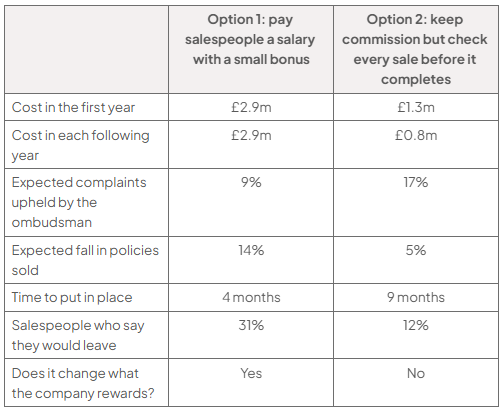
Comparison of Option 1 (salary plus small bonus) and Option 2 (commission with pre-sale checks): first-year cost £2.9m/£1.3m; later £2.9m/£0.8m; upheld complaints 9%/17%; sales fall 14%/5%; setup 4/9 months; leavers 31%/12%; rewards change yes/no.

Policies sold last year = 128 000, at an average premium of £672

Source: Analyst

Harrowgate Mutual is considering two ways of making sure it sells only what customers need:

Option 1: pay salespeople a salary with a small bonus

Option 2: keep commission but check every sale before it completes

Evaluate both options and recommend which one Harrowgate Mutual should choose.

Calculate Harrowgate Mutual's revenue under Option 1 to support your answer.

2
15 marks

Source A: Linmoor Software Ltd

Linmoor Software Ltd writes scheduling software for care homes and veterinary practices. Two developers founded it in 2017, it now employs 70 people, and in the year to March 2025 it had revenue of £8.6 million and an operating profit of £940 000. It keeps one office in Leeds with 24 desks, and 58 of its 70 people work mainly from home.

For the first few years everybody could hear everybody else. Decisions were made in the room, the founders knew what every customer wanted, and nobody needed telling what the company was for. Twenty-eight of the current staff joined in the last twelve months, nine of them live outside the United Kingdom, and the company works across four time zones.

The annual survey has picked up what that has done. In 2022, when there were eighteen people, 88% said they knew who decided things. The same question now gets 44%. Only 32% have met most of their colleagues in person, and 37% have never met a founder.

Nothing has been written down. There is no description of how the company works, no employee forum, and most decisions are still announced in a group chat. The six team leads have had no leadership training, and the longest any of them has been in the role is fourteen months. Both founders still personally approve any spending over £2 000.

The whole company is together in one place once a year. The board has been asked whether that is enough.

Source: Linmoor Software Ltd

Appendix B: What Linmoor's people said in 2022, and what they say now

Grouped bar chart of the share of Linmoor's people agreeing with each statement, in 2022 and now: know the aim, 94% and 61%; know who decides, 88% and 44%; decision in a day, 81% and 39%; would recommend, 92% and 78%; met colleagues, 100% and 32%. The vertical axis runs from 0% to 100%.

Share agreeing, percentages

Two tables. Share agreeing in 2022 and now: I know what the company is trying to do, 94% and 61%; I know who decides things, 88% and 44%; I can get a decision in a day, 81% and 39%; I would recommend working here, 92% and 78%; I have met most of my colleagues in person, 100% and 32%. A table of measures: 18 employees when the survey was first run in 2022; 70 employees now; no written description of how the company works; 1 day a year the whole company is in one place; 37% of employees have never met a founder in person; the company works across 4 time zones.

Source: Analyst

Appendix C: How Linmoor is led and how decisions get made

Table of how Linmoor is led: 2 levels between a founder and a developer; 6 team leads; 9 developers for each team lead; a founder still personally approves any spending over £2 000; most decisions are announced by a message in a group chat; 2 formal one-to-one meetings a year for each employee; no employee forum or council; 42% of employees say they were asked before changes that affect them; no leadership training given to the six team leads; 14 months is the longest any team lead has been in the role.

Source: Analyst

Appendix D: Two ways of holding the culture together

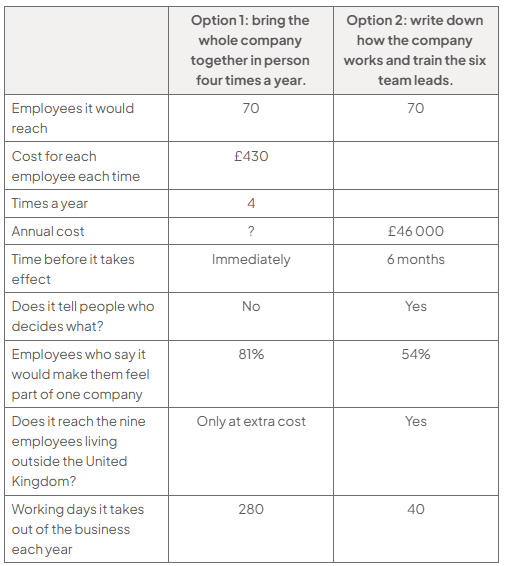
Comparison table: Option 1 brings 70 employees together four times yearly at £430 each time (annual cost not provided); it acts immediately, but does not clarify decisions, reaches overseas staff only at extra cost, and takes 280 working days. Option 2 costs £46 000 yearly, takes six months, clarifies decisions, reaches overseas staff and takes 40 days; 81% versus 54% feel part of one company.

70 employees, operating profit £940 000

Source: Analyst

Linmoor Software Ltd is considering two ways of holding its culture together:

Option 1: bring the whole company together in person four times a year

Option 2: write down how the company works and train the six team leads

Evaluate both options and recommend which one Linmoor Software Ltd should choose.

Calculate the annual cost of Option 1 to support your answer.

3
15 marks

Source A: Monzo

Monzo is a digital bank with no branches. In the year to 31 March 2025 revenue passed £1 billion for the first time, rising 48% to £1.2 billion, and adjusted profit before tax went from £13.9 million to £113.9 million. It now has more than 12 million customers, including about 625 000 business customers. Of the 2.4 million customers who joined during the year, more than two thirds came by word of mouth.

It grew up on an unusually open way of working. Most internal channels could be read by anybody in the company, decisions were argued out where everyone could see them, and employees were expected to say when they thought something was wrong. That was straightforward when there were a few hundred people.

There are now 5 275, a rise of 34% in a year, and more than half of them have been there under two years. The culture survey has moved with the size. The share who say they can see the decisions that affect them being made has fallen from 84% to 46%, and the share who say they can raise a concern and be heard from 88% to 63%.

Two other things have changed. Monzo is a regulated bank, so anything affecting customers' money now has to follow a formal process rather than a conversation in a channel, and some information cannot be visible to 5 275 people at all. And 61% of employees work mainly from home, across three offices, with 72% on London contracts.

The board is preparing to launch in two more countries and wants to know what it is prepared to change.

Source: Monzo Bank Limited Annual Report for the year ended 31 March 2025

Appendix B: What Monzo's people said at 1 000 employees, and what they say now

Bar chart comparing employee agreement at 1 000 and 5 275 employees: know the aim, 91% versus 72%; see decisions made, 84% versus 46%; recommend working there, 93% versus 81%; raise a concern, 88% versus 63%.
Two tables. Share agreeing, at 1 000 employees and now at 5 275: I know what the company is trying to do, 91 and 72; I can see the decisions that affect me being made, 84 and 46; I would recommend working here, 93 and 81; I can raise a concern and be heard, 88 and 63. A table of measures: 1 341 employees added during the year; 54% of employees have been there under two years; most internal channels can be read by any employee; the company is a regulated bank; anything affecting customers' money must now follow a formal process; 2 countries being prepared for.

Source: Analyst

Appendix C: How Monzo is organised and where its people work

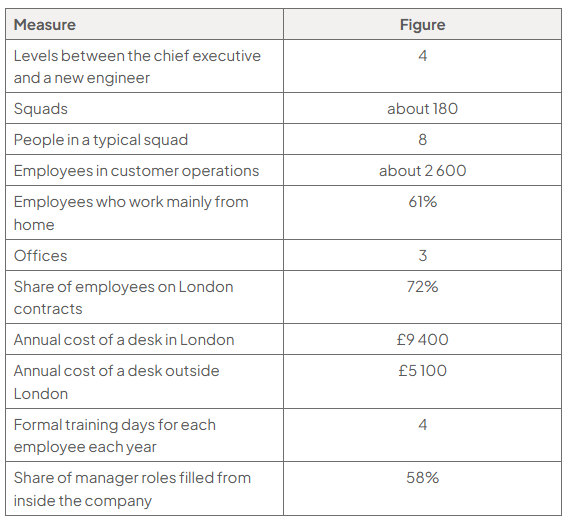
Table of how Monzo is organised: 4 levels between the chief executive and a new engineer; about 180 squads; 8 people in a typical squad; about 2 600 employees in customer operations; 61% of employees work mainly from home; 3 offices; 72% of employees on London contracts; annual cost of a desk £9 400 in London and £5 100 outside London; 4 formal training days for each employee each year; 58% of manager roles filled from inside the company.

Source: Analyst

Appendix D: Two ways of keeping the culture as Monzo gets bigger

Revenue of £1.2bn came from more than 12 million customers.

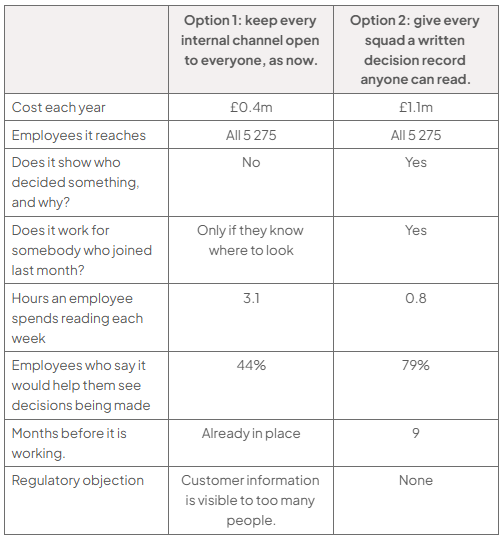
Comparison table of Monzo’s culture options: open channels versus written squad decision records. Costs £0.4m/£1.1m; transparency no/yes; reading 3.1/0.8 hours weekly; support 44%/79%; implementation now/9 months; objections: privacy/none.

Source: Analyst

Monzo is considering two ways of keeping its culture as it gets bigger:

Option 1: keep every internal channel open to everyone, as now

Option 2: give every squad a written decision record anyone can read

Evaluate both options and recommend which one Monzo should choose.

Calculate Monzo's sales per employee to support your answer.