Strategy & Planning (AQA A Level Business): Exam Questions

Exam code: 7132

Syllabus Edition

First teaching 2026

First exams 2028

3 hours17 questions
1
6 marks

Source A: Trainline

Trainline plc, which is listed on the London Stock Exchange, sells rail and coach tickets through its app and website in the UK and across Europe. It also provides ticketing technology to train operators and to travel management companies, which book travel for businesses. Its app is the most downloaded rail app in Europe.

Trainline earns its revenue mainly as commission on the tickets it sells. In April 2025 its commission on UK online ticket sales fell from 5.0% to 4.5%, under a rail industry agreement announced in 2022.

In the year to 28 February 2026:

  • it sold tickets worth £6 319 million, up 7%, to 27 million customers, 18 million of them in the UK

  • revenue rose by 2% to £453 million, while UK revenue fell by 2%

  • adjusted EBITDA was 2.80% of the value of tickets sold; the target for the year to February 2027 is about 2.9%

Growth in the UK slowed in the second half of the year. Trainline identified three causes:

  • Contactless payment. Transport for London is expanding contactless payment, which lets passengers travel by tapping a bank card without buying a ticket.

  • Operators' websites. Train operators have encouraged customers to use their own websites, including by offering automatic delay compensation, which independent retailers such as Trainline were not allowed to offer.

  • Fares. The government has frozen regulated rail fares until March 2027.

The government is creating Great British Railways to run most of the railway; its online retailer is expected eventually to replace the operators' websites. In March 2026 the government announced that passengers will then be able to claim delay compensation wherever they bought their ticket, including through Trainline.

In the first half of the year, sales to foreign travellers fell after Google changed its search results page. Trainline has made its app available within ChatGPT and introduced artificial intelligence features which help customers when trains are disrupted. Young people are among its most important customers: 45% of railcard holders aged 16 to 30 use a Trainline digital railcard, held on their phone.

Source: Trainline plc, Results for the twelve months ended 28 February 2026

Trainline's adjusted EBITDA was 2.80% of the value of the tickets it sold in the year to February 2026. It aims for about 2.9% in the year to February 2027.

Analyse one way in which setting an objective for adjusted EBITDA as a percentage of ticket sales might help Trainline's managers.

2
6 marks

Source A: Burberry

Burberry Group plc is a British luxury fashion brand, headquartered in London and listed on the London Stock Exchange, where it is a member of the FTSE 100. It was founded in 1856 by Thomas Burberry, whose gabardine fabric and trench coat became the basis of the brand. It sells mainly through its own stores, of which there were 410 at 28 March 2026, and online. It also sells to other retailers and earns income from licences.

In the 52 weeks to 29 March 2025 Burberry's comparable store sales fell by 12% and its adjusted operating profit fell to £26 million. Joshua Schulman, who became Chief Executive in July 2024, launched a strategy called Burberry Forward in November 2024. Its aims include restoring the brand's cultural relevance and asserting its authority in outerwear and scarves before extending that success to other categories.

In the 52 weeks to 28 March 2026 Burberry's revenue was £2 420 million, compared with £2 461 million the year before, while comparable store sales rose by 2% and adjusted operating profit rose to £160 million. The Chief Executive described the year as "a meaningful inflection point". During the year the company:

  • achieved savings in operating costs of £80 million, while continuing to invest in marketing;

  • spent £45 million on restructuring, mainly on redundancies and consultancy;

  • opened 200 scarf bars in its stores;

  • increased e-commerce sales by a percentage in the high teens;

  • opened 9 stores and closed 21.

Outerwear sold better than other categories in every region, scarves grew throughout the year, and sales of leather goods improved in the second half.

Sales growth differed between regions. In Europe, the Middle East, India and Africa, sales were held back by a fall in tourist numbers. In Japan, sales fell by 6% in the final quarter as fewer visitors arrived, while South Korea grew by 13%, helped by visitors from China. In Greater China and the Americas, sales in the final quarter grew by 10%, driven by local customers.

For the year to March 2027 Burberry expects to increase both its revenue and its profit margin, but says it is mindful of the uncertain economic and political environment.

Source: Burberry Group plc, Preliminary Results, 14 May 2026

In the year to 28 March 2026 Burberry's comparable store sales rose by 2% while its revenue fell from £2 461 million to £2 420 million. During the year it opened 9 stores and closed 21.

Analyse one way in which comparable store sales might give Burberry's managers a better measure of its performance than total revenue.

3
6 marks

Source B: Swanmoor Knitwear

Swanmoor Knitwear Limited makes knitted jumpers, cardigans and scarves at a factory in Hinckley, Leicestershire, a town with a long history of knitwear manufacturing. The company was founded in 1958 and has been owned and run since 2015 by Priya Desai. It employs 92 people.

For most of its history Swanmoor Knitwear made knitwear for other brands, including luxury fashion houses, to their designs and under their labels. Since 2015 it has also sold its own brand, Swanmoor, online. Own-brand jumpers sell for an average of £165. They are designed to last for at least twenty years, and the company repairs them free of charge.

Customers can choose the colour of an own-brand jumper on Swanmoor's website and have it knitted to order, for delivery within ten days.

Swanmoor's managers use data on the workforce to judge the success of their decisions. After a new training scheme was introduced in 2025, the share of employees leaving each year fell from 18% to 9%.

The company is considering buying four seamless knitting machines, which knit a whole garment in a single piece. At present, the separate pieces of each garment are knitted and then joined by hand, a skilled process called linking.

Second-hand clothing is increasingly bought and sold through apps such as Vinted, where Swanmoor jumpers resell for around £70.

Source: Swanmoor Knitwear

After Swanmoor Knitwear introduced a new training scheme in 2025, the share of its employees leaving each year fell from 18% to 9%.

Analyse one way in which this data might help Swanmoor Knitwear's managers judge the success of the training scheme.

4
6 marks

Source A: Rightmove

Rightmove plc runs the UK's largest property portal, where estate agents, letting agents and housebuilders advertise homes for sale and to rent. It is listed on the London Stock Exchange. Its customers are the agents and developers, who pay a monthly subscription; people looking for a home use the website and app free of charge. In 2025 users spent 16.8 billion minutes on Rightmove, which had 89% of all the time spent on UK property portals in December 2025, and more than 85% of visits came to the site directly rather than through a search engine or advertisement.

In the year to 31 December 2025 Rightmove's revenue rose 9% to £425.1 million and its underlying operating profit rose 9% to £297.7 million, a margin of 70%. Average revenue per advertiser rose by 6%, while the number of advertisers rose by 1%. Most agents choose a package of products, and a growing share choose the most expensive one.

Rightmove has three newer areas of business, which it calls its strategic growth areas: commercial property, mortgages and services for landlords and tenants. Together their revenue grew by 25% in 2025.

The company is using artificial intelligence across its business. It had 46 strategic AI initiatives in progress by June 2026. It has also launched a conversational search tool developed with Google Cloud and has submitted an app for use within ChatGPT. In November 2025 it announced that it would increase its investment in technology and AI, and that its underlying operating profit would therefore grow by only 3% to 5% in 2026. Its share price fell by more than 25% that day.

Source: Rightmove plc, Results for the year ended 31 December 2025, and Half Year Results 2026

In 2025 Rightmove's average revenue per advertiser rose by 6%, while the number of advertisers rose by 1%.

Analyse one way in which data on average revenue per advertiser might help Rightmove's managers assess the success of its product packages.

5
6 marks

Source A: Red Funnel

Red Funnel Limited provides ferry services across the Solent between Southampton and Cowes on the Isle of Wight, trading as Red Funnel. It has served the island since 1861. It runs vehicle ferries between Southampton and East Cowes, a freight ferry, and the Red Jet Hi-Speed passenger service between Southampton and West Cowes. Its passengers include island residents, visitors, commuters and patients travelling to mainland hospitals, and for many of them the service is a lifeline. Competitors, such as Wightlink, operate other routes across the Solent.

Red Funnel's mission is "to be the preferred ferry service to and from the Isle of Wight". Its strategy includes:

  • operating a safe, reliable and year-round lifeline service

  • offering customer service that exceeds expectations

  • gaining market share through a superior value proposition based on safety, reliability, service, price and value for money

  • improving its environmental footprint on the pathway to Net Zero

  • managing the business efficiently, with robust financial stewardship and investment discipline.

In 2025 Red Funnel carried 2.71 million passengers, including about 922 000 on the Red Jet, and 163 000 freight vehicles. Turnover rose by 0.7% to £60.4 million. Costs rose faster, including the effects of increases in the National Living Wage and employers' National Insurance contributions.

On 28 November 2025 the company was bought by a business controlled by Njord Partners, an investment firm, after government approval. As part of the deal, banks wrote off loans, the debt was restructured, and the owners provided new capital. The company says this provides a "materially strengthened financial platform from which to invest in operations, infrastructure and customer experience".

Source: Red Funnel Limited, Annual Report and Financial Statements for the year ended 31 December 2025

Red Funnel's strategy includes gaining market share through a superior value proposition based on safety, reliability, service, price and value for money. Its managers measure the punctuality and reliability of every service it runs.

Analyse one way in which this operations data might help Red Funnel to plan how to gain market share.

6
6 marks

Source B: Stowe Valley Mutual

Stowe Valley Mutual is a building society founded in 1867 in Buckingham. It takes savings from its members and lends to members who are buying a home. It has nine branches in Buckinghamshire and Oxfordshire and 155 employees. As a building society it has no shareholders: it is owned by its 97 100 members, its savers and borrowers, who each have a vote at its annual general meeting. Its profits are not paid out as dividends but kept as reserves, which the law requires it to hold to protect its savers.

Its mission is "helping members save and own their homes, with a branch in every town we serve". By law, at least half of a building society's funds must come from its members' savings, and at least three-quarters of its lending must be secured on homes.

Stowe Valley Mutual's income comes mainly from the gap between the interest it earns on mortgages and the interest it pays to savers. Bank Rate, the Bank of England's interest rate, has fallen from 5.25% in July 2024 to 3.75% in September 2026.

Its board measures performance with key performance indicators including its cost to income ratio (operating costs as a percentage of income), its profit before tax, and the satisfaction of its members.

Source: Stowe Valley Mutual

Stowe Valley Mutual's board measures performance with key performance indicators including its cost to income ratio, its profit before tax and the satisfaction of its members.

Analyse one way in which the cost to income ratio might help Stowe Valley Mutual's board to plan.

7
6 marks

Source A: Just Eat Takeaway

Just Eat Takeaway.com (JET) runs online food delivery platforms in Europe, including Just Eat in the UK and Ireland, Lieferando in Germany and Thuisbezorgd in the Netherlands. Its headquarters are in Amsterdam. JET was formed in 2020 when Just Eat merged with Takeaway.com. In October 2025 JET was bought by Prosus, a Dutch-listed technology investor, for about €4.1 billion, and its shares were removed from the stock market. Roberto Gandolfo replaced the founder, Jitse Groen, as chief executive in January 2026.

Customers order from restaurants and shops through JET's apps and websites. Some orders are delivered by the restaurant itself and some by couriers working through JET.

JET has changed in three main ways:

  • Acquisitions. In 2021 it bought Grubhub, a US delivery business, for $7.3 billion; it sold Grubhub in January 2025.

  • Countries. Since 2022 it has left Norway, Portugal, New Zealand, France, Australia, Denmark and Bulgaria, and it now operates in 14 countries. When it left Denmark in April 2026, its customers there were directed to Uber Eats.

  • Technology. About 450 jobs were cut in September 2025, partly by automating customer service. An AI voice assistant was launched across Europe in August 2026; early UK users found what they wanted about 40% faster than with the text assistant.

In the UK, JET competes with Uber Eats and with Deliveroo, which DoorDash, a US delivery business, bought in October 2025.

Prosus wants JET to become "a true European tech champion" and says it is "trading short-term profitability" for growth.

Source: Just Eat Takeaway.com, results for 2024 and the half year to June 2025; Prosus; and press reports

Prosus, the owner of Just Eat Takeaway.com, says it is "trading short-term profitability" for growth.

Analyse one reason why a business might plan to accept lower profits in the short term.

1
9 marks

Source A: Red Funnel

Red Funnel Limited provides ferry services across the Solent between Southampton and Cowes on the Isle of Wight, trading as Red Funnel. It has served the island since 1861. It runs vehicle ferries between Southampton and East Cowes, a freight ferry, and the Red Jet Hi-Speed passenger service between Southampton and West Cowes. Its passengers include island residents, visitors, commuters and patients travelling to mainland hospitals, and for many of them the service is a lifeline. Competitors, such as Wightlink, operate other routes across the Solent.

Red Funnel's mission is "to be the preferred ferry service to and from the Isle of Wight". Its strategy includes:

  • operating a safe, reliable and year-round lifeline service

  • offering customer service that exceeds expectations

  • gaining market share through a superior value proposition based on safety, reliability, service, price and value for money

  • improving its environmental footprint on the pathway to Net Zero

  • managing the business efficiently, with robust financial stewardship and investment discipline.

In 2025 Red Funnel carried 2.71 million passengers, including about 922 000 on the Red Jet, and 163 000 freight vehicles. Turnover rose by 0.7% to £60.4 million. Costs rose faster, including the effects of increases in the National Living Wage and employers' National Insurance contributions.

On 28 November 2025 the company was bought by a business controlled by Njord Partners, an investment firm, after government approval. As part of the deal, banks wrote off loans, the debt was restructured, and the owners provided new capital. The company says this provides a "materially strengthened financial platform from which to invest in operations, infrastructure and customer experience".

Source: Red Funnel Limited, Annual Report and Financial Statements for the year ended 31 December 2025

Appendix A: Red Funnel financial data

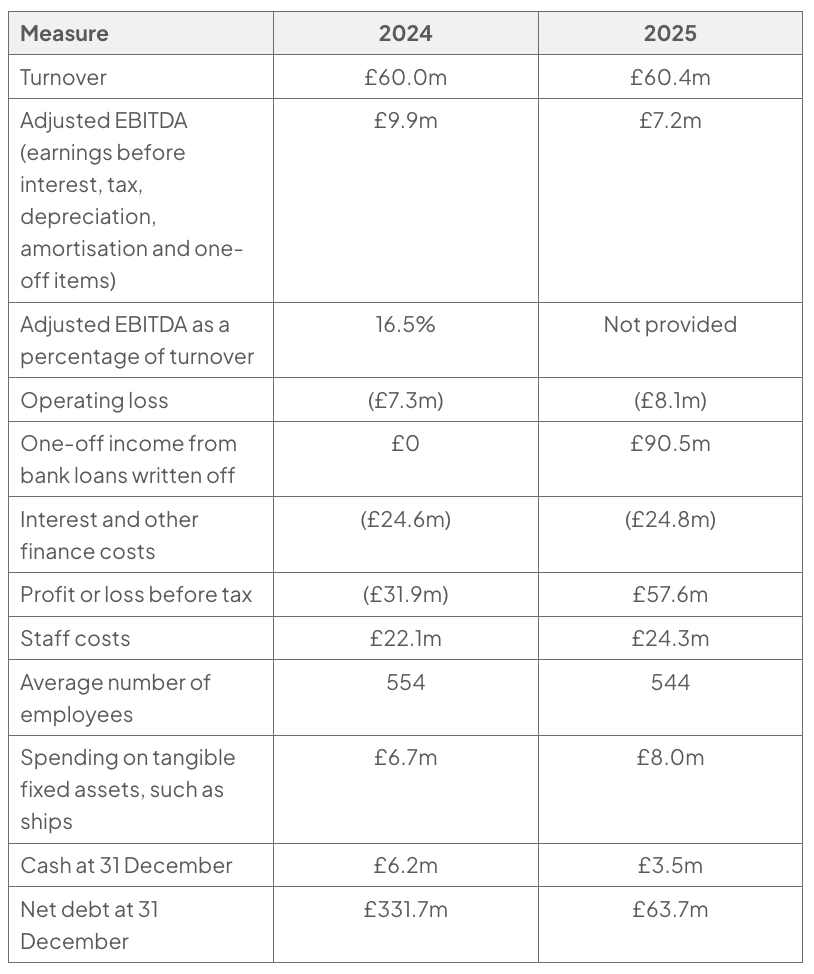
Table comparing Red Funnel’s 2024 and 2025 financial measures, including turnover, adjusted EBITDA, profit or loss, costs, employees, assets, cash and net debt.

Adjusted EBITDA in 2024: £9 893 000. In 2025: £7 220 000. Turnover in 2025: £60 380 000.

Source: Red Funnel Limited

Appendix B: Red Funnel operations and market

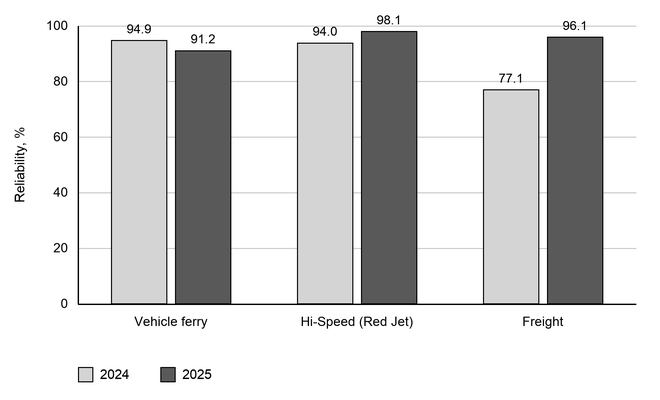
Bar chart of Red Funnel reliability by service, measured as a percentage in 2024 and 2025: vehicle ferry fell from 94.9% to 91.2%; Hi-Speed rose from 94.0% to 98.1%; freight rose from 77.1% to 96.1%.
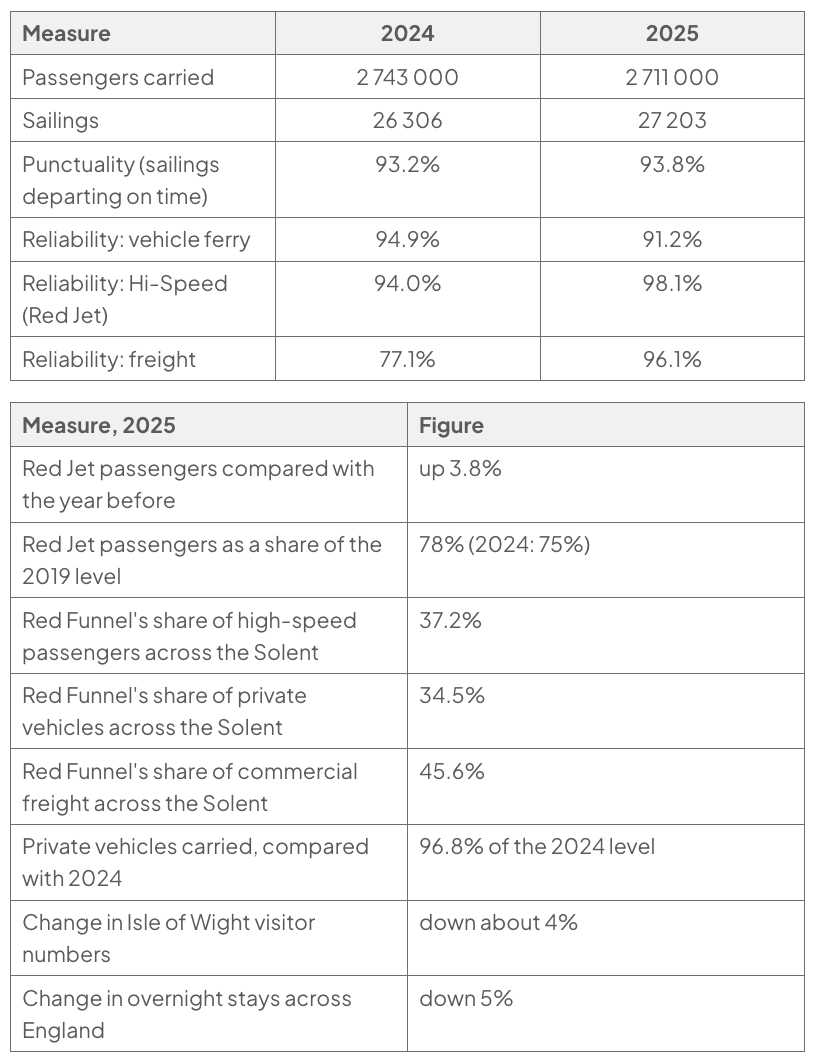
Two tables compare Red Funnel’s 2024 and 2025 operations and list 2025 market measures, including passengers, sailings, punctuality, reliability, market shares and visitor-number changes.

Red Funnel describes the cross-Solent ferry market as "highly competitive", which "limits the ability to pass on external cost increases". It says early bookings for 2026 have been "encouraging".

Source: Red Funnel Limited and Isle of Wight Council

Assess whether Red Funnel's performance in 2025 was better than its performance in 2024.

Calculate Red Funnel's adjusted EBITDA as a percentage of its turnover in 2025 to support your answer. Give your answer to one decimal place.

2
9 marks

Source B: Eden Project

The Eden Project opened in 2001 in a former china clay pit near St Austell, Cornwall. Its giant biomes hold plants from the rainforest and the Mediterranean, and in February 2026 it welcomed its 25 millionth visitor. Eden Project Limited runs the site, its shops, cafés and events, including the Eden Sessions summer concerts. It is wholly owned by The Eden Trust, a registered charity whose mission is "to demonstrate and inspire positive action for the planet".

The company "exists only to deliver the charitable objectives of the Trust", and every activity, "including that which might ordinarily be termed commercial", is designed to educate people about the environment or inspire them to change. Visitors are described as "the primary source of earned income". Other income includes grants from funders and Gift Aid, a tax relief on donations which the charity reclaims and passes to the company.

Visitor numbers fell by more than 10% in the year to March 2025. In January 2025 Eden Project announced plans to cut its payroll by about 20%, affecting about 80 jobs. Its accounts describe "a programme of organisational change to simplify structures, reduce costs and strengthen operational control", including "workforce reduction and changes to leadership structures". The board endorsed "a stabilisation strategy, prioritising control, clarity and resilience", to lay the foundations for "scaffolded growth".

In the year to 31 March 2026 visitor numbers rose by about 0.4%, and the company said it had "halted the pattern of decline seen in prior years". It is also developing two new Eden projects, in Morecambe and Dundee.

Source: Eden Project Limited, Annual Report and Consolidated Financial Statements for the year ended 31 March 2026

Appendix D: Eden Project financial data

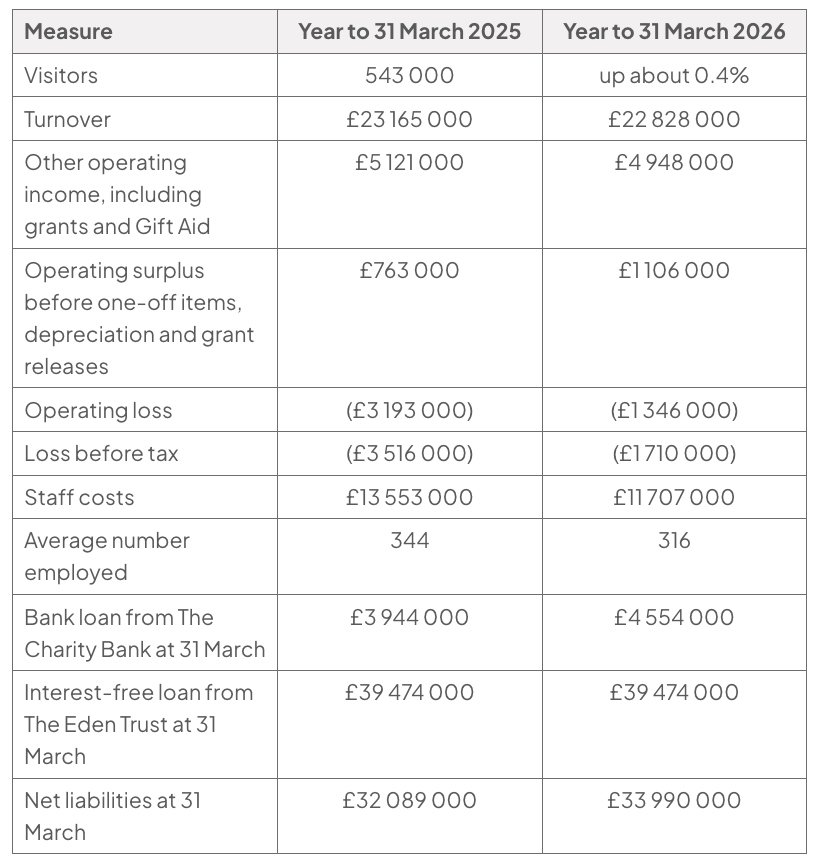
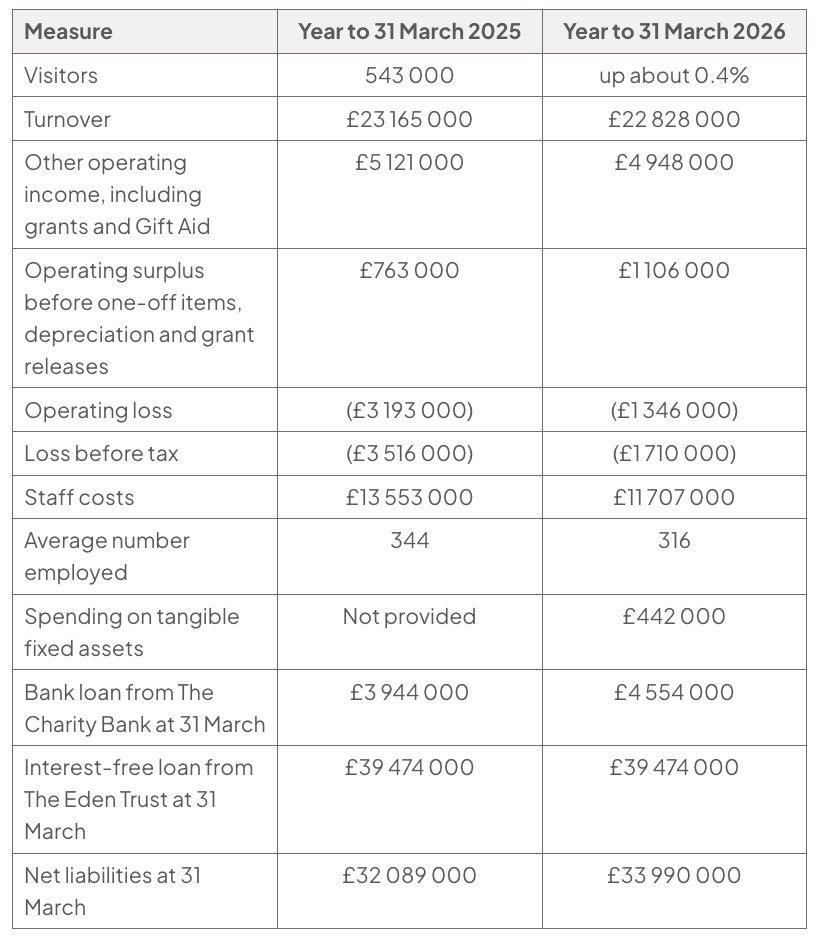
Table of Eden Project financial data for the years to 31 March 2025 and 2026: visitors 543 000 in 2025, up about 0.4% in 2026; turnover £23 165 000 and £22 828 000; other operating income, including grants and Gift Aid, £5 121 000 and £4 948 000; operating surplus before one-off items, depreciation and grant releases £763 000 and £1 106 000; operating loss £3 193 000 and £1 346 000; loss before tax £3 516 000 and £1 710 000; staff costs £13 553 000 and £11 707 000; average number employed 344 and 316; bank loan from The Charity Bank at 31 March £3 944 000 and £4 554 000; interest-free loan from The Eden Trust at 31 March £39 474 000 in both years; net liabilities at 31 March £32 089 000 and £33 990 000.

Visitors in the year to 31 March 2024: 604 000. Staff restructuring costs in the year to 31 March 2025: £587 000.

Source: Eden Project Limited and press reports

Appendix E: Eden Project's workforce

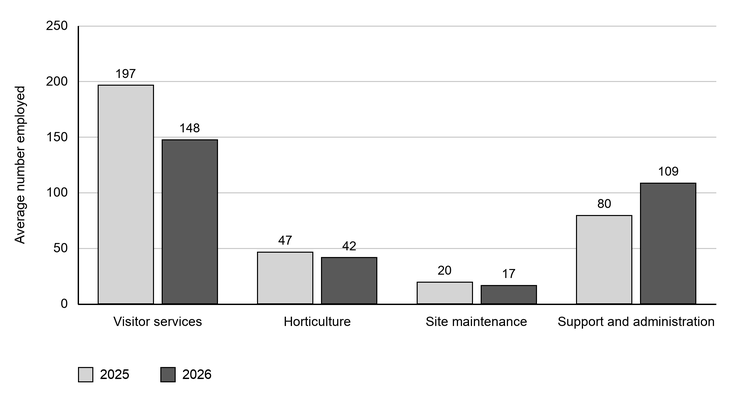
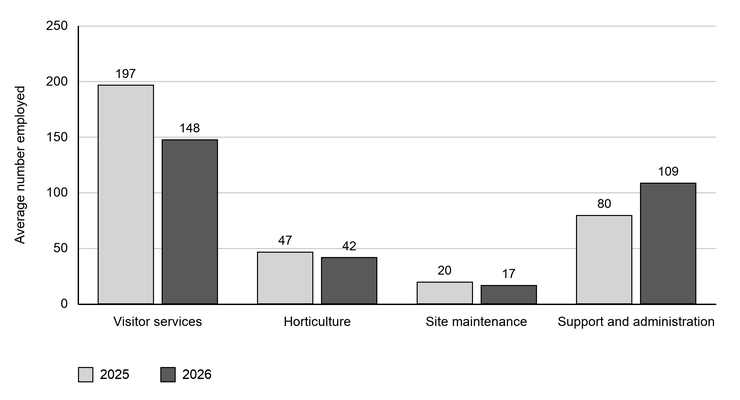
Grouped bar chart of average employees in 2025 and 2026: visitor services 197 to 148, horticulture 47 to 42, site maintenance 20 to 17, and support and administration 80 to 109.
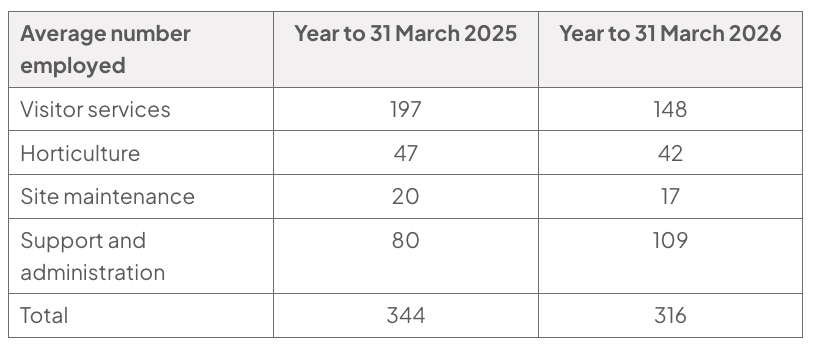
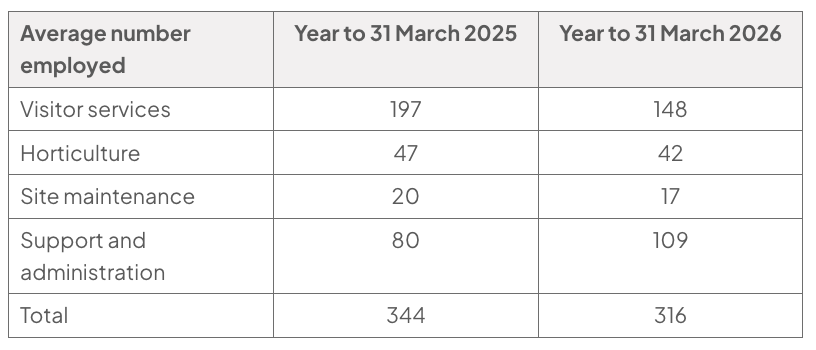
Table of average employees by department in years to 31 March 2025 and 2026: visitor services 197 to 148, horticulture 47 to 42, site maintenance 20 to 17, support and administration 80 to 109; total 344 to 316.
  • The company says that during the change, "emphasis was placed on communication, consultation and maintaining capability in key operational roles".

  • Two directors left in the year to March 2026 and received £93 000 in compensation for loss of office. Andy Jasper, formerly a director at the National Trust, became Chief Executive in September 2024.

Source: Eden Project Limited

Assess whether Eden Project's stabilisation strategy improved its performance in the year to 31 March 2026.

Calculate Eden Project's employee costs as a percentage of revenue in the year to 31 March 2026 to support your answer. Give your answer to one decimal place.

3
9 marks

Source A: Lancashire Cricket

Lancashire County Cricket Club Limited, known as Lancashire Cricket, was founded in 1864 and plays at Emirates Old Trafford in Manchester. It has men's and women's teams, hosts international matches, and runs a hotel and a conference and events business at the ground. It is not owned by shareholders: it is a registered society, owned by its members, who vote at its general meetings and elect some members of its Board.

In 2025 Lancashire Women won their first two professional trophies, and Emirates Old Trafford hosted a five-day men's Test match against India. Turnover rose slightly, to £34.8 million. The Chief Executive said that "the primary challenge for the business now is not revenue generation" but operating costs, which have increased significantly since the pandemic. During the year the club outsourced its catering and retail operations.

In 2025 the England and Wales Cricket Board (ECB) sold stakes in the eight teams in The Hundred, a short-format competition. RPSG Group, an Indian business which also owns teams in the Indian Premier League and South Africa, bought 70% of Manchester Originals; Lancashire Cricket kept 30%, and the team was renamed Manchester Super Giants. The club received dividends of £29.2 million from the sale, repaid £13.3 million of loans, and expects further dividends over the next few years. Lancashire Cricket's surplus before tax was £25.8 million.

The club's £20 million second ground at Farington, near Preston, built in partnership with Lancashire County Council, was handed over to the club in early 2026.

Source: Lancashire County Cricket Club Limited, Annual Report and Financial Statements 2025

Appendix A: Lancashire Cricket financial data

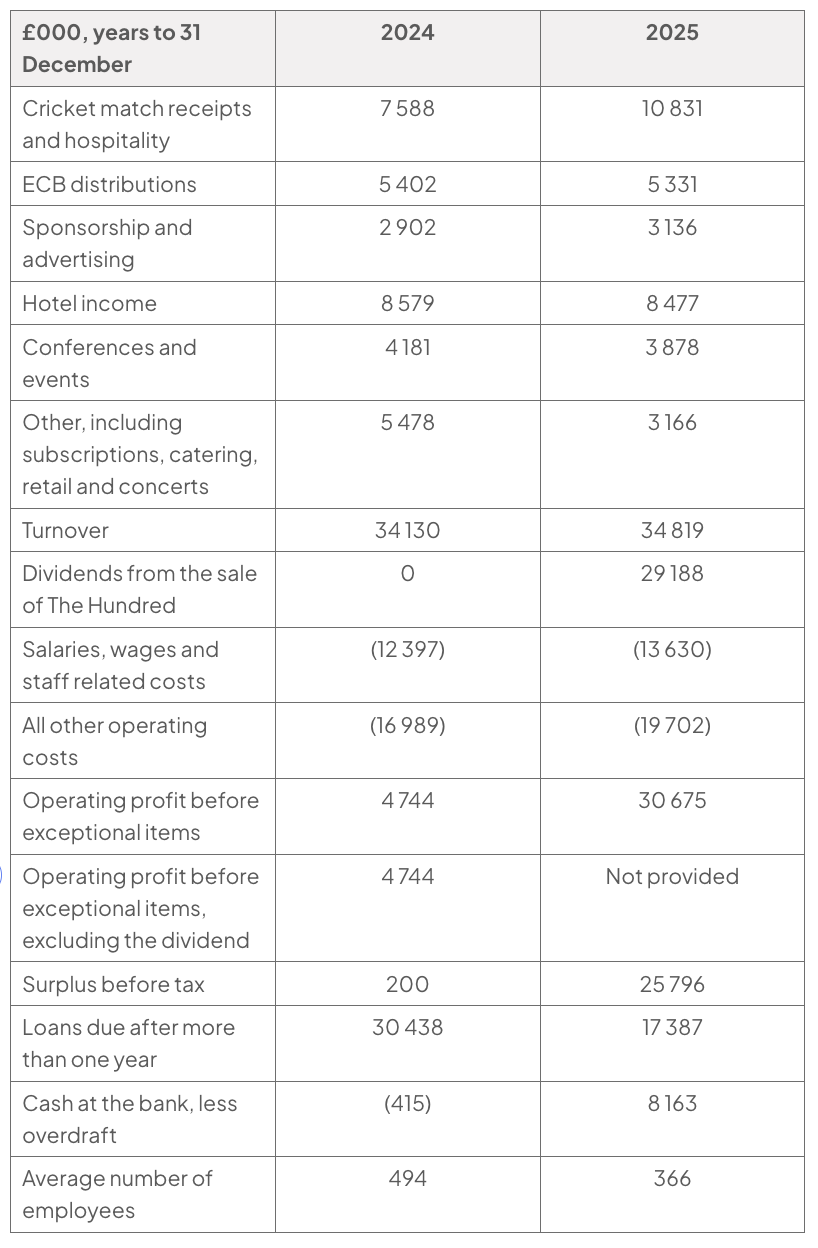
Financial table in £000 for 2024 and 2025: 2025 turnover is 34,819, dividends from The Hundred are 29,188, and operating profit before exceptional items is 30,675.

Source: Lancashire County Cricket Club Limited

Appendix B: Cricket, venue, costs and digital

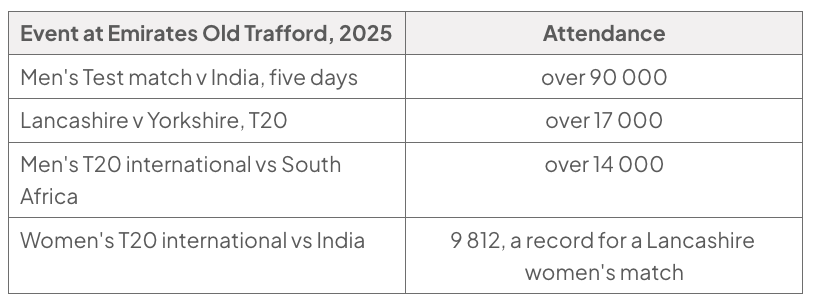
Table of Emirates Old Trafford event attendances in 2025: India Test, over 90,000; Lancashire v Yorkshire T20, over 17,000; South Africa T20I, over 14,000; India women’s T20I, 9,812, a record.
  • 2026 fixtures. Two men's T20 internationals and four matchdays of the ICC Women's T20 World Cup. The club expects international cricket "will be challenging financially compared to previous years". No concerts are planned; there were three sold-out concerts in 2024 and none in 2025.

  • Hotel. Revenue just below £8.5m, down just over 1%, with high occupancy but a slightly lower average room rate.

  • Conferences and events. "A very competitive market, with many companies slowing down spend"; revenue fell by just over £0.3m.

  • Costs. Since 2019 payroll has risen by £2.4m (22%) and utilities by £0.4m (56%). Business rates will rise by £0.2m in 2026 and a further £0.2m in 2027. The National Living Wage and employers' National Insurance contributions both rose in April 2025. The club gave staff a standard pay rise of 2% and says "the UK economy is not thriving".

  • The economy, September 2026. Bank Rate 3.75%; inflation 3.1%; unemployment 4.9%.

  • Digital. In July 2025 the club launched LancsTV, a streaming service built with StreamAMG, a Manchester company, showing all non-televised home men's and women's matches, interviews and archive footage. It is free, but viewers must register; members and ticket holders use the same login as for tickets and membership. A members-only area, LancsTV+, is planned. The Chief Executive said: "we have no plans to charge supporters to watch LancsTV". The club also updated its website in 2025.

  • Partnerships. Commercial partnership revenue is about £3m a year.

Source: Analyst, using Lancashire County Cricket Club Limited, the Bank of England, the Office for National Statistics and press reports

Assess whether Lancashire Cricket's performance in 2025 was as strong as its surplus before tax suggests.

Calculate Lancashire Cricket's operating profit before exceptional items, excluding the dividend, as a percentage of its turnover in 2025 to support your answer. Give your answer to one decimal place.

4
9 marks

Source B: Hartlake Department Store

Hartlake Department Store Limited has traded from the same building on the high street of a Cheshire market town since 1886. The Hartlake family owns it, and all four directors are family members; the Managing Director is Rachel Hartlake. The board meets four times a year.

The store has four floors selling clothing, beauty, homeware and toys, a café, and 6 500 square metres of selling space. Most in-store sales are to customers aged 55 or over.

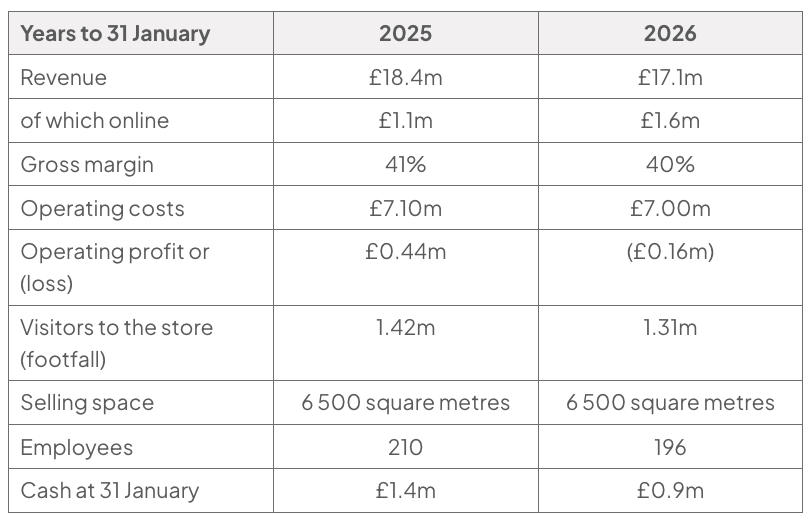
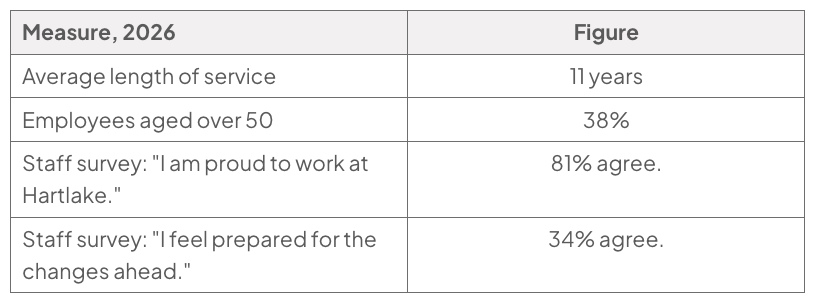
Hartlake employs 196 people, down from 210 a year earlier. Many have worked there for more than ten years; 38% are over 50. Most sales staff have strong relationships with regular customers.

In 2023 a new till system took nine months to install instead of the planned three, and cost 40% more than budgeted. In 2025 Hartlake:

  • relaunched its website, offering delivery and click-and-collect; most online sales are to customers under 45

  • introduced self-service tills on the ground floor

In the year to 31 January 2026:

  • revenue fell to £17.1 million and the store made its first operating loss for eleven years

  • visitors to the store fell from 1.42 million to 1.31 million

  • the share of online orders collected in store rose from 31% to 46%; customers who collect spend an average of £18 more in the store on the same visit

  • in a staff survey, 34% of employees felt prepared for the changes ahead

The board must choose between two plans to change the business in 2026. The Managing Director says: "We have never had to change this much, this quickly."

Source: Hartlake Department Store

Appendix D: Hartlake Department Store selected data

Selected data table for the years to 31 January 2025 and 2026, including revenue, online revenue, margins, costs, footfall, selling space, employees and cash.

Source: Hartlake Department Store

Appendix F: People and culture

Table of Hartlake’s 2026 measures: average employee service is 11 years; 38% are over 50; 81% agree they are proud to work there; 34% agree they feel prepared for changes ahead.
  • A new till system introduced in 2023 took nine months to install, instead of the planned three, and cost 40% more than budgeted.

  • The board meets four times a year; the Managing Director says: "We have never had to change this much, this quickly."

  • Most sales staff have worked in one department for many years and have strong relationships with regular customers.

Source: Hartlake Department Store

Assess whether Hartlake Department Store's performance shows that its store is too large.

Calculate Hartlake Department Store's operating profit margin in the year to 31 January 2026 to support your answer. Give your answer to one decimal place.

5
9 marks

Source A: Oxfam GB

Oxfam GB works to end poverty. It is a registered charity and a company limited by guarantee, and one of 21 affiliates of the Oxfam confederation, which worked in 79 countries in 2024/25. In 2024/25 Oxfam GB's work reached 9.21 million people, 8.05 million of them through humanitarian responses to emergencies.

Oxfam GB raises money from four main sources:

  • donations and legacies

  • grants from governments and international organisations

  • funding from other Oxfam affiliates

  • its shops

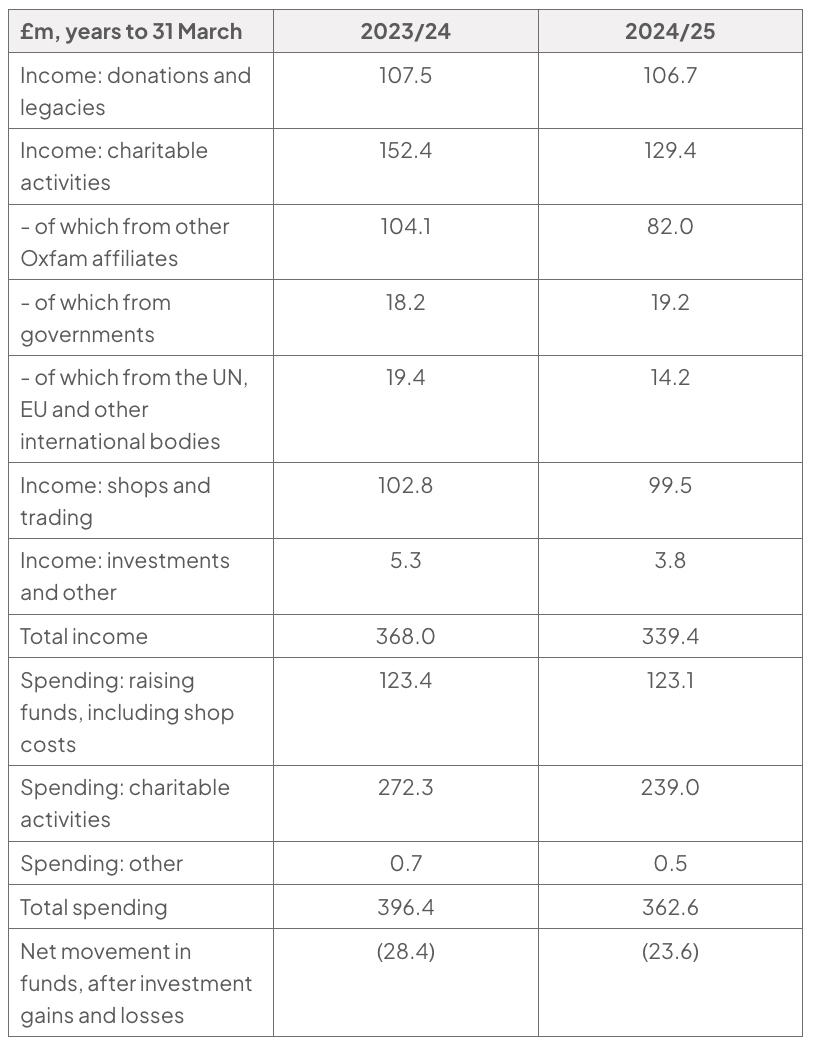
In 2024/25 Oxfam GB's income fell by £28.6 million, and it spent more than it received for the second year running. Funding from other Oxfam affiliates fell from £104.1 million to £82.0 million. The largest affiliate funder, Oxfam Germany, gave £17.8 million, down from £27.2 million.

Oxfam GB has gone through several changes:

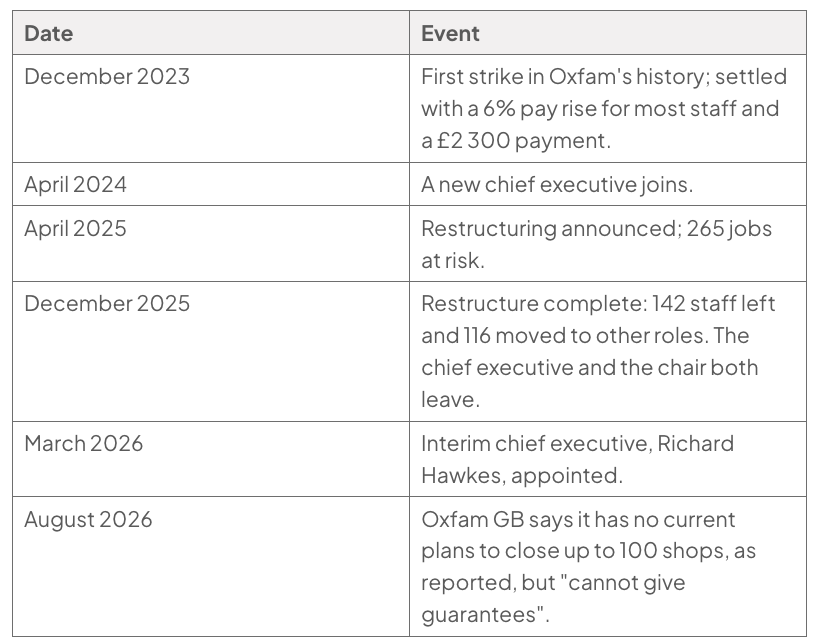
  • Pay. In December 2023 its staff held the first strike in Oxfam's history. It was settled with a 6% pay rise for most staff and a £2 300 payment.

  • Restructure. In April 2025 it began a restructure to save £10.2 million of forecast pay costs, putting 265 jobs at risk.

  • Leadership. Its chief executive since April 2024 left in December 2025, and an interim chief executive, Richard Hawkes, took over from 31 March 2026.

Its goals for 2025/26 are Income, Influence, People and Decolonisation. Decolonisation means shifting money and decision-making to partners in the Global South.

Source: Oxfam GB, annual report and accounts for the year ended 31 March 2025, and press reports

Appendix A: Oxfam GB financial data

Financial table (£m, years to 31 March) comparing Oxfam GB in 2023/24 and 2024/25: total income 368.0 and 339.4, including 104.1 and 82.0 from other Oxfam affiliates; spending on raising funds 123.4 and 123.1; charitable spending 272.3 and 239.0; total spending 396.4 and 362.6; net movement in funds after investment gains and losses (28.4) and (23.6).
  • Why income fell. "Largely due to lower emergency appeal income", together with lower income from other Oxfam affiliates and international bodies.

  • Charitable spending, 2024/25. Humanitarian 52%, development 46%, campaigning 2%.

  • Reserves. General reserves rose from £32.9m to £35.5m, against a target range of £35m to £45m.

  • Shops. 534 shops in 2024 and 515 in 2025. Shop profit fell from £8.3m to £6.3m. Online sales were £11.2m in 2024/25.

  • People. Average staff fell from 4 180 to 4 084: 2 119 employed in Great Britain and 1 965 overseas. About 28 000 volunteers, more than 20 000 of them in shops.

Source: Oxfam GB

Appendix B: Change at Oxfam GB

Oxfam GB timeline: December 2023, first strike, settled with a 6% pay rise and £2 300 payment; April 2024, new chief executive; April 2025, restructure puts 265 jobs at risk; December 2025, 142 staff leave, 116 move roles, and chief executive and chair leave; March 2026, Richard Hawkes appointed interim chief executive; August 2026, no plans to close up to 100 shops but “cannot give guarantees”.
  • Goals for 2025/26. Income, Influence, People and Decolonisation.

  • Shops. In 2024/25 Oxfam GB closed low-profit shops and opened a large shop in Manchester; overall, its number of shops fell from 534 to 515.

Source: Analyst, using Oxfam GB and press reports

Assess how well Oxfam GB performed in 2024/25.

6
9 marks

Source B: Brackenfold Outdoor

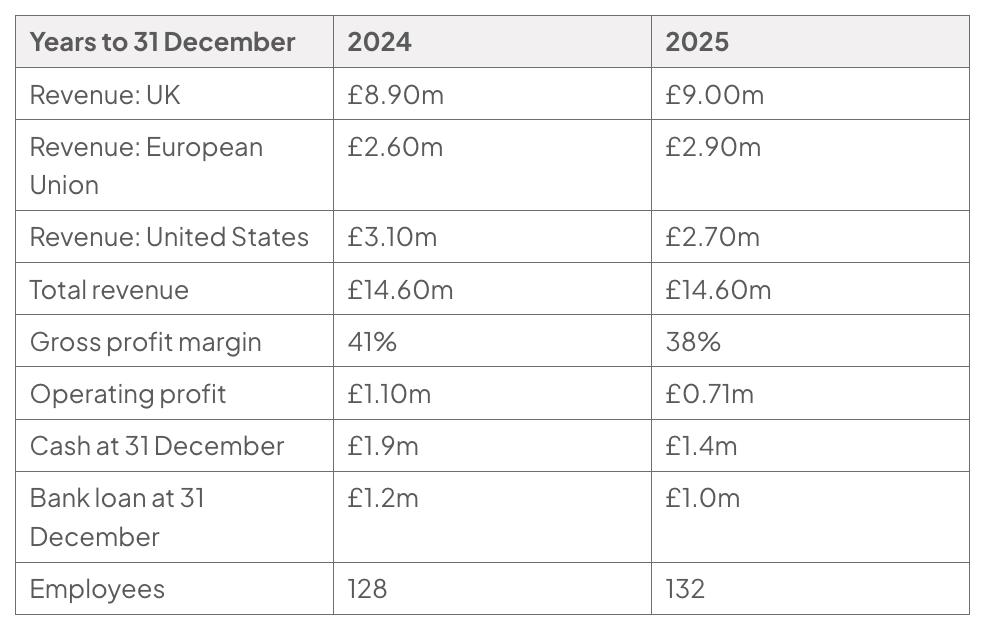
Brackenfold Outdoor Limited is a private limited company, founded in 1987 in Kendal, Cumbria. It designs and makes waterproof jackets and trousers for walkers and for people who work outdoors, and employs 132 people. Its waterproof fabric is bought from an overseas supplier and priced in US dollars.

Brackenfold sells its products in three markets:

  • United Kingdom. It sells to outdoor shops and through its own website.

  • European Union. It sells to shops in the European Union.

  • United States. It sells to shops through a distributor.

In 2025 its sales to the European Union rose, while its sales to the United States fell.

Brackenfold also offers a repair service for its products. The number of jackets it repaired rose by more than half in 2025. In a survey of its website customers, more than half said they would rather repair a jacket than replace it.

The company faces two main pressures:

  • Trade. Since April 2025 most UK goods sold into the United States have faced an extra US tariff of 10%.

  • Costs. Its wage costs rose in 2025, after increases in the National Living Wage and in employers' National Insurance. The price of its waterproof fabric also rose.

Brackenfold's directors are considering investing in automated cutting machinery.

Source: Brackenfold Outdoor

Appendix D: Brackenfold Outdoor selected data

Financial comparison table for years to 31 December, with rows for revenue by market, total revenue, gross profit margin, operating profit, cash, bank loan and employees.

Source: Brackenfold Outdoor

Appendix E: Costs and customers

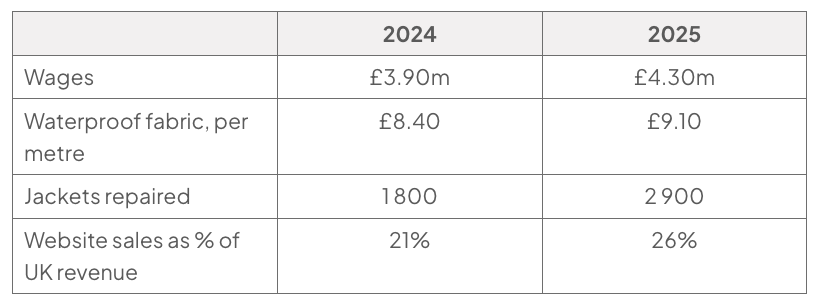
Comparison table for 2024 and 2025: wages £3.90m to £4.30m; waterproof fabric per metre £8.40 to £9.10; jackets repaired 1 800 to 2 900; website sales 21% to 26% of UK revenue.
  • Wages. The National Living Wage rose to £12.21 an hour in April 2025 and £12.71 in April 2026. In April 2025 employers' National Insurance rose from 13.8% to 15%.

  • Customers. In a survey of website customers, 58% said they would rather repair a jacket than replace it, and 44% said price was the most important factor when choosing outdoor clothing.

  • Loan. The interest rate on Brackenfold's bank loan changes with the Bank of England's Bank Rate.

Source: Brackenfold Outdoor

Assess how well Brackenfold Outdoor performed in 2025.

Calculate Brackenfold Outdoor's employee costs as a percentage of revenue in 2025 to support your answer. Give your answer to one decimal place.

1
15 marks

Source B: Farmoor Cycles

Farmoor Cycles is an independent bicycle retailer in the UK. It was established in Oxford in 2002 as a worker cooperative by a group of cycling enthusiasts. It now has two other shops in Birmingham and Manchester. The UK bicycle retail sector has a few large national chains that sell bikes, such as Halfords, Decathlon and Argos, as well as many small independent businesses. The entry threat to the industry is high.

The mission of Farmoor Cycles is to:

  • provide affordable bicycles for cyclists of all kinds

  • promote the benefits of cycling for cyclists of all kinds

  • build a fairer society through cooperative ownership.

The business states that 'we have the passion, specialist expertise and links with the local community that customers want'.

It values:

  • democracy

  • honesty

  • openness

  • social responsibility

  • caring for others.

The business is considering investing in a new inventory management system (Appendix C) which has a forecast life span of 4 years. It usually aims for an average rate of return on its investments of at least 10%. The current rate of interest for taking out a bank loan is 8%.

Appendix C: Investment in a new inventory management system

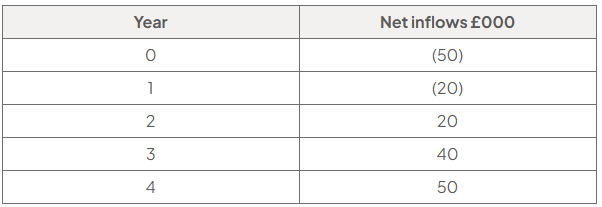
Table of investment net cash flows in £000: year 0, (50); year 1, (20); year 2, 20; year 3, 40; year 4, 50. Brackets indicate net outflows.

Source: based on calculations of Farmoor Cycles' Operations Manager using data provided by the supplier of the equipment

Appendix D: Farmoor Cycles' data

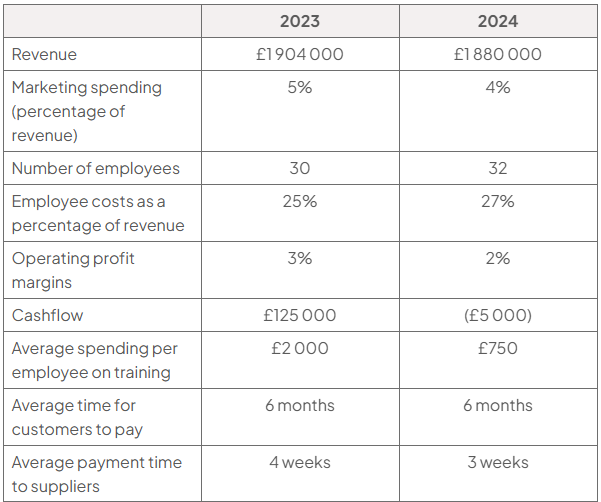
Appendix D, 2023→2024: revenue £1.904m→£1.880m; marketing 5%→4%; employees 30→32; employee costs 25%→27%; margin 3%→2%; cash flow £125k→(£5k); training £2 000→£750; customer payment 6 months; supplier payment 4→3 weeks.

Appendix E: Farmoor Cycles' product information

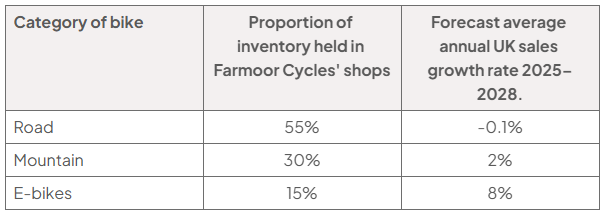
Table comparing Farmoor Cycles’ inventory with forecast UK sales growth for 2025 to 2028: road bikes 55% and minus 0.1%; mountain bikes 30% and 2%; e-bikes 15% and 8%.

Appendix F: Farmoor Cycles' marketing data

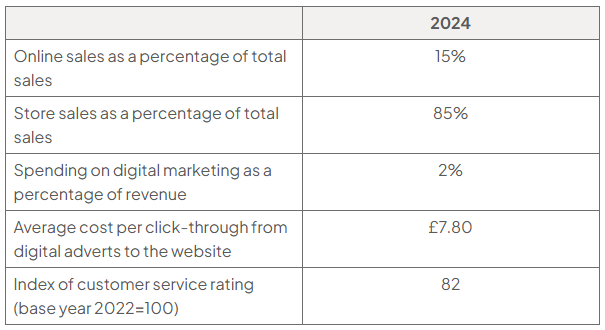
Table of Farmoor Cycles’ marketing data for 2024: online sales 15% and store sales 85% of total; digital marketing 2% of revenue; cost per click £7.80; customer service index 82 (2022 base year = 100).

Appendix G: UK bicycle retail industry data

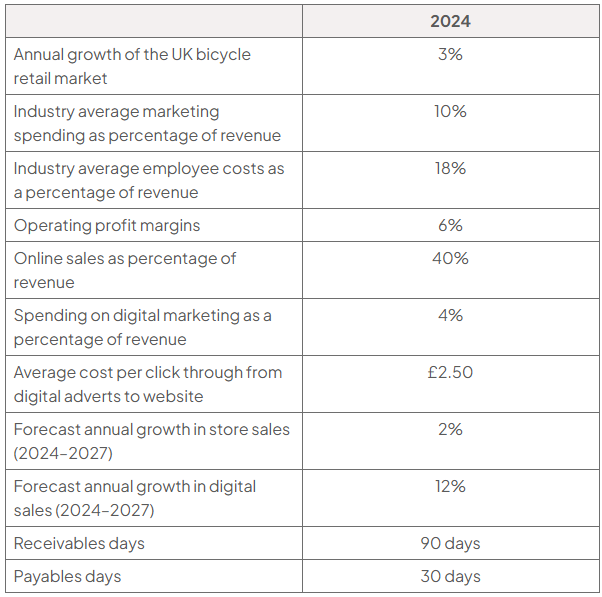
Appendix G, UK bicycle retail industry data for 2024: market growth 3%; marketing 10%; employee costs 18%; operating margin 6%; online sales 40%; digital marketing 4%; cost per click £2.50; forecast store growth 2%, digital 12%; receivables 90 days, payables 30 days.

Farmoor Cycles wants to improve the performance of the business.

Evaluate two actions the business should take to improve its performance and recommend which one it should focus on first.

Use information from Appendices C to G to support your answer.

2
15 marks

Source A: Burberry

Burberry Group plc is a British luxury fashion brand, headquartered in London and listed on the London Stock Exchange, where it is a member of the FTSE 100. It was founded in 1856 by Thomas Burberry, whose gabardine fabric and trench coat became the basis of the brand. It sells mainly through its own stores, of which there were 410 at 28 March 2026, and online. It also sells to other retailers and earns income from licences.

In the 52 weeks to 29 March 2025 Burberry's comparable store sales fell by 12% and its adjusted operating profit fell to £26 million. Joshua Schulman, who became Chief Executive in July 2024, launched a strategy called Burberry Forward in November 2024. Its aims include restoring the brand's cultural relevance and asserting its authority in outerwear and scarves before extending that success to other categories.

In the 52 weeks to 28 March 2026 Burberry's revenue was £2 420 million, compared with £2 461 million the year before, while comparable store sales rose by 2% and adjusted operating profit rose to £160 million. The Chief Executive described the year as "a meaningful inflection point". During the year the company:

  • achieved savings in operating costs of £80 million, while continuing to invest in marketing;

  • spent £45 million on restructuring, mainly on redundancies and consultancy;

  • opened 200 scarf bars in its stores;

  • increased e-commerce sales by a percentage in the high teens;

  • opened 9 stores and closed 21.

Outerwear sold better than other categories in every region, scarves grew throughout the year, and sales of leather goods improved in the second half.

Sales growth differed between regions. In Europe, the Middle East, India and Africa, sales were held back by a fall in tourist numbers. In Japan, sales fell by 6% in the final quarter as fewer visitors arrived, while South Korea grew by 13%, helped by visitors from China. In Greater China and the Americas, sales in the final quarter grew by 10%, driven by local customers.

For the year to March 2027 Burberry expects to increase both its revenue and its profit margin, but says it is mindful of the uncertain economic and political environment.

Source: Burberry Group plc, Preliminary Results, 14 May 2026

Appendix A: Burberry selected data

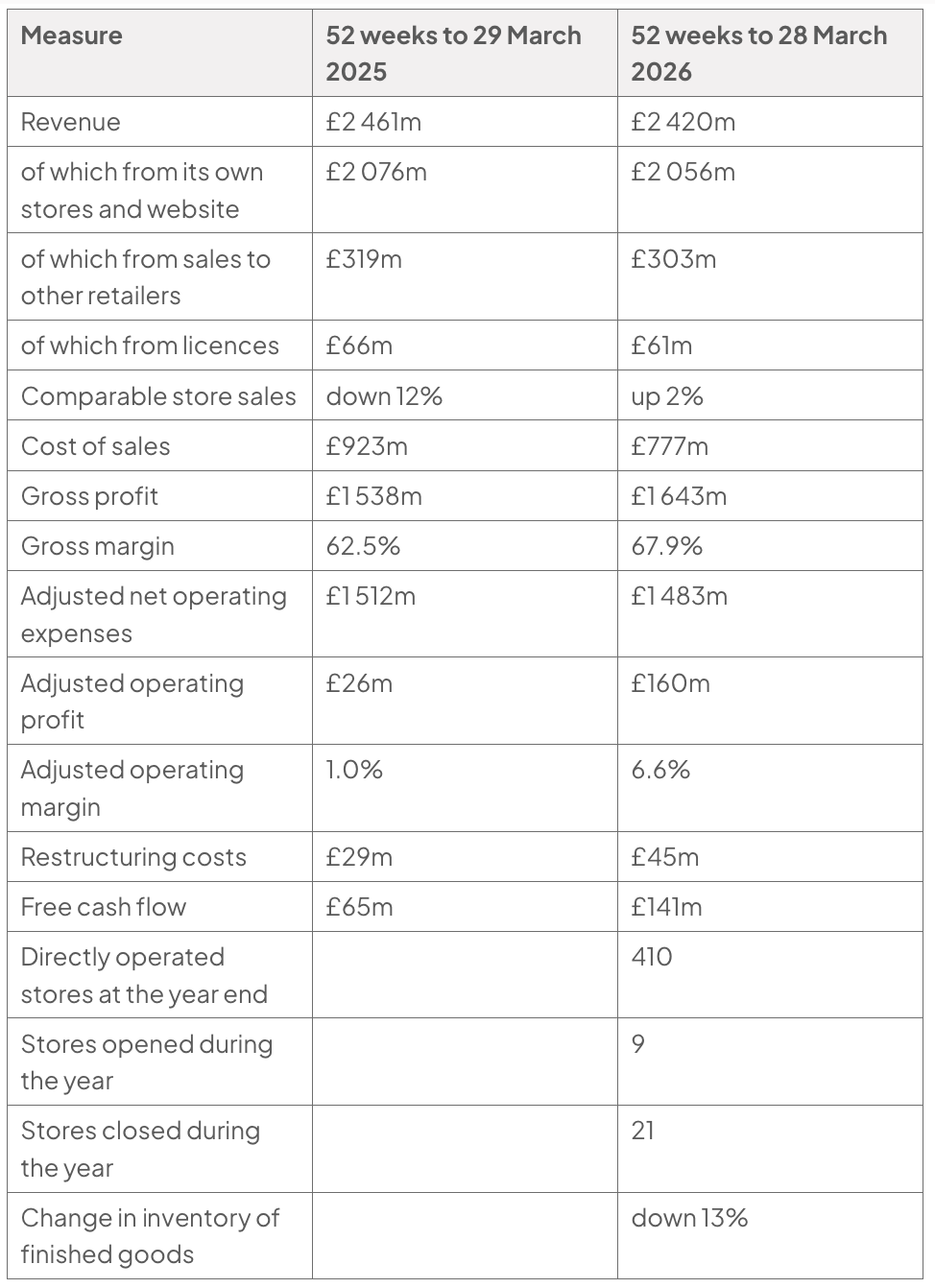
Table comparing Burberry’s 2025 and 2026 results: revenue fell from £2 461m to £2 420m, while gross margin rose from 62.5% to 67.9%, operating profit from £26m to £160m and free cash flow from £65m to £141m.

The gross margin in the year to March 2026 was helped by better sales at full price and by recovery from the clearance of excess inventory in the previous year.

Source: Burberry Group plc

Appendix B: Comparable store sales by region, year to 28 March 2026

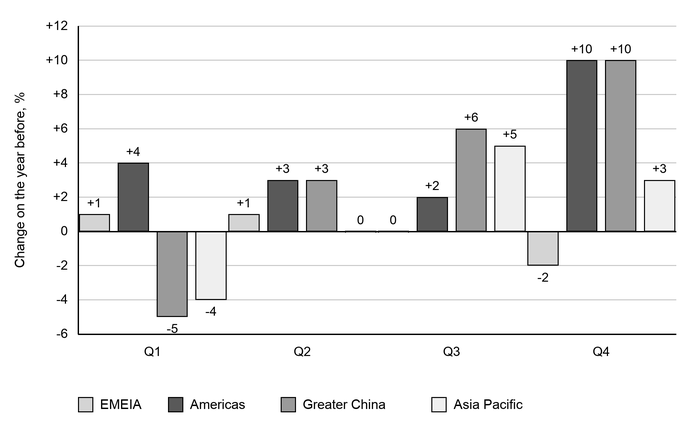
Grouped bar chart of quarterly comparable store sales change for EMEIA, the Americas, Greater China and Asia Pacific, with a y-axis from −6% to +12%; in Q4, values are −2%, +10%, +10% and +3% respectively.

Change in comparable store sales on the same quarter a year earlier

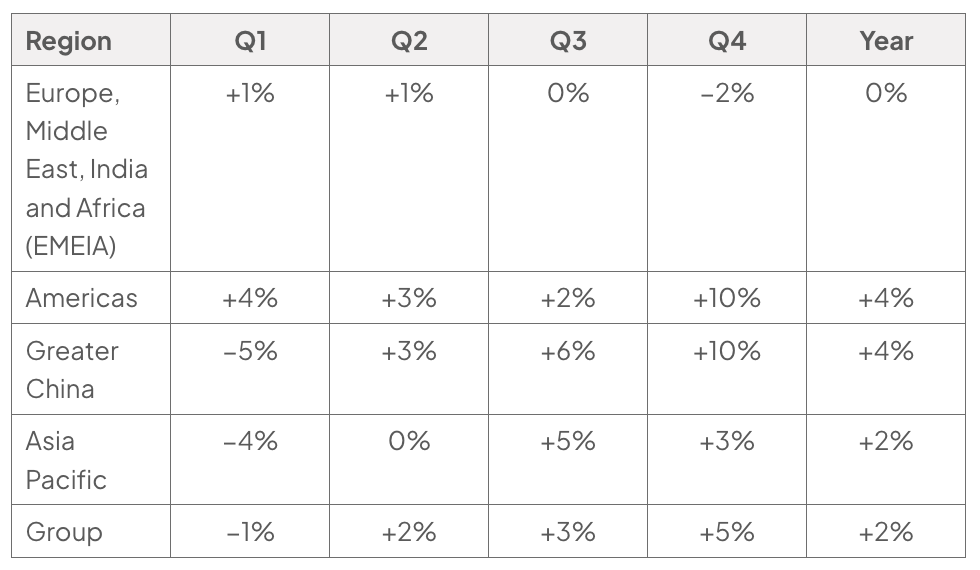
Table of Burberry comparable store sales by region for Q1 to Q4 and the year: EMEIA 0%, Americas +4%, Greater China +4%, Asia Pacific +2%, and Group +2% overall.
  • EMEIA: the fall in Q4 reflected fewer tourists in the region and conflict in the Middle East towards the end of the quarter.

  • Americas and Greater China: growth in Q4 was driven by spending by local customers.

  • Asia Pacific: South Korea grew 13% in Q4, helped by visitors from China; Japan fell 6% as fewer visitors arrived.

Source: Burberry Group plc

Appendix C: Burberry Forward and the year ahead

  • In stores. 200 scarf bars opened in FY26. "Polo galleries" and "trench destinations" are being introduced in FY27 to encourage customers to buy across categories.

  • Online. E-commerce sales grew by a percentage in the high teens, helped by an improved website.

  • Costs. Savings of £80 million were achieved in FY26; annual savings are expected to reach £100 million in FY27. The company continued to invest in marketing.

  • Expectations for FY27. Growth in revenue and in profit margin; store space broadly unchanged; sales to other retailers expected to grow by a mid-single-digit percentage in the first half; capital spending of about £120 million.

  • Risks. The company is mindful of the uncertain geopolitical and economic environment and its possible effect on consumer confidence.

  • Board. The Chair will retire in November 2026 and be succeeded by a new Chair who joins the Board in July 2026.

Source: Analyst, using Burberry Group plc

Burberry's Chief Executive has described the year to March 2026 as "a meaningful inflection point".

Evaluate two measures Burberry's board could use to judge whether Burberry Forward is succeeding and recommend which one it should rely on most.

3
15 marks

Source A: Premier Foods

Premier Foods plc is one of the UK's largest food manufacturers. Its brands include Ambrosia, Batchelors, Bisto, Loyd Grossman, Mr Kipling, Oxo and Sharwood's, and it makes Cadbury cakes under licence. It has bought three newer brands: The Spice Tailor, FUEL10K and, in 2025, Merchant Gourmet, for £46.1 million. It is listed on the London Stock Exchange.

In the 52 weeks to 28 March 2026 Premier Foods' headline revenue rose by 2.5% to £1 175.2 million and its trading profit rose by 6.7% to £200.4 million. Sales of its branded products grew by 3.4%. Mr Kipling had its biggest ever year, helped by new products such as cake bites tubs, and the company gained market share in both of its divisions, Grocery and Sweet Treats.

The company's strategy has five pillars:

  • Grow the UK core through brand investment and new products.

  • Enter new categories, such as FUEL10K yogurt and granola pots.

  • Build international businesses in Australia and New Zealand, North America and Europe.

  • Acquire brands with strong growth potential.

  • Invest in its factories to increase efficiency and automation.

During the year capital investment rose by 25% to £51.9 million. It included a solar farm at its cake factory near Barnsley, which can supply up to 70% of the site's electricity, and an investment that made the pot filling and packing line at its Ambrosia site in Devon faster and more efficient.

Many of the company's products, including most cakes, are classed by law as less healthy because they are high in fat, sugar or salt. From 5 January 2026 such products may not be advertised on television or on-demand services between 5.30am and 9pm, or in paid-for online adverts at any time. Adverts which show a brand without showing a less healthy product are still allowed.

Source: Premier Foods plc, Full Year Results for the 52 weeks ending 28 March 2026

Appendix A: Premier Foods selected data

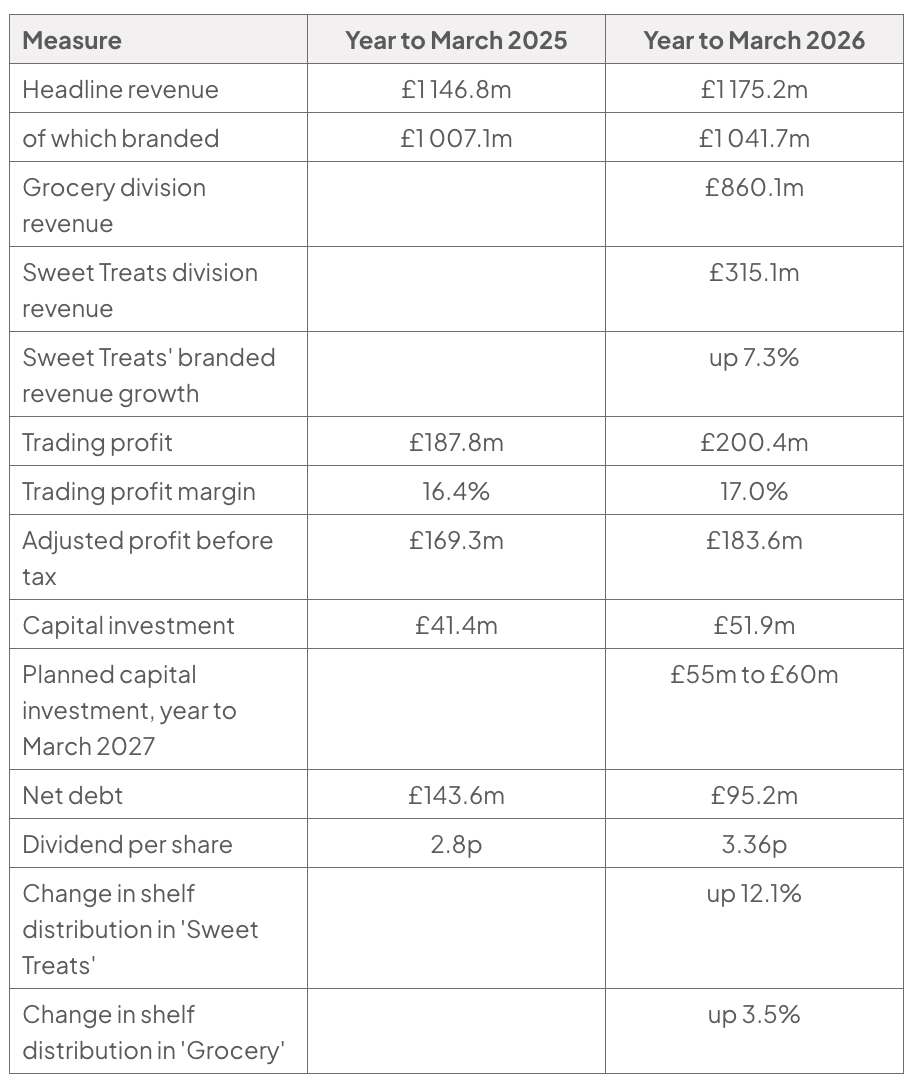
Three-column table comparing Premier Foods’ selected financial and operating measures for the years to March 2025 and March 2026, with a forecast capital-investment figure for 2027.

Source: Premier Foods plc

Appendix C: Strategy and investment in the year to March 2026

  • UK core. UK branded revenue up 3.7%, and up 5.0% in the second half of the year. Market share gained in Grocery and Sweet Treats. Marketing uses television, radio, outdoor, digital and social media, "the latter to drive greater connection with younger demographic audiences".

  • New categories. Revenue up 37%, from a small base, led by FUEL10K yogurt and granola pots.

  • International. Revenue £50.4m, down 1.8%, because retailers in Australia reduced their inventories of cake; revenue up 17% in the US and 9% in Europe.

  • Acquisitions. The Spice Tailor, FUEL10K and Merchant Gourmet all grew revenue by more than 10%. Merchant Gourmet's annual revenue is about £30m.

  • Factories. Investment aimed at automation and efficiency. Planned for the year to March 2027: more cooking sauce capacity at Worksop, more flexible production lines at the Mr Kipling site near Barnsley, and upgrades to IT systems. The company says efficiency benefits from capital investment contributed to the growth in profit.

  • Finance. Net debt is 0.4 times adjusted EBITDA, low enough to fund further investment or acquisitions.

Source: Analyst, using Premier Foods plc

Premier Foods' strategy has five pillars: the UK core, new categories, international businesses, acquisitions and investment in its factories.

Evaluate two of these pillars and recommend which one Premier Foods should focus on most in the year to March 2027.

4
15 marks

Source B: Eden Project

The Eden Project opened in 2001 in a former china clay pit near St Austell, Cornwall. Its giant biomes hold plants from the rainforest and the Mediterranean, and in February 2026 it welcomed its 25 millionth visitor. Eden Project Limited runs the site, its shops, cafés and events, including the Eden Sessions summer concerts. It is wholly owned by The Eden Trust, a registered charity whose mission is "to demonstrate and inspire positive action for the planet".

The company "exists only to deliver the charitable objectives of the Trust", and every activity, "including that which might ordinarily be termed commercial", is designed to educate people about the environment or inspire them to change. Visitors are described as "the primary source of earned income". Other income includes grants from funders and Gift Aid, a tax relief on donations which the charity reclaims and passes to the company.

Visitor numbers fell by more than 10% in the year to March 2025. In January 2025 Eden Project announced plans to cut its payroll by about 20%, affecting about 80 jobs. Its accounts describe "a programme of organisational change to simplify structures, reduce costs and strengthen operational control", including "workforce reduction and changes to leadership structures". The board endorsed "a stabilisation strategy, prioritising control, clarity and resilience", to lay the foundations for "scaffolded growth".

In the year to 31 March 2026 visitor numbers rose by about 0.4%, and the company said it had "halted the pattern of decline seen in prior years". It is also developing two new Eden projects, in Morecambe and Dundee.

Source: Eden Project Limited, Annual Report and Consolidated Financial Statements for the year ended 31 March 2026

Appendix D: Eden Project financial data

Table of Eden Project financial data for the years to 31 March 2025 and 2026: visitors 543 000 in 2025, up about 0.4% in 2026; turnover £23 165 000 and £22 828 000; other operating income, including grants and Gift Aid, £5 121 000 and £4 948 000; operating surplus before one-off items, depreciation and grant releases £763 000 and £1 106 000; operating loss £3 193 000 and £1 346 000; loss before tax £3 516 000 and £1 710 000; staff costs £13 553 000 and £11 707 000; average number employed 344 and 316; spending on tangible fixed assets not provided for 2025 and £442 000 in 2026; bank loan from The Charity Bank at 31 March £3 944 000 and £4 554 000; interest-free loan from The Eden Trust at 31 March £39 474 000 in both years; net liabilities at 31 March £32 089 000 and £33 990 000.

Visitors in the year to 31 March 2024: 604 000. Staff restructuring costs in the year to 31 March 2025: £587 000.

Source: Eden Project Limited and press reports

Appendix E: Eden Project's workforce

Bar chart of Eden Project’s average employees by department in 2025 and 2026: visitor services 197 to 148, horticulture 47 to 42, site maintenance 20 to 17, and support and administration 80 to 109.
Table of average employees by department in years to 31 March 2025 and 2026: visitor services 197 to 148, horticulture 47 to 42, site maintenance 20 to 17, support and administration 80 to 109; total 344 to 316.
  • The company says that during the change, "emphasis was placed on communication, consultation and maintaining capability in key operational roles".

  • Two directors left in the year to March 2026 and received £93 000 in compensation for loss of office. Andy Jasper, formerly a director at the National Trust, became Chief Executive in September 2024.

Source: Eden Project Limited

Appendix F: Income, funders and supporters

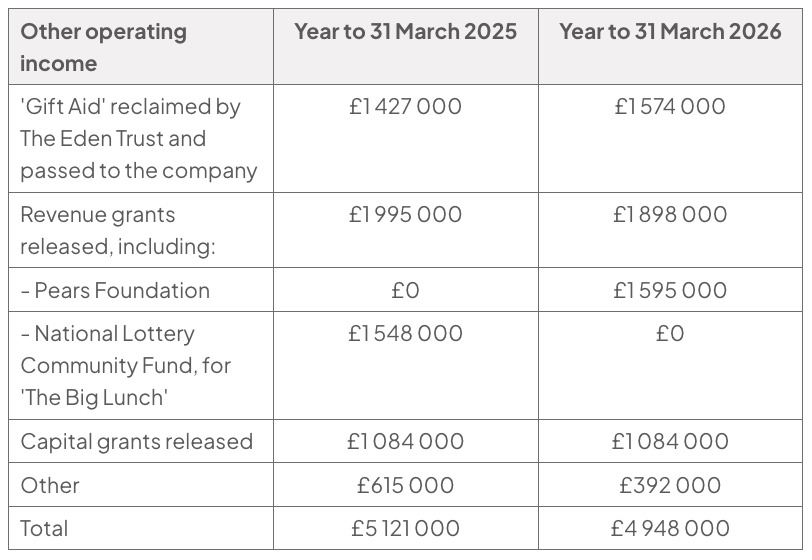
Table of Eden Project other operating income for the years to 31 March 2025 and 2026: Gift Aid reclaimed by The Eden Trust and passed to the company £1 427 000 and £1 574 000; revenue grants released £1 995 000 and £1 898 000, including Pears Foundation £0 and £1 595 000 and National Lottery Community Fund, for The Big Lunch, £1 548 000 and £0; capital grants released £1 084 000 in both years; other £615 000 and £392 000; total £5 121 000 and £4 948 000.
  • The Big Lunch, Eden's national community programme, had over 10 million participants in 2024.

  • Eden has over 13 000 members and regular donors, and about 100 regular volunteers.

  • The 2026 Eden Sessions concerts attracted almost 60 000 people to 10 shows.

  • Eden's carbon emissions fell 5.7% in the year to March 2026 and are 38.5% below 2019/20, which is behind its target of a 10% reduction a year.

Source: Analyst, using Eden Project Limited, the Eden Project Annual Review 2024/25 and press reports

Appendix G: Eden's three sites

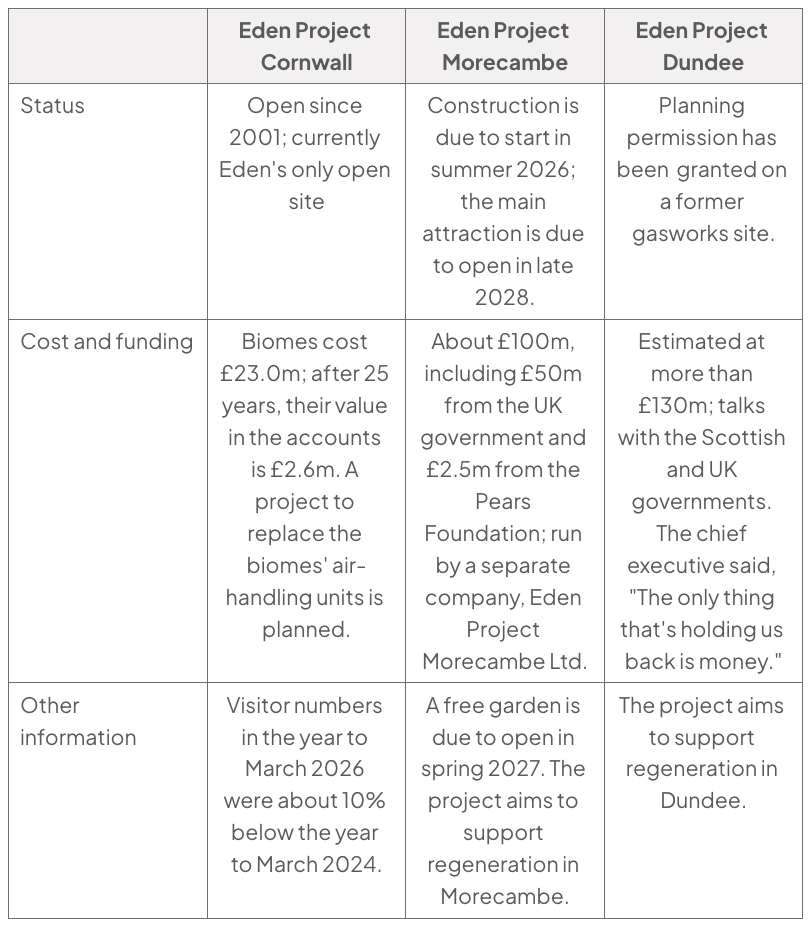
Table comparing Eden’s sites: Cornwall opened in 2001; its biomes cost £23m and visitors fell 10%. Morecambe costs £100m and opens in 2028; Dundee has permission and costs over £130m.

Source: Analyst, using Eden Project Limited and press reports

Eden Project's board has endorsed a stabilisation strategy, but Eden is also developing new projects in Morecambe and Dundee.

Evaluate whether Eden Project should focus its resources over the next three years on its Cornwall site or on its new projects in Morecambe and Dundee.

Use information from Appendices D to G to support your answer.