Marketing Objectives & Planning (AQA A Level Business): Exam Questions

Exam code: 7132

Syllabus Edition

First teaching 2026

First exams 2028

2 hours15 questions
1
6 marks

Source B: Riverford Organic Farmers Ltd

Riverford Organic Farmers Limited grows and delivers organic vegetables. Guy Singh-Watson began delivering boxes of vegetables to local households from the family farm in Devon, and the business was registered as a private limited company in 1999. Its registered office is still Wash Barn at Buckfastleigh in Devon, and its registered business activity is the growing of vegetables, roots and tubers.

Customers subscribe to a weekly box rather than choosing individual items. Boxes are packed at Riverford's own sites and delivered straight to the door by its own drivers, so the company controls its route to market and does not sell through supermarkets. Subscribers pay in advance and can pause or change an order online. Riverford owns five of its sites outright and holds another nine on lease.

In 2018 Guy Singh-Watson began transferring ownership of the company to the people who work in it. The process finished on 8 June 2023, when he sold his remaining shares and the Riverford Employee Ownership Trust became the company's only person with significant control. The business is now held in trust on behalf of its roughly 1 000 employees. There are no outside shareholders, so no dividends are paid to investors outside the business.

In the year ended 3 May 2025 turnover rose by 5.9% to £116.9 million. Cash held at the bank rose by a quarter to £12.31 million, and total liabilities fell by 13.0%.

Organic food remains a small part of UK grocery, and supermarkets have been widening their own organic ranges at lower prices.

Because there are no outside shareholders, the directors and the trust decide together what to do with each year's profit. There is £2.4 million available this year. It could be paid to the co-owners as a profit share, or it could be spent on solar panels and new refrigeration at Wash Barn, which would cut the company's running costs every year from then on.

Source: information sourced from Companies House, 2026

Riverford Organic Farmers Ltd grows much of what it sells and delivers every box with its own drivers.

Analyse one way in which signing up a large number of new subscribers might create problems for Riverford Organic Farmers Ltd.

2
6 marks

Source A: Games Workshop Group PLC

Games Workshop Group PLC designs, makes and sells fantasy miniatures, and the games and stories that go with them. Its main brand is Warhammer. The company is based at Willow Road in Nottingham, where it makes its models, and it is a public limited company whose shares are traded on the London Stock Exchange. Kevin Rountree is the chief executive. It employs about 3 000 people.

The company earns money in two quite different ways. Most of it comes from the core business: selling miniatures and books through its own shops, through independent retailers it calls trade accounts, and through its own website. The rest comes from licensing, which means letting other companies pay to use Warhammer characters and worlds in their own products, such as video games and television.

In the 52 weeks to 31 May 2026 the core business had its best year yet. Core revenue rose 10.9% to £626.8 million and core operating profit rose to £245.1 million. Licensing went the other way. Licensing revenue fell from £52.5 million to £32.9 million, and licensing operating profit fell from £49.5 million to £29.9 million.

Licensing matters more than its size suggests. It costs very little to run, because the company is selling permission rather than a product, so almost all of the revenue it brings in becomes profit.

Total revenue still reached a record £659.7 million and profit before tax a record £275.7 million. Earnings per share rose from 594.9p to 624.0p. Even so, the dividend paid during the year fell from 520p a share to 485p.

Games Workshop says its decisions are focused on long-term success rather than short-term gains, and that it intends to carry on making the best fantasy miniatures in the world forever.

Source: Games Workshop Group PLC results, 28 July 2026

Appendix C: Extract from Games Workshop Group PLC's stated strategy

"Our ambitions remain clear: to make the best fantasy miniatures in the world, to engage and inspire our customers, and to sell our products globally at a profit. We intend to do this forever. Our decisions are focused on long-term success, not short-term gains."

"We nurture a craft based hobby. We understand that what we make may not appeal to everyone, so to recruit and retain customers we are absolutely focused on making our models the best in the world."

Source: Games Workshop Group PLC annual report, 2026

Games Workshop Group PLC says its ambition is to make the best fantasy miniatures in the world (Appendix C).

Analyse one way in which this ambition might affect the price Games Workshop Group PLC charges for its models.

3
6 marks

Source A: Moonpig Group plc

Moonpig Group plc sells greeting cards, gifts and experience days online. It has no shops. The group owns the Moonpig brand in the UK, Greetz in the Netherlands, and Buyagift and Red Letter Days, which sell experience days such as spa breaks and driving days. It is a public limited company listed in London.

The business runs on knowing when a customer's friends and family have birthdays. A customer who sends one card gives Moonpig Group plc a name and a date, and the company then reminds them when that date comes round again. Around that reminder it offers a gift to send with the card, which is where much of the growth now comes from. It also sells a paid membership called Plus, and during the year it launched tools that use artificial intelligence to help customers write and design cards.

In the year to 30 April 2025 revenue was £350.1 million, 2.6% up on the year before. That figure hides three very different businesses. The Moonpig brand grew 8.6%, and its revenue in the United States, Australia and Ireland grew 36.1% between them. Greetz fell 4.7%. The Experiences business was difficult enough that the group wrote £56.7 million off the value of it.

Underneath, the numbers the company watches most closely moved the right way. Active customers across Moonpig and Greetz reached 12.0 million, up from 11.5 million. Total orders grew 4.1% and the average order value grew 2.1%.

Profit depends entirely on which figure is read. Adjusted profit before tax, which leaves out the write-off, was £67.5 million against £58.2 million, a rise of 16.0%. Reported profit before tax, which includes it, was £3.0 million against £46.4 million, a fall of 93.6%. Free cash flow was £66.1 million, and the company bought back £25 million of its own shares during the second half.

Source: information sourced from Moonpig Group plc results announcement for the year ended 30 April 2025

Moonpig Group plc says its growth comes from three things: more active customers, customers ordering more often, and customers spending more each time they order.

Analyse one way in which having three separate objectives like these might affect how Moonpig Group plc plans its marketing.

4
6 marks

Source A: Warpaint London plc

Warpaint London plc makes and sells cosmetics. Its largest brand is W7, which sells eyeshadow palettes, lipsticks and foundations at prices most teenagers can afford, and it also owns Technic, Skin & Tan, Super Facialist, Dirty Works and Fish Soho. It does not own shops. Its products reach customers through other retailers, from supermarkets and high street chains to discounters, in the United Kingdom, across Europe and in the United States. It is a public limited company quoted on AIM.

The way it competes is not a secret. Premium cosmetics houses employ studios of designers, run laboratories and spend heavily on advertising to decide what a season's colours will be. Warpaint London plc watches what those trends turn out to be and puts a version on the shelf quickly, at a fraction of the price. It also states that all of its products are manufactured cruelty free.

The year to 31 December 2024 was a record. Group sales grew 13% to £101.6 million, from £89.6 million. The gross profit margin rose to 41.2% from 39.9%, and the company ended the year with no debt at all.

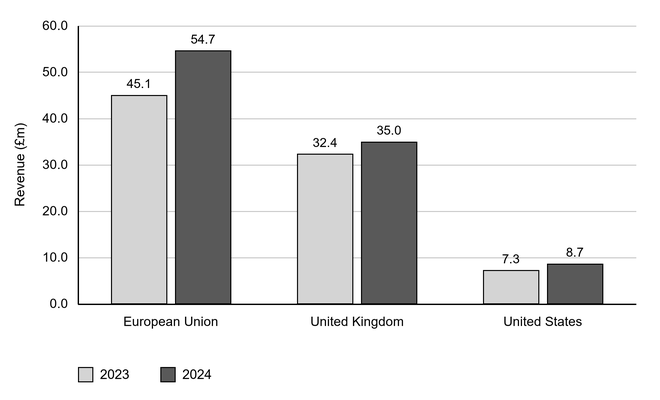
Where that revenue comes from is the surprise. The European Union is now Warpaint London plc's largest market, at £54.7 million against £45.1 million the year before. The United Kingdom, the country the company is based in, came second at £35.0 million against £32.4 million. The United States brought in £8.7 million against £7.3 million, and the remaining £3.2 million came from the rest of the world.

Source: information sourced from Warpaint London PLC results for the year ended 31 December 2024

Appendix B: Warpaint London plc revenue by region

Bar chart of Warpaint London plc revenue by region, in £ millions, for 2023 and 2024: EU £45.1m to £54.7m, UK £32.4m to £35.0m, and US £7.3m to £8.7m. Y-axis 0 to 60.

Source: Warpaint London plc

In 2024 Warpaint London plc's revenue in the European Union grew from £45.1 million to £54.7 million, while its revenue in the United Kingdom grew from £32.4 million to £35.0 million.

Analyse one way in which knowing this difference might affect where Warpaint London plc chooses to spend its marketing budget.

5
6 marks

Source A: PZ Cussons plc

PZ Cussons plc owns personal care and beauty brands. In the United Kingdom it owns Carex, the best-selling hand wash, Original Source, Imperial Leather, Childs Farm, which is made for babies and children, and St Tropez, which is self-tanning. It does not own shops: its products reach customers through supermarkets, pharmacies, discounters and beauty retailers. It is a public limited company listed in London.

Much of the business is not in Britain at all. PZ Cussons plc has sold in Nigeria for more than a century and manufactures there, and it also sells across Asia Pacific. That reach is the source of both its growth and its biggest problem.

In the year to 31 May 2025 like-for-like revenue, which strips out the effect of currency changes, grew 8.0%, mostly because of price rises in Nigeria, where the volume sold fell. Reported revenue, which is what the accounts say, fell 2.7% to £513.8 million from £527.9 million. The difference is the Nigerian naira. The currency was stable through the year, but it averaged 38% below where it had been the year before, so every naira of Nigerian sales turned into far fewer pounds.

Adjusted operating profit was £54.9 million against £58.3 million, and the operating margin slipped to 10.7% from 11.0%.

The UK brands did not all pull the same way. Carex grew both its revenue and its gross margin, and held its position as the largest hand wash brand. St Tropez had a difficult year: its revenue fell by a double-digit percentage, reflecting weak demand for self-tan in the United States, while like-for-like revenue in Europe and the Americas grew only 0.6%. The company considered what to do with St Tropez and decided to keep it, saying it would give the brand a new direction.

Source: information sourced from PZ Cussons plc preliminary results for the year ended 31 May 2025

Appendix B: The UK hand wash market, analyst estimates

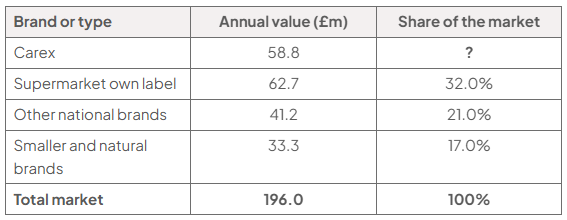
Table of UK hand wash market: Carex £58.8m, share marked “?”; supermarket own label £62.7m (32.0%), other national brands £41.2m (21.0%), smaller and natural brands £33.3m (17.0%); total £196.0m (100%).

Source: Analyst

Carex is the largest hand wash brand in the United Kingdom and grew both its revenue and its gross margin last year.

Analyse one way in which already being the largest brand might affect the marketing objectives PZ Cussons plc sets for Carex.

6
6 marks

Source A: Pelham Audio Ltd

Pelham Audio Ltd designs and builds studio headphones and microphones in Cambridge. It is a private limited company founded by Nadia Sokolova and it employs 41 people, fourteen of them engineers.

For twenty years its customers were recording studios: a few thousand of them worldwide, buying expensive equipment and keeping it for a decade. That is still where the reputation comes from. It is no longer where most of the units go. Podcasters, musicians recording at home and people making video for a living now buy more Pelham Audio Ltd equipment than studios do, at less than a fifth of the price per item.

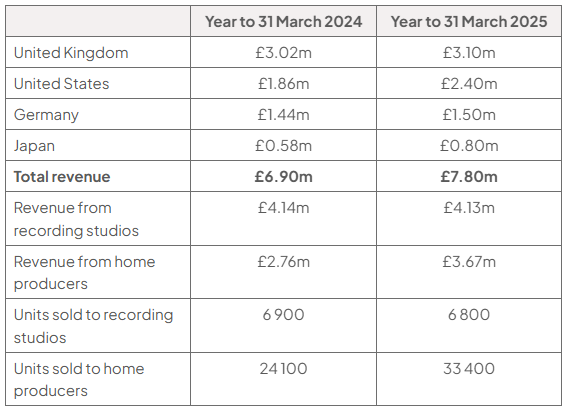
Last year revenue was £7.8 million. The United Kingdom accounted for £3.1 million, the United States £2.4 million, Germany £1.5 million and Japan £0.8 million. Everything is sold either through specialist dealers or directly from the company's own website.

Nadia Sokolova has spent money on finding things out. The company now knows what each dealer sells, what its website visitors look at before they buy, and what its customers say when asked. In February it commissioned a survey of 400 home producers, which found that 62% would pay more for a microphone that plugs straight into a computer without a separate audio interface. The research company reported the result with a margin of error of 4.9 percentage points at the 95% confidence level.

The data has produced two questions rather than one answer. The first is which country to put money behind next. The second is larger: whether Pelham Audio Ltd is a company that makes equipment for studios and happens to sell some to home producers, or the other way round.

Appendix A: Pelham Audio Ltd, revenue by market and by customer

Table of figures for years ending 31 March 2024/2025: revenue (£m): UK 3.02/3.10, US 1.86/2.40, Germany 1.44/1.50, Japan 0.58/0.80, total 6.90/7.80; studio/home revenue 4.14/4.13 and 2.76/3.67; units 6,900/6,800 and 24,100/33,400.

Source: Analyst

Pelham Audio Ltd has to decide which of its four markets to put money behind next.

Analyse one way in which setting a marketing objective for each country separately might affect how Pelham Audio Ltd spends its marketing budget.

7
6 marks

Source A: Marchmont Paper Co. Ltd

Marchmont Paper Co. Ltd makes notebooks, planners and page-a-day diaries in a converted mill in Hebden Bridge. It is a private limited company owned by Ines Marchmont and Tom Prideaux, and it employs 28 people. The paper is milled in Cumbria, the covers are cloth-bound by hand, and a planner sells for around £24.

Revenue last year was £3.8 million. Of that, £2.7 million came from the United Kingdom, £664 000 from Japan, £397 800 from France and £38 200 from everywhere else. Inside the UK figure, £1.4 million was taken on Marchmont Paper Co. Ltd's own website and £1.3 million through about 400 independent stationers and one department store chain.

Ines Marchmont buys a market report each year. It values the UK market for premium paper stationery at £210 million and covers sales made through stationery shops only. Marchmont Paper Co. Ltd's shop sales of £1.3 million give it a share of 0.62% on that basis. Just over half of what the company actually sells in the UK is not in the report at all.

The marketing objective for this year, written into a plan every January and reviewed the following January, is to grow revenue by 25%.

Japan is where the plan has been working and not working at the same time. Until 2024 Marchmont Paper Co. Ltd sold direct to about 90 Japanese shops. In 2025 it moved to a single distributor, which buys in bulk and sells on. The number of items sold rose sharply. What came back did not.

Marchmont Paper Co. Ltd knows very little about who buys its planners. The website asks one question at checkout, "what will you use this for?", and roughly a fifth of customers answer it. Nobody has ever spoken to a customer who bought from a shop.

Marchmont Paper Co. Ltd writes a marketing plan each January and reviews it the following January.

Analyse one way in which planning a full year ahead might affect how Marchmont Paper Co. Ltd responds if a competitor launches a similar range of planners in March.

1
9 marks

Source B: Battersea Dogs' and Cats' Home

Battersea Dogs' and Cats' Home is a registered charity, number 206394. It works with animals, provides services to the general public, and operates in London, in Windsor and Maidenhead, and in Kent. It has no shareholders and no owners. Any money left over at the end of the year stays in the charity.

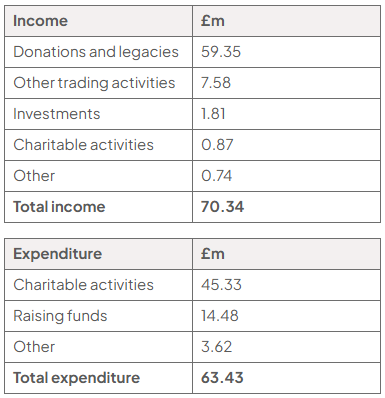
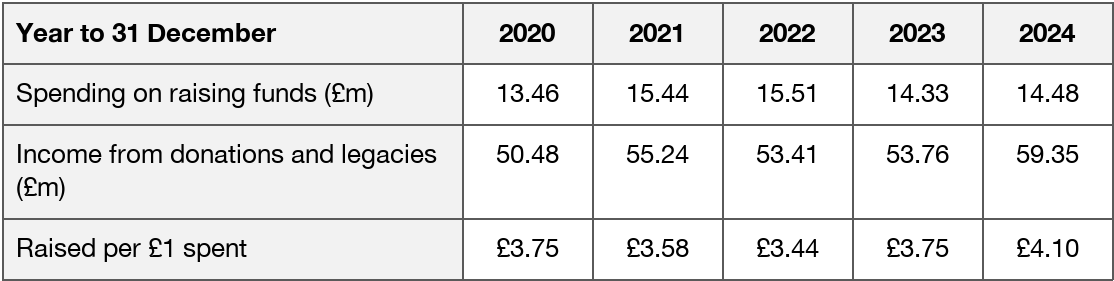
Almost all of its money is given rather than earned. In the year to 31 December 2024 its total income was £70.34 million, of which £59.35 million came from donations and legacies. A legacy is money left to a charity in somebody's will, and legacies alone came to £32.57 million, almost half of everything Battersea received. The rest came from other trading activities, £7.58 million, from charitable activities, £869 000, from investments, £1.81 million, and from other sources, £741 000.

Raising that money costs money. Battersea spent £14.48 million on raising funds during the year. It spent £45.33 million on its charitable activities and £3.62 million on other costs, giving total expenditure of £63.43 million.

Income has grown in three of the past four years, from £52.71 million in 2020 to £70.34 million in 2024. Expenditure has risen every year over the same period.

Source: Charity Commission register of charities, entry 206394

Appendix D: Battersea Dogs' and Cats' Home income and expenditure, year to 31 December 2024

Appendix D tables (£m): income totals 70.34, including donations and legacies 59.35; expenditure totals 63.43, including raising funds 14.48. Other income and expenditure categories are also listed.

Appendix F: Battersea Dogs' and Cats' Home spending on raising funds

Table for 2020–2024: in 2023 and 2024, spending on raising funds was £14.33m and £14.48m; donations and legacies were £53.76m and £59.35m; raised per £1 spent was £3.75 and £4.10.

Source: Charity Commission

Assess whether Battersea Dogs' and Cats' Home should spend more on raising funds.

Calculate the percentage change in Battersea Dogs' and Cats' Home's income from donations and legacies between 2023 and 2024 to support your answer.

Give your answer to one decimal place.

2
9 marks

Source A: The Gym Group plc

The Gym Group plc runs low cost gyms. It opened its first in 2008 and is now a public limited company with shares traded on the London Stock Exchange. It describes itself as a leading low cost gym operator and its offer as high value, low cost. Members pay by the month, there is no long contract to sign, and the gyms are open 24 hours a day.

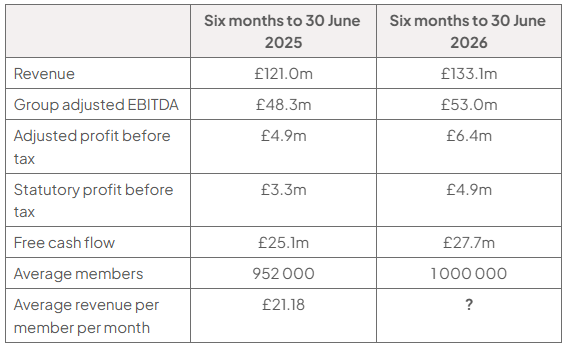
The company calls its approach a labour light business model. Gyms are largely self-service, so a site can run with a small team, and the savings go into the price rather than into staff on the front desk. In the six months to 30 June 2026 The Gym Group had an average of one million members, up 5% on the same period a year earlier, and average revenue per member per month rose 5%.

Growth comes from two places. The company opens new gyms, and it improves the ones it already has. Four new sites opened in the first half of 2026, with eleven more being built, and it expects to open at least 20 during the year as part of a plan to open around 75 over three years, paid for out of its own cash. It also refurbishes older gyms to a newer design. Three were refurbished in the first half of 2026 and eighteen more were planned for the second half. Gyms refurbished during 2025 went on to win 10% more members than before.

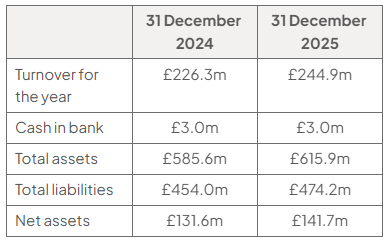
The business is not short of demand, but it is carrying a lot of debt. At the end of 2025 its total liabilities were £474.2 million against total assets of £615.9 million, and it held only £3 million in cash. The company says its aim is a 30% return on the money invested in its mature gyms, and it is buying back some of its own shares.

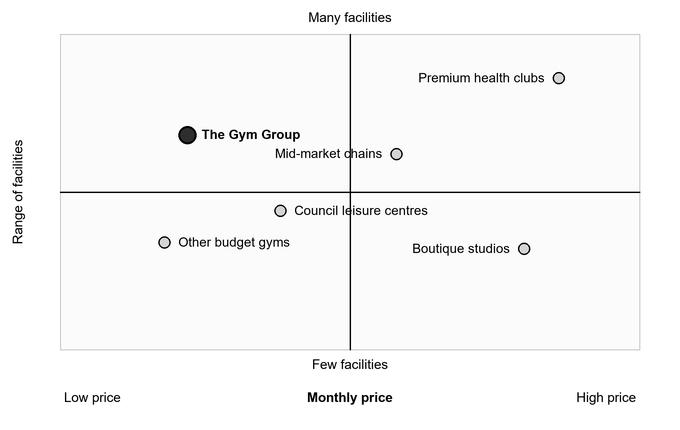
Appendix C shows where The Gym Group sits against other kinds of gym.

Source: The Gym Group plc interim results, 9 September 2026, and Companies House

Appendix A: The Gym Group plc results for the six months ended 30 June 2026

Table comparing six months to 30 June 2025 and 2026: revenue £121.0m/£133.1m; adjusted EBITDA £48.3m/£53.0m; adjusted profit before tax £4.9m/£6.4m; statutory profit before tax £3.3m/£4.9m; free cash flow £25.1m/£27.7m; average members 952,000/1,000,000; average monthly revenue per member £21.18/unknown.

Source: The Gym Group plc

Appendix B: The Gym Group plc financial position at 31 December 2025

Financial table comparing 31 December 2024 and 2025: turnover £226.3m and £244.9m; cash £3.0m in both years; assets £585.6m/£615.9m; liabilities £454.0m/£474.2m; net assets £131.6m/£141.7m.

Source: Companies House

Appendix C: Market map of the UK gym market

Market map: monthly price runs low to high and range of facilities from few to many. The Gym Group is low-price with many facilities; premium health clubs, mid-market chains, council leisure centres, other budget gyms and boutique studios are also plotted.

Source: Analyst

Assess whether opening at least 20 new gyms during 2026 is likely to improve The Gym Group plc's competitiveness.

3
9 marks

Source A: Softcat plc

Softcat plc sells technology to other organisations. If a company needs 400 laptops, a new firewall, a cloud contract and someone to set it all up, it can deal with a dozen manufacturers or it can deal with Softcat. It is a public limited company listed in London, and it sells to about 10 200 customers: businesses of every size and a large amount of public sector work.

Softcat does not describe its own size the way most companies do, and the reason is worth understanding. When it sells a laptop it buys the laptop and sells it on, so the whole price counts as its revenue. When it sells a software licence it is acting more as an agent for the software company, and accounting rules require it to count only the commission it keeps, not the price the customer paid. Two sales of exactly the same value to the customer therefore appear in Softcat's accounts at completely different sizes.

That is why it publishes a third figure. Gross invoiced income is the total value of everything it invoiced, whichever way the accounting treats it, and Softcat regards gross profit as its main measure of scale.

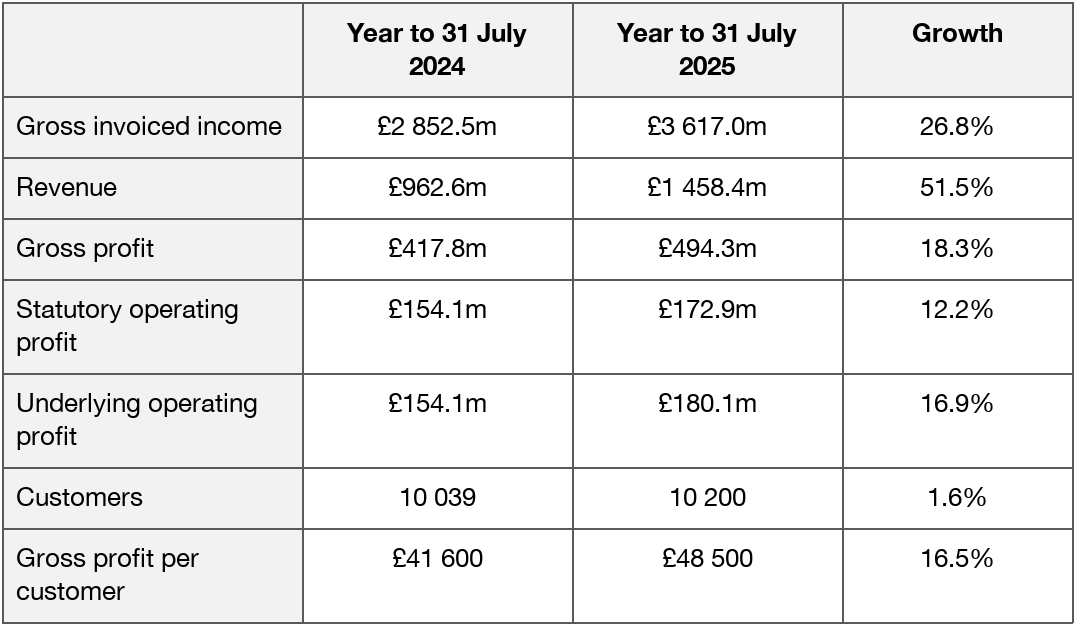
In the year to 31 July 2025 all three grew, and none of them agreed with the others. Gross invoiced income rose 26.8% to £3 617.0 million. Revenue rose 51.5% to £1 458.4 million. Gross profit rose 18.3% to £494.3 million. Statutory operating profit rose 12.2% to £172.9 million and underlying operating profit rose 16.9% to £180.1 million. Appendix B shows the three top-line measures together.

Behind all of it, the customer numbers barely moved. Softcat served 10 200 customers, 1.6% more than the year before, and gross profit per customer rose 16.5% to £48 500. It also completed its first acquisition.

Source: information sourced from Softcat plc preliminary results for the year ended 31 July 2025

Appendix A: Softcat plc selected results

Table comparing Softcat results for years to 31 July 2024 and 2025: 2024 gross invoiced income £2,852.5m, revenue £962.6m, gross profit £417.8m, operating profits £154.1m, 10,039 customers and £41,600 gross profit per customer.

Source: Softcat plc

Assess whether Softcat plc should try to increase the number of customers it serves.

4
9 marks

Source A: Skylark Adventure Ltd

Skylark Adventure Ltd runs six indoor adventure parks, in converted warehouses on the edges of northern towns. Each one has climbing walls, trampolines, an obstacle course and a café. It is a private limited company owned by Ben Attah and Priya Shergill, who opened the first site in 2016, and it employs 148 people, most of them part time.

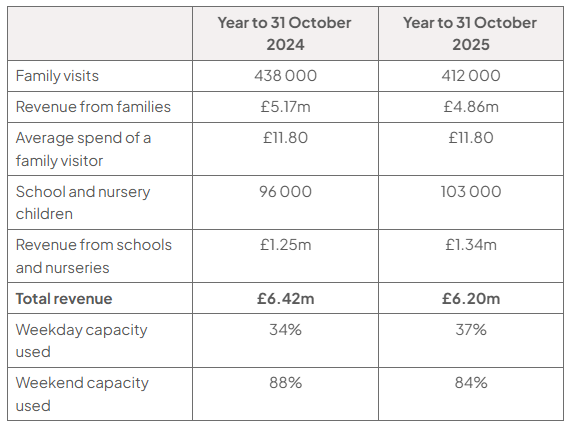
Almost all of the money comes from families. Last year 412 000 family visits brought in £4.86 million, an average of £11.80 a head once the café is counted. The rest, £1.34 million, came from schools and nurseries, who book weekday mornings a whole year ahead.

The two kinds of customer behave nothing like each other. A school booking is made in September for the following July and is almost never cancelled. A family visit is decided on a Saturday morning and is the first thing to go when money is tight. Appendix B shows what happened to family visits over five years as real household disposable income moved, and the two lines are hard to look at separately.

Ben Attah and Priya Shergill have £250 000 to spend across the six sites. They can lower prices, which they have never done, or they can put a new activity into every site and leave the price where it is. They are also arguing about something larger: whether a business that depends on families having spare money is one they should be trying to change.

Appendix A: Skylark Adventure Ltd, where the money comes from

Table comparing years to 31 October 2024/2025: family visits 438,000/412,000; family revenue £5.17m/£4.86m; average spend £11.80 both; school children 96,000/103,000; revenue £1.25m/£1.34m; total revenue £6.42m/£6.20m; weekday capacity 34%/37%, weekend 88%/84%.

Source: Analyst

Assess whether Skylark Adventure Ltd should set itself the objective of filling its weekday mornings.

5
9 marks

Source A: Wrenfield Schoolwear Ltd

Wrenfield Schoolwear Ltd makes and sells school uniform from a unit in Nottingham: blazers, jumpers, skirts, trousers and PE kit, most of it carrying an embroidered school badge. Priya Wrenfield started it in 2009 after both her children came home in December with blazers that had already worn through at the elbow. The objective written into the company's own documents has never changed: to make uniform that lasts three years, and to keep a full set below £60. It is a private limited company and it employs 41 people.

It sells in two ways. Sixty-two schools have an exclusive supply contract with Wrenfield Schoolwear Ltd, which means a parent at one of those schools cannot buy the uniform anywhere else; the school receives a share of everything sold. That brought in £3 320 000 last year. The rest, £1 165 000, came from Wrenfield Schoolwear Ltd's own website, mostly from parents at schools with no exclusive supplier.

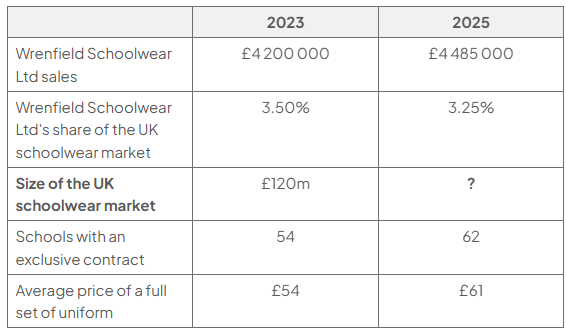
The marketing objective set two years ago was to grow sales by 5% by 2025. Sales rose from £4 200 000 to £4 485 000, which is 6.8%, and Priya Wrenfield has told the board the objective was met. Appendix A contains the figure she has not put in front of them.

A full set of uniform now costs a parent £61.

Wrenfield Schoolwear Ltd commissioned a survey last spring of 400 parents, 400 pupils and 96 school business managers, asking each of them to score four things out of ten. The results are in Appendix B. Priya Wrenfield has read them several times and has not yet decided what to do about them.

Appendix A: Wrenfield Schoolwear Ltd and the UK schoolwear market

Table comparing Wrenfield Schoolwear in 2023 and 2025: sales £4.2m and £4.485m; UK market share 3.50% and 3.25%; market size £120m and unknown; exclusive-contract schools 54 and 62; average full-set price £54 and £61.

Source: Analyst

Assess whether Wrenfield Schoolwear Ltd should set its next marketing objective in terms of sales growth.

Calculate the size of the UK schoolwear market in 2025 to support your answer.

Give your answer in £ million.

1
15 marks

Source B: Mishcon de Reya LLP

Mishcon de Reya LLP is a law firm. It advises businesses and wealthy individuals on disputes, property, corporate deals and private matters, and it is led by managing partner James Libson. It has offices in London, Cambridge and Oxford, and overseas in Hong Kong, Singapore and the United Arab Emirates. About 1 250 people work there, including more than 650 lawyers.

It is not a company. It is a limited liability partnership, which means it is owned by its members, the partners, rather than by shareholders. Members put capital into the firm when they join and take a share of the profit rather than a salary. Nobody outside the partnership owns any part of it.

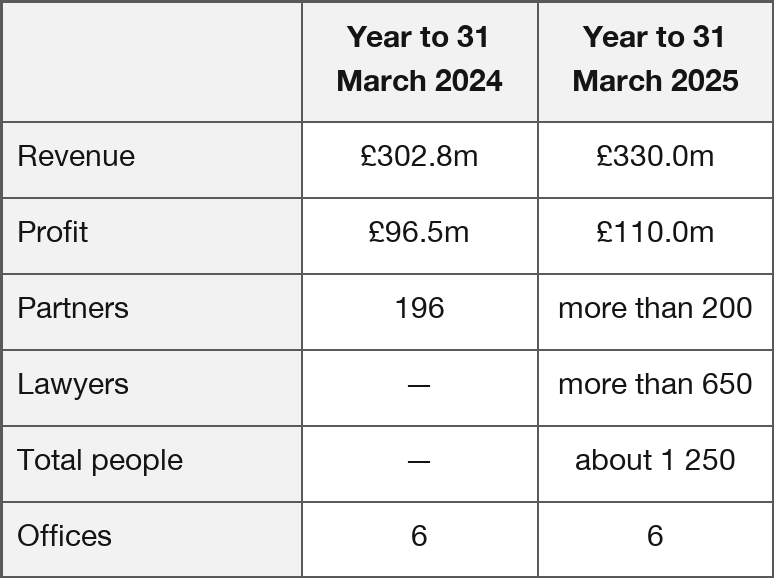
The year to 31 March 2025 was the firm's best. Revenue rose 9% to £330 million and profit rose 14% to £110 million, the first time it has passed £100 million. The firm says it has tripled in size over the past decade. Its work during the year included advising Wayve on what it describes as Europe's largest artificial intelligence investment and defending O2 in a collusion claim.

Growing has meant admitting people. Sixteen new partners joined during the year and a further 27 people were promoted to partner from inside the firm, alongside 13 promotions to legal director. There are now more than 200 partners. As in any partnership, some members retire or leave each year, so membership grows by less than the number admitted.

That is the tension the firm is sitting with. In a partnership the profit is divided between the members, so every partner admitted is another share of the same pool. The firm now has to decide where its next stage of growth should come from: more partners in the United Kingdom, where it already has three offices and knows the market, or a bigger presence in Hong Kong, Singapore and the United Arab Emirates, where the offices exist but are small. Appendix F sets out the two options.

Source: information sourced from Mishcon de Reya LLP, results for 2024/25

Appendix D: Mishcon de Reya LLP selected results

Selected results for years to 31 March 2024/2025: revenue £302.8m/£330.0m; profit £96.5m/£110.0m; partners 196/over 200; lawyers —/over 650; total people —/about 1,250; offices 6/6.

Source: Mishcon de Reya LLP; 2024 partner number from analyst estimates

Appendix E: Mishcon de Reya LLP profit and members, analyst estimates

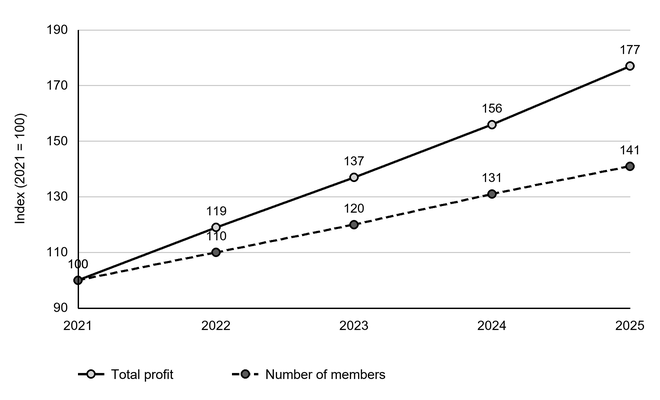
Line chart of Mishcon de Reya LLP’s indexed total profit and number of members, 2021 to 2025 (2021 = 100): profit rises 100, 119, 137, 156, 177; members rise 100, 110, 120, 131, 141.
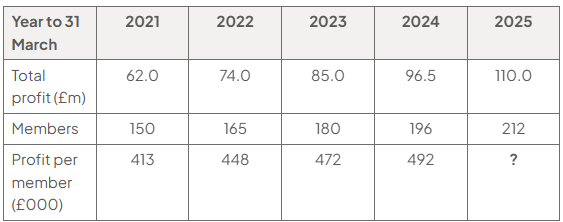
Table for years to 31 March 2021 to 2025: total profit (£m) 62.0, 74.0, 85.0, 96.5, 110.0; members 150, 165, 180, 196, 212; profit per member (£000) 413, 448, 472, 492, ?.

Source: Analyst

Appendix F: Data for two ways of growing

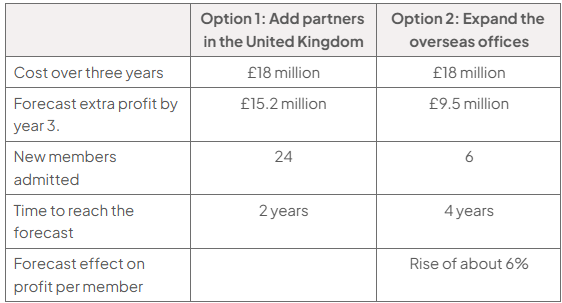
Table: UK partner expansion costs £18m, forecasts £15.2m extra profit by year 3, adds 24 members in 2 years; overseas expansion costs £18m, forecasts £9.5m, adds 6 in 4 years and raises profit per member 6%.

Source: Analyst

Appendix F shows two ways in which Mishcon de Reya LLP could grow.

Evaluate both options and recommend which one would be the better way for Mishcon de Reya LLP to grow.

2
15 marks

Source A: Loomfield Home Ltd

Loomfield Home Ltd sells bedding, towels and throws online. It has no shops. It is a private limited company founded by Esi Boateng, it employs 23 people and it works from a warehouse in Bristol.

Everything it sells is made from organic or recycled cotton, and that is what the business is built on. Its packaging carries the words "carbon neutral", which the company can say because it buys offsets to match the emissions of its deliveries, rather than because those deliveries produce no emissions. Nothing about the claim is untrue, and Esi Boateng has begun to wonder how long it will be before a customer asks her to explain the difference.

The website does something else she is less comfortable with. When a product is running low the page shows how many are left, and the number is real. What is not obvious to a customer is that the message appears whenever inventory falls below twenty, which for most lines is most of the time.

Last year Loomfield Home Ltd took £6.4 million, of which £5.6 million was in the United Kingdom, £0.5 million in Germany and £0.3 million in France. Both European markets are sold through the same website in the local language, with delivery from Bristol.

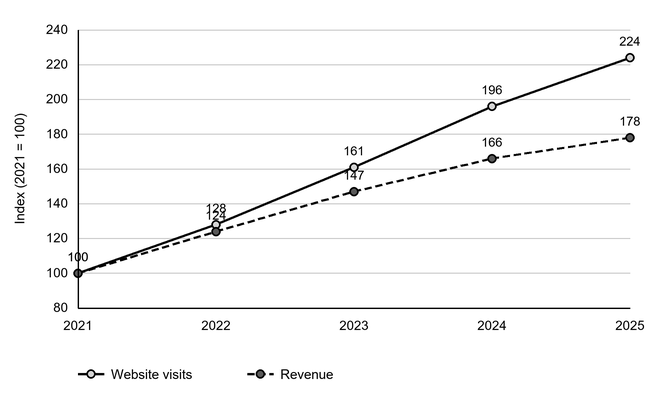
The company spends most of its marketing money on getting people to the website, and it has been successful at it. Since 2021 the number of visits has more than doubled. The number of orders has not.

Appendix A: Loomfield Home Ltd, four years apart

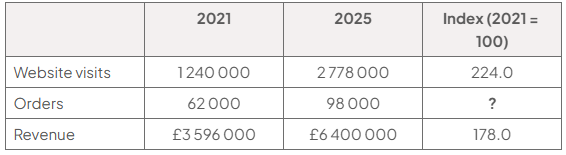
Table comparing Loomfield Home Ltd data in 2021 and 2025: website visits 1,240,000 to 2,778,000 (index 224.0); orders 62,000 to 98,000 (index unknown); revenue £3,596,000 to £6,400,000 (index 178.0).

Source: Analyst

Appendix B: Loomfield Home Ltd, website visits and revenue since 2021

Line chart of indexed website visits and revenue (2021 = 100): both rise from 100 in 2021 to 224 and 178 respectively in 2025, with visits increasing faster. Values are shown for 2022 to 2024.

Source: Analyst

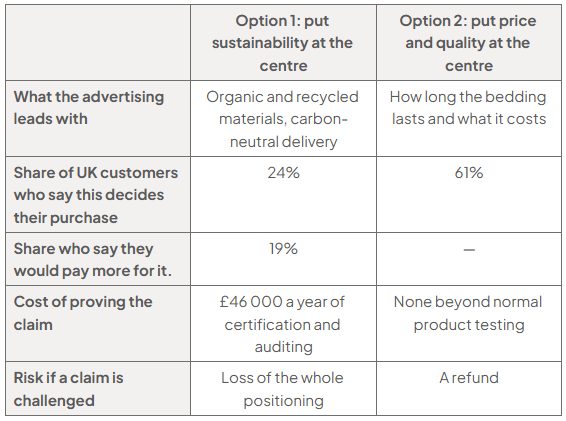
Appendix C: Data for two ways of marketing Loomfield Home Ltd

Marketing comparison: sustainability: organic/recycled, carbon-neutral; 24% influenced, 19% pay more, £46,000 annual auditing, risk losing positioning. Price/quality: lasting, affordable bedding; 61% influenced, no extra payment, normal testing, refund risk.

Source: Analyst

Appendix C shows two ways in which Loomfield Home Ltd could market itself.

Evaluate whether Loomfield Home Ltd should put sustainability at the centre of its marketing or put price and quality there instead.

3
15 marks

Source A: Marchmont Paper Co. Ltd

Marchmont Paper Co. Ltd makes notebooks, planners and page-a-day diaries in a converted mill in Hebden Bridge. It is a private limited company owned by Ines Marchmont and Tom Prideaux, and it employs 28 people. The paper is milled in Cumbria, the covers are cloth-bound by hand, and a planner sells for around £24.

Revenue last year was £3.8 million. Of that, £2.7 million came from the United Kingdom, £664 000 from Japan, £397 800 from France and £38 200 from everywhere else. Inside the UK figure, £1.4 million was taken on Marchmont Paper Co. Ltd's own website and £1.3 million through about 400 independent stationers and one department store chain.

Ines Marchmont buys a market report each year. It values the UK market for premium paper stationery at £210 million and covers sales made through stationery shops only. Marchmont Paper Co. Ltd's shop sales of £1.3 million give it a share of 0.62% on that basis. Just over half of what the company actually sells in the UK is not in the report at all.

The marketing objective for this year, written into a plan every January and reviewed the following January, is to grow revenue by 25%.

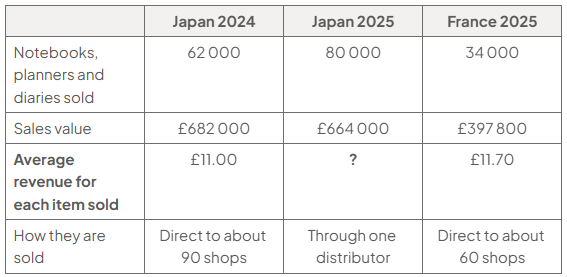
Japan is where the plan has been working and not working at the same time. Until 2024 Marchmont Paper Co. Ltd sold direct to about 90 Japanese shops. In 2025 it moved to a single distributor, which buys in bulk and sells on. The number of items sold rose sharply. What came back did not.

Marchmont Paper Co. Ltd knows very little about who buys its planners. The website asks one question at checkout, "what will you use this for?", and roughly a fifth of customers answer it. Nobody has ever spoken to a customer who bought from a shop.

Appendix A: Marchmont Paper Co. Ltd sales outside the UK

Table: Japan 2024—62,000 items, £682,000 sales, £11.00 each, direct to about 90 shops; Japan 2025—80,000, £664,000, average revenue unknown, one distributor; France 2025—34,000, £397,800, £11.70 each, about 60 shops.

Source: Analyst

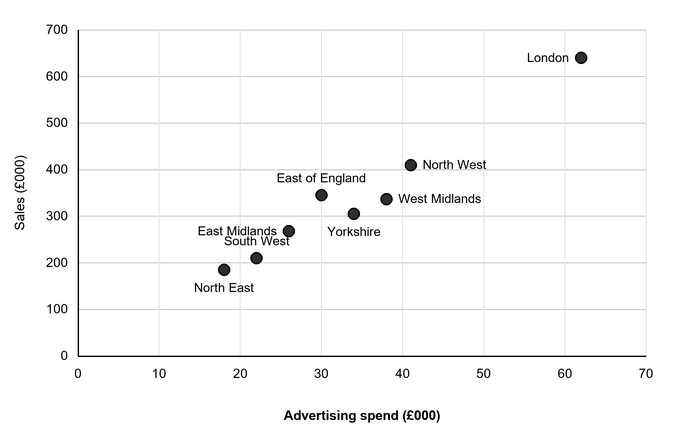
Appendix B: Marchmont Paper Co. Ltd UK advertising spend and sales, by region

Scatter graph of regional advertising spend and sales: sales generally rise as spend increases. Axes show £000s, spend 0–70 and sales 0–700; London is highest at £62,000 and £640,000, while North East is lowest at £18,000 and £185,000.

Source: Analyst

Marchmont Paper Co. Ltd's marketing objective for this year is to grow revenue by 25%.

Evaluate whether Marchmont Paper Co. Ltd should set its marketing objectives in terms of revenue growth or in terms of market share.