Global Strategy (AQA A Level Business): Exam Questions

Exam code: 7132

Syllabus Edition

First teaching 2026

First exams 2028

2 hours17 questions
1
6 marks

Source B: Pukka Pads

Pukka Pads is a stationery business based in Poole, Dorset, owned and controlled by Chris Stott. It sells notebooks, pads, files, packaging and party products to retailers, to other businesses and online. It makes products in its UK factories and buys others from suppliers in China and the Far East, paying them in US dollars. It has companies in the United States, Hong Kong, China and the Netherlands.

In the year to 30 September 2025:

  • turnover fell by 10% to £21.8 million, "primarily as a result of moving away from very low margin product sales in the UK business"

  • gross profit rose, and operating profit rose to £652 055

  • inventory was reduced by £1.57 million

  • the average number of employees fell from 84 to 71

The company faces two main pressures:

  • Currency. No contracts to fix the exchange rate were in place at 30 September 2025, though some were taken out shortly afterwards. Administrative expenses included an exchange loss of £68 483 in 2025, against an exchange gain of £413 141 in 2024.

  • Trade. Since April 2025 the United States has charged a tariff of 10% on most goods imported from the UK, and higher tariffs on many goods from China.

For 2026, Pukka Pads says that "new machines have been acquired to improve manufacturing processes, reduce waste and headcount". In 2024-25, £367 080 of new machinery was financed through hire purchase. It also says that leaving one of its UK warehouses by 30 June 2026 will save more than £700 000 a year.

Source: Pukka Pads UK Limited, group accounts for the year ended 30 September 2025

Pukka Pads buys many of its products from suppliers in China and the Far East, paying them in US dollars.

Analyse one way in which a fall in the value of the pound against the US dollar might affect Pukka Pads.

2
6 marks

Source B: Gadderby Sportswear

Gadderby Sportswear Limited is a private limited company, founded in 2008 by Martin Ashworth, a former rugby league player, and based in Huddersfield, West Yorkshire. It is owned by the Ashworth family, and Martin's daughter, Jo Ashworth, is Managing Director.

The company makes custom kit, including shirts, shorts, socks and training wear in each team's colours with names, numbers and sponsors' logos, for about 2 300 amateur rugby, football and netball clubs and 410 schools. Its mission is "kit made in Yorkshire for every grassroots team".

Every garment is cut, printed and sewn in its own factory, which allows it to deliver an order in 10 working days. The company repairs damaged kit free of charge for the first season and keeps each club's designs on file for quick reorders.

Revenue rose from £12.6 million to £14.2 million in 2025, and the factory made 610 000 garments. In 2025 the company began supplying clubs in Ireland and the Netherlands, which are in the European Union. Three rules apply to sales to EU customers:

  • Tariffs. UK-made goods are free of tariffs if they meet the "rules of origin" in the UK-EU trade agreement.

  • Customs. Every shipment needs a customs declaration.

  • VAT. EU customers pay VAT when their goods arrive.

Many competitors sell online and import kit from factories in Asia, at lower prices but with deliveries that take four to six weeks.

The company's objective is to reach revenue of £20 million by 2030 with an operating profit margin of at least 10%.

Source: Gadderby Sportswear

In 2025 Gadderby Sportswear began supplying clubs in Ireland and the Netherlands, which are in the European Union.

Analyse one way in which selling to clubs in the European Union might affect Gadderby Sportswear's costs.

3
6 marks

Source A: Alexander Dennis

Alexander Dennis Limited (ADL) is a private limited company, owned since 2019 by NFI Group, a Canadian bus and coach maker. It designs and builds single-deck and double-deck buses, including electric buses, and provides spare parts and servicing. It has factories in Scarborough and at Falkirk and Larbert in Scotland, and businesses in Hong Kong, New Zealand, Singapore, Malaysia, Germany and Mexico.

In 2025 ADL's turnover fell by 18.1% to £426.9 million, which it blamed on "increasing Chinese competition for zero-emission vehicles". By market:

  • UK: fell from £482.5 million to £370.7 million

  • Americas: rose from £8.1 million to £31.3 million; firm orders in North America run to 2028

Government grants help bus operators in England and Scotland buy zero-emission buses from any maker. ADL argues that UK rules for buying buses do not reward "local content, job retention and creation". In March 2026 it called the results of Scotland's latest grant scheme "extremely disappointing with the majority of the available funding going overseas".

ADL's Scottish factories have faced two proposals:

  • June 2025: close both, putting 400 jobs at risk, and move all bus-body building to Scarborough. In September 2025, after talks with the UK and Scottish governments and trade unions, ADL kept both.

  • March 2026: close Falkirk and turn Larbert into a site for building chassis, the frame and running gear under a bus body, with up to 115 jobs at risk, about 200 safeguarded and about 350 kept in Scotland. ADL keeps the option of bringing bus-body building back to Larbert if UK volume rises.

Source: Alexander Dennis Limited, annual report and financial statements for the year ended 28 December 2025, and press reports

Alexander Dennis sells buses outside the UK, including in North America, Hong Kong and New Zealand. Its owner, NFI Group, is a Canadian bus and coach maker.

Analyse one way in which selling buses in other countries might help Alexander Dennis.

4
6 marks

Source B: Ravenshall Engineering

Ravenshall Engineering Limited is a private limited company, founded in Burnley, Lancashire, in 1978. It makes aluminium body frames, floors and battery housings for buses and coaches, which bus makers use to build complete vehicles. It employs 240 people. Its customers are:

  • three UK bus makers

  • five bus and coach makers in Poland, the Netherlands and Spain, whom it invoices in euros

Its products can be sold to EU customers without tariffs if they meet the rules of origin in the UK-EU trade agreement, but every shipment needs a customs declaration and delivery takes four days.

In 2025 revenue rose to £38.6 million, helped by growing exports to the European Union. The gross profit margin was 21%, compared with 22% in 2024.

The company faces three main pressures:

  • One large customer. 44% of its sales go to one UK bus maker, up from 39% in 2024. That customer has reduced its workforce and sites in the last two years.

  • Government grants. Most of its UK customers' orders are for buses bought with the help of government grants, which do not require buses to be built in the UK.

  • Chinese competition. Chinese bus makers such as Yutong ship complete buses to the UK, built with their own frames and battery housings.

Ravenshall's board is considering two investments:

  • An automated welding line in Burnley. It would reduce labour costs and rework, with 30 fewer welding jobs and 6 new technician roles.

  • A new factory in Poland, close to its EU customers.

Source: Ravenshall Engineering

Ravenshall Engineering sells to bus and coach makers in Poland, the Netherlands and Spain, and invoices them in euros.

Analyse one way in which a rise in the value of the pound against the euro might affect Ravenshall Engineering.

5
6 marks

Source A: Oxfam GB

Oxfam GB works to end poverty. It is a registered charity and a company limited by guarantee, and one of 21 affiliates of the Oxfam confederation, which worked in 79 countries in 2024/25. In 2024/25 Oxfam GB's work reached 9.21 million people, 8.05 million of them through humanitarian responses to emergencies.

Oxfam GB raises money from four main sources:

  • donations and legacies

  • grants from governments and international organisations

  • funding from other Oxfam affiliates

  • its shops

In 2024/25 Oxfam GB's income fell by £28.6 million, and it spent more than it received for the second year running. Funding from other Oxfam affiliates fell from £104.1 million to £82.0 million. The largest affiliate funder, Oxfam Germany, gave £17.8 million, down from £27.2 million.

Oxfam GB has gone through several changes:

  • Pay. In December 2023 its staff held the first strike in Oxfam's history. It was settled with a 6% pay rise for most staff and a £2 300 payment.

  • Restructure. In April 2025 it began a restructure to save £10.2 million of forecast pay costs, putting 265 jobs at risk.

  • Leadership. Its chief executive since April 2024 left in December 2025, and an interim chief executive, Richard Hawkes, took over from 31 March 2026.

Its goals for 2025/26 are Income, Influence, People and Decolonisation. Decolonisation means shifting money and decision-making to partners in the Global South.

Source: Oxfam GB, annual report and accounts for the year ended 31 March 2025, and press reports

Oxfam GB is one of 21 affiliates of the Oxfam confederation, which worked in 79 countries in 2024/25.

Analyse one benefit to Oxfam GB of being part of a global confederation.

6
6 marks

Source B: Woolmere Data Services

Woolmere Data Services Limited was founded in Sheffield in 2009. It analyses customer data for retailers and leisure businesses, helping them understand what their customers buy and why. It employs 160 people, most of whom are either consultants, who analyse data and advise clients, or software engineers. It stores its clients' data on its own computer servers in Sheffield.

For most of its history Woolmere earned its revenue from consultancy projects, in which its analysts studied a client's data and presented their findings. In 2022 it launched Woolmere Insight, an online platform that clients pay for by annual subscription and use to run their own analysis. The number of subscription clients rose in 2025.

In 2025 Woolmere reorganised into teams built around the platform and announced the changes to staff by email. Consultants now spend part of their time supporting platform clients instead of leading projects.

Woolmere opened a small office in Dublin in 2024, and its revenue from clients in Ireland rose in 2025. Two of its UK clients, which also have stores in the United States, have asked whether Woolmere could support them there.

The company faces two main pressures:

  • Competition. Two large international software businesses sell platforms similar to Woolmere Insight.

  • Staff. Most of the employees who left in 2025 were consultants with more than five years' service.

Its board is considering where to expand outside the UK, whether to stop taking new consultancy projects, and whether to move its clients' data to a cloud computing provider.

Source: Woolmere Data Services

Woolmere Data Services opened an office in Dublin in 2024, and some of its UK clients also have stores in the United States.

Analyse one benefit to Woolmere Data Services of selling its services outside the UK.

7
6 marks

Source A: Just Eat Takeaway

Just Eat Takeaway.com (JET) runs online food delivery platforms in Europe, including Just Eat in the UK and Ireland, Lieferando in Germany and Thuisbezorgd in the Netherlands. Its headquarters are in Amsterdam. JET was formed in 2020 when Just Eat merged with Takeaway.com. In October 2025 JET was bought by Prosus, a Dutch-listed technology investor, for about €4.1 billion, and its shares were removed from the stock market. Roberto Gandolfo replaced the founder, Jitse Groen, as chief executive in January 2026.

Customers order from restaurants and shops through JET's apps and websites. Some orders are delivered by the restaurant itself and some by couriers working through JET.

JET has changed in three main ways:

  • Acquisitions. In 2021 it bought Grubhub, a US delivery business, for $7.3 billion; it sold Grubhub in January 2025.

  • Countries. Since 2022 it has left Norway, Portugal, New Zealand, France, Australia, Denmark and Bulgaria, and it now operates in 14 countries. When it left Denmark in April 2026, its customers there were directed to Uber Eats.

  • Technology. About 450 jobs were cut in September 2025, partly by automating customer service. An AI voice assistant was launched across Europe in August 2026; early UK users found what they wanted about 40% faster than with the text assistant.

In the UK, JET competes with Uber Eats and with Deliveroo, which DoorDash, a US delivery business, bought in October 2025.

Prosus wants JET to become "a true European tech champion" and says it is "trading short-term profitability" for growth.

Source: Just Eat Takeaway.com, results for 2024 and the half year to June 2025; Prosus; and press reports

Just Eat Takeaway.com has left several countries since 2022 and now operates in 14.

Analyse one reason why Just Eat Takeaway.com might choose to leave some countries.

8
6 marks

Source B: Brackenfold Outdoor

Brackenfold Outdoor Limited is a private limited company, founded in 1987 in Kendal, Cumbria. It designs and makes waterproof jackets and trousers for walkers and for people who work outdoors, and employs 132 people. Its waterproof fabric is bought from an overseas supplier and priced in US dollars.

Brackenfold sells its products in three markets:

  • United Kingdom. It sells to outdoor shops and through its own website.

  • European Union. It sells to shops in the European Union.

  • United States. It sells to shops through a distributor.

In 2025 its sales to the European Union rose, while its sales to the United States fell.

Brackenfold also offers a repair service for its products. The number of jackets it repaired rose by more than half in 2025. In a survey of its website customers, more than half said they would rather repair a jacket than replace it.

The company faces two main pressures:

  • Trade. Since April 2025 most UK goods sold into the United States have faced an extra US tariff of 10%.

  • Costs. Its wage costs rose in 2025, after increases in the National Living Wage and in employers' National Insurance. The price of its waterproof fabric also rose.

Brackenfold's directors are considering investing in automated cutting machinery.

Source: Brackenfold Outdoor

Brackenfold Outdoor sells its clothing to shops in the European Union and, through a distributor, in the United States.

Analyse one benefit to Brackenfold Outdoor of selling its products abroad.

1
9 marks

Source A: The Body Shop

The Body Shop was founded by Anita Roddick, who opened its first shop in Brighton on 27 March 1976 with 25 products. From the start it sold products in refillable bottles. It became known for its campaigns: in 1987 it launched Community Trade, through which it buys ingredients directly from producer communities, and in 1989 it began campaigning against the testing of cosmetics on animals. In 2019 it was certified as a B Corporation. Much of its growth outside the UK came through franchising; by 1994, 89% of its shops were run by franchisees.

The business has had four owners since 2006:

  • L'Oréal bought it for £652.3 million in 2006.

  • Natura & Co bought it for £880 million in 2017, when it had about 3 200 stores in 66 countries.

  • Aurelius, an investment firm, bought it for £207 million in November 2023.

  • Auréa, a group led by Mike Jatania, bought the UK business and the brand from the administrators in September 2024 for at least £44.3 million.

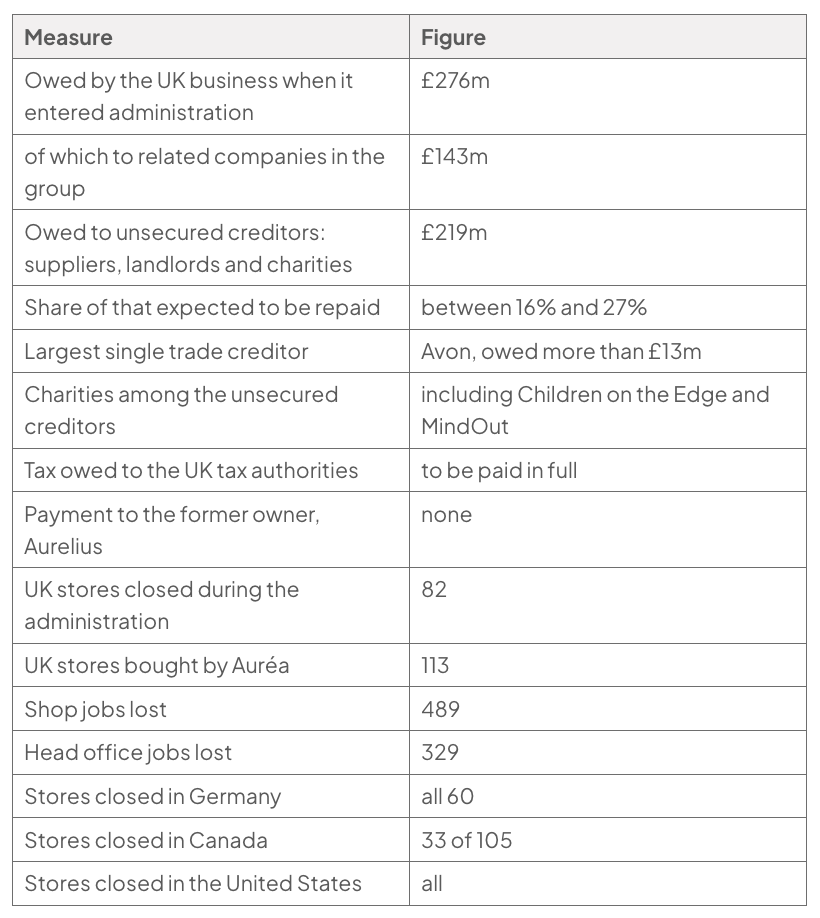
In February 2024 the UK business entered administration owing £276 million. More than 80 UK stores closed and more than 800 jobs were lost. The company-run businesses in Germany and the United States closed all their stores, while shops run by franchisees in many other countries continued to trade.

Auréa has said that the business returned to profit after it "fundamentally changed the operating model" and cut costs quickly, including reducing the range from more than 800 products. It has said that The Body Shop is unlikely to open many more UK stores, and that it is considering selling its products through other retailers, such as Boots, and supplying miniature products to hotels. In January 2024 the company completed a move to make its entire range vegan; in August 2025 it reintroduced some products which are not vegan.

Source: The Body Shop, Auréa and press reports

Appendix B: The UK administration, 2024

Two-column table of measures and figures from The Body Shop’s 2024 UK administration: debts, creditors, repayments, tax, stores closed or bought, and shop and head-office jobs lost in the UK and overseas.

Source: Analyst, using the administrators' reports and press reports

Appendix C: Since the rescue

  • The first 100 days. In December 2024 the new management told staff that the business had made a profit of £2 million on sales of £28 million in its first 100 days under Auréa. A source close to the business warned that it was now a smaller operation and that sales may have been helped by discounting and clearing old inventory.

  • Profit. In June 2026 Auréa said that the accounts it was about to file would show earnings before interest, tax, depreciation and amortisation of more than £24 million for the latest year, compared with a loss of £27 million the year before: the first profit since 2021.

  • What changed. The loss-making UK stores had already been closed during the administration. The new owners reduced the range from more than 800 products and cut costs.

  • Where it plans to sell. Auréa has focused on online sales and on wholesale deals with other businesses. It is considering selling through rival retailers such as Boots, and supplying miniature products to hotels. It has said it is unlikely to open many more UK stores.

  • Franchise markets. The franchise partner in India, with around 200 stores, aims to have more than 400 within five years. The Body Shop returned to New Zealand through a franchise partner in November 2025, after the company-run business there closed. The company-run business in Austria became insolvent in January 2026, affecting 12 shops.

  • Values. The range became entirely vegan in January 2024. In August 2025 some products that are not vegan were reintroduced.

Source: Analyst, using press reports

Assess whether franchising is likely to be the best way for The Body Shop to grow outside the UK.

2
9 marks

Source A: JCB

J.C. Bamford Excavators Limited, known as JCB, makes construction and agricultural machinery, including backhoe loaders, excavators and telescopic handlers. It was founded in 1945 by Joseph Cyril Bamford and is still owned by the Bamford family. Its headquarters are at Rocester, Staffordshire, and it employs more than 20 000 people in 23 factories around the world. It sells its machines through independent dealers. Its competitors include Caterpillar and Komatsu, both of which are larger.

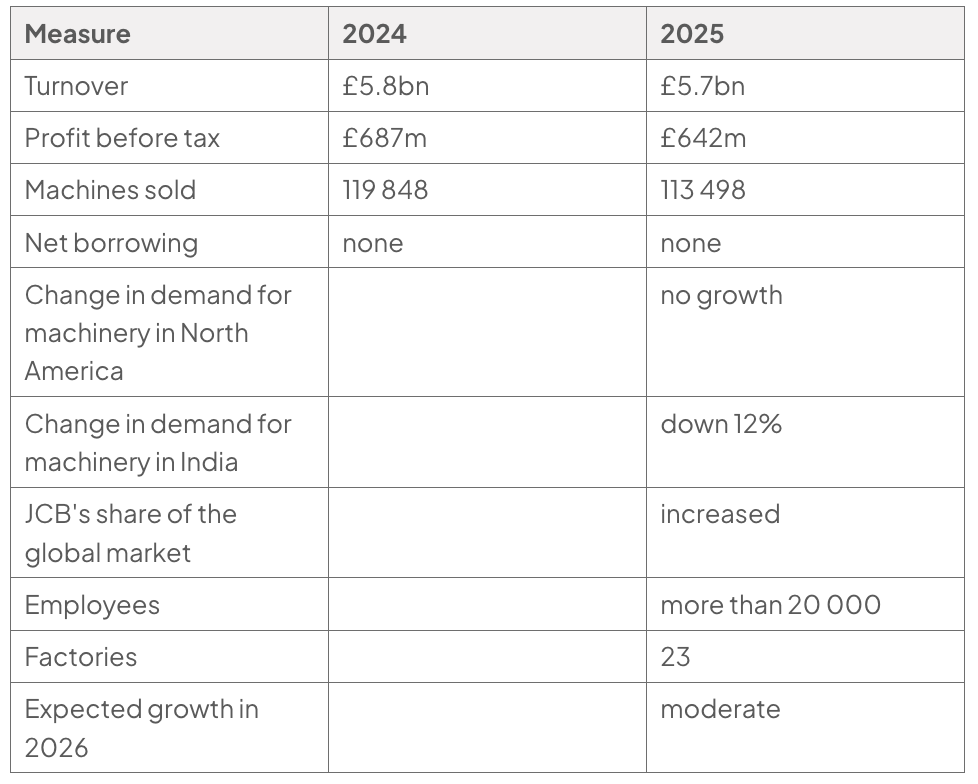
In 2025 JCB's turnover was £5.7 billion, compared with £5.8 billion in 2024, and its profit before tax fell from £687 million to £642 million. It sold 113 498 machines, about 5% fewer than in 2024, although it increased its share of the global market. Demand for machinery was flat in North America and fell by 12% in India. The company has no net borrowing, and it expects moderate growth in 2026.

Demand for construction machinery depends on the amount of building taking place, which tends to fall when interest rates are high. Many machines in the UK are bought by plant hire companies, which buy in large numbers and rent the machines to builders.

JCB is investing £100 million at its Staffordshire headquarters, including £60 million in a fully automated paint plant, which it says will help to secure more than 8 000 UK jobs.

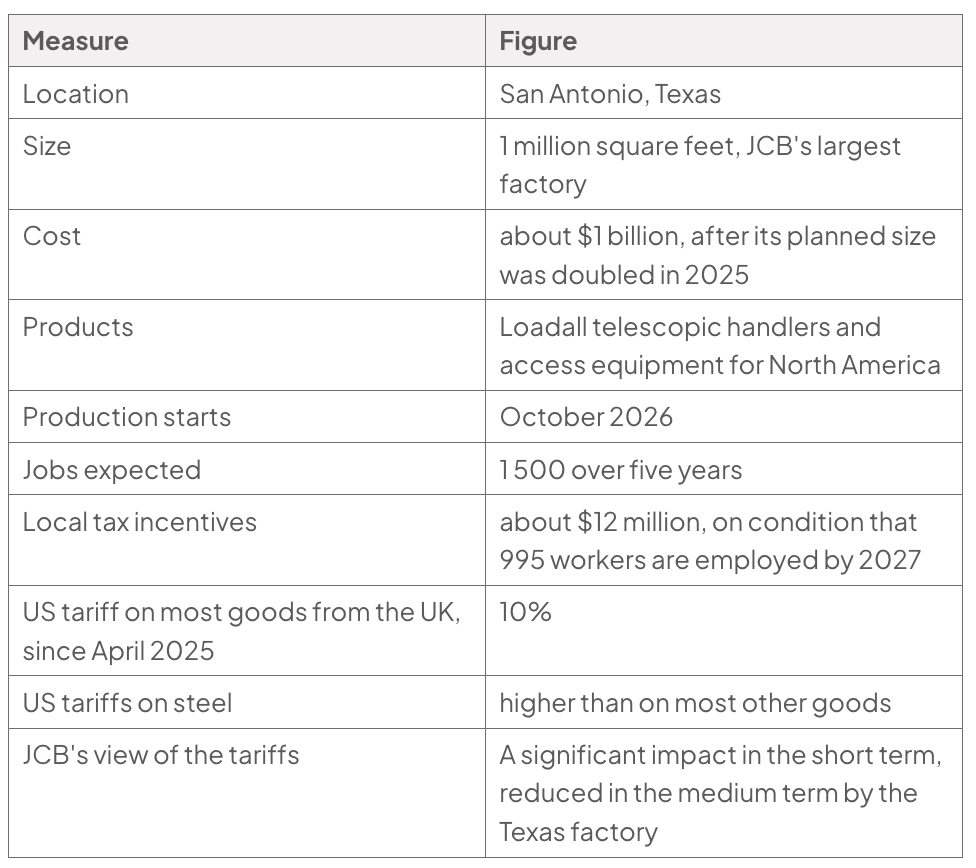
In April 2025 the United States introduced tariffs on imports, including a tariff of 10% on most goods from the UK. JCB responded by doubling the size of the factory it was building in San Antonio, Texas, which will be its largest in the world. It said that in the short term the tariffs would have a significant impact on its business, but that in the medium term the Texas factory would help to reduce that impact.

Over three years JCB spent £100 million, and employed more than 150 engineers, developing an engine which burns hydrogen instead of diesel. In January 2025 the engine was approved for use in Great Britain, Northern Ireland and nine other European countries. JCB also makes machines powered by batteries.

Source: JCB and press reports

Appendix A: JCB selected data

Table comparing JCB data in 2024 and 2025: turnover £5.8bn/£5.7bn, profit before tax £687m/£642m, and machines sold 119 848/113 498; other rows cover borrowing, demand, market share, staff and factories.

Source: JCB

Appendix B: The Texas factory and US tariffs

Table of Texas factory and tariff data: San Antonio; 1 million square feet; about $1 billion; production from October 2026; 1 500 jobs; 10% UK-goods tariff; significant short-term impact, reduced by the factory.

Source: Analyst, using JCB and press reports

Assess whether making machines in the countries where they are sold is likely to increase JCB's profit.

Calculate JCB's unit costs for each machine sold in 2025, taking its total costs as turnover minus profit before tax, to support your answer. Give your answer to the nearest pound.

3
9 marks

Source A: Wise

Wise Group plc is a public limited company, founded in London in 2011, as TransferWise, by Kristo Käärmann and Taavet Hinrikus. It describes its mission as "building the best way to move and manage the world's money". Its services allow people and businesses to:

  • send money between countries

  • hold more than 40 currencies in one account

  • spend abroad with a Wise card

Banks and other companies also use Wise's technology through Wise Platform to offer international payments to their own customers. Wise Platform partners include UniCredit, Raiffeisen Bank, MBSB Bank and, from April 2026, Capitec.

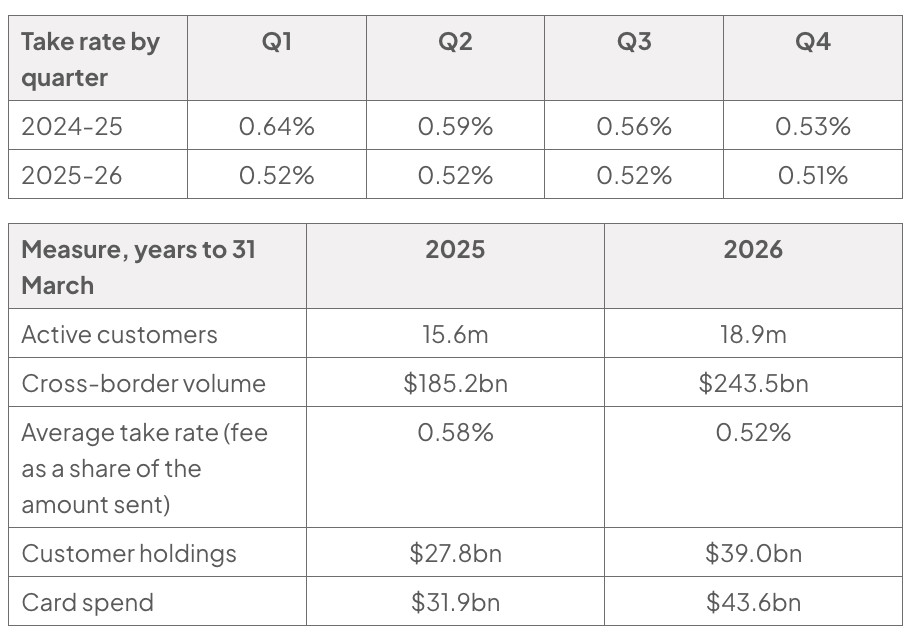
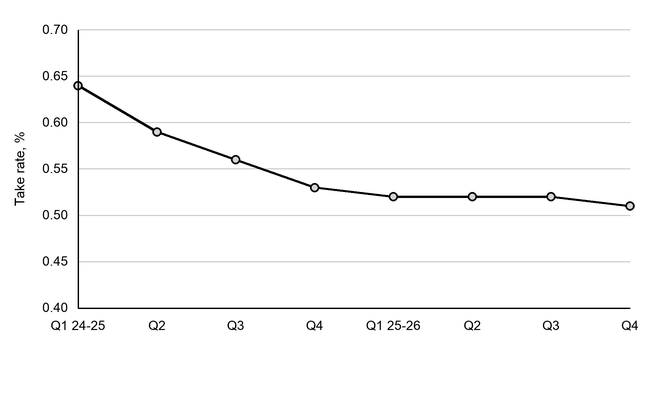
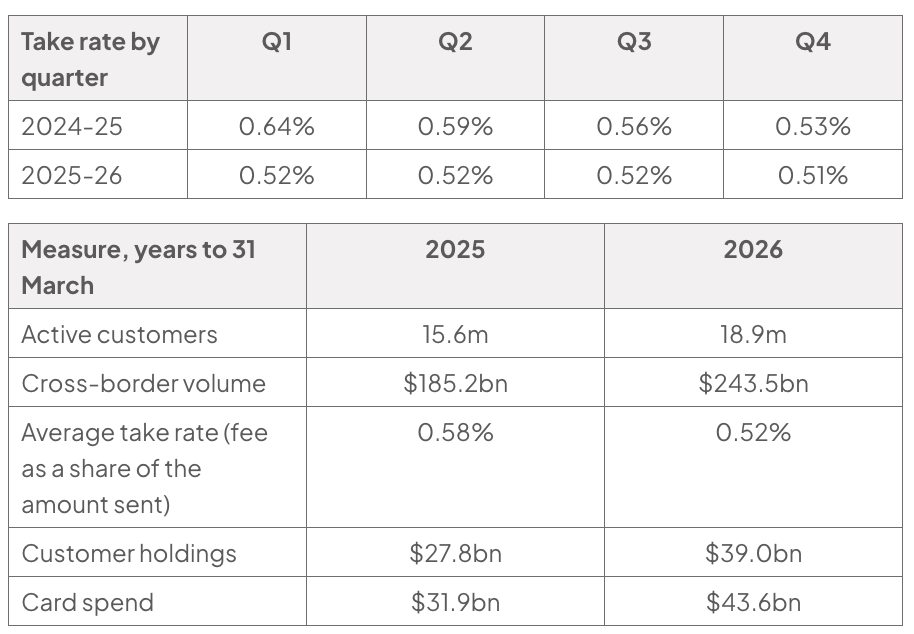
Wise keeps its prices low. In the year to 31 March 2026 the average fee it charged on a cross-border transfer fell to 0.52% of the amount sent. Its 19 million active customers moved $243 billion across borders, 31% more than in the previous year, and its net revenue rose by 19% to $2.5 billion. In the fourth quarter of the year, 75% of payments arrived in under 20 seconds.

Wise must hold a licence from regulators in each country where it offers its services. In 2025-26 it won licences in South Africa, the UAE and Thailand and connected directly to the domestic payment systems of Brazil and Japan, which Wise says reduces its costs and increases speed.

On 11 May 2026 Wise moved its primary share listing to the Nasdaq stock exchange in New York, keeping a secondary listing in London.

Source: Wise Group plc, Full Year 2026 results

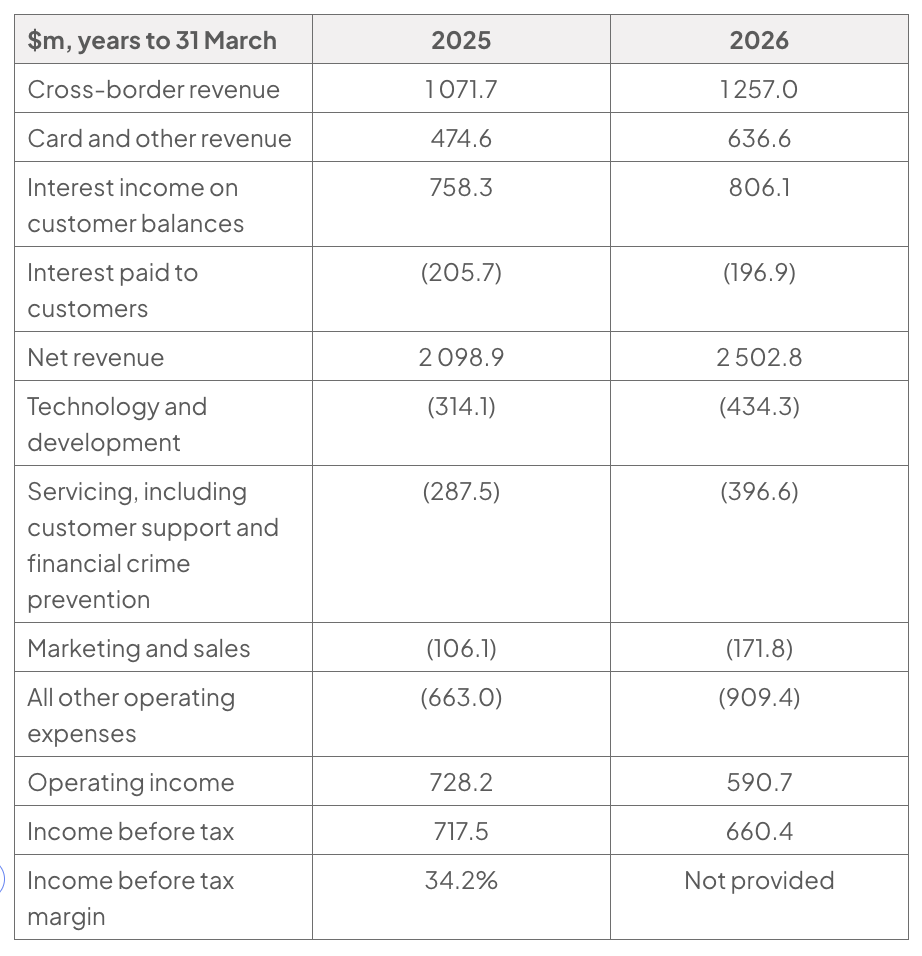
Appendix A: Wise financial data

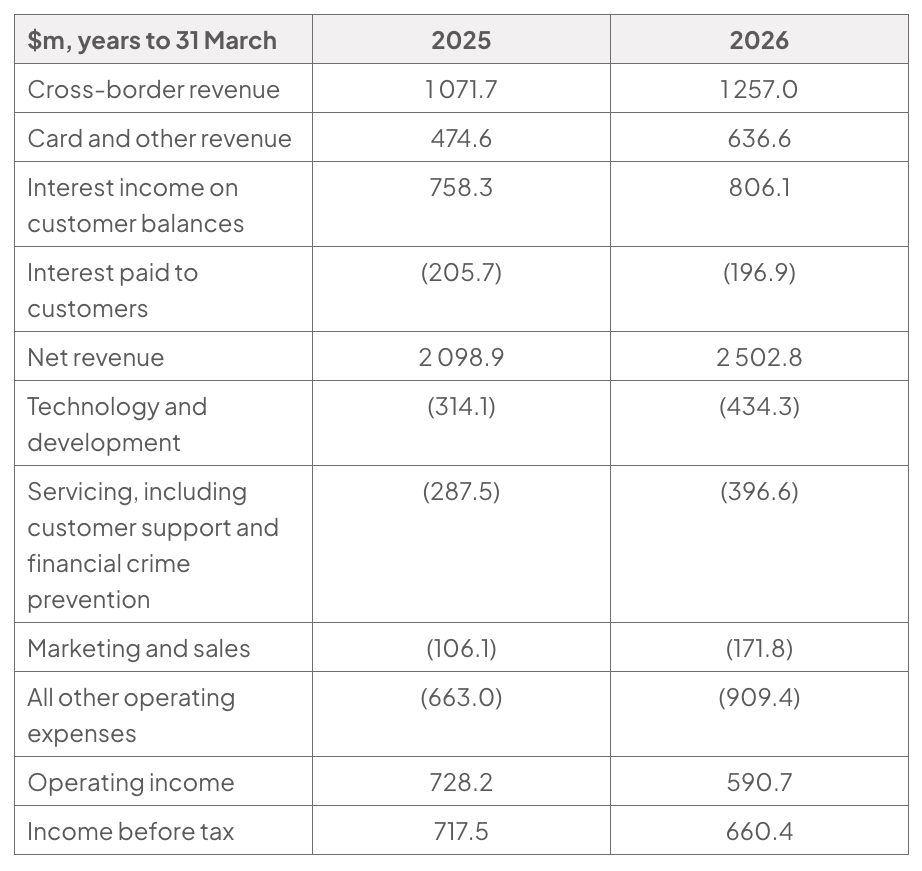
Financial table headed “$m, years to 31 March”, comparing Wise in 2025 and 2026: cross-border revenue 1 071.7 and 1 257.0; card and other revenue 474.6 and 636.6; interest income on customer balances 758.3 and 806.1; interest paid to customers (205.7) and (196.9); net revenue 2 098.9 and 2 502.8; operating expenses in brackets; operating income 728.2 and 590.7; income before tax 717.5 and 660.4.
  • Targets. Net revenue growth of 15-20% a year. Wise expects its income before tax margin to be 20-25% while interest rates stay high, and aims for 15-20% in the medium term.

  • Shareholders. In 2025-26 Wise spent $470m buying its own shares for its employee share scheme, and plans to buy more than $500m of shares in 2026-27.

Source: Wise Group plc

Appendix B: Customers, prices and countries

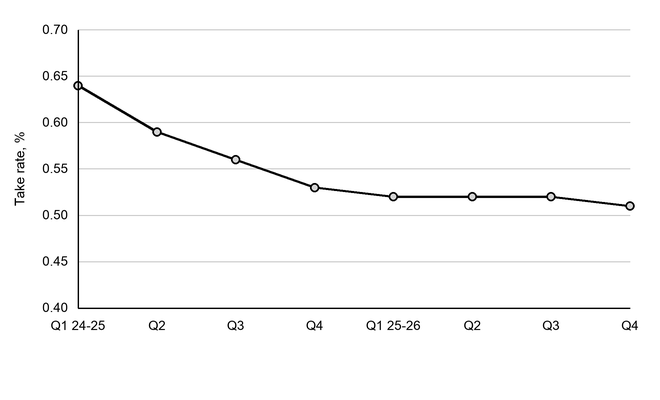
Line chart of Wise’s quarterly take rate, falling from 0.64% in Q1 2024-25 to 0.53% in Q4, then remaining about 0.52% before reaching 0.51% in Q4 2025-26. Y-axis: 0.40% to 0.70%.
Two tables: quarterly take rate falls from 0.64% to 0.51%; 2025-26 data show 18.9m customers, $243.5bn cross-border volume and a 0.52% average take rate.
  • Countries. New licences in South Africa, the UAE and Thailand; direct connections to domestic payment systems in Brazil and Japan, which Wise says reduce costs and increase speed.

  • Wise Platform. New partners include UniCredit, Raiffeisen Bank, MBSB Bank and, in April 2026, Capitec, which use Wise's technology to offer international payments to their own customers.

  • Market. People and businesses move about $43 trillion across borders each year.

Source: Wise Group plc

Assess whether Wise's growth depends mainly on moving money across borders.

Calculate Wise's market share of the money moved across borders each year, using its cross-border volume in the year to 31 March 2026, to support your answer. Give your answer to two decimal places.

4
9 marks

Source B: Pukka Pads

Pukka Pads is a stationery business based in Poole, Dorset, owned and controlled by Chris Stott. It sells notebooks, pads, files, packaging and party products to retailers, to other businesses and online. It makes products in its UK factories and buys others from suppliers in China and the Far East, paying them in US dollars. It has companies in the United States, Hong Kong, China and the Netherlands.

In the year to 30 September 2025:

  • turnover fell by 10% to £21.8 million, "primarily as a result of moving away from very low margin product sales in the UK business"

  • gross profit rose, and operating profit rose to £652 055

  • inventory was reduced by £1.57 million

  • the average number of employees fell from 84 to 71

The company faces two main pressures:

  • Currency. No contracts to fix the exchange rate were in place at 30 September 2025, though some were taken out shortly afterwards. Administrative expenses included an exchange loss of £68 483 in 2025, against an exchange gain of £413 141 in 2024.

  • Trade. Since April 2025 the United States has charged a tariff of 10% on most goods imported from the UK, and higher tariffs on many goods from China.

For 2026, Pukka Pads says that "new machines have been acquired to improve manufacturing processes, reduce waste and headcount". In 2024/25, £367 080 of new machinery was financed through hire purchase. It also says that leaving one of its UK warehouses by 30 June 2026 will save more than £700 000 a year.

Source: Pukka Pads UK Limited, group accounts for the year ended 30 September 2025

Appendix D: Pukka Pads financial data

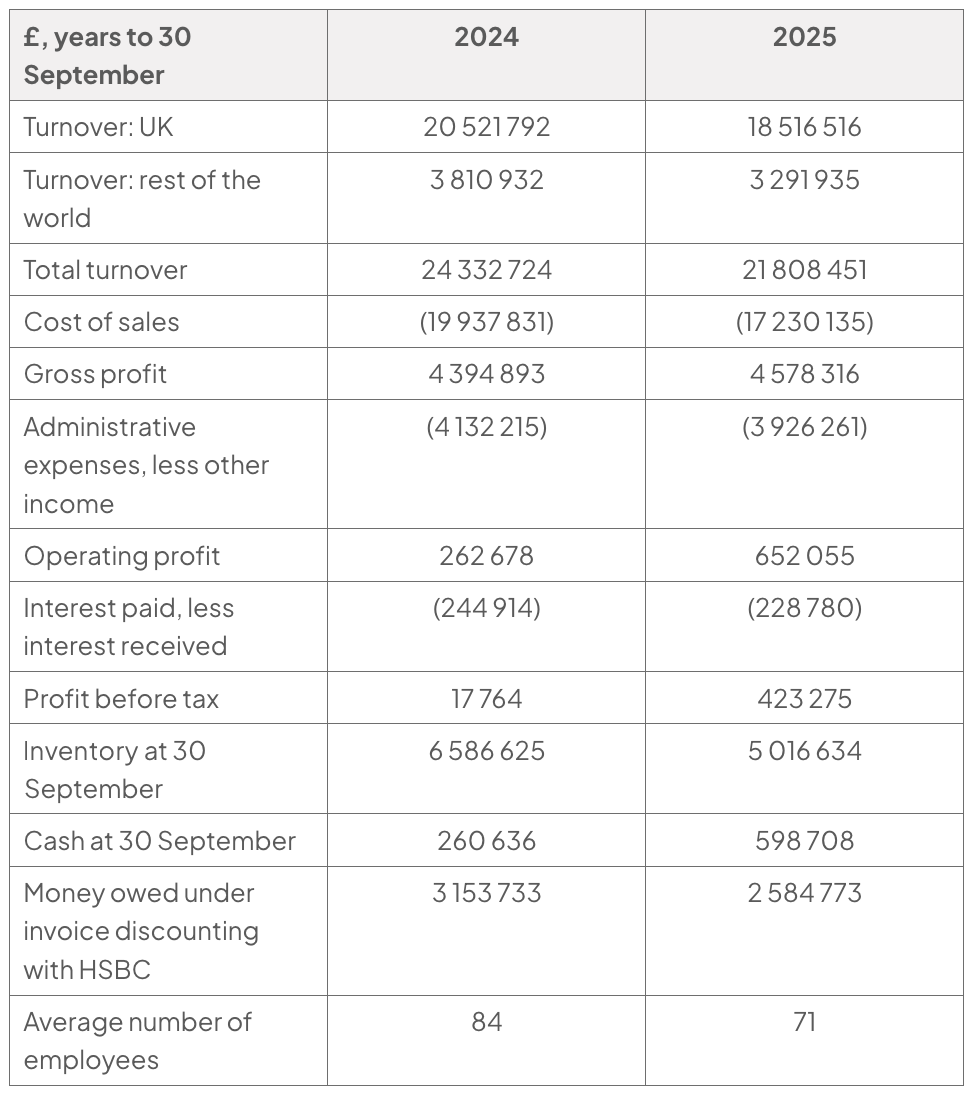
Table of Pukka Pads financial data in pounds for the years to 30 September 2024 and 2025: turnover in the UK 20 521 792 and 18 516 516; turnover in the rest of the world 3 810 932 and 3 291 935; total turnover 24 332 724 and 21 808 451; cost of sales (19 937 831) and (17 230 135); gross profit 4 394 893 and 4 578 316; administrative expenses, less other income (4 132 215) and (3 926 261); operating profit 262 678 and 652 055; interest paid, less interest received (244 914) and (228 780); profit before tax 17 764 and 423 275; inventory at 30 September 6 586 625 and 5 016 634; cash at 30 September 260 636 and 598 708; money owed under invoice discounting with HSBC 3 153 733 and 2 584 773; average number of employees 84 and 71.
  • Invoice discounting is a loan secured on money owed by customers; Pukka Pads pays 2.21 percentage points above Bank Rate.

  • Administrative expenses include an exchange loss of £68 483 in 2025 (2024: an exchange gain of £413 141).

Source: Pukka Pads UK Limited

Appendix E: Markets and group companies

  • Business. "The sale of stationery, packaging and party products worldwide with the primary market being the UK but with significant investment on-going in new territories such as the USA and the Far East."

  • Investment in 2024/25. In "e-commerce channels, more fashionable designs for pad and file products, more sustainable products in terms of recycling and reduction of waste at the factory", and more packaging and party products.

  • China. Pukka Pads Trading Co Ltd, in Ningbo, buys products and manages shipping from the Far East. A new company aims to sell in China's home market; its Chief Executive was given 20% of the shares in the Ningbo business, with the option of 5% more if performance targets are met.

  • Other countries. Pukka Pads USA Corp in the US, Pukka Pads (HK) Ltd in Hong Kong and Pukka Planet BV in the Netherlands.

  • Diversification. Pukka Power Ltd, set up to diversify into green energy, stopped trading after a review of the market; all its creditors were paid in full.

Source: Analyst, using Pukka Pads UK Limited

Assess whether Pukka Pads should increase its sales outside the UK.

Calculate Pukka Pads' operating profit margin in the year to 30 September 2025 to support your answer. Give your answer to one decimal place.

5
9 marks

Source A: Mulberry

Mulberry Group plc was founded in Somerset in 1971 and is known for leather handbags such as the Bayswater. Its two largest shareholders are Challice, controlled by Singapore's Ong family, and Frasers Group, which owns retailers such as Sports Direct and Flannels. In 2024 Mulberry's board rejected a takeover approach from Frasers.

Mulberry designs, makes and sells bags, small leather goods and clothing. About half of its iconic bags are made by craftspeople at its two factories in Somerset. It sells through:

  • its own stores and website

  • franchise partners abroad

  • wholesale to other retailers

In the year to March 2025 Mulberry's revenue fell by 21% and it made a loss before tax of £32.2 million. Andrea Baldo, who became Chief Executive in 2024, launched a strategy called "Back to the Mulberry Spirit" in January 2025. Its aims are to:

  • simplify the business

  • restore profitability

  • rebuild the gross margin by selling more at full price

  • "put creativity back at the centre of what we do"

In July 2025 Challice and Frasers provided £20 million of funding. As part of the strategy, Mulberry:

  • made redundancies in both the year to March 2025 and the year to March 2026

  • closed one UK store and eight international stores in the year to March 2026

  • introduced a new incentive scheme for store staff "supporting a stronger performance culture"

In the 52 weeks to 28 March 2026 revenue rose by 4% to £125.5 million, and the loss before tax fell to £8.9 million. More than half of Mulberry's UK sales through its stores and website came from returning customers. Its pre-loved service, Mulberry Exchange, which buys back and resells used Mulberry bags, increased its sales by 46%.

Mulberry's medium-term goal is revenue of more than £200 million with an adjusted operating profit margin of 15%.

Source: Mulberry Group plc, audited results for the 52 weeks ended 28 March 2026

Appendix A: Mulberry financial data

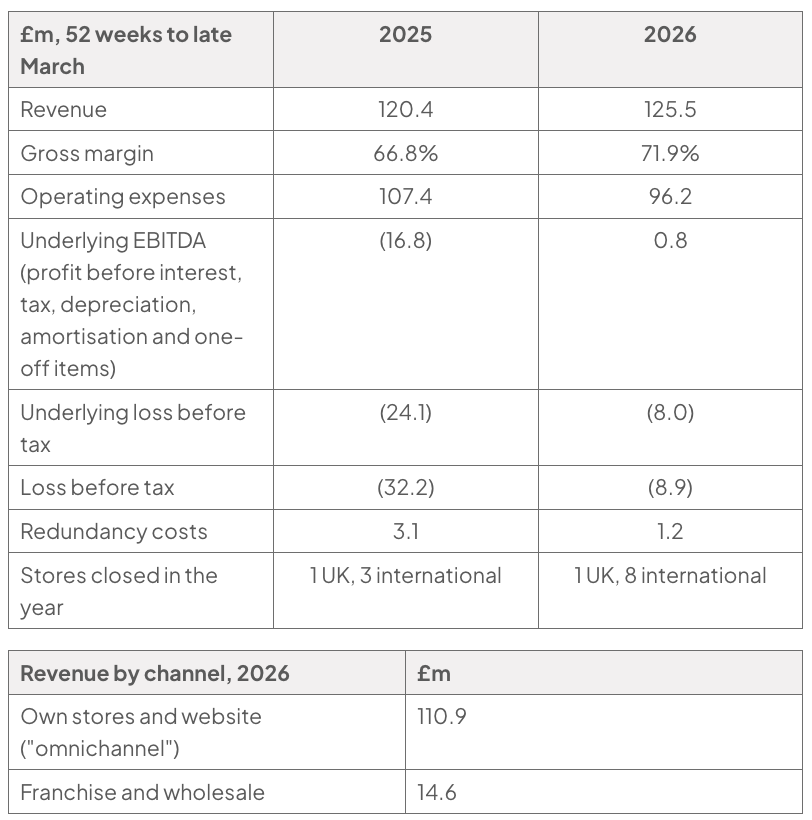
Two Mulberry financial tables: a 2025 and 2026 comparison for the 52 weeks to late March, covering revenue, margins, expenses, profits and losses, redundancies and store closures; and 2026 revenue by channel.
  • Revenue grew 11% in the second half of the year. Like-for-like sales through Mulberry's own stores and website rose 9%.

  • Mulberry's bank facilities are committed until July 2028. Staff costs were £41.2m.

Source: Mulberry Group plc

Appendix B: Markets around the world

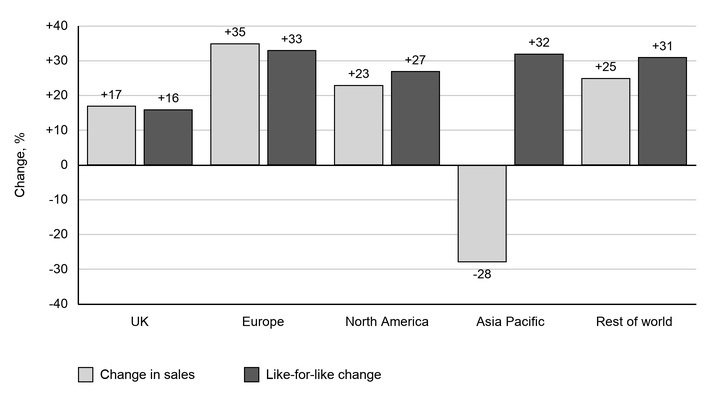
Bar chart of Mulberry own-store and website sales changes over 13 weeks to 27 June 2026: change/like-for-like: UK +17/+16%, Europe +35/+33%, North America +23/+27%, Asia Pacific −28/+32%, rest of world +25/+31%.
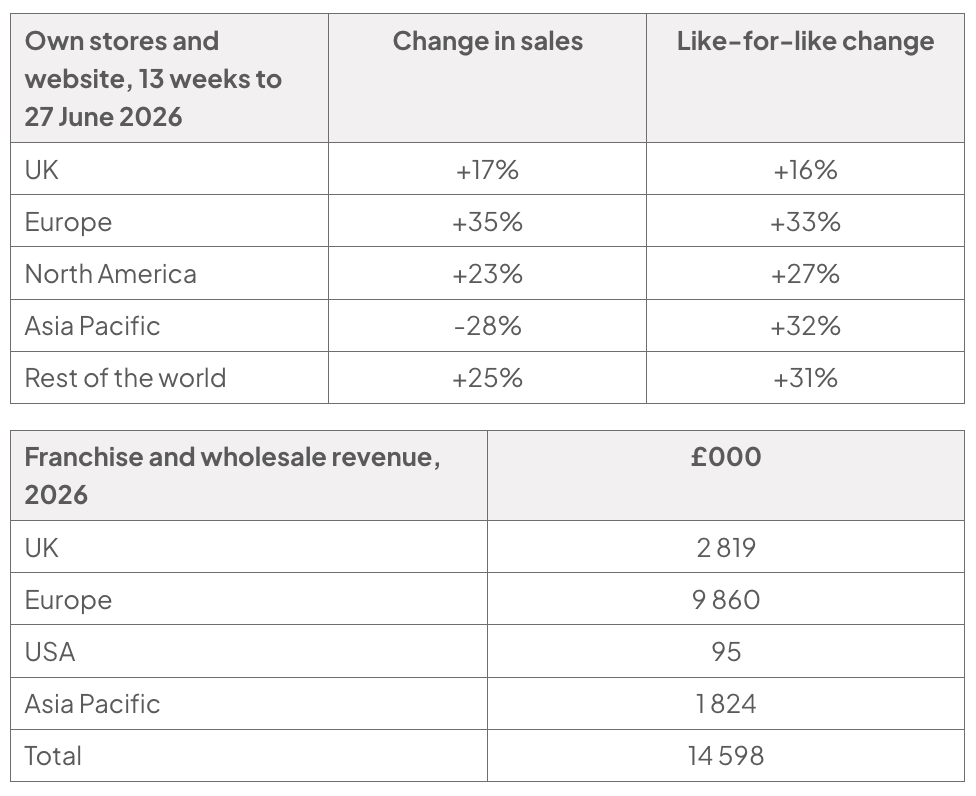
Two tables summarising Mulberry’s regional own-store and website sales changes and 2026 franchise and wholesale revenue.
  • Group revenue in the 13 weeks to 27 June 2026 was 23% higher than a year earlier; franchise and wholesale revenue was 56% higher.

  • Mulberry is "reshaping the Asia Pacific business with a focus on profitability".

  • Like-for-like sales compare stores and websites that were open in both periods.

Source: Mulberry Group plc

Assess whether international markets offer Mulberry its best route to growth.

Calculate Mulberry's employee costs as a percentage of revenue in 2026 to support your answer. Give your answer to one decimal place.

6
9 marks

Source B: Ravenshall Engineering

Ravenshall Engineering Limited is a private limited company, founded in Burnley, Lancashire, in 1978. It makes aluminium body frames, floors and battery housings for buses and coaches, which bus makers use to build complete vehicles. It employs 240 people. Its customers are:

  • three UK bus makers

  • five bus and coach makers in Poland, the Netherlands and Spain, whom it invoices in euros

Its products can be sold to EU customers without tariffs if they meet the rules of origin in the UK-EU trade agreement, but every shipment needs a customs declaration and delivery takes four days.

In 2025 revenue rose to £38.6 million, helped by growing exports to the European Union. The gross profit margin was 21%, compared with 22% in 2024.

The company faces three main pressures:

  • One large customer. 44% of its sales go to one UK bus maker, up from 39% in 2024. That customer has reduced its workforce and sites in the last two years.

  • Government grants. Most of its UK customers' orders are for buses bought with the help of government grants, which do not require buses to be built in the UK.

  • Chinese competition. Chinese bus makers such as Yutong ship complete buses to the UK, built with their own frames and battery housings.

Ravenshall's board is considering two investments:

  • An automated welding line in Burnley. It would reduce labour costs and rework, with 30 fewer welding jobs and 6 new technician roles.

  • A new factory in Poland, close to its EU customers.

Source: Ravenshall Engineering

Appendix D: Ravenshall Engineering selected data

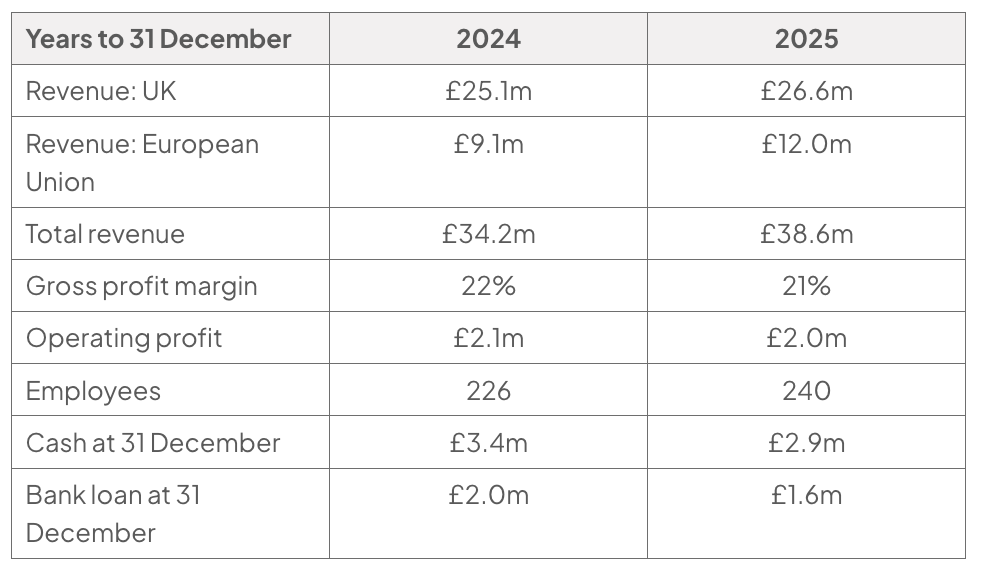
Table of Ravenshall Engineering data for the years to 31 December 2024 and 2025: UK revenue £25.1m and £26.6m; European Union revenue £9.1m and £12.0m; total revenue £34.2m and £38.6m; gross profit margin 22% and 21%; operating profit £2.1m and £2.0m; employees 226 and 240; cash at 31 December £3.4m and £2.9m; bank loan at 31 December £2.0m and £1.6m.

Source: Ravenshall Engineering

Appendix E: Customers and risks

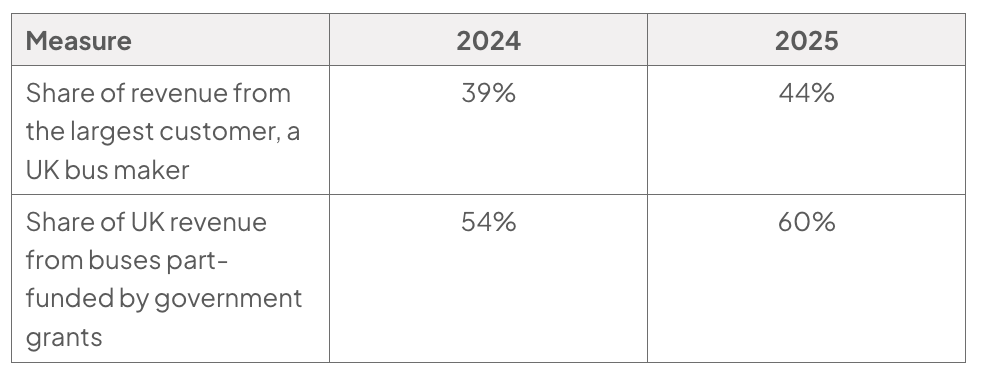
Table comparing Ravenshall Engineering’s 2024 and 2025 figures: largest customer’s share of revenue rose from 39% to 44%, while grant-funded buses’ share of UK revenue rose from 54% to 60%.
  • If the pound rises against the euro, each euro of sales is worth fewer pounds.

  • Chinese bus makers such as Yutong ship complete buses to the UK, built with their own frames and battery housings.

  • Ravenshall's largest customer has reduced its workforce and sites in the last two years.

Source: Ravenshall Engineering

Assess whether Ravenshall Engineering should focus its growth on exports to the European Union.

Calculate Ravenshall Engineering's sales per employee in 2024 and in 2025 to support your answer. Give your answers to the nearest pound.

1
15 marks

Source A: Wise

Wise Group plc is a public limited company, founded in London in 2011, as TransferWise, by Kristo Käärmann and Taavet Hinrikus. It describes its mission as "building the best way to move and manage the world's money". Its services allow people and businesses to:

  • send money between countries

  • hold more than 40 currencies in one account

  • spend abroad with a Wise card

Banks and other companies also use Wise's technology through Wise Platform to offer international payments to their own customers. Wise Platform partners include UniCredit, Raiffeisen Bank, MBSB Bank and, from April 2026, Capitec.

Wise keeps its prices low. In the year to 31 March 2026 the average fee it charged on a cross-border transfer fell to 0.52% of the amount sent. Its 19 million active customers moved $243 billion across borders, 31% more than in the previous year, and its net revenue rose by 19% to $2.5 billion. In the fourth quarter of the year, 75% of payments arrived in under 20 seconds.

Wise must hold a licence from regulators in each country where it offers its services. In 2025-26 it won licences in South Africa, the UAE and Thailand and connected directly to the domestic payment systems of Brazil and Japan, which Wise says reduces its costs and increases speed.

On 11 May 2026 Wise moved its primary share listing to the Nasdaq stock exchange in New York, keeping a secondary listing in London.

Source: Wise Group plc, Full Year 2026 results

Appendix A: Wise financial data

Financial data table for Wise, $m for years to 31 March, comparing 2025 and 2026. It lists revenue, interest, operating expenses, operating income and income before tax; 2026 income-before-tax margin is not provided.
  • Targets. Net revenue growth of 15-20% a year. Wise expects its income before tax margin to be 20-25% while interest rates stay high, and aims for 15-20% in the medium term.

  • Shareholders. In 2025-26 Wise spent $470m buying its own shares for its employee share scheme, and plans to buy more than $500m of shares in 2026-27.

Source: Wise Group plc

Appendix B: Customers, prices and countries

Line chart of Wise’s take rate by quarter, falling from 0.64% in Q1 2024–25 to 0.51% in Q4 2025–26, after remaining at 0.52% in Q1–Q3 2025–26; axis ranges from 0.40% to 0.70%.
Two tables compare Wise’s quarterly take rate and annual business measures for 2025 and 2026; take rate falls, while customers, cross-border volume, customer holdings and card spend rise.
  • Countries. New licences in South Africa, the UAE and Thailand; direct connections to domestic payment systems in Brazil and Japan, which Wise says reduce costs and increase speed.

  • Wise Platform. New partners include UniCredit, Raiffeisen Bank, MBSB Bank and, in April 2026, Capitec, which use Wise's technology to offer international payments to their own customers.

  • Market. People and businesses move about $43 trillion across borders each year.

Source: Wise Group plc

Appendix C: Regulators and listing

  • Listing. Shareholders approved the move of Wise's primary listing to the US in July 2025; the High Court approved it in April 2026, and Nasdaq trading began on 11 May 2026. Wise's US operations are based in New York.

  • UK safeguarding rules, from 7 May 2026. Payment firms regulated by the Financial Conduct Authority must check every business day that customers' money is fully protected, and most must have an annual safeguarding audit. At 31 March 2026 Wise held $14.8bn of customer funds in protected accounts.

  • US penalties. In July 2025 regulators in six US states fined Wise $4.2m for weaknesses in its anti-money-laundering controls; it must also use an independent firm to check its improvements and report every quarter for two years. In January 2025 the US Consumer Financial Protection Bureau ordered Wise to pay about $2.5m over its money-transfer practices; in May 2025 the penalty was cut to $45 000, with about $450 000 still to be repaid to customers.

Source: Analyst, using Wise Group plc and press reports

Wise moved its primary share listing to New York in May 2026, and in 2025-26 won new licences in South Africa, the UAE and Thailand.

Evaluate whether Wise should focus its expansion on the United States or on other countries.

2
15 marks

Source A: Oxfam GB

Oxfam GB works to end poverty. It is a registered charity and a company limited by guarantee, and one of 21 affiliates of the Oxfam confederation, which worked in 79 countries in 2024/25. In 2024/25 Oxfam GB's work reached 9.21 million people, 8.05 million of them through humanitarian responses to emergencies.

Oxfam GB raises money from four main sources:

  • donations and legacies

  • grants from governments and international organisations

  • funding from other Oxfam affiliates

  • its shops

In 2024/25 Oxfam GB's income fell by £28.6 million, and it spent more than it received for the second year running. Funding from other Oxfam affiliates fell from £104.1 million to £82.0 million. The largest affiliate funder, Oxfam Germany, gave £17.8 million, down from £27.2 million.

Oxfam GB has gone through several changes:

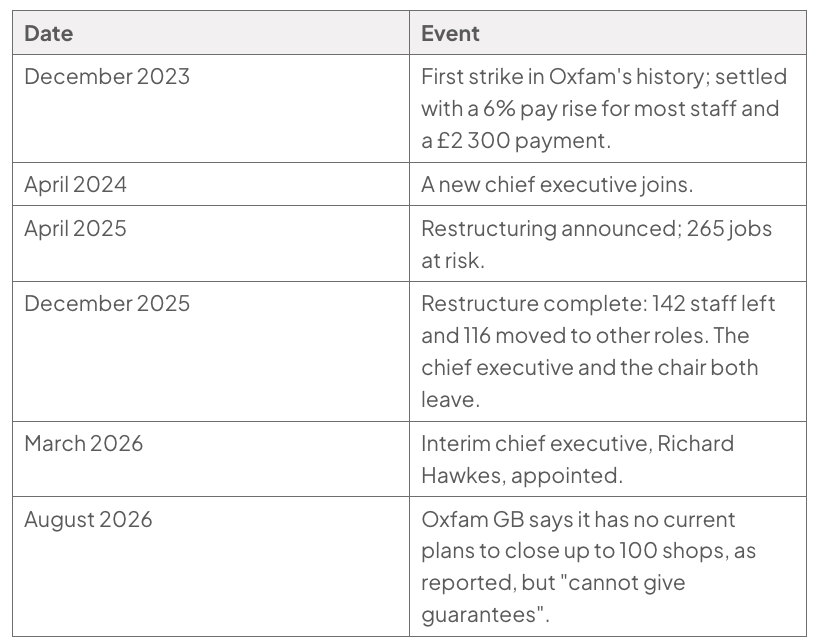
  • Pay. In December 2023 its staff held the first strike in Oxfam's history. It was settled with a 6% pay rise for most staff and a £2 300 payment.

  • Restructure. In April 2025 it began a restructure to save £10.2 million of forecast pay costs, putting 265 jobs at risk.

  • Leadership. Its chief executive since April 2024 left in December 2025, and an interim chief executive, Richard Hawkes, took over from 31 March 2026.

Its goals for 2025/26 are Income, Influence, People and Decolonisation. Decolonisation means shifting money and decision-making to partners in the Global South.

Source: Oxfam GB, annual report and accounts for the year ended 31 March 2025, and press reports

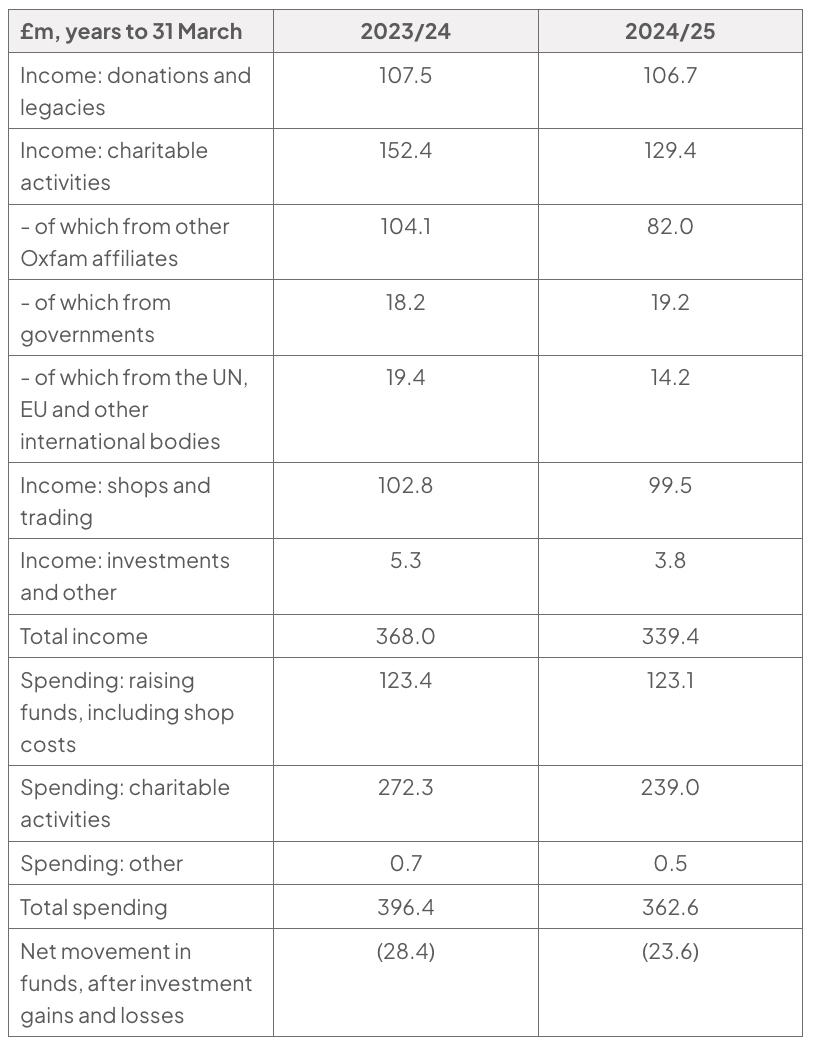
Appendix A: Oxfam GB financial data

Financial table (£m, years to 31 March) comparing Oxfam GB in 2023/24 and 2024/25: total income 368.0 and 339.4, including 104.1 and 82.0 from other Oxfam affiliates; charitable spending 272.3 and 239.0; total spending 396.4 and 362.6; net movement in funds after investment gains and losses (28.4) and (23.6).
  • Why income fell. "Largely due to lower emergency appeal income", together with lower income from other Oxfam affiliates and international bodies.

  • Charitable spending, 2024/25. Humanitarian 52%, development 46%, campaigning 2%.

  • Reserves. General reserves rose from £32.9m to £35.5m, against a target range of £35m to £45m.

  • Shops. 534 shops in 2024 and 515 in 2025. Shop profit fell from £8.3m to £6.3m. Online sales were £11.2m in 2024/25.

  • People. Average staff fell from 4 180 to 4 084: 2 119 employed in Great Britain and 1 965 overseas. About 28 000 volunteers, more than 20 000 of them in shops.

Source: Oxfam GB

Appendix B: Funding and the outside world

  • UK aid. On 25 February 2025 the UK government announced that aid spending would fall from 0.5% to 0.3% of national income by 2027, to pay for higher defence spending.

  • United States. In January 2025 the US government froze aid funding. In February 2025 USAID ended its humanitarian contracts with Oxfam GB.

  • Government funders, 2024/25. Sweden £10.8m, the United States £2.8m, Switzerland £2.5m.

  • Oxfam affiliates. The largest affiliate funder, Oxfam Germany, gave £17.8m, down from £27.2m.

  • History. In 2018 it was reported that Oxfam staff had committed misconduct in Haiti in 2011. Oxfam GB stopped bidding for UK government funding, and in June 2019 a Charity Commission inquiry found that its culture and safeguarding had repeatedly fallen short and issued it with an Official Warning. New UK government funding was suspended again in April 2021 and restored in November 2022.

Source: Analyst, using Oxfam GB, UK government announcements and press reports

Appendix C: Change at Oxfam GB

Timeline table of change at Oxfam GB from December 2023 to August 2026. It records the first strike, leadership changes, restructuring affecting 265 jobs, staff departures and moves, and uncertainty over closing up to 100 shops.
  • Goals for 2025/26. Income, Influence, People and Decolonisation.

  • Shops. In 2024/25 Oxfam GB closed low-profit shops and opened a large shop in Manchester; overall, its number of shops fell from 534 to 515.

Source: Analyst, using Oxfam GB and press reports

One of Oxfam GB's goals for 2025/26 is to shift money and decision-making to partners in the Global South.

Evaluate whether Oxfam GB should shift money and decision-making to partners in the Global South or keep running its own programmes overseas, and recommend which.

3
15 marks

Source B: Woolmere Data Services

Woolmere Data Services Limited was founded in Sheffield in 2009. It analyses customer data for retailers and leisure businesses, helping them understand what their customers buy and why. It employs 160 people, most of whom are either consultants, who analyse data and advise clients, or software engineers. It stores its clients' data on its own computer servers in Sheffield.

For most of its history Woolmere earned its revenue from consultancy projects, in which its analysts studied a client's data and presented their findings. In 2022 it launched Woolmere Insight, an online platform that clients pay for by annual subscription and use to run their own analysis. The number of subscription clients rose in 2025.

In 2025 Woolmere reorganised into teams built around the platform and announced the changes to staff by email. Consultants now spend part of their time supporting platform clients instead of leading projects.

Woolmere opened a small office in Dublin in 2024, and its revenue from clients in Ireland rose in 2025. Two of its UK clients, which also have stores in the United States, have asked whether Woolmere could support them there.

The company faces two main pressures:

  • Competition. Two large international software businesses sell platforms similar to Woolmere Insight.

  • Staff. Most of the employees who left in 2025 were consultants with more than five years' service.

Its board is considering where to expand outside the UK, whether to stop taking new consultancy projects, and whether to move its clients' data to a cloud computing provider.

Source: Woolmere Data Services

Appendix D: Woolmere Data Services selected data

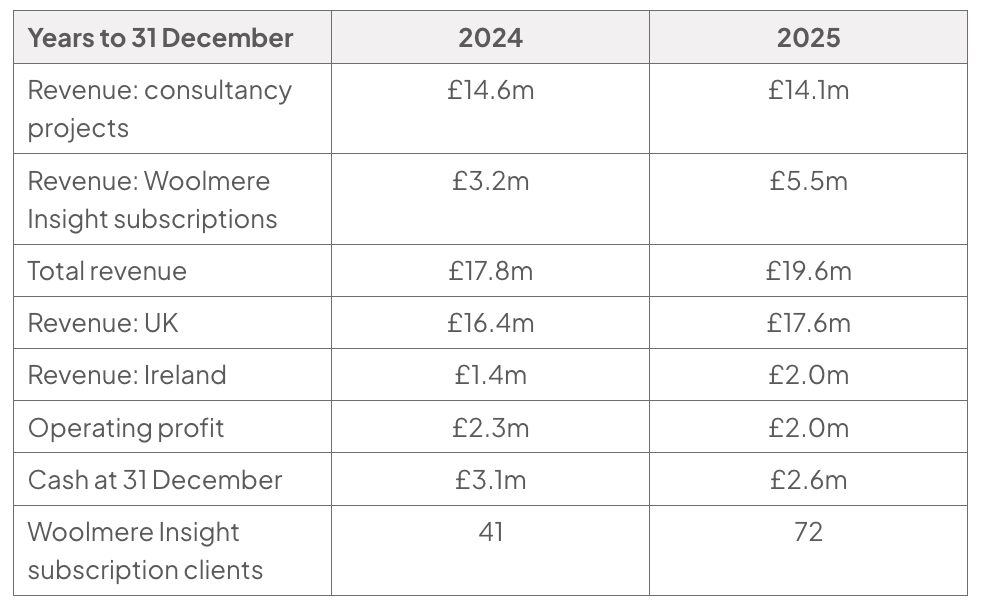
Appendix D table, years to 31 December (2024/2025): consultancy revenue £14.6m/£14.1m; Insight £3.2m/£5.5m; total £17.8m/£19.6m; UK £16.4m/£17.6m; Ireland £1.4m/£2.0m; profit £2.3m/£2.0m; cash £3.1m/£2.6m; clients 41/72.

Source: Woolmere Data Services

Appendix F: Two options for international growth

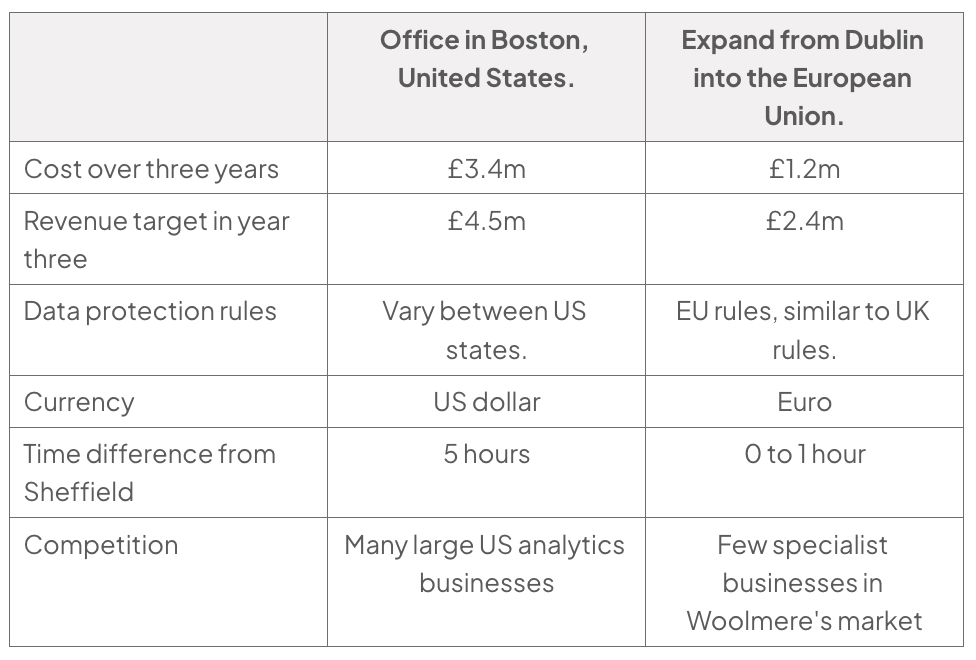
Comparison table of growth options: Boston versus EU expansion from Dublin. Three-year cost £3.4m/£1.2m; year-three revenue £4.5m/£2.4m; data rules vary by US state/EU like UK; dollar/euro; Sheffield time difference 5 hours/0–1 hour; competition many US firms/few specialists.

Source: Woolmere Data Services

Woolmere Data Services is considering opening an office in Boston, United States, or expanding into the European Union from its Dublin office.

Evaluate which option Woolmere Data Services should choose.

Use information from Appendices D and F to support your answer.