Selling & Operating Globally (AQA A Level Business): Revision Note
Syllabus Edition
First teaching 2026
First exams 2028
Exam code: 7132

Benefits of selling and operating globally
Businesses can become more global in two distinct ways
By selling more of their existing products into overseas markets (exporting)
By operating, producing, staffing or basing part of the business abroad
A business does not need to choose only one
Many businesses combine exporting with overseas operations as their global strategy develops
Why sell or operate globally?
Selling globally (exporting or expanding international sales) allows a business to extend its customer base far beyond a saturated or slow-growing domestic market
It can extend the life cycle of an established product by launching it into markets where demand is still emerging
Example
Costa Coffee has expanded rapidly into China, tapping into a large and fast-growing coffee-drinking market well beyond its original UK customer base
Establishing actual production or operations abroad can significantly reduce costs by taking advantage of cheaper labour, land or materials in the host country
Example
Adidas manufactures a significant proportion of its footwear in Vietnam and Indonesia, taking advantage of lower labour costs to keep production competitive
Operating within a target market, rather than only exporting to it, can also help a business avoid trade barriers
Example
Nissan built its Sunderland car factory in 1986, allowing it to manufacture vehicles directly within the UK and European market rather than importing them from Japan
In doing so Nissan avoided the tariffs and quotas that would otherwise have applied to Japanese car imports
It can also respond faster to local customer needs and build closer relationships with local suppliers
Example
Aldi's UK operation sources the majority of its fresh produce directly from British farmers, rather than importing it
The retailer can respond quickly to local customer preferences and build close working relationships with domestic suppliers
Drawbacks of selling and operating globally
Selling globally exposes a business to trade barriers, including tariffs
This can suddenly increase the cost of exporting and reduce profit margins
Example
Jaguar Land Rover faced significantly higher costs exporting UK-built vehicles to the United States in 2025, after new US tariffs on imported cars made shipments considerably more expensive and briefly disrupted deliveries
Operating globally brings the added complexity of managing overseas operations
This includes unfamiliar regulations, different business cultures and consumer habits, which can lead to costly failure if not properly understood
Example
After years of losses, Walmart was forced to exit the German market in 2006, having failed to adapt its store format and pricing approach to local shopping habits and strong existing competition
Glocalisation
Glocalisation means adapting a global product or brand to suit local tastes, culture or regulations in each individual market
It balances the benefits of a global brand and scale with local relevance
Advantages of glocalisation
Advantage | Example |
|---|---|
|
|
|
|
Disadvantages of glocalisation
Disadvantage | Example |
|---|---|
|
|
|
|
Attractiveness of global markets
Factors influencing the attractiveness of international markets
When a business is deciding whether to move into a new country, it needs to determine whether it will support it in meeting its long-term strategic objectives
Managers weigh up several key features of the target economy before committing time and money
Why international markets are attractive
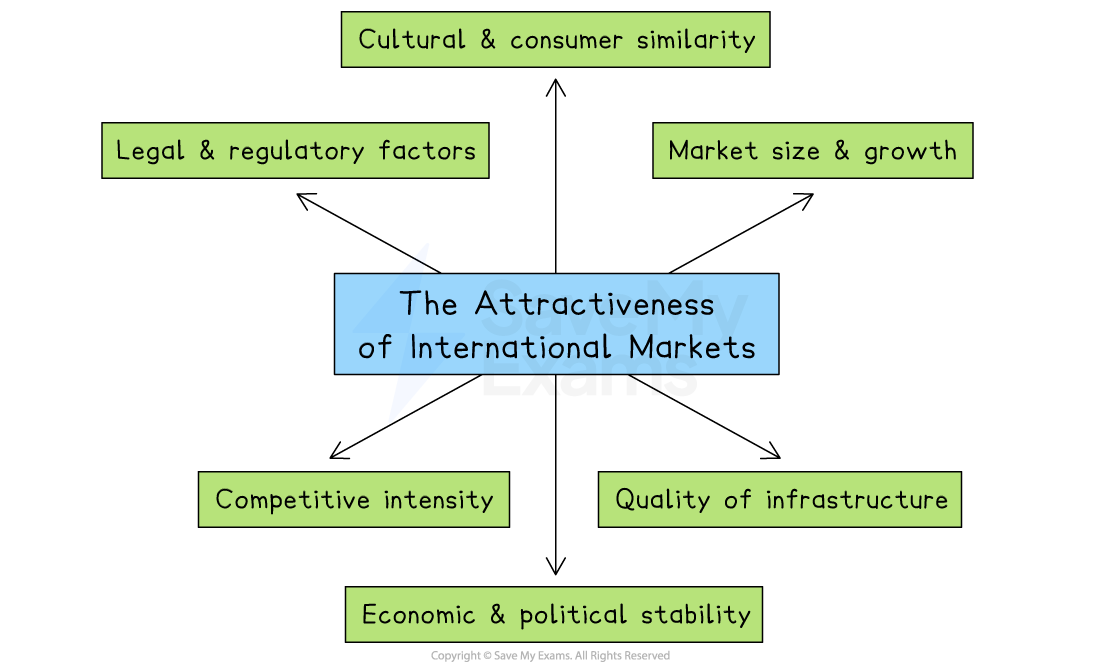
Market size and growth rate
Large populations with rising incomes, or smaller markets growing quickly, offer more potential customers and fast sales growth
Example
Nestlé has expanded its baby food and consumer goods sales significantly across Sub-Saharan Africa, drawn by rapid population growth and an expanding middle class
Economic and political stability
Low inflation, steady government policies and the absence of conflict reduce the risk of sudden losses or business disruption
Example
Tesla has prioritised developed markets such as Germany and the United States for its major Gigafactories
It is attracted by strong consumer purchasing power, reliable infrastructure and stronger legal protection for intellectual property
Legal and regulatory environment
Clear, business-friendly laws on property rights, taxes and product standards make it easier and cheaper to operate
Competitive intensity
Entering a market with few strong rivals can be more attractive than trying to compete with established global brands
Cultural and consumer similarity
When tastes, language and buying habits are similar to those at home, a business can adapt its product and marketing with less cost and risk
Example
Greggs' expansion into Northern Ireland required very little adaptation, since tastes, language and shopping habits are so similar to other areas of the UK, allowing it to use largely the same menu and store format
Quality of infrastructure
Reliable transport, power, internet and supply networks cut delays and costs, helping a business meet customer demand efficiently
Why are different markets attractive to UK businesses?
Market attractiveness is not a single, fixed measure, but depends on what a specific business is trying to achieve
United States

The US is the world's largest economy
It offers an enormous and extremely wealthy consumer base
This is particularly attractive to businesses selling higher-value or premium products
It shares a common business language and many similar consumer habits with the UK
This reduces the cost and complexity of adapting products or marketing
It offers strong legal protection for intellectual property
This reduces the risk of a UK business's innovations being copied
It has high levels of healthcare spending and a sophisticated research infrastructure
These factors make it particularly attractive for science-based UK businesses
Example
AstraZeneca generates a very significant share of its global revenue from the United States, attracted by the sheer size of the market, high levels of healthcare spending, and a strong environment for pharmaceutical research
India

India is one of the largest and fastest-growing populations in the world
It offers enormous long-term market potential as incomes rise
It has a rapidly expanding middle class with increasing disposable income
This creates growing demand for mobile technology, financial services and consumer goods
English is very widely used in Indian business
This reduces language barriers compared with many other high-growth markets
It has long-standing historical and trade links with the UK
This familiarity and existing business relationships help businesses entering the market to succeed
Example
Vodafone built a very large mobile network business in India through its joint venture, Vodafone Idea, attracted by the sheer scale and rapid growth of India's mobile phone market
Germany

Germany is the largest economy in the European Union
It has high average disposable income and strong consumer purchasing power
It is geographically close to the UK
This keeps transport costs and delivery times low and reduces logistical complexity compared to more distant markets
German consumers value quality, engineering and innovative design
This closely matches the strengths of some key UK brands
It has a broadly similar consumer protection standards to the UK
This reduces the cost of adapting products to comply with local laws
Example
Dyson has achieved strong sales in Germany, where consumers' preference for well-engineered, innovative technology closely matches Dyson's premium positioning, requiring relatively little adaptation to succeed

Unlock more, it's free!
Join the 100,000+ Students that ❤️ Save My Exams
the (exam) results speak for themselves:

Was this revision note helpful?
