Key Human Resource Objectives (AQA A Level Business): Revision Note
Syllabus Edition
First teaching 2026
First exams 2028
Exam code: 7132

What are human resource objectives?
Human resource (HR) objectives are the specific targets a business sets for managing its workforce
They translate the overall goals of the business into measurable aims for how people are recruited, developed, managed and retained
HR objectives must be aligned with the wider strategic direction of the business
A company pursuing rapid growth will need different HR objectives to one focused on cost reduction
A business entering a new international market will have different workforce priorities to one consolidating its existing operations
Effective HR objectives help a business to:
Ensure it has the right number of people with the right skills in the right roles
Manage the cost of employing people efficiently
Build a motivated, engaged and productive workforce
Meet its legal and ethical obligations as an employer
Number and skills of employees
Workforce planning involves forecasting the business's future staffing needs and taking action to meet them
Getting the number of employees right means
Avoiding being understaffed
Too few employees leads to overworked staff, missed deadlines, poor customer service and lost revenue
Avoiding being overstaffed
Too many employees increases costs without a corresponding increase in output or revenue
Getting skills right means ensuring employees have the knowledge, abilities and qualifications the business needs, both now and in the future
This may involve recruiting people with specific expertise or investing in training and development to build skills internally
Failing to meet workforce number and skills objectives has direct consequences for business performance
A retail business that cannot recruit enough staff for the Christmas period will lose sales and disappoint customers
A technology company that lacks employees with the right coding skills cannot develop new products or maintain existing systems
A manufacturer that retains too many workers during a period of falling demand faces unnecessarily high labour costs that reduce profit margins
Example
A delivery company that wins a major new delivery contract must rapidly increase its driver workforce
Without clear HR objectives around recruitment and skills (including appropriate licence qualifications), it cannot fulfil the contract, potentially losing it to a competitor
Employee turnover and retention
Employee turnover refers to the rate at which employees leave a business and need to be replaced
It is expressed as a percentage and calculated using the formula
Worked Example
A greetings card manufacturer employs an average of 124 people, 30 of whom leave during the year.
Calculate the business's employee turnover rate.
Answer
Employee turnover rate
Employee retention is the ability of a business to keep its employees rather than losing them to competitors or other opportunities
High retention means low employee turnover
The costs of high employee turnover
Recruitment costs
Advertising, interviewing and onboarding new staff is expensive and time-consuming
Training costs
New employees need time and investment before they reach full productivity
Lost knowledge
Experienced staff take valuable skills, relationships and institutional knowledge with them when they leave
Impact on morale
Frequent staff departures can unsettle remaining employees and signal that the business is not a good place to work
Customer experience
In customer-facing roles, high employee turnover can reduce the quality and consistency of service
Retention strategies
HR objectives focused on employee retention help businesses minimise these costs and maintain a stable, experienced workforce
Typical retention strategies include competitive pay, flexible working, career development opportunities and positive workplace culture
Example
A restaurant chain with an annual employee turnover rate of 80% - common in the hospitality sector - spent a disproportionate amount of management time and money on recruitment and training
Reducing employee turnover to 40% through improved pay and working conditions significantly reduced costs and improved the quality of customer service
Employee engagement
Employee engagement refers to the extent to which employees are emotionally committed to their work, their team and the organisation
An engaged employee is not simply doing their job
They genuinely care about the outcomes of their work and the success of the business
Engagement is different from satisfaction
An employee can be satisfied with their pay and working conditions without being engaged - motivated to go above and beyond what is required
Signs of high employee engagement
Employees taking pride in their work and the business
Willingness to suggest improvements and contribute ideas
Low absenteeism and strong attendance
Employees acting as advocates for the business with customers and in the wider community
The importance of high employee engagement
Businesses with high levels of employee engagement outperform those with disengaged workforces
Productivity
Engaged employees work harder, more carefully and more creatively than disengaged ones
Quality
Employees who care about their work are less likely to cut corners or make careless mistakes
Customer service
Engaged frontline employees deliver a better customer experience, directly affecting revenue and reputation
Retention
Engaged employees are less likely to leave, reducing employee turnover costs
Innovation
Engaged employees are more likely to contribute new ideas that improve products, processes or services
Example
A study of two similar manufacturing plants found that the one with higher employee engagement scores produced 21% more output per employee and had 40% fewer quality defects
The difference was attributed not to equipment or processes, but to how employees felt about their work and their managers
Employee costs
Employee costs, sometimes called labour costs, include all the costs associated with employing people
For most businesses, employee costs are the largest single category of operating expenditure
In labour-intensive sectors such as retail, hospitality, healthcare and education, employee costs can account for 60–80% of total costs
Examples of employee costs
Wages and salaries
The direct pay received by employees
Employer's National Insurance contributions
A tax paid by employers based on employee earnings
Pension contributions
Employers are legally required to contribute to employees' workplace pensions
Recruitment and training costs
The cost of hiring and developing staff
Other benefits
Company cars, private healthcare, bonuses and other non-salary benefits
The significance of employee costs
Managing employee costs is a critical HR objective for several reasons
Excessive labour costs reduce profit margins and can threaten the viability of the business
Cutting labour costs too aggressively can reduce workforce quality, increase employee turnover and harm both productivity and customer service
Rising minimum wage legislation, pension auto-enrolment, and employer National Insurance increases can significantly increase the cost base — particularly for businesses that employ large numbers of lower-paid workers
The challenge for businesses is to manage employee costs efficiently without compromising the quality, motivation or stability of the workforce
This requires balancing financial discipline with fair and competitive employment practices
Example
A supermarket employing 15,000 staff faces a 10% increase in the National Living Wage. The additional annual cost runs into tens of millions of pounds
The business must decide whether to absorb this through efficiency improvements, reduce hours, increase prices or accept lower profit margins
Each option has different consequences for employees, customers and shareholders
Equality, diversity, inclusion and belonging
These four concepts are closely related but distinct
Equality |
|
|---|---|
Diversity |
|
Inclusion |
|
Belonging |
|
The significance of equality, diversity, inclusion and belonging
Setting HR objectives around equality, diversity, inclusion and belonging matters for a range of reasons
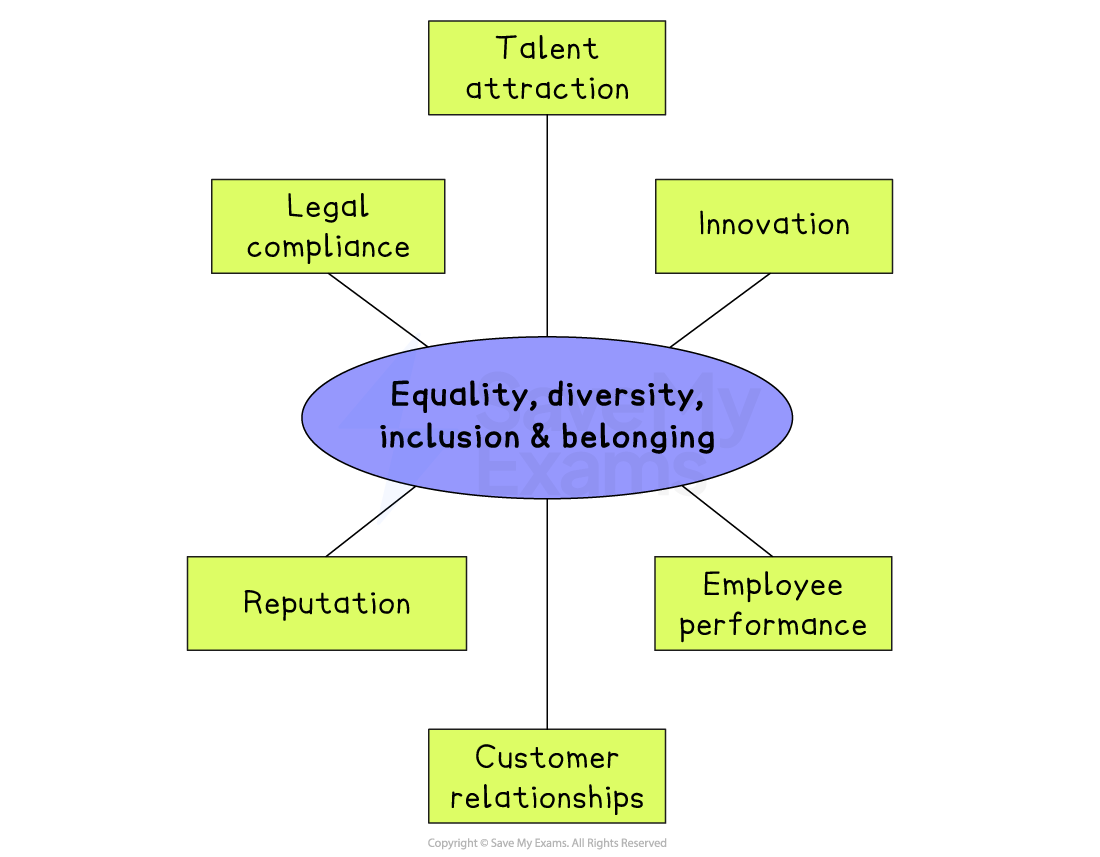
Legal compliance
Failure to uphold equality obligations can result in employment tribunal claims, financial penalties and reputational damage
Attracting talent
Businesses with strong inclusion reputations attract a wider pool of candidates, increasing the quality of recruitment
Innovation
Diverse teams bring a broader range of perspectives and experiences
This can lead to more creative problem-solving and better decision-making
Employee performance
People who feel they belong and are valued perform better and are more engaged
Customer relationships
A diverse workforce is better placed to understand and serve a diverse customer base
Reputation
Customers, investors and potential employees increasingly choose to associate with businesses that demonstrate genuine commitment to these values
Example
A financial services firm that reviews its recruitment processes and removes unconscious bias from application screening finds that it attracts a significantly more diverse pool of candidates
Within two years, it reports higher employee satisfaction scores, lower employee turnover and measurable improvements in team performance
Influences on HR objectives
HR objectives are shaped by a range of internal and external factors
Internal influences
Overall business strategy
A growth strategy requires HR objectives focused on recruitment and skills development
A cost-reduction strategy may lead to objectives around reducing headcount or managing labour costs more tightly
Financial position
A business under financial pressure may prioritise reducing employee costs
A profitable, cash-rich business may invest more in pay, benefits, training and staff development
Other business functions
Marketing decisions, such as launching a new product, create demand for specific skills
Operational changes, such as automating a process, affect the number of staff required
Culture and values
A business with strong values around people will set ambitious objectives around engagement, inclusion and well-being
External influences
Labour market conditions
In a tight labour market where skilled workers are scarce, businesses must set more ambitious retention and reward objectives to remain competitive
In a looser market, recruitment is easier and costs may be lower
Legislation
Changes to employment law, such as minimum wage, working hours, pension contributions or equality requirements, directly affect what HR objectives are legally required and financially feasible
Economic conditions
A recession may lead to objectives focused on cost reduction
A period of growth may shift focus to recruitment and development
Technological change
Automation and artificial intelligence are reshaping the skills businesses need, requiring HR objectives focused on retraining and reskilling existing employees
Case Study
FarmFresh Stores

FarmFresh Stores operates 62 small supermarkets across the Midlands and North of England. A combination of internal and external pressures has significantly reshaped its HR objectives over the past two years.
Internally, FarmFresh's board approved a strategy to open twelve new stores within three years. This created an immediate need to recruit around 1,800 additional employees. HR objectives shifted towards recruitment and skills development, with particular focus on training store managers capable of leading new sites from opening day.
At the same time, two significant external changes demanded attention. A rise in the National Living Wage increased FarmFresh's annual wage bill by £4.2 million, making employee cost management a more urgent HR priority.
Simultaneously, the company's ongoing rollout of self-service checkouts reduced the number of till operators needed, but increased demand for technically skilled maintenance and support staff to service the new equipment.
Together, these pressures forced FarmFresh's HR team to pursue seemingly contradictory objectives at the same time - recruiting heavily for growth, tightening labour cost control and reskilling parts of the existing workforce for roles that had not previously existed in the business.
Examiner Tips and Tricks
When evaluating HR objectives in the exam, always link them to the specific context of the business. A small start-up will have very different HR priorities to a large multinational. Always consider whether the objective is realistic given the business's financial position, the state of the labour market, and the broader strategic goals the business is pursuing

Unlock more, it's free!
Join the 100,000+ Students that ❤️ Save My Exams
the (exam) results speak for themselves:

Was this revision note helpful?
