Automation (AQA A Level Business): Revision Note
Syllabus Edition
First teaching 2026
First exams 2028
Exam code: 7132

What is automation?
Automation means using machinery, robotics or software to perform tasks that would otherwise be carried out by human workers, with little or no direct human involvement once it is set up
It can range from simple mechanical processes, such as a conveyor belt, to advanced robotics and artificial intelligence capable of making decisions or adapting to changing conditions
Businesses automate tasks that are repetitive, predictable, physically demanding or require high precision
In these situations, a machine can often perform more consistently, quickly or cheaply than a person
Examples of automation in operations
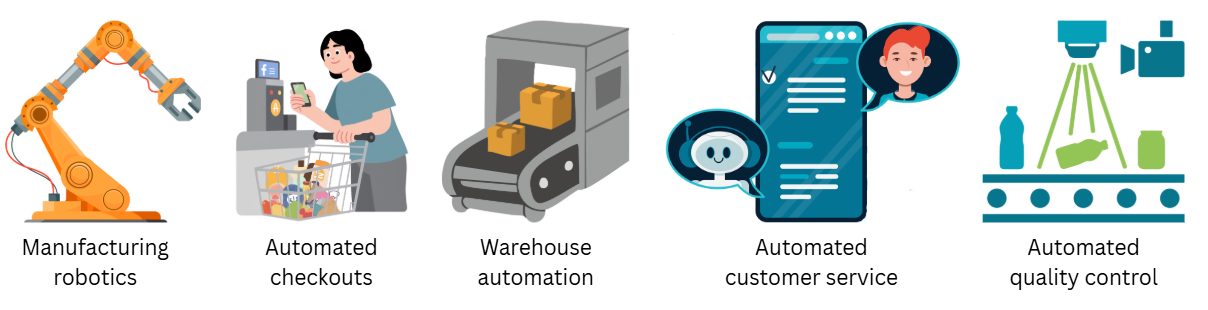
Manufacturing robotics
Robotic arms assemble, weld or paint products on a production line with high speed and precision
E.g. Car manufacturers use robotic arms to weld and paint vehicle bodies
These tasks would be slower, less consistent and more hazardous if carried out entirely by hand
Automated checkouts
Self-service tills allow customers to scan and pay for their own shopping without needing a staff member for every transaction
E.g. Supermarkets such as Tesco have widely installed self-checkout machines in recent years
The number of staffed tills needed during quieter periods is significantly reduced, lowering wage costs
Warehouse automation
Robots and automated systems sort, store and retrieve inventory without manual handling
E.g. Online retailers such as Amazon use automated conveyor systems and robots to sort parcels by destination before they're loaded for delivery
Automated customer service
Chatbots and automated phone systems handle routine customer queries without needing a human adviser
E.g. Banks use chatbots on their websites and apps to answer common questions, such as checking a balance
This frees up staff to deal with more complex enquiries
Automated quality control
Machine vision and sensors inspect products for faults far more quickly and consistently than a person
E.g. Coca-Cola uses automated cameras to check that every bottle is filled to the correct level, rejecting any that don't meet the standard
Automation and competitiveness
Automation can improve a business's competitive position in a range of ways
Benefit | Explanation |
|---|---|
It reduces unit costs |
|
It increases production speed and capacity |
|
It improves consistency and quality |
|
It frees up employees from repetitive tasks |
|
It improves workplace safety |
|
Businesses that fail to automate where competitors do risk falling behind on cost, speed or quality, weakening their market position
Example
A clothing manufacturer that automates its cutting and sewing processes can produce garments faster and more cheaply than a rival still relying entirely on manual labour, allowing it to undercut competitors on price while maintaining consistent quality
Problems of automation
It requires a significant upfront investment in machinery, robotics or software
This may be particularly unaffordable for smaller businesses
It can lead to job losses
This can damage staff morale, harm a business's reputation or create conflict with trade unions
It reduces flexibility
Automated systems can be costly or slow to reprogram if a business needs to change its product or process
Technical faults or breakdowns can halt production entirely
A workforce can often adapt or find alternative ways to continue
It requires specialist staff to install, maintain and repair automated systems
This adds to ongoing costs and makes a business dependent on staff with technical expertise
Examiner Tips and Tricks
In evaluate-style questions, don't assume automation is always the right strategy — consider whether the business's size, sector or product type makes it impractical, for example a small, bespoke or highly personalised service where machines can't easily replace human judgement. Recognising when a strategy doesn't suit a business shows stronger judgement than listing its benefits alone

Unlock more, it's free!
Join the 100,000+ Students that ❤️ Save My Exams
the (exam) results speak for themselves:

Was this revision note helpful?
