Internal Sources of Finance (AQA A Level Business): Revision Note
Syllabus Edition
First teaching 2026
First exams 2028
Exam code: 7132

Introduction to internal sources of finance
Internal sources of finance are funds raised from within the business itself, without borrowing from banks or seeking investment from investors.
Because they do not involve interest payments or giving up a share of ownership, internal sources are generally the cheapest and simplest way for a business to raise money
However, they are limited by what the business already has available
The main sources of internal finance
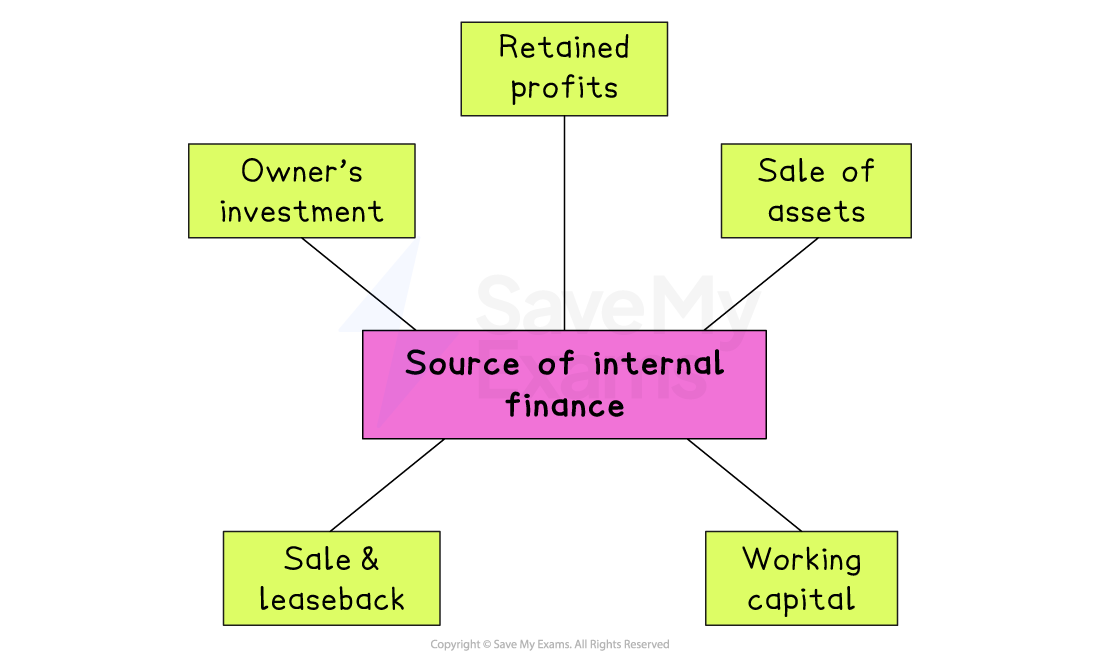
Owners' investment
Owners' investment involves the owner putting their own personal savings or wealth directly into the business
This is most common when a business is being set up or when the owner needs to top up the business's funds at short notice
Advantages and disadvantages of owners' investment
Advantages |
|
|---|---|
Disadvantages |
|
Suitability
Owner's investment is best suited to start-ups and small businesses needing relatively modest amounts of funding quickly
It is less appropriate when large-scale investment is required or when the owner's personal savings have already been committed
Case Study
Layla's Pet Grooming
Layla had worked as a dog groomer for six years before deciding to set up on her own. She had saved £8,000 over several years and decided to invest the full amount into her new business, Layla's Pet Grooming, operating from a converted garage at her home in Bristol.

Layla used her savings to buy a professional grooming table, clippers, dryers and a booking system. Because the business was brand new and had no trading history, a bank was unlikely to offer her a loan on favourable terms. By using her own money, Layla avoided paying interest and did not need to give anyone else a say in how she ran the business.
Within six months, Layla had a full client list and was turning a small profit. She acknowledged the personal risk - if the business had failed, her savings would have been gone - but felt confident in her skills and her local market research before committing her funds
Retained profits
Retained profit is the profit a business has earned and chosen to keep within the business rather than paying out to owners or shareholders as dividends
It is reinvested to fund future activity
This is the most common internal source of finance for established businesses
Advantages and disadvantages of retained profits
Advantages | Disadvantages |
|---|---|
|
|
Suitability
It is ideal for established, profitable businesses funding moderate investment or steady expansion
It is not suitable for new businesses, those making losses, or situations where a large sum is needed quickly
Case Study
Hartley Sports

Hartley Sports is an independent sports equipment retailer based in Leeds. After five years of steady trading, the business had accumulated £45,000 in retained profits.
The owner, Marcus, decided to use £30,000 of this to refurbish the shop, improve the website and add a click-and-collect service. Rather than approaching a bank for a loan, Marcus preferred to use the profits the business had already earned.
Using retained profit meant no interest payments, and Marcus did not need to bring in outside investors or give up any control. The refurbishment took three months and resulted in a significant increase in footfall and online orders in the following year.
The remaining £15,000 was kept in reserve for emergencies. Marcus described the approach as "spending money we've already earned, on something we know will pay off" — a straightforward investment in the business's own future with no strings attached.
Sale of assets
Sale of assets involves raising funds by selling items the business owns but no longer needs
This can include old machinery, vehicles, property or equipment
Advantages and disadvantages of sale of assets
Advantages | Disadvantages |
|---|---|
|
|
Suitability
It is best suited to businesses with surplus or underused assets that can be sold without disrupting operations
It is less appropriate when the business has few sellable assets or when the asset being sold is still essential to day-to-day activity
Case Study
Cresting Print
Cresting Print has been producing promotional materials for local businesses for over 15 years.

When the owner, Janet, decided to shift entirely to digital design services and reduce large-format printing, she realised the business was holding equipment it no longer needed.
Janet sold three large-format printers, a laminator, and a guillotine cutter to a second-hand machinery dealer for a total of £22,000. The money was used to upgrade the business's design software and hire a junior digital designer.
The sale cleared space in the workshop and removed the cost of maintaining and insuring equipment that was being used less than twice a week.
Janet acknowledged that the printers had originally cost far more than £22,000 but accepted that the lower price reflected their age.
The key benefit was speed - the sale was completed within a fortnight, giving Cresting Print the cash it needed to invest in its new direction without taking on any debt.
Sale and leaseback
Sale and leaseback is a specific arrangement in which a business sells an asset, such as a building or large piece of equipment, to a buyer, and then immediately leases it back, paying rent to continue using it
The business gives up ownership but retains full use of the asset
Advantages and disadvantages of sale and leaseback
Advantages | Disadvantages |
|---|---|
|
|
Suitability
It is particularly suitable for businesses that own significant property and need to release a large amount of capital - for example, to fund expansion or restructuring
It is less suitable for businesses that would struggle to meet regular lease payments or that own few valuable assets
Case Study
Orion Logistics
Orion Logistics is a delivery and warehousing company based in the East Midlands. The business owned its main warehouse outright - a large commercial unit it had bought twelve years earlier, now valued at £1.2 million.
When Orion's directors decided to expand into two new regions, they needed significant capital for new vehicles and staff. Rather than taking out a large bank loan, they sold the warehouse to a commercial property investor for £1.1 million and immediately signed a ten-year lease to continue operating from the same building, paying £6,000 per month in rent.
The sale released substantial cash without disrupting daily operations. Orion used the funds to purchase eight new delivery vans and lease a second depot.
The directors were aware that committing to monthly rent was a long-term obligation, and that they no longer stood to benefit if the property increased in value. However they felt the capital released made the arrangement worthwhile for a business in a strong growth phase
Working capital
Working capital is the money available for a business's day-to-day operations
It is calculated using the formula
Rather than being a direct source of new money, improving working capital management frees up cash already within the business but currently tied up
Three ways to improve working capital
Chasing debtors more quickly
Collecting money owed by customers sooner reduces the amount of cash tied up waiting to be received
Negotiating longer payment terms with suppliers
Paying suppliers later keeps cash in the business for longer
Reducing stock levels
Holding less stock frees up cash that would otherwise be sitting on shelves
Advantages and disadvantages of working capital
Advantages | Disadvantages |
|---|---|
|
|
Suitability
It is most appropriate for businesses that have room to improve the efficiency of their cash cycle
It is not suitable as a solution when large-scale funding is required, or for businesses already managing working capital tightly
Case Study
Fernwood Kitchens

Fernwood Kitchens designs and installs bespoke kitchens for homeowners across Northern Ireland. The business was profitable but frequently ran short of cash - money was regularly tied up waiting to be collected from customers or sitting in stock that took months to be used.
The owner, David, worked with his accountant to improve the way the business managed its working capital. Customers were previously given 60 days to pay their final invoice; this was reduced to 30 days, with a small early-payment discount offered as an incentive. At the same time, David renegotiated payment terms with his main supplier, extending from 30 days to 45 days.
Together, these changes freed up approximately £18,000 in cash that had previously been stuck in the business's working capital cycle. No money was borrowed and no assets were sold - the improvement came entirely from running the business more efficiently. David used the released cash to take on two additional installation jobs without needing any external finance.
Examiner Tips and Tricks
Internal sources of finance are almost always cheaper and simpler than external alternatives, but they are limited by what the business already has.
In evaluation questions, consider whether the business is profitable enough to have retained profits, has assets to sell, or has inefficiency in its working capital cycle before recommending an internal source. A start-up or loss-making business will typically need to look externally instead

Unlock more, it's free!
Join the 100,000+ Students that ❤️ Save My Exams
the (exam) results speak for themselves:

Was this revision note helpful?
