Poor Employer & Employee Relations (AQA A Level Business): Revision Note
Syllabus Edition
First teaching 2026
First exams 2028
Exam code: 7132

Reasons for poor employer-employee relations
Employer-employee relations, or industrial relations, describes the state of the relationship between a business and its workforce
When this relationship breaks down, the consequences can be significant
It can affect productivity, the business's reputation and its long-term performance
Why employer-employee relations may be poor
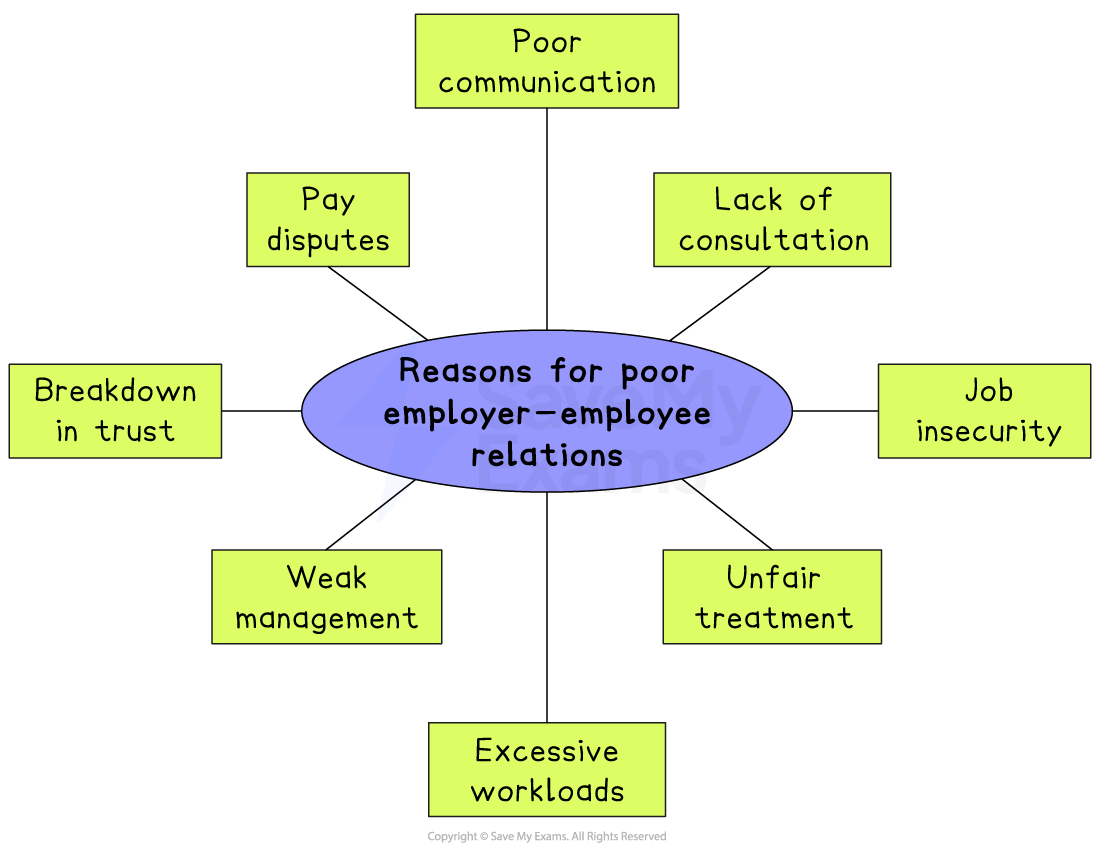
Pay disputes
Employees feel their pay does not fairly reflect their work, fails to keep up with inflation or compares unfavourably with competitors'
Pay disputes are among the most common triggers for workplace conflict
Poor communication
Management fails to keep employees informed about decisions that affect them
This can create uncertainty, cause rumours and lead to mistrust
Lack of consultation
Employees feel that major decisions, such as restructuring, changes to working conditions or redundancies, are imposed rather than discussed
This can undermine their sense of respect and create a 'them and us' situation
Job insecurity
The threat of redundancy, increased use of zero-hours contracts or outsourcing creates anxiety and reduces employee commitment
Unfair treatment
Perceived favouritism, inconsistent application of workplace policies or discrimination damages trust and morale across the workforce
Excessive workload
Employees who feel consistently overworked and underappreciated are more likely to be disengaged or leave the business
Weak management
Poor leadership, lack of recognition and inconsistent decision-making damage the relationship between managers and their teams
Breakdown in trust
Particularly following broken promises, poor business decisions or high-profile incidents of poor treatment
Once lost, trust is very difficult to rebuild
Consequences of poor employer-employee relations
When the relationship between an employer and its workforce breaks down, the effects can spread quickly across the business
What begins as a dispute over pay or working conditions can escalate into industrial action, rising absence rates and long-term damage to productivity and reputation
Conflict leads to disengagement, disengagement leads to higher employee turnover - making it difficult to rebuild a motivated, stable workforce
Industrial action
Industrial action is collective steps taken by employees to put pressure on an employer
Examples of industrial action
Industrial action | How it works |
|---|---|
Strike |
|
Go-slow |
|
Work-to-rule |
|
Overtime ban |
|
Other consequences of poor employer-employee relations
High absenteeism
Employees who are disengaged or stressed are more likely to take sick days, increasing costs and disrupting business operations
High staff turnover
Employees who feel undervalued leave for better workplaces, increasing recruitment and training costs
Low productivity and quality
Disengaged employees are less focused, make more errors and are less likely to take care with their work
Reputational damage
Poor employer-employee relations, particularly high-profile disputes or strikes, can damage the business's reputation with customers and investors and can make future recruitment more challenging
Legal disputes
Unresolved grievances can escalate to employment tribunal claims, which are costly and time-consuming for the business
Customer service deterioration
Unmotivated or disengaged staff deliver a lower quality of service, which can damage customer loyalty and, potentially, affect revenue
Improving employer-employee relations
Preventing poor employer-employee relations is far more effective than attempting to repair them once conflict has taken hold
Businesses that communicate openly, treat workers fairly and genuinely involve employees are less likely to face disputes in the first place
Where relations have already deteriorated, a structured and honest approach to rebuilding trust - sometimes with the support of external bodies such as ACAS - can help restore stability and prevent further escalation
Ways to improve employer-employee relations
Approach | Explanation |
|---|---|
Open and honest communication |
|
Fair pay and rewards |
|
Effective grievance procedures |
|
Investment in employee development and wellbeing |
|
Constructive relationships with trade unions |
|
ACAS (Advisory, Conciliation and Arbitration Service)
ACAS is an independent public body funded by the government that provides guidance, training and dispute resolution services to employers and employees
It plays a particularly important role in collective disputes
Where the breakdown in relations is between an employer and a trade union ACAS provides a neutral space for negotiation
ACAS functions
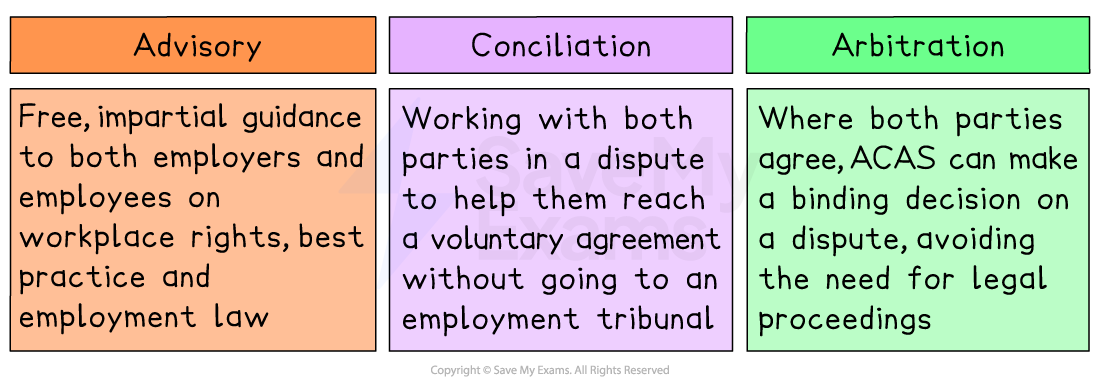
ACAS conciliation must be attempted before employment tribunals can be pursued
Case Study
Relay Distribution Ltd
Relay Distribution is a UK-based logistics company with 1,200 employees, delivering parcels and freight on behalf of retailers. In early 2025, the business announced plans to introduce a new shift pattern requiring drivers to work longer hours for the same pay, with just two weeks' notice and no consultation.
The trade union representing 60% of Relay's drivers immediately called an overtime ban. Relations deteriorated rapidly, absenteeism rose by 22% and three large retailers threatened to move their contracts to competitors.
Relay's senior team approached ACAS to mediate. ACAS arranged talks between management and union representatives, resulting in a new shift agreement, a pay review and the establishment of a joint consultative committee to prevent future disputes.
Within six months, absenteeism returned to pre-dispute levels, and all three retail clients were retained. The episode showed how the failure to consult employees before significant operational changes can cause a rapid and costly breakdown in relations and how early, impartial intervention can help rebuild trust before permanent damage is done.
Examiner Tips and Tricks
When answering questions on poor employer-employee relations, make sure you distinguish between the cause of the breakdown and the form it takes. For example, a pay dispute (cause) may lead to an overtime ban (form of industrial action). Examiners reward precise use of terminology, so know the difference between a strike, a go-slow and a work-to-rule, and use the correct term for the situation described in the question

Unlock more, it's free!
Join the 100,000+ Students that ❤️ Save My Exams
the (exam) results speak for themselves:

Was this revision note helpful?
