Entrepreneurs (AQA A Level Business): Revision Note
Syllabus Edition
First teaching 2026
First exams 2028
Exam code: 7132

Reasons for setting up in business
Over 800,000 new companies were registered in the UK in 2025, demonstrating the scale of entrepreneurial activity across the country (Companies register activities April 2024 to March 2025)
Entrepreneurs set up businesses for a wide variety of reasons
These are broadly divided into financial reasons (motivated by money) and non-financial reasons (motivated by personal goals)
Financial reasons
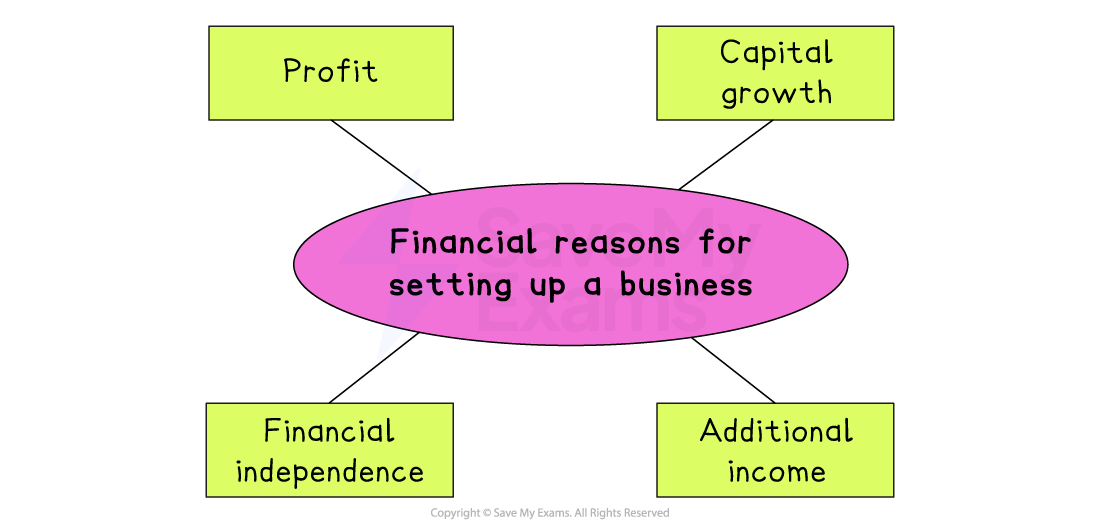
Profit
The money left after all costs have been deducted from revenue
For many entrepreneurs, earning a profit is the primary motivation for starting a business
Financial independence
Generating income without relying on an employer
Entrepreneurs have direct control over their own earnings
Capital growth
Building the value of a business over time with the aim of selling it at a profit in the future
Additional income
Using a business as an extra source of earnings alongside existing employment
Non-financial reasons
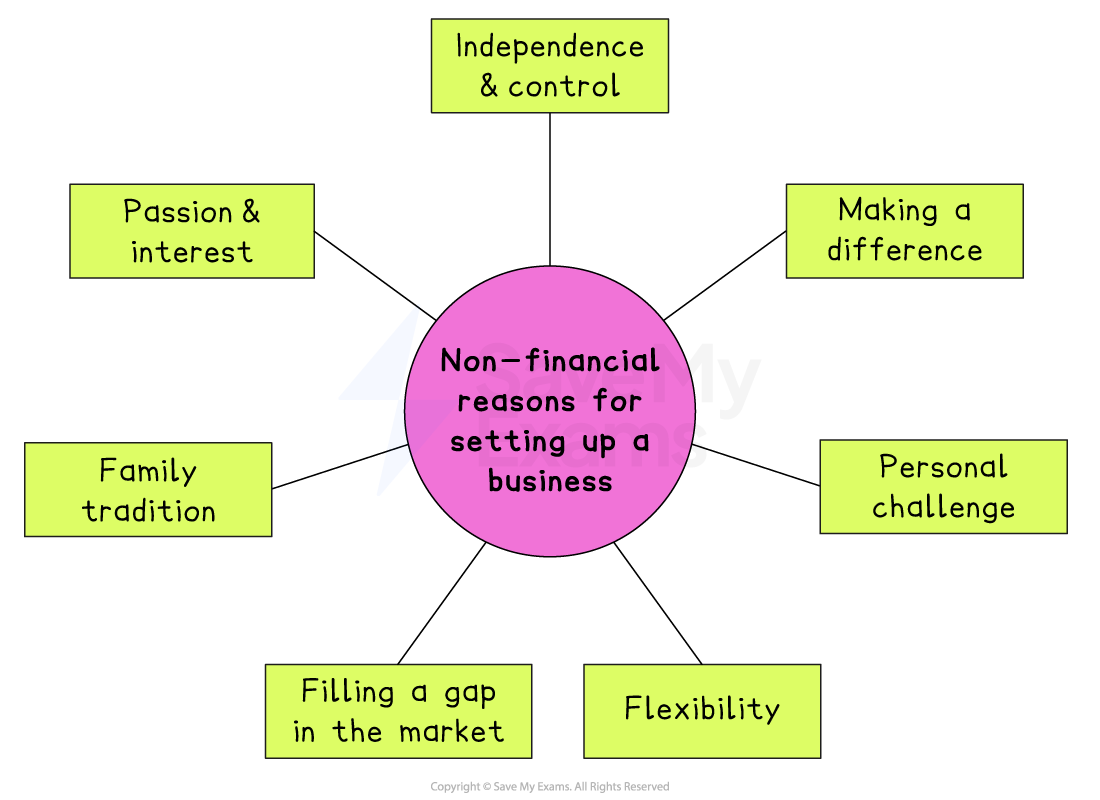
Passion and interest
Turning something they genuinely enjoy or care about into a business
E.g. a keen chef opening their own restaurant
Independence and control
Being their own boss
Making their own decisions about how, when and where to work
Making a difference
Building a business to address a social or environmental problem
E.g. setting up a social enterprise to support a local community
Personal challenge
The desire to achieve something significant, test their abilities or prove their own capabilities
Flexibility
Managing their own working hours to achieve a better work–life balance
Filling a gap in the market
Identifying a product or service that does not yet exist and building a business around that opportunity
Family tradition
Continuing or taking over an existing family business
Examiner Tips and Tricks
In exam questions, you may be asked to identify a reason why an entrepreneur started their business using information from a case study. Make sure you link your answer to the specific context given - simply listing reasons without applying them to the business described will not be credited
Characteristics of entrepreneurs
Entrepreneurs need a specific set of personal characteristics to successfully start, run and grow a business
Characteristic | Explanation |
|---|---|
Risk taker |
|
Resilient |
|
Focused |
|
Passionate |
|
Innovative |
|
Adaptable |
|
Challenges of setting up in business
Fewer than half of all new UK businesses survive beyond their first five years (ONS, 2025)
Entrepreneurs often face significant financial, market and operational problems when starting out
Financial challenges
Raising finance
Banks and investors are reluctant to lend to unproven businesses with no trading record
Entrepreneurs often rely on personal savings, which increases personal financial risk
Cash flow pressure
Start-up costs such as premises, equipment, stock and marketing are typically high before sufficient revenue is generated
A business can be profitable on paper yet still run out of cash
E.g. a new restaurant spending heavily on a fit-out before serving its first customer
Personal financial risk
Entrepreneurs who invest personal savings face significant financial consequences if the business fails
Market challenges
Competition from established businesses
Existing competitors already have loyal customers, brand recognition and cost advantages such as economies of scale, making it difficult for new entrants to compete on price or quality
Building a customer base
Attracting customers to an unknown brand takes time and marketing investment
Without sufficient revenue, the business cannot cover its costs
Market uncertainty
Predicting demand for a new product or service is difficult
Actual sales may fall short of initial forecasts
Operational challenges
Skills gaps
Entrepreneurs are often experts in their product or service but may lack experience in areas such as financial management, marketing or employment law
Legal and regulatory requirements
New businesses must meet a wide range of legal obligations, including business registration, tax compliance, health and safety and data protection
Recruiting and retaining staff
Finding skilled employees is competitive and costly
Wages and employer National Insurance contributions add financial pressure at a time when cash flow is already stretched
Entrepreneurs and business growth
Around 5.4 million of the UK's 5.7 million businesses are micro businesses with fewer than ten employees (Gov.uk, 2026)
As a business grows, the entrepreneur's role shifts fundamentally - from doing the work themselves to leading and directing others
Early-stage role
In the early stages, the entrepreneur is typically responsible for almost everything
Makes all key decisions independently, with few or no staff to consult
Carries out day-to-day operational tasks, e.g. producing the product, serving customers and managing the accounts
Builds personal relationships with customers, suppliers and any early employees
Acts as a generalist – covering multiple business functions without specialist support
Sets the vision, culture and values of the business from the outset
How the role evolves with growth
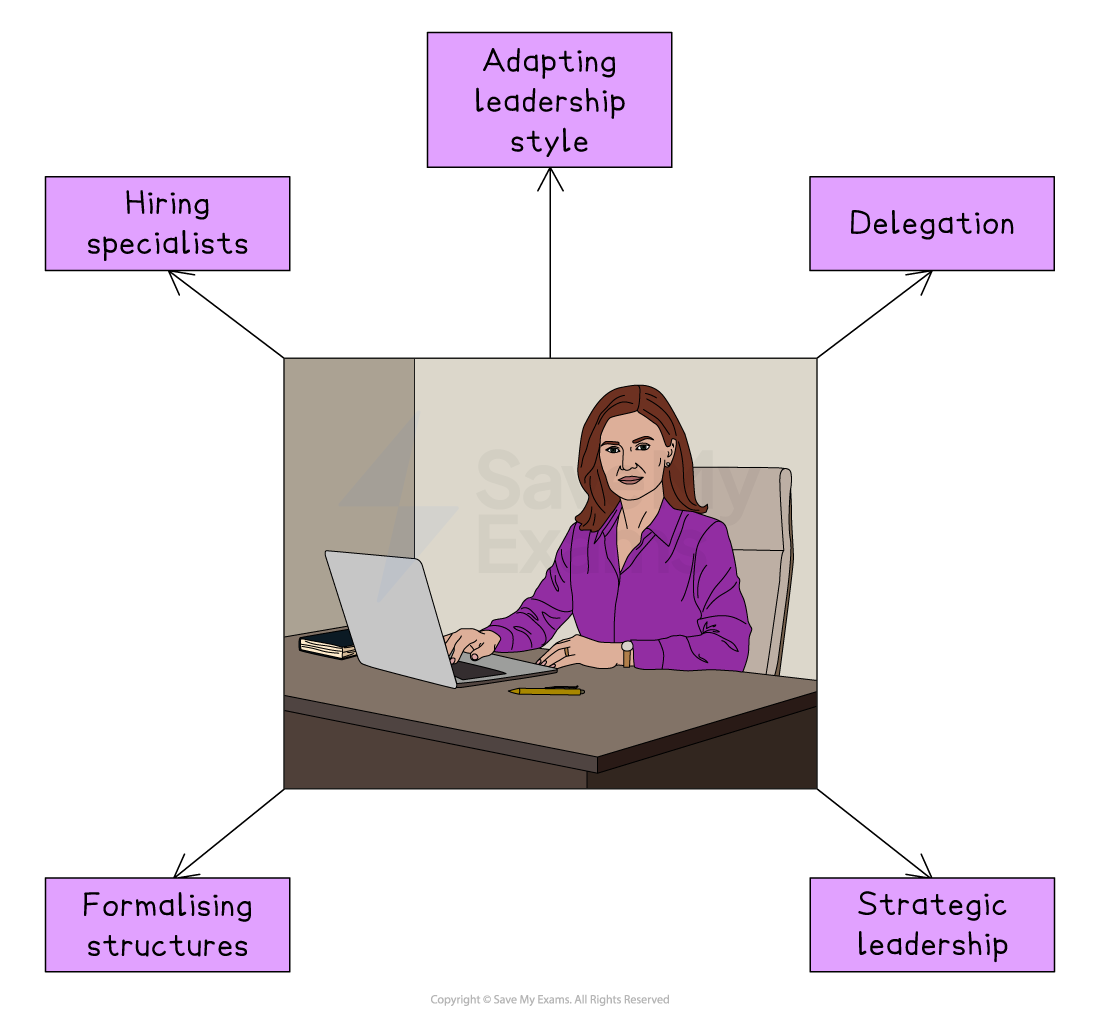
Delegation
Operational tasks are handed over to employees and managers
The entrepreneur focuses on higher-level decisions rather than day-to-day activities
Hiring specialists
Growing businesses need expertise the entrepreneur may not have
E.g. recruiting a finance director or HR manager
Strategic leadership
Attention shifts from operations to long-term direction, competitive strategy and investment decisions
Formalising structures
The business requires formal systems, processes and management hierarchies to function effectively at scale
Adapting leadership style
Managing a larger team demands different skills
The entrepreneur may need to move towards a more democratic or transformational approach
Case Study
Maya's Clean Home
When Maya Shah's son developed a skin reaction to a well-known cleaning product, she spotted a gap in the market. In 2020, she left her marketing job to launch Maya's Clean Home, a range of plant-based, refillable household cleaners
Her motivation was primarily non-financial: a passion for sustainability and a desire to solve a problem she had experienced personally
In her first year she struggled to secure supermarket buyers and nearly ran out of cash, but refused to give up, switching to direct online sales instead
Her adaptability proved key. When one-off orders were unpredictable, she introduced a subscription model that generated reliable monthly revenue
As the business grew, Maya hired a team of eight and shifted her role from making products herself to managing suppliers, overseeing strategy and planning new product lines
Challenges of the transition
Challenge | Explanation |
|---|---|
Letting go of control |
|
Skills gaps |
|
Maintaining culture |
|
Loss of original purpose |
|
Examiner Tips and Tricks
In exam questions about why a business struggles to grow, consider whether the entrepreneur's failure to adapt their role could be a contributing factor. An entrepreneur who continues to micromanage as the business grows may slow decision-making and demotivate staff. This links to leadership style and organisational design - useful connections to make in longer answers

Unlock more, it's free!
Join the 100,000+ Students that ❤️ Save My Exams
the (exam) results speak for themselves:

Was this revision note helpful?
