Economic Environment in Practice: Exchange Rates & Unemployment (AQA A Level Business): Revision Note
Syllabus Edition
First teaching 2026
First exams 2028
Exam code: 7132

Exchange rates
An exchange rate is the value of one currency expressed in terms of another
Appreciation
A rise in the value of one currency relative to another
Depreciation
A fall in the value of one currency relative to another
Exchange rates are an important economic influence for businesses that import raw materials and components and for businesses that export their products
Exchange rates fluctuate for a range of reasons, including
Changing demand for a currency
Economic growth
Changes to interest rates
Recent trends
A currency can move in different directions against different currencies at the same time, depending on relative interest rates and economic conditions
As of late July 2026, one pound was worth around 1.33 US dollars, having weakened slightly from around 1.35 dollars earlier in the month
Over the same period, one pound was worth around 1.17 euros, close to a one-year high against the euro
The pound has strengthened against the euro because UK interest rates (3.75%) are higher than eurozone interest rates (2.25%)
This makes it more attractive for investors to hold pounds
Calculating the effect on export prices
Worked Example
A UK manufacturer sells a machine priced at £10,000
At an exchange rate of £1 = $1.33, the export price is
If the pound appreciates against the dollar to £1 = $1.40, the export price becomes
This means the machine costs $700 more for the American buyer, even though the UK price has not changed at all
The UK manufacturer has become less price-competitive in the US market
Calculating the effect on import costs
Worked Example
A UK retailer imports goods costing $13,300
At an exchange rate of £1 = $1.33, the import cost is
If the pound appreciates to £1 = $1.40, the import cost becomes
This means the same goods now cost £500 less to import
Each pound buys more dollars, reducing costs for the importing business
The US manufacturer has become more price-competitive in the UK market
The impact on business of changes in currency values
Change to currency value | Impact on exporting businesses | Impact on importing businesses |
|---|---|---|
An increase in the value of the £ against other Currencies (appreciation) |
|
|
A decrease in the value of the £ against other currencies (depreciation) |
|
|
Business responses to changes in the exchange rate
Businesses can use hedging to fix a future exchange rate and protect themselves against currency volatility
Some businesses absorb the cost of an unfavourable exchange rate change by accepting a lower profit margin, rather than passing the full cost on to customers
Businesses can switch to domestic suppliers to reduce their exposure to currency fluctuations
Trading across multiple currencies and markets can help spread and reduce a business's currency risk
The impact of exchange rate change on functional areas
Functional area | Impact | Example |
|---|---|---|
Marketing |
|
|
Finance |
|
|
Human resources |
|
|
Operations |
|
|
Case Study
Exchange Rate Impact on BrewCraft Ltd
BrewCraft Ltd is a UK-based premium craft beer producer located in Yorkshire
It exports to EU countries, particularly Germany and France
It also imports hops and specialty brewing equipment from the US and New Zealand

Background: Depreciation of £ in Q2 2025
In early 2025, the value of the pound fell sharply against both the euro and the US dollar due to weak UK economic growth and falling interest rates
Business Impact
Positive impact on exports
BrewCraft’s beers became cheaper for European customers, leading to a 22% increase in overseas sales within 3 months
The company raised euro prices slightly without affecting demand, boosting profit margins
Negative impact on imports
The cost of imported hops from the US and New Zealand rose by 15%
BrewCraft temporarily switched to UK-based hop suppliers to manage costs, despite minor compromises on flavour profile
Strategic Business Adjustments
Introduced a “Limited UK Edition” line using only British ingredients to appeal to local consumers and reduce import reliance
Agreed future currency purchases with its bank at an agreed rate to stabilise input costs
Outcome
Net profits increased by 8%, mainly due to export gains
Customer base in France and Germany grew by 30%
UK customers appreciated the local-sourcing shift, increasing domestic brand loyalty
Examiner Tips and Tricks
Remember SPICED: Strong Pound = Imports Cheap and Exports Dear
Get the direction right and focus on the impact on revenue, not on production costs if suppliers are UK‑based
Unemployment
Unemployment is the number of people who are able and willing to work but cannot find a job, usually expressed as a percentage of the labour force
It is measured in the UK using the Labour Force Survey and the claimant count, both published by the government's Office for National Statistics (ONS)
Recent trends
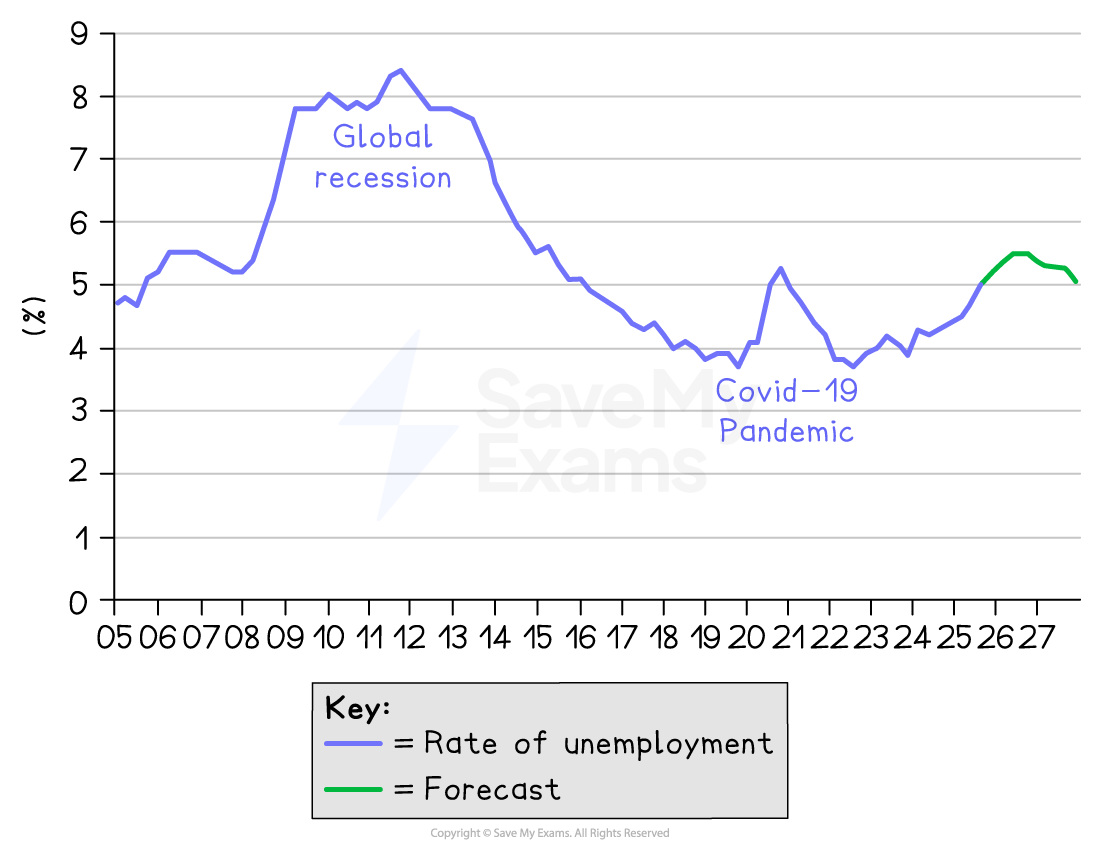
The UK unemployment rate was 4.9 per cent in the three months to May 2026, up 0.2 percentage points on the year, with 1.76 million people unemployed
Youth unemployment remained significantly higher than the overall rate
Around 14.5 per cent of 16 to 24-year-olds were unemployed in May 2026
Overall, the labour market has weakened gradually since 2022
Opportunities and threats of rising unemployment
Opportunities |
|
|---|---|
Threats |
|
Opportunities and threats of falling unemployment
Opportunities |
|
|---|---|
Threats |
|
Business responses to changes in the unemployment rate
Businesses may increase marketing spending on budget product ranges and promotions during periods of high unemployment, when consumers are more price-sensitive
Recruitment and training budgets may be increased during periods of low unemployment, to attract and retain scarce staff
Some businesses build closer relationships with schools, colleges or training providers to develop a reliable future supply of workers
The impact of unemployment on functional areas
Functional area | Impact | Example |
|---|---|---|
Marketing |
|
|
Finance |
|
|
Human resources |
|
|
Operations |
|
|
Case Study
The UK retail sector and unemployment
The CBI's Distributive Trades Survey, published 26 June 2026, showed UK retail sales falling at their sharpest annual rate in over a year, as weakening consumer confidence and a weaker job market made shoppers more cautious with spending.
At the same time, UK retailers employed fewer people in early 2026 than at any point since records began, with just 2.76 million retail jobs in March 2026, as rising labour costs combined with weak demand forced many retailers to freeze recruitment and cut staff hours.
This shows how weakening employment conditions can create a negative cycle for a sector: falling confidence reduces spending, which then leads businesses to cut jobs, further reducing confidence and spending.
Source: CBI, July 2026
Examiner Tips and Tricks
For unemployment and other economic environment topics, remember that the same change can create both opportunities and threats depending on a business's situation, so always consider both sides before reaching a judgement

Unlock more, it's free!
Join the 100,000+ Students that ❤️ Save My Exams
the (exam) results speak for themselves:

Was this revision note helpful?