External Sources of Finance (AQA A Level Business): Revision Note
Syllabus Edition
First teaching 2026
First exams 2028
Exam code: 7132

Introduction to external sources of finance
External sources of finance are funds raised from outside the business — from lenders, investors, suppliers or the public
They are typically used when internal sources are unavailable or insufficient
Such as when a business is new, loss-making or needs to raise a larger amount than it could generate itself
External finance usually comes at a cost
Either interest payments, a share of ownership, or both
Businesses must weigh up whether the return on the investment will be worth the cost
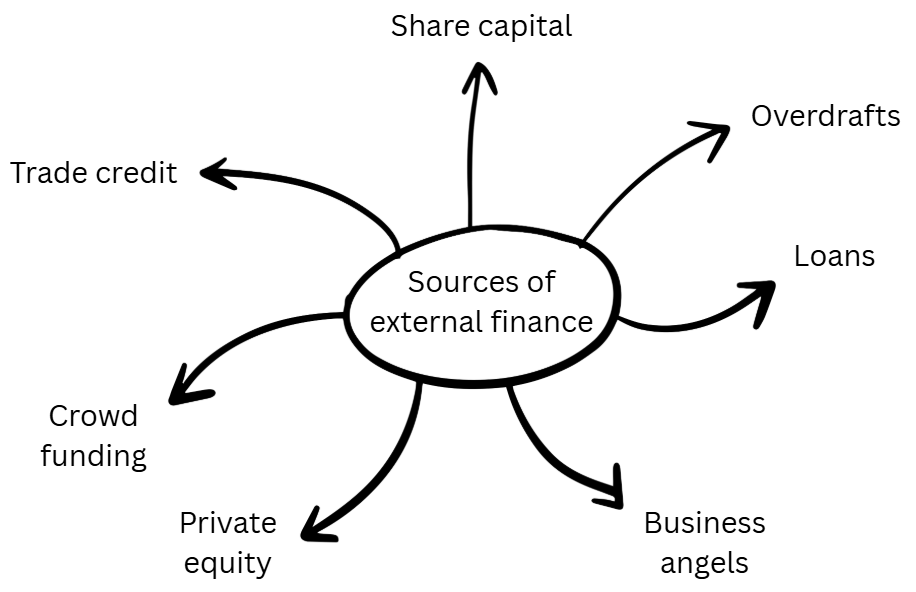
The main sources of external finance
Trade credit
Trade credit is an arrangement where a business receives goods or services from a supplier now but pays for them later - typically after 30, 60 or 90 days
Rather than providing cash, trade credit effectively delays a cash outflow, giving the business more time to generate revenue before the payment is due
Advantages and disadvantages of trade credit
Advantages |
|
|---|---|
Disadvantages |
|
Suitability
Trade credit is particularly useful for businesses that buy stock or materials regularly and have reliable revenue coming in before the credit period ends
It is less suitable as a long-term solution to cash flow problems or for businesses with strained supplier relationships
Case Study
Bloomfield Bakery Supplies
Bloomfield Bakery Supplies distributes flour, sugar and packaging to independent bakeries across the North West.

When a large supermarket chain placed an unusually big order in November ahead of the Christmas period, Bloomfield needed to purchase significantly more stock than usual.
Rather than taking out a short-term loan, the owner contacted her three main suppliers and negotiated 60-day payment terms. This meant she could receive and pay for the extra ingredients in November, supply the supermarket in December, and collect payment before her supplier invoices fell due in January.
The arrangement cost nothing in interest and required no formal application. The owner had built strong relationships with her suppliers over several years, which made the negotiation straightforward. She was careful to pay all three invoices on time, knowing that her suppliers' willingness to offer credit in future depended on her reliability. The Christmas order was fulfilled successfully, and Bloomfield ended the quarter with its biggest-ever profit margin
Share capital
Share capital is money raised by selling shares in a business
Investors who buy shares become shareholders and own a portion of the company
In return for their investment, they may receive a share of the profits — a dividend — and a say in major business decisions
Share capital is only available to companies
Advantages and disadvantages of share capital
Advantages |
|
|---|---|
Disadvantages |
|
Suitability
Share capital is suited to businesses that need large, long-term investment and are willing to share ownership in return
It is less appropriate when the owner wants to retain full control, or when only a modest amount of funding is needed
Case Study
Velocity Scooters
Velocity Scooters was founded in Manchester by two university friends who developed a lightweight electric scooter designed for urban commuters. After two years of product development, the business was ready to launch but needed £500,000 to fund manufacturing, marketing and distribution.
The founders decided to raise this through equity crowdfunding on Crowdcube, offering 20% of the business in exchange for investment. They produced a short video, shared financial projections, and explained the environmental case for electric scooters. The campaign attracted 340 individual investors and reached its target in 18 days.
The share sale meant the founders gave up a fifth of their business, but they retained full day-to-day control. No repayments or interest was required. The campaign also generated significant media attention, which drove pre-orders before the product had even launched. The founders viewed the loss of some ownership as a worthwhile trade-off for the capital, the publicity and the community of engaged early supporters they had built.
Overdrafts
A bank overdraft allows a business to spend more than it currently has in its bank account, up to an agreed limit
The overdraft is only used when needed and interest is only paid on the amount overdrawn
Overdrafts are designed to cover short-term cash shortfalls, not long-term investment
Advantages and disadvantages of overdrafts
Advantages |
|
|---|---|
Disadvantages |
|
Suitability
Overdrafts are best suited to businesses with short-term, temporary cash flow gaps
For example, a retailer waiting for payment from a large customer, or a business managing seasonal peaks and troughs
They are not appropriate as a source of long-term finance
Case Study
Church's Garden Centre
Church's Garden Centre in Shropshire is a family-run business that sells plants, compost, tools, and outdoor furniture. Like most garden centres, trade is highly seasonal - roughly 70% of annual revenue comes between March and June, with January and February typically very quiet.
Each winter, Church's faced the same problem: wages, heating bills and supplier invoices still needed paying, but very little cash was coming in. Rather than taking out a loan for a problem that resolved itself every spring, the owners arranged a £20,000 overdraft facility with their bank.
In a typical January, the business used around £12,000 of the facility, paying interest only on the amount overdrawn. By April, the overdraft was cleared as spring customers returned. The flexibility suited Church's perfectly - the owners were not committed to fixed monthly loan repayments during their busiest season, and the cost was manageable because the overdraft was only used for a few months each year.
Loans
A bank loan is a fixed amount of money borrowed from a lender and repaid over an agreed period, with interest
Repayments are typically made monthly and are fixed in advance, making them predictable and easy to plan around
Loans may be secured — the lender holds an asset, such as property, as collateral, or unsecured — no collateral required, but typically higher interest rates
Advantages and disadvantages of loans
Advantages |
|
|---|---|
Disadvantages |
|
Suitability
Loans are suited to businesses with a specific, planned investment where the cost and timescale are known in advance
Examples include buying equipment, expanding premises or launching a new product
They are less appropriate for short-term or unpredictable cash needs
Case Study
Harmons Adventure Park

Harmons Adventure Park is an outdoor activity centre in the Lake District offering climbing, zip-lining and orienteering experiences for school groups and families. After several record-breaking summers, the owners identified strong demand for indoor climbing facilities that could operate year-round regardless of weather.
To fund an indoor climbing wall and a new café building, the owners applied to their bank for a £180,000 secured business loan over seven years. The bank reviewed three years of accounts, a detailed business plan, and cash flow forecasts before approving the loan.
Monthly repayments of approximately £2,400 were fixed for the full term, making budgeting straightforward. The owners preferred a loan over bringing in outside investors because they wanted to retain complete ownership and control of the business. The indoor facilities opened the following spring and allowed Harmons to take bookings throughout the winter months for the first time, increasing annual revenue by 35% within two years, comfortably covering the loan repayments.
Business angels
Business angels are wealthy private individuals who invest their own money into early-stage or growing businesses, usually in exchange for a share of ownership
They often have business experience themselves and may take an active role in advising the company
Advantages and disadvantages of business angels
Advantages |
|
|---|---|
Disadvantages |
|
Suitability
Business angels are particularly well-suited to start-ups or small businesses with strong growth potential that struggle to secure bank finance due to a lack of trading history or assets
They are less appropriate for businesses where the owner is unwilling to share control or profits
Case Study
Lumio Learning
Lumio Learning was set up by a former secondary school teacher, Aisha, who created an adaptive revision app for GCSE students. Early user testing showed strong results, but Aisha needed £75,000 to develop the full platform, hire a software developer and fund marketing.
Banks were reluctant to lend to a business with no trading history and no physical assets to secure a loan against. Through a regional business angel network, Aisha was introduced to a retired tech entrepreneur who had previously built and sold an education software company. He invested £75,000 in exchange for a 25% stake in Lumio Learning.
Alongside the funding, the angel offered monthly mentoring sessions, introduced Aisha to contacts at several academy trusts and helped her prepare for future investment rounds.
Aisha acknowledged that giving up a quarter of her business was a big decision, but felt the combination of capital, experience and connections was far more valuable than a loan could have provided.
Private equity
Private equity firms are professional investment companies that provide large amounts of funding to businesses, usually in exchange for a significant ownership stake
Unlike business angels, private equity firms invest pooled money from multiple investors and typically target more established businesses rather than start-ups
Private equity investors usually plan to exit after a set period - often 5 to 7 years - by selling their stake at a profit
Advantages and disadvantages of private equity
Advantages |
|
|---|---|
Disadvantages |
|
Suitability
Private equity is best suited to established businesses seeking large-scale investment for expansion, acquisitions or restructuring
It is not appropriate for small businesses or those where the owner wishes to retain control over the long term
Case Study
ClearPath Logistics
ClearPath Logistics had grown steadily over twelve years into one of the largest independent delivery businesses in the Midlands, with a fleet of 90 vehicles and annual revenues of £14 million. The founders wanted to expand nationally but lacked the capital to open new regional depots, upgrade their fleet and invest in tracking technology.
A private equity firm invested £4 million in exchange for a 40% stake in the business. Alongside the capital, the firm assigned a team of operations specialists who restructured the management team and introduced new efficiency systems. Within three years, ClearPath had opened depots in four new cities and grown its fleet to 180 vehicles.
The founders were aware that the private equity firm expected to sell its stake within five to seven years - likely by selling the entire business or floating it on a stock market. They accepted this as the cost of the rapid growth the investment made possible, which they could not have achieved through loans or retained profit alone.
Crowd funding
Crowd funding involves raising money from a large number of individuals, typically through an online platform
Each individual contributes a relatively small amount
Types of crowd funding
Reward crowd funding | Equity crowd funding | Peer-to-peer lending |
|---|---|---|
|
|
|
Advantages and disadvantages of crowd funding
Advantages |
|
|---|---|
Disadvantages |
|
Suitability
Crowd funding is particularly suited to creative, consumer-facing or innovative businesses that have a compelling story to tell and an engaged potential audience
It is less appropriate for B2B businesses or those that need to raise large sums quickly without public exposure
Case Study
The Repair Café Co.
The Repair Café Co. was set up by two friends in Bristol who wanted to open a chain of community cafés where customers could bring broken items - clothes, electronics, furniture - to be fixed by trained volunteers, while enjoying coffee and food.

Traditional lenders were cautious about the unusual business model, so the founders launched a reward-based crowdfunding campaign on Kickstarter, aiming to raise £30,000. Backers who pledged £25 or more received vouchers for free coffee and a repair session; those who pledged £100 received a lifetime membership card.
The campaign raised £38,000 from 620 backers in 35 days, exceeding its target by 27%. The founders kept full ownership of the business — no shares were issued, and no interest was owed. The campaign also proved there was a genuine public appetite for the concept before the first café opened, which later helped them secure a small bank loan for their second location. The community of backers became the business's most loyal early customers.
Examiner Tips and Tricks
When recommending a source of finance, always link your choice to the specific circumstances in the question — the size of the business, how much is needed, how quickly, and whether the owner is willing to give up control or take on debt. There is rarely one right answer, so the quality of your reasoning matters more than the source you choose

Unlock more, it's free!
Join the 100,000+ Students that ❤️ Save My Exams
the (exam) results speak for themselves:

Was this revision note helpful?
