Income Statement (AQA A Level Business): Revision Note
Syllabus Edition
First teaching 2026
First exams 2028
Exam code: 7132

What is the income statement?
The income statement records a business's revenue, expenses, profit or loss during a set period, usually a year
It records income when it is earned and costs when they are incurred, regardless of when cash actually changes hands
The income statement has several important purposes
It shows whether the business has made a profit or a loss over the period
It reveals how efficiently the business is managing its costs at each stage of the profit calculation
It provides the basis for calculating profit margins, which allow comparisons to be made over time or with competitors
Stakeholders use the income statement in a variety of ways
Assessing financial performance
Managers, shareholders and investors use the income statement to evaluate whether the business is profitable, whether performance is improving and whether it is generating a sufficient return on investment
Informing financial decisions
Suppliers use profit data to decide how much trade credit to offer
Banks and lenders use it to assess the risk of lending
Managers use it to identify where costs need to be controlled or where investment is needed
Meeting legal and regulatory obligations
Government agencies use the income statement to calculate the corporation tax owed
Structure of the income statement
The income statement is divided into three parts
The trading account
Records the revenue generated from sales and deducts the cost of sales
The result is the gross profit
The trading account answers the question of how much profit the business made from its core buying and selling activity, before any other costs are considered
The profit and loss account
Takes the gross profit from the trading account and deducts all remaining costs - operating expenses such as rent, wages and marketing, finance costs such as interest on borrowing, and tax
The result is the profit for the year
This section gives a complete picture of the business's overall profitability after every cost has been accounted for
The appropriation account
Shows what happens to the profit for the year - how the profit is divided up between different uses
For a company, this typically means splitting the profit between
Dividends
The share of profit paid out to shareholders as a return on their investment
Retained profit
The remainder kept within the business to fund future growth or act as a financial reserve
The appropriation account does not affect how much profit is made - it simply records the decisions made about what to do with it
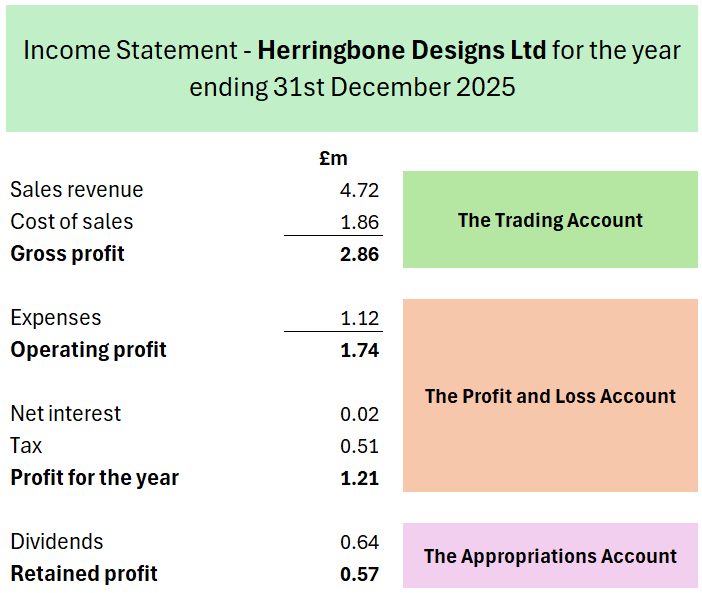
An example income statement
Analysis
The trading account
In 2025 Herringbone Design Ltd's sales revenue was £4.72m and its cost of sales were £1.86m
The gross profit for the period was therefore
The profit and loss account
In 2025 gross profit was £2.86m and expenses were £1.12m
The operating profit was therefore
The business also paid £0.02m interest and £0.51m tax
The profit for the year was therefore
The appropriations account
In 2025 Herringbone Design Ltd distributed £0.64m to shareholders as dividends
Retained profit was therefore
Notes to the accounts
Public limited companies are required by law to include details of
Depreciation of non-current assets
Directors' earnings
Audit details, including the identity and costs of the appointed auditor
Employee details, such as the size of the workforce, wage and salary costs, pension liabilities and national insurance contributions
Exceptional items, which are significant one-off items of income or expenditure that are unusual but a part of normal trading activities, such as a very large order placed by a customer
Interpreting and amending the income statement
Reading an income statement means understanding not just the individual figures, but what they reveal about the business's performance
Key questions to ask
Is the business profitable at each stage, or does it only make a loss once certain costs are added?
E.g. A business could show a healthy gross profit but a very low - or even negative - operating profit
This would suggest that overheads are too high relative to the gross profit being generated
Is the gross profit large enough to absorb operating expenses and still leave a meaningful operating profit?
How significant are finance costs - does the business carry a heavy debt burden?
How does this year's performance compare with the previous year or with industry benchmarks?
Profit quality
Profit quality measures how reliable and sustainable a company’s reported profit really is
It considers whether profit comes from normal, cash-generating activities or from one-off, non-cash or unreliable sources
High-quality profit | Poor-quality profit |
|---|---|
|
|
Making changes to the income statement
Amending an income statement means recalculating the figures when one or more inputs change
Worked Example
During 2025, Herringbone Designs Ltd increased its selling prices, raising revenue from £4.72m to £4.96m. The cost of sales increased to £2.06m and expenses increased to £1.19m.
The business paid the same amount of interest, but its tax bill increased to £0.54m.
Amend the income statement to illustrate the impact of this change on gross profit, operating profit and profit for the year.
Answer
Gross profit
Operating profit
Profit for the year
New income statement
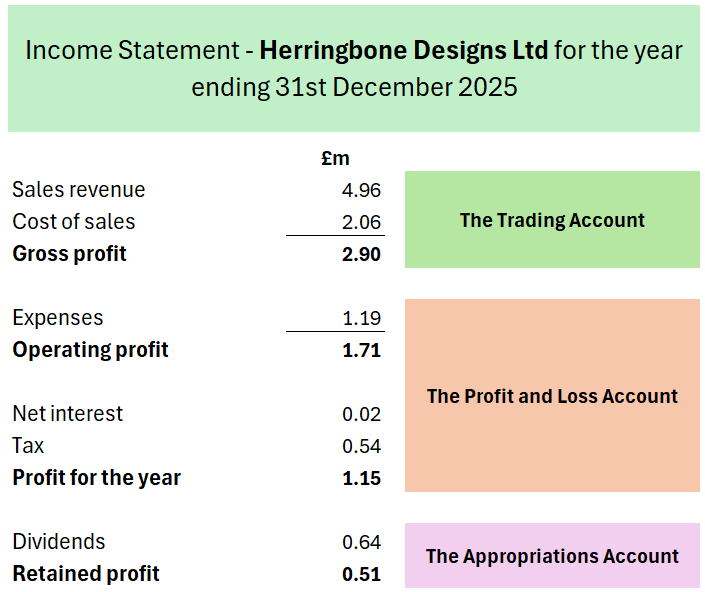
Although revenue and gross profit increased, both operating profit and profit for the year fell as a result of increased costs
Profit and profit margins
A profit margin measures the proportion of revenue that is converted into profit
Higher and increasing profit margins are preferable, as they mean more revenue is being converted to profit
Gross profit margin
The gross profit margin is the proportion of revenue that is converted to gross profit
It is expressed as a percentage and calculated using the formula
Changes in the gross profit margin indicate how well managers are keeping direct costs low or encouraging sales
A rising gross profit margin indicates increasing levels of sales revenue and/or falling cost of sales
A falling gross profit margin indicates lower sales revenue and/or a rising cost of sales
Worked Example
An e-scooter manufacturer sells its products to retailers for £180 per unit. Variable costs are £72 per scooter, with monthly fixed costs being £82,000. The manufacturer sells 2,200 scooters a month
The business pays £240 interest on a mortgage each month. It pays corporation tax of £372,000
Calculate the business's gross profit margin for the year
Answer
Gross profit per unit
Gross profit per month
Gross profit per year
Revenue per month and per year
Gross profit margin
Operating profit margin
The operating profit margin shows the proportion of revenue that is turned into operating profit
It is expressed as a percentage and calculated using the formula:
Changes in the operating profit margin indicate how well managers are keeping indirect costs low or encouraging sales
A rising operating profit margin indicates increasing levels of sales revenue and/or falling overheads
A falling operating profit margin indicates lower sales revenue and/or rising overheads
Worked Example
An e-scooter manufacturer sells its products to retailers for £180 per unit. Variable costs are £72 per scooter, with monthly fixed costs being £82,000. It sells 2,200 scooters a month
The business pays £240 interest on a mortgage each month. It paid corporation tax of £372,000
Calculate the business's operating profit margin for the year.
Answer:
Total variable costs for the year
Total fixed costs for the year
Total costs for the year
Operating profit for the year
Operating profit margin
Profit for the year margin
The profit for the year margin shows the proportion of revenue that is turned into profit for the year
It is expressed as a percentage and calculated using the formula
Changes in the net profit margin indicate how well managers are keeping borrowing costs low, minimising the level of tax paid or encouraging sales
A rising net profit margin indicates increasing levels of sales revenue and/or lower tax or borrowing costs
A falling net profit margin indicates lower sales revenue and/or higher tax or borrowing costs
Worked Example
An e-scooter manufacturer sells its products to retailers for £180 per unit. Variable costs are £72 per scooter, with monthly fixed costs being £82,000. It sells 2,200 scooters a month
The business pays £240 interest on a mortgage each month. It paid corporation tax of £372,000
Calculate the business's profit margin for the year.
Answer:
Total interest costs for the year
Interest costs added to the tax paid for the year
Total costs including interest and tax
Profit for the year
Profit for the year margin
Examiner Tips and Tricks
Don’t confuse operating profit with profit for the year: Take off finance costs and tax after operating profit
Label each figure clearly to secure the calculation marks

Unlock more, it's free!
Join the 100,000+ Students that ❤️ Save My Exams
the (exam) results speak for themselves:

Was this revision note helpful?
