The Purpose & Nature of Innovation (AQA A Level Business): Revision Note
Syllabus Edition
First teaching 2026
First exams 2028
Exam code: 7132

The importance of innovation
Innovation means introducing something new, or significantly improving something that already exists, within a business
Product innovation is new or improved goods and services offered to customers
Process innovation is new or improved ways of producing, delivering or organising a business's operations
Innovation is different from invention
Invention means creating something entirely new
Innovation includes applying, improving or commercialising an idea, whether it is original or builds on existing technology
Businesses of any size or sector can innovate, from a small business improving how it takes orders, to a large business developing an entirely new product
Example
A coffee chain introduces a mobile app allowing customers to order and pay ahead of collection, improving the process without changing the product itself
The value of innovation
Innovation can create new revenue streams and open access to new markets
It improves efficiency and reduces costs when applied to processes rather than products
It can help a business respond to changing customer needs, technology and market trends
It builds long-term resilience, as businesses that fail to innovate risk becoming outdated compared to competitors
It can strengthen brand image as it positions a business as modern and forward-thinking
Example
A supermarket introduces self-checkout technology to speed up the shopping experience and reduce staffing costs
Challenges of innovation
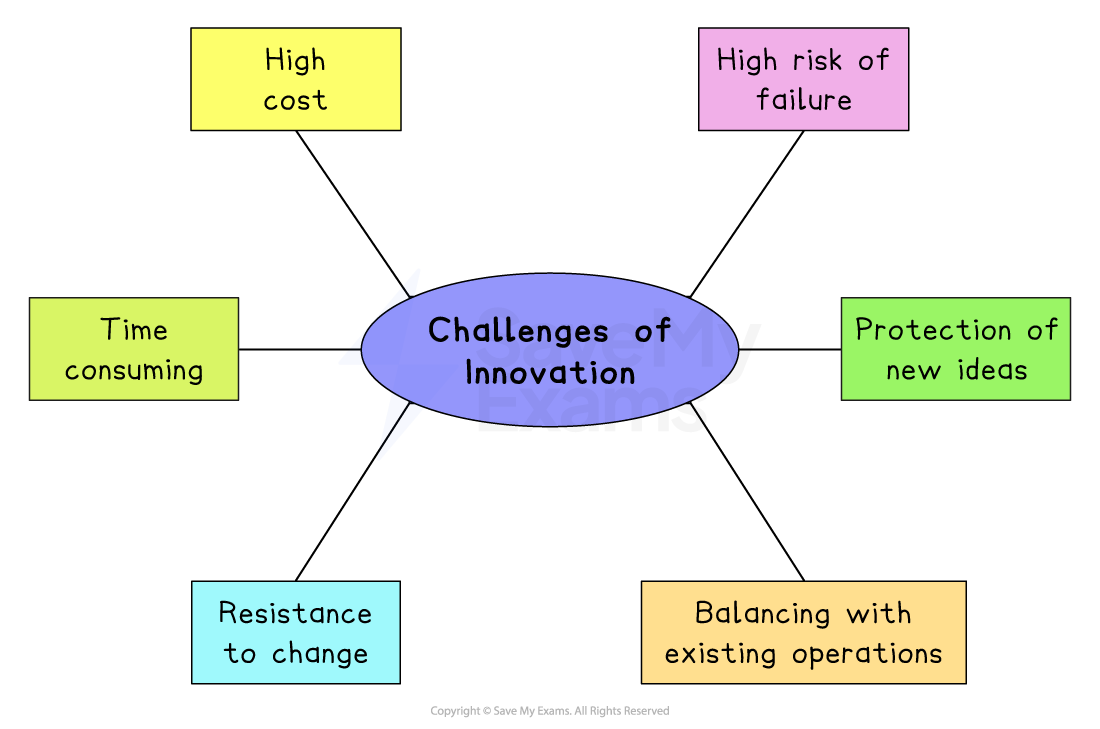
High cost
Research, development and testing of new ideas can require significant investment before any return is seen
Example
A car manufacturer invests heavily in developing electric vehicle technology, but faces years of losses before the new models become profitable
High risk of failure
Many new products or processes don't succeed commercially, despite the investment made
Time-consuming
Developing and testing new ideas can take months or years before they are ready to launch
Protecting new ideas
Competitors may copy successful innovations unless they are protected, for example through patents
Example
A small technology start-up patents its new app design after discovering a larger competitor had begun developing a similar product
Resistance to change
Employees or customers may be reluctant to adopt new products or ways of working
Balancing innovation with existing operations
Pursuing new ideas can distract resources and management attention away from core business activities
Example
A confectionery manufacturer delays a new product launch after its research team is pulled onto solving a problem with its existing production lines
Ways of developing innovation
Research and development (R&D)
Research and development (R&D) is the systematic investigation and experimentation a business carries out to develop new or improved products, processes or technologies
This can range from small-scale product testing to large, dedicated research departments or laboratories
Example
A pharmaceutical company invests heavily in R&D to develop new medicines, testing many potential treatments before finding ones that work
Advantages and disadvantages of research and development
Advantages |
|
|---|---|
Disadvantages |
|
Talent acquisition and retention
Talent acquisition and retention means attracting and keeping skilled, creative employees who can generate and develop new ideas
Innovative businesses often compete to recruit specialists and offer incentives to retain them, since employee expertise and creativity lead to new ideas
Example
Google offers high salaries, flexible working and creative freedom to attract and retain talented software engineers
Advantages |
|
|---|---|
Disadvantages |
|
Cross-functional teams
Cross-functional teams bring together employees from different departments, such as marketing, finance and operations, to work on projects together
Combining different perspectives and expertise can generate more creative solutions than employees working within a single department alone
Example
A clothing retailer forms a cross-functional team of designers, marketers and supply chain staff to develop a new sustainable product range
Advantages |
|
|---|---|
Disadvantages |
|
Intrapreneurship
Intrapreneurship means encouraging employees to act like entrepreneurs within a business, developing new ideas, products or processes as if running their own venture
Businesses may give employees time, a budget or freedom to explore new ideas independently
Example
3M has run a "15% time" policy since 1948, allowing employees to spend 15% of their working hours on projects of their own choosing.
This intrapreneurial approach led directly to some of the company's best-known products, including the Post-it Note, invented by scientist Art Fry during his allotted time
Advantages |
|
|---|---|
Disadvantages |
|
Case Study
Nimbus Home Tech

Nimbus Home Tech designs and sells smart home devices such as thermostats and lighting systems.
Facing growing competition from larger rivals, the directors decided to invest more heavily in innovation, setting up a cross-functional team of engineers, designers and marketers to develop a new voice-controlled home assistant.
The project required significant upfront investment in research and testing and took over a year to develop before it was ready for launch, delaying other planned projects.
Some experienced staff were resistant to the new device, preferring to focus on the company's established product range rather than an unproven idea.
Despite this, the cross-functional team's mix of technical and marketing expertise helped identify and fix several design problems before launch that might otherwise have gone unnoticed.
The new device launched successfully, and sales grew faster than any previous product the company had released.
However, a separate idea developed through the company's intrapreneurship scheme, a smart plant-watering device, failed to attract enough customer interest and was withdrawn within months.
Examiner Tips and Tricks
When answering questions on ways of developing innovation, link the method to the specific resources or culture of the business in the case study, rather than describing R&D, talent, teams or intrapreneurship in isolation.

Unlock more, it's free!
Join the 100,000+ Students that ❤️ Save My Exams
the (exam) results speak for themselves:

Was this revision note helpful?
