Changing Organisational Design (AQA A Level Business): Revision Note
Syllabus Edition
First teaching 2026
First exams 2028
Exam code: 7132

Centralisation and decentralisation
What is centralisation?
Centralisation is where decision-making authority is concentrated at the top of the organisation
Senior managers make most or all significant decisions
Lower-level employees have limited power to act independently
Example
A national fast food chain sets menus, prices and promotional offers centrally
This ensures customers receive a consistent experience in every location regardless of regional differences in demand or taste
Advantages of centralisation
Decisions are consistent across all parts of the business
This protects brand standards and reduces the risk of conflicting approaches in different locations or departments
Senior managers retain close control over the direction of the business
This is particularly important during a period of change or financial difficulty
Bulk purchasing and other economies of scale are easier to achieve when buying decisions are made centrally
Coordination of activity across departments and locations may be easier
Disadvantages of centralisation
Decision-making can be slow, as everything must be referred upwards through the hierarchy
Senior managers may be too far removed from customers and frontline operations to make well-informed decisions
Employees at lower levels may feel undervalued and lacking in autonomy
This can reduce motivation and engagement
Creates a bottleneck at the top
Senior managers can become overloaded with decisions that could be handled effectively at a lower level
Decentralisation
Decentralisation is where decision-making authority is delegated to managers and employees lower down the organisation
This gives them greater autonomy to make decisions within their areas of responsibility
Example
A hotel group allows individual hotel managers to set room rates, approve local partnerships and respond to guest complaints without seeking approval from head office
This means a faster, more personalised service than a centralised competitor could provide
Advantages of decentralisation
Decisions can be made more quickly
They do not need to travel up through multiple layers of management
Managers closer to the customer are better placed to respond to local conditions, preferences and competitive pressures
Greater autonomy motivates employees
By giving them responsibility and the opportunity to develop their decision-making skills
Senior management is freed up to focus on longer-term strategic priorities rather than day-to-day operational decisions
Disadvantages of decentralisation
Decisions may be inconsistent across different parts of the business
This can harm the brand and create confusion for customers
Lower-level managers may lack the experience or information needed to make good decisions
Harder to coordinate activity across departments and locations when multiple people have independent decision-making authority
May require significant investment in management training and development to ensure decisions are of a high quality
Case Study
Compass Retail Group Ltd

Compass Retail Group operates 85 homeware and furniture stores across the UK. For many years, the business ran a highly centralised structure, with all pricing, promotions, stock ordering and staffing decisions being made by a small team at head office in Birmingham.
As the business grew, the limitations of this approach became increasingly apparent:
Regional managers reported that they were unable to respond quickly to local competitor activity or customer preferences
Staff turnover in stores was high, with employees citing a lack of autonomy and development opportunities as key reasons for leaving.
The board approved a major restructuring programme.
Two layers of middle management were removed through delayering, reducing costs by £3.2 m annually and shortening the chain of command between store managers and the chief executive
Authority for local pricing, staffing schedules and in-store promotions was decentralised to regional managers, who were given training and a clear decision-making framework to support their new responsibilities.
Within 18 months, staff turnover fell by 22%, customer satisfaction scores improved and the business reported faster responses to local competitive threats.
Restructuring
Restructuring involves making significant changes to the way a business is organised – including its hierarchy, departments, workforce size or the allocation of responsibilities
Its aim is to improve efficiency, reduce costs or better align the organisation with its strategic goals
Common forms of restructuring
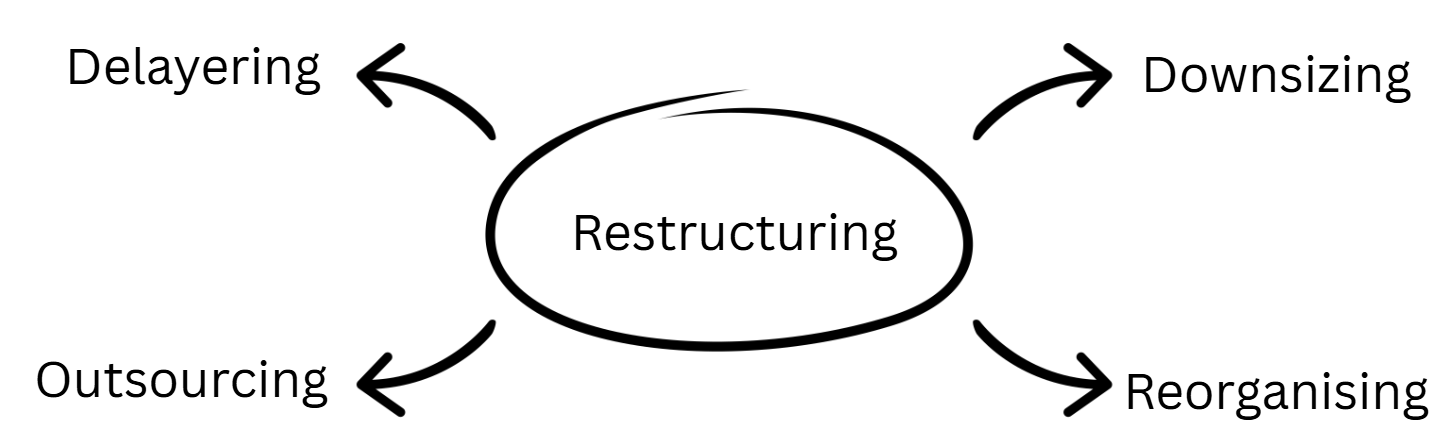
Delayering
Involves removing one or more levels of management from the hierarchy
Creates a flatter structure, speeds up communication and reduces management costs
E.g. Unilever announced plans in 2024 to cut 7,500 roles globally by removing a layer of senior management. Its aim was to create a leaner structure with faster decision-making between teams and senior leadership
Downsizing
Reducing the overall size of the workforce through redundancies
Typically a strategy to cut costs or improve efficiency
E.g. Meta laid off approximately 11,000 employees in 2022 — around 13% of its global workforce — after over-hiring during the pandemic period
Outsourcing
Contracting out certain functions, such as IT, payroll or customer service, to specialist external providers, allowing the business to focus on its core activities
E.g. The NHS outsources some diagnostic services — including MRI scans and physiotherapy — to private providers to reduce waiting times
Outsourcing is considered in more detail here
Reorganising departments
Merging, splitting or changing teams and divisions to reflect new strategic priorities or to remove duplication
E.g. Google reorganised its entire business in 2015, creating a new parent company called Alphabet. Google became one of several subsidiaries and longer-term projects, such as self-driving cars and life sciences were included in the new structure
Example
In 2023, BT announced plans to cut up to 55,000 jobs by 2030, partly through replacing some roles with artificial intelligence and automation
The restructuring aimed to significantly reduce operating costs and improve efficiency, but raised concerns about the impact on affected workers and the communities in which BT operates
Advantages and disadvantages of restructuring
Advantages |
|
|---|---|
Disadvantages |
|
Examiner Tips and Tricks
When evaluating centralisation, decentralisation or restructuring, always consider the specific context of the business. What works well for a large, geographically spread organisation may be inappropriate for a small, single-site business. Restructuring may improve efficiency in the long run, but the short-term costs – financial and human – are real and should always be acknowledged in a balanced evaluation

Unlock more, it's free!
Join the 100,000+ Students that ❤️ Save My Exams
the (exam) results speak for themselves:

Was this revision note helpful?
