The Importance of Suppliers (AQA A Level Business): Revision Note
Syllabus Edition
First teaching 2026
First exams 2028
Exam code: 7132

Supply chain transparency
Supply chain transparency means a business being open about where its materials and products come from, and the conditions under which they are made
Businesses increasingly publish information about their suppliers and sourcing, and rely on external certification schemes, rather than relying only on their own claims
The purpose and value of supply chain transparency
Builds trust with customers, who increasingly want to know where products come from and how they are made
Reduces reputational risk, as it becomes harder for problems such as poor working conditions or environmental damage to go unnoticed
Provides independent, credible assurance that standards are being met, which carries more weight with customers than a business's own claims
E.g. Fairtrade certification is independently checked by FLOCERT, an accredited certification body
This gives customers confidence that farmers have received a fair minimum price without having to verify this themselves
Can differentiate a business from less transparent competitors, supporting premium pricing or customer loyalty
Example
Nestlé publishes supplier lists for commodities including palm oil, cocoa and coffee, and can now trace over 99% of its palm oil back to the mill where it was processed
Influences on the choice of suppliers
Choosing suppliers involves decisions about both how many suppliers to use and which suppliers to use
Using a single supplier can allow closer relationships and potentially lower costs
However, it leaves a business vulnerable if that supplier fails
Using multiple suppliers spreads risk and increases flexibility
However, it can be more complex and expensive to manage
What affects the choice of suppliers?
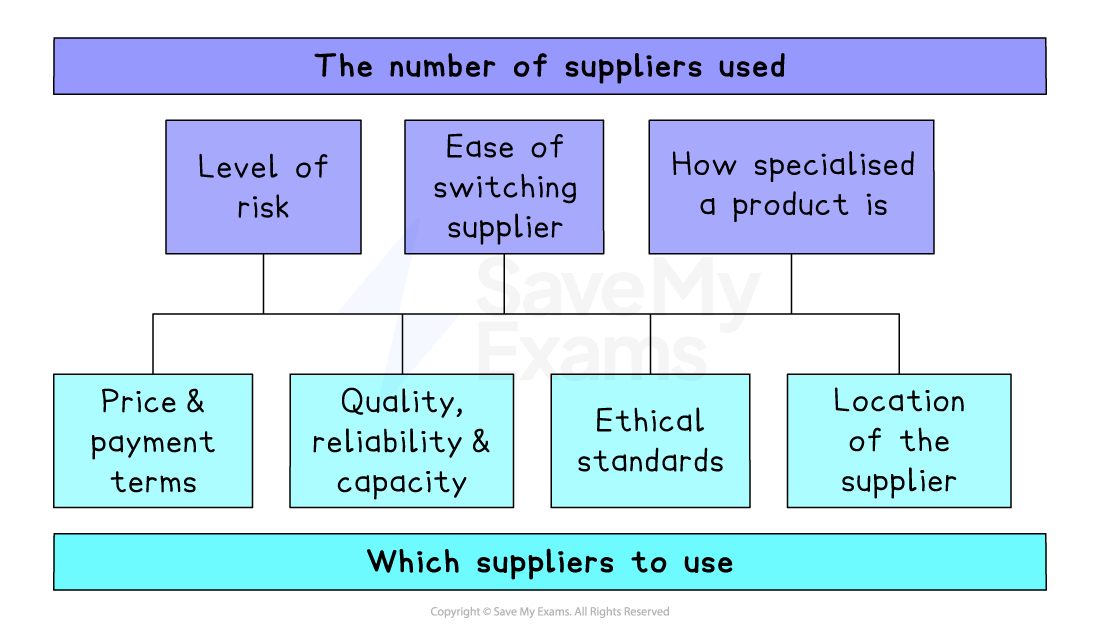
Influences on the number of suppliers used
The level of risk a business is willing to accept from relying on one supplier
A business more comfortable with risk may rely on a single supplier to secure better prices or a closer relationship
A more risk-averse business spreads orders across several suppliers to protect itself
How easily a business could find and switch to an alternative supplier if needed
Where alternative suppliers are readily available, a business can safely rely on fewer of them, since switching quickly is possible if problems arise
Whether the product or component is highly specialised, making multiple suppliers harder to find
Specialised materials or components may only be available from a small number of suppliers
This forces a business to rely on fewer sources even if it would prefer more choice
Influences on which suppliers to use
Price and payment terms offered by each supplier
Lower prices and more favourable credit terms reduce costs and help cash flow, making a supplier more attractive to work with
Quality, reliability and capacity to meet the required volume
A supplier must consistently deliver the right quality and quantity on time
Failure to do so can lead to production delays and customer dissatisfaction
Ethical, environmental and legal standards, particularly where a business values or requires accreditation
Choosing suppliers that meet recognised standards reduces the risk of reputational damage and satisfies customers who care about ethical sourcing
Location, which affects delivery times, transport costs and exposure to disruption
Suppliers based closer to a business typically offer faster, cheaper delivery
They are also less exposed to risks such as long-distance transport delays
Example
Apple has increased iPhone production in India and expanded component manufacturing in Vietnam, reducing its reliance on a single country, China, after COVID-19 disruption exposed the risks of depending too heavily on one location
Profits in the supply chain
The distribution of profit along the supply chain refers to how the total profit made from a product is divided between the businesses involved in producing, distributing and selling it, such as growers, manufacturers, distributors and retailers
The share of profit each business receives depends on factors such as bargaining power, brand strength and how replaceable each stage of the chain is
Influences on the distribution of profits
Relative size and bargaining power
Larger businesses, such as major retailers, can often negotiate lower prices from smaller suppliers
Branding
Businesses that own a well-known brand can often achieve more profit than businesses producing an unbranded component
Number of alternative suppliers
Producers who are easily replaced typically have less power to negotiate a higher price
Ethical trading schemes, such as Fairtrade
These set a guaranteed minimum price to protect producers regardless of market conditions

Coffee farmers typically receive around one per cent of the retail price of a cup of coffee, with most of the value awarded to roasters, retailers and coffee shops
Examiner Tips and Tricks
When discussing the distribution of profit in a supply chain, refer to bargaining power and brand strength specifically, rather than simply stating that "some businesses earn more than others," as this shows clearer analysis

Unlock more, it's free!
Join the 100,000+ Students that ❤️ Save My Exams
the (exam) results speak for themselves:

Was this revision note helpful?
