Ansoff's Matrix (AQA A Level Business): Revision Note

Syllabus Edition

First teaching 2026

First exams 2028

Exam code: 7132

Lisa Eades

Written by: Lisa Eades

Reviewed by: Bridgette Barrett

Updated on

Choosing strategic direction

  • Strategic direction is the long-term path a business chooses to follow to achieve its objectives and fulfil its vision

    • It sets out where the company wants to go and the steps it will take to get there

Why clear strategic direction matters

  • Guides decision-making

    • When everyone knows the way in which the business is moving, it is easier to choose the right projects and make the right investment

  • Aligns the team

    • A clear direction helps staff understand priorities and work together towards the same goals

  • Focuses resources

    • It ensures money, people and time are used on activities that move the business forward, not on distractions

  • Measures progress

    • With a defined path, managers can track progress and adjust plans if things aren’t working as expected

Factors that determine strategic direction

Diagram depicting factors influencing strategic direction: leadership style, financial resources, organisational culture, and technological capabilities.
Strategic direction is determined by factors including leadership and management style, available financial resources and organisational culture
  1. Leadership and management style

    • The experience, vision and attitude to risk of the senior team influence whether a company aims for rapid growth, cautious expansion or innovation leadership

  2. Financial resources

    • The amount of cash a business has and its access to credit determine how big or fast a business can invest in new facilities, technology or staff

  3. Organisational culture and values

    • A company’s shared beliefs, such as a focus on teamwork, customer service or ethical practice, guide choices about new markets, partnerships and ways of working

  4. Technological Capabilities

    • The skills, systems and digital tools a firm already has, or can build, affect whether it can pursue strategies based on, for example, automation or online services

Ansoff's matrix: strategies for growth

  • Ansoff’s Matrix is a tool for businesses that want to grow quickly and have a growth objective

  • It is used to identify an appropriate strategic direction and identify the level of risk associated with the chosen strategy

  • The model considers four elements, which are broken down into two categories

    • The market - existing and new markets

    • The product - existing and new products

Ansoff's strategic matrix
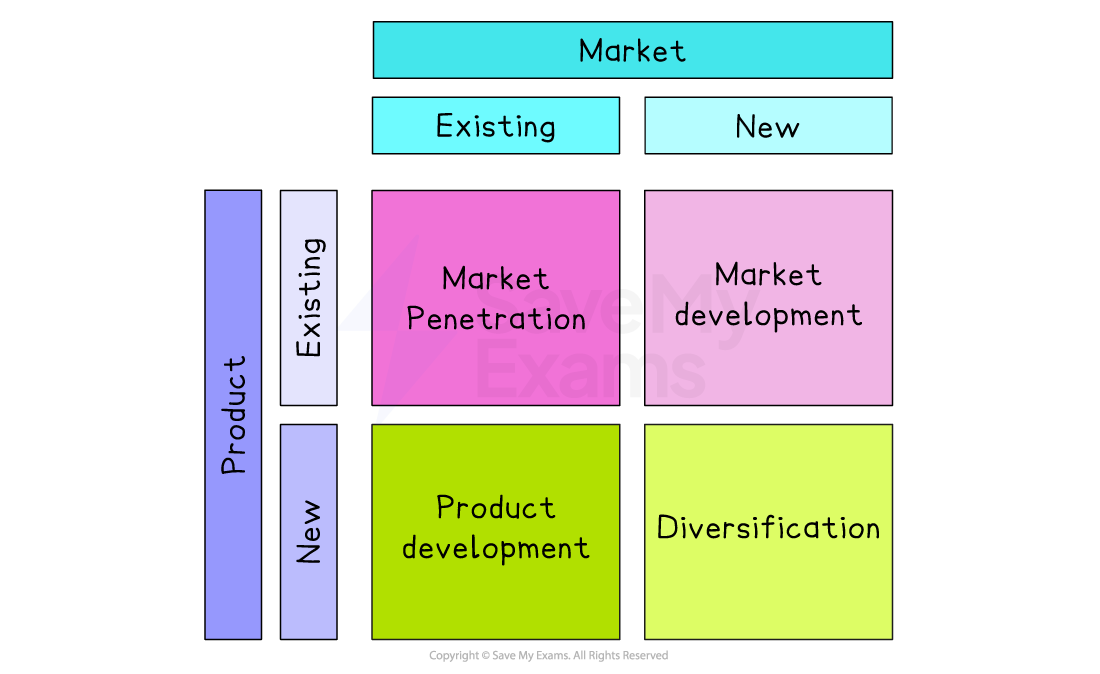
Ansoff Matrix showing growth strategies: market penetration, market development, product development, and diversification, based on market and product status.
Ansoff’s strategic matrix identifies strategies for growth, depending on whether the product and market already exist or are new

Market penetration

  • The least risky strategy to achieve growth is to pursue a strategy of market penetration 

    • This involves selling more products to existing customers by encouraging

      • More regular use of the product

      • Increased usage of the product

      • Brand loyalty of customers

Advantages and disadvantages of market penetration

Advantages

  • Lower risk

    • The business already understands its existing product and market, avoiding the added risk of unfamiliar customers or an unfamiliar and untested product

  • Relatively low cost

    • Increasing marketing spend or introducing a loyalty scheme is usually far cheaper than developing a new product or entering a new market

  • Builds on existing brand strength

    • Deepening loyalty around an already-trusted brand tends to be quicker than building trust with entirely new customers

  • Can be implemented quickly

    • Since no new product development or unfamiliar market research is required, growth can often be achieved in the short term

Disadvantages

  • Limited by the size of the existing market

    • Once most potential customers are already loyal, there is a ceiling on how much further growth this strategy alone can achieve

  • Risk of price wars

    • Competing more aggressively for the same customers, for example through discounting, can trigger retaliation from rivals

  • Over-reliance on one market or product

    • Since all growth comes from a single area, a downturn there, such as a change in consumer tastes, affects the whole business severely

  • May attract regulatory attention

    • Growing market share too far can raise competition concerns, potentially triggering an investigation by a body such as the Competition and Markets Authority (CMA)

Market development

  • Market development involves finding and exploiting new market opportunities for existing products by

    • Entering new markets abroad

    • Repositioning the product by selling to different customer profiles (selling to other businesses as well as direct to consumers)

    • Seeking complementary locations

      • E.g. M&S Food has achieved significant growth since teaming up with fuel retailers such as BP and Applegreen and providing express retail outlets

Advantages and disadvantages of market development

Advantages

  • Makes use of an already proven product

    • Since the product itself does not need to change, the business avoids the cost and risk of new product development

  • Spreads risk across more markets

    • If sales fall in one market or region, growth or stability in a new market can help offset the loss

  • Can extend a product's life cycle

    • A product reaching maturity in its original market can be relaunched into growth elsewhere instead of declining

Disadvantages

  • Requires research into unfamiliar markets

    • A business may misjudge the needs, tastes or regulations of a new market, especially if it is a different country

  • Cultural or legal differences can undermine success

    • A product that works well domestically may not suit consumer preferences abroad, or may fail to meet different regulations, such as food safety standards

  • Higher marketing costs

    • Building brand awareness among an entirely new customer base is more expensive than marketing to already loyal customers

  • Currency and political risk

    • Entering foreign markets exposes a business to exchange rate movements and political instability that do not affect purely domestic growth

Product development

  • Product Development involves selling new or improved products to existing customers by

    • Developing new versions or upgrades of existing successful products

    • Redesigning packaging and aesthetic features

    • Relaunching heritage products at commercially convenient intervals

      • E.g. Lindt relaunches Christmas-themed products each year, often with a subtle design change, to recapture the interest of customers

Advantages and disadvantages of product development

Advantages

  • Builds on strong existing customer relationships

    • Since the business already understands its existing customers well, it can design new or improved products more likely to succeed

  • Extends the life cycle of a successful brand

    • Regularly refreshing a product prevents it from stagnating as customer tastes evolve

    • E.g. Lindt's yearly Christmas relaunches, often with only a subtle design change, recapture customer interest without the cost of developing an entirely new product

  • Strengthens brand loyalty

    • Customers who see a business regularly innovating may feel more engaged and continue to choose that brand over competitors

  • Harder for rivals to imitate quickly

    • A business with strong research and design capability may create innovations competitors cannot easily copy, protecting its advantage for longer

Disadvantages

  • Expensive and time-consuming

    • Research, design and testing of new or improved products can require significant investment before any return is seen

  • Risk of product failure

    • Even with a strong existing customer base, there is no guarantee a new or updated product will be well received

  • Risk of cannibalising existing sales

    • A new or upgraded version may simply replace sales of the existing version rather than generating genuinely new sales, limiting the overall growth achieved

Diversification 

  • Diversification is the most risky growth strategy, as it involves targeting new customers with entirely new or redeveloped products

    • Examples of diversification include

      • UK supermarket Tesco launching a range of financial products, including current accounts and credit cards

      • Café chain Greggs launching a range of themed clothing products

Advantages and disadvantages of diversification

Advantages

  • Spreads risk across different markets and products

    • If one part of the business suffers a downturn, other unrelated areas may continue to perform well, protecting overall profit stability

    • E.g. Tesco's banking products are largely unaffected by a downturn in grocery retail, helping to stabilise overall group profit

  • Opens up entirely new sources of revenue

    • Moving into a fast-growing or profitable new market, unrelated to the core business, can significantly boost overall growth

  • Builds on an existing brand name to reduce launch risk

    • Customers who already trust a business may be more willing to try new, unrelated products than they would from an unknown brand

    • E.g. Greggs' range of clothing and homeware relies on strong existing brand recognition to attract interest despite being entirely unrelated to its food products

Disadvantages

  • The most risky of Ansoff's strategies

    • The business has no existing experience of either the new product or the new market, meaning both variables are unfamiliar at once

  • Requires significant new expertise and investment

    • A business may lack the knowledge, skills or infrastructure needed to succeed in an entirely unrelated market

  • Risk of brand dilution

    • Launching products unrelated to a business's core identity can confuse customers about what the brand actually stands for, weakening its reputation

  • Management may lack focus

    • Spreading senior management attention and resources across very different areas of the business can reduce the quality of decision-making in each

Examiner Tips and Tricks

If asked about Ansoff Matrix, pick one strategy and explain why it fits the business – don’t just list the four options

Unlock more, it's free!

Join the 100,000+ Students that ❤️ Save My Exams

the (exam) results speak for themselves:

Lisa Eades

Author: Lisa Eades

Expertise: Curriculum Expert

Lisa has taught A Level, GCSE, BTEC and IBDP Business for over 20 years and is a senior Examiner for Edexcel. Lisa has been a successful Head of Department in Kent and has offered private Business tuition to students across the UK. Lisa loves to create imaginative and accessible resources which engage learners and build their passion for the subject.

Bridgette Barrett

Reviewer: Bridgette Barrett

Expertise: Development Editor

After graduating with a degree in Geography, Bridgette completed a PGCE over 30 years ago. She later gained an MA Learning, Technology and Education from the University of Nottingham focussing on online learning. At a time when the study of geography has never been more important, Bridgette is passionate about creating content which supports students in achieving their potential in geography and builds their confidence.
