Profits & Profit Margins (AQA A Level Business): Revision Note
Syllabus Edition
First teaching 2026
First exams 2028
Exam code: 7132

Interpreting profits and profit margins
Calculating a profit figure or a profit margin is only the starting point — the real value comes from assessing what those numbers mean
For example, a gross profit margin of 40% or an operating profit of £2 million is neither good nor bad until it is measured against something meaningful
Comparisons for profit and profit margins
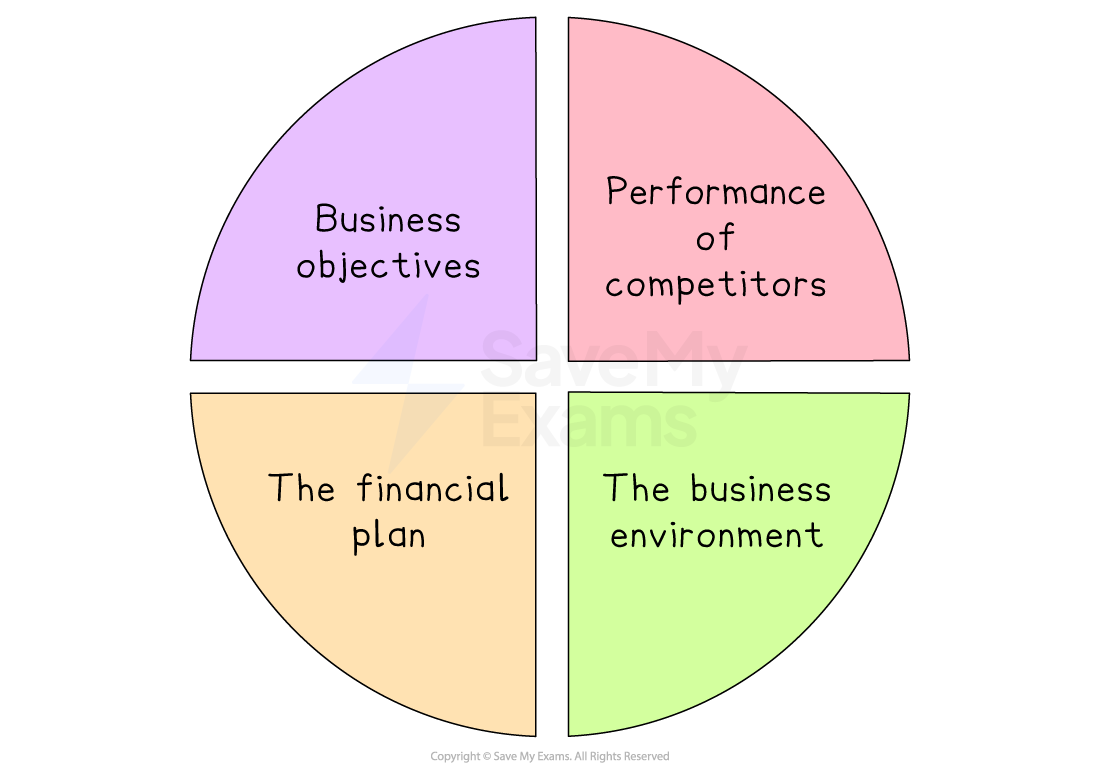
Profit and profitability relative to objectives
A business's profit performance should be judged first against what it was actually trying to achieve
Different objectives lead to very different financial outcomes
A profit figure that looks disappointing against an external benchmark may be entirely consistent with the business's own goals
A business pursuing aggressive growth may deliberately accept lower profit margins in the short term as it invests heavily in marketing, new staff or expansion of its premises
Judging it against a profit margin benchmark designed for stable, mature businesses would be misleading.
A business with a market penetration strategy may set low prices to attract customers, reducing profit margins intentionally
Once market share has increased, profit margins are expected to improve.
A business that prioritises social or environmental objectives alongside profit may accept a lower margin
The cost of ethical sourcing, fair wages or sustainable production is 'priced in' to their profit expectations
Example
A children's toy manufacturer sets an objective of increasing market share by 15% over two years
To achieve this, it reduces prices and increases its marketing spending significantly
These tactics reduce its operating profit margin from 18% to 11%
Against its strategic objective of market share growth, this outcome may be judged a success even though the profit margin has fallen
Profit and profitability relative to competitors
Comparing profit margins against competitors and industry averages is an informative way to assess performance
If a business's gross profit margin is 45% while the industry average is 38%, it suggests either that it has greater pricing power, more efficient production or a better product mix than its rivals
However, comparisons must be made carefully
Competitors may operate in slightly different market segments, making direct comparison less meaningful
Larger businesses may benefit from economies of scale that artificially improve their profit margins relative to smaller rivals
Published accounts may not reveal the full picture - accounting policies and the treatment of certain costs, such as depreciation, can vary
Example
A furniture retailer reports an operating profit margin of 7%
Its largest competitor, a national chain with significantly higher sales volumes, reports 11%.
The gap may reflect the larger competitor's buying power, more efficient logistics, or higher brand recognition that allows for premium pricing
These are all advantages that are difficult for a smaller rival to match quickly
Profit and profitability relative to business planning
Profit performance should also be compared against the business's own budgets
Was the profit achieved in line with what was planned? If not, why not?
A favourable variance (actual profit higher than planned) suggests either stronger than expected revenue, better cost control than anticipated, or both
An adverse variance (actual profit lower than planned) requires investigation
Was it caused by factors within the business's control or by unexpected external events?
Comparing actual to planned profit margins helps managers identify specific areas where performance differs from expectations
For example, if gross profit margin is on target but operating profit margin is below budget, the issue lies in overhead costs rather than production efficiency
Example
A printing company budgets for a gross profit margin of 42% and an operating profit margin of 16%.
Actual results show a gross margin of 43% - slightly above budget - but an operating margin of only 11%.
This tells managers that production costs are well controlled, but overheads have exceeded budget.
Further investigation reveals an unplanned IT system upgrade and higher-than-expected energy costs as the main causes.
Profit and profitability and the context of the business
Even when profit figures and margins are assessed against objectives, competitors and plans, the broader context of the business must always be considered
Contextual issue | Explanation |
|---|---|
Stage of the business lifecycle |
|
Economic conditions |
|
Business model |
|
One-off events |
|
Example
A travel company reports an operating profit margin of just 3%, well below its historical average of 9%.
In the context of a cost-of-living crisis that has caused consumers to cut back on discretionary spending, combined with a sharp rise in aviation fuel costs, this outcome may reflect good management rather than poor performance.
A competitor that failed to cut costs in response to the same pressures reported a loss in the same year.
Profits and profit margins in context
A profit figure or a profit margin on its own is a starting point
Knowing that a business made £3 million in profit last year, or that its gross profit margin is 42%, tells you very little until you can answer a more important question
Is that good or bad, given everything we know about this business?
The answer depends on context
The same profit margin that represents strong performance for a business in a highly competitive, low-price market might be disappointing for a premium brand that should be commanding far higher returns
A falling margin might signal a serious problem, or it might reflect a deliberate short-term investment in future growth
A profit figure below last year's might look like decline, but set against a backdrop of rising costs across the whole industry, it could actually represent excellent management
Raw figures need to be measured against the business's own objectives, compared with what competitors are achieving, checked against what was planned, and interpreted in light of the environment the business is operating in
Case Study
Kazoo Plc
The business and its financial results
Kazoo Plc designs and sells educational toys and games for children aged 3 to 10, distributing through major toy retailers and its own website. In its most recent financial year, the business reported the following results:
2005 | 2004 | |
|---|---|---|
Revenue | £45m | £38m |
Gross profit margin | 48% | 49% |
Operating profit margin | 12% | 17% |
Profit for the year margin | 8% | 12% |
Key observations
Revenue has grown strongly - up 18% year on year - suggesting the business is expanding successfully
However, all three profit margins have fallen, meaning costs have grown faster than revenue
The sharpest decline is in operating profit margin - down 5 percentage points
This suggests rising overhead costs rather than a production efficiency problem (since the gross margin has held up relatively well)
Case Study
Kazoo Plc
Benchmarking against competitors
The educational toy sector averages for the same financial year were:
Sector average | Kazoo Plc | |
|---|---|---|
Gross profit margin | 42% | 48% |
Operating profit margin | 15% | 12% |
Profit for the year margin | 10% | 8% |
Key observations
Kazoo's gross profit margin of 48% is significantly above the sector average of 42%
This suggests strong pricing power and efficient management of production costs, possibly a reflection of its premium positioning
However, Kazoo's operating and profit for the year margins both fall below the sector average
This indicates that overheads are disproportionately high compared to rivals
Case Study
Kazoo Plc
Objectives and business planning
Kazoo's annual report reveals that the board had set a strategic objective of launching five new product lines over the next two years
To support this, the business significantly increased its spending on marketing and product development during the year - both of which are classified as operating expenses
The budget approved at the start of the year had forecast an operating profit margin of 14%, acknowledging that increased investment would reduce profit margins in the short term
Key observations
The actual operating margin of 12% represents an adverse variance of 2 percentage points against the planned 14%
This suggests costs came in slightly higher than budgeted, but not dramatically so
Crucially, the profit margin decline was a planned and deliberate consequence of the business's growth strategy
It is not evidence of poor management or loss of control
Assessing Kazoo's performance against its own objectives, rather than simply against the sector average, gives a more accurate and fair picture of how well the business is being run
Case Study
Kazoo Plc
Context and outlook
The wider context provides further important perspective
The toy sector experienced a challenging year, with rising production costs driven by higher material and shipping prices affecting all manufacturers
Several of Kazoo's competitors reported significant falls in gross profit margins as a result
Kazoo's ability to maintain a gross margin of 48% - only one percentage point below the previous year
This reflects effective cost management and the pricing strength of its brand
Looking ahead, Kazoo's management forecasts that the five new product launches will increase revenue above £60 million within two years
The operating profit margin is expected to recover to 16–18% as the upfront investment in marketing and development is absorbed
Key observations
External cost pressures affected the whole sector
The fact that Kazoo held its gross margin broadly steady in this environment is a positive indicator of operational resilience
The fall in profitability should be seen as the short-term cost of a planned investment programme - not as a sign that the business is in long-term decline
The projections, if achieved, would see Kazoo outperforming current sector averages on all three margin measures
This suggests the short-term reduction in the profit margin may prove to be a well-judged strategic trade-off

Unlock more, it's free!
Join the 100,000+ Students that ❤️ Save My Exams
the (exam) results speak for themselves:

Was this revision note helpful?
