The Marketing Budget (AQA A Level Business): Revision Note
Syllabus Edition
First teaching 2026
First exams 2028
Exam code: 7132

The significance of the marketing budget
A marketing budget is the amount of money a business allocates to its marketing activities over a set period, usually a financial year
It covers all marketing spending, including advertising, promotions, market research, social media and events
Why the marketing budget matters
It sets the boundaries for marketing activity
A larger budget opens up options such as national television campaigns or large-scale promotions
A smaller budget may limit the business to social media and local advertising.
It links marketing to business strategy
A well-set budget reflects the business's objectives
A business prioritising rapid growth will allocate more to marketing than one focused on maintaining its current position
It ensures marketing spend is purposeful
It enables planning and control
Setting a budget in advance allows the business to plan its marketing calendar, allocate funds across different activities and avoid overspending
It also creates accountability as managers must justify their spending and demonstrate results
It allows return on investment (ROI) to be measured
With a clear budget in place, a business can calculate how much revenue was generated per pound spent on marketing
This helps identify which activities deliver the best value and informs future decisions
It helps prioritise marketing objectives
If the budget cannot fund all marketing objectives, it forces the business to decide which are most important
For example, prioritising brand awareness for a new product launch over customer retention activity
Case Study
Foxfield & Co
Foxfield & Co is a small independent women's clothing boutique in Leeds with one store and a recently launched online shop.

Owner Paulina has always spent money on marketing — the odd boosted Instagram post, occasional leaflets, a local magazine advert at Christmas — but never with a plan. She has no idea which activities have actually brought in customers, and some months she spends nothing at all.
With online sales growing, Paulina wants to expand the business but is unsure where to spend her limited funds. Her accountant suggests setting a formal marketing budget for the first time. With a set amount of £500 per month Paulina would be forced to choose between options — paid social media advertising, an email newsletter or a local influencer partnership.
Crucially, she could track how many sales each activity generates, calculating the return on investment for the first time. A budget would also make her prioritise. Right now, building brand awareness for the online shop matters more than loyalty offers for existing in-store customers.
Without structure, Paulina's marketing spend is reactive and difficult to justify. A budget would make it purposeful.
Examiner Tips and Tricks
A larger marketing budget does not automatically lead to better results - it is how the budget is spent that matters. In evaluation questions, consider whether a business is allocating its budget to the right activities given its target market and objectives.
Influences on the marketing budget
Several factors affect how large a marketing budget is set and how it is allocated across different activities
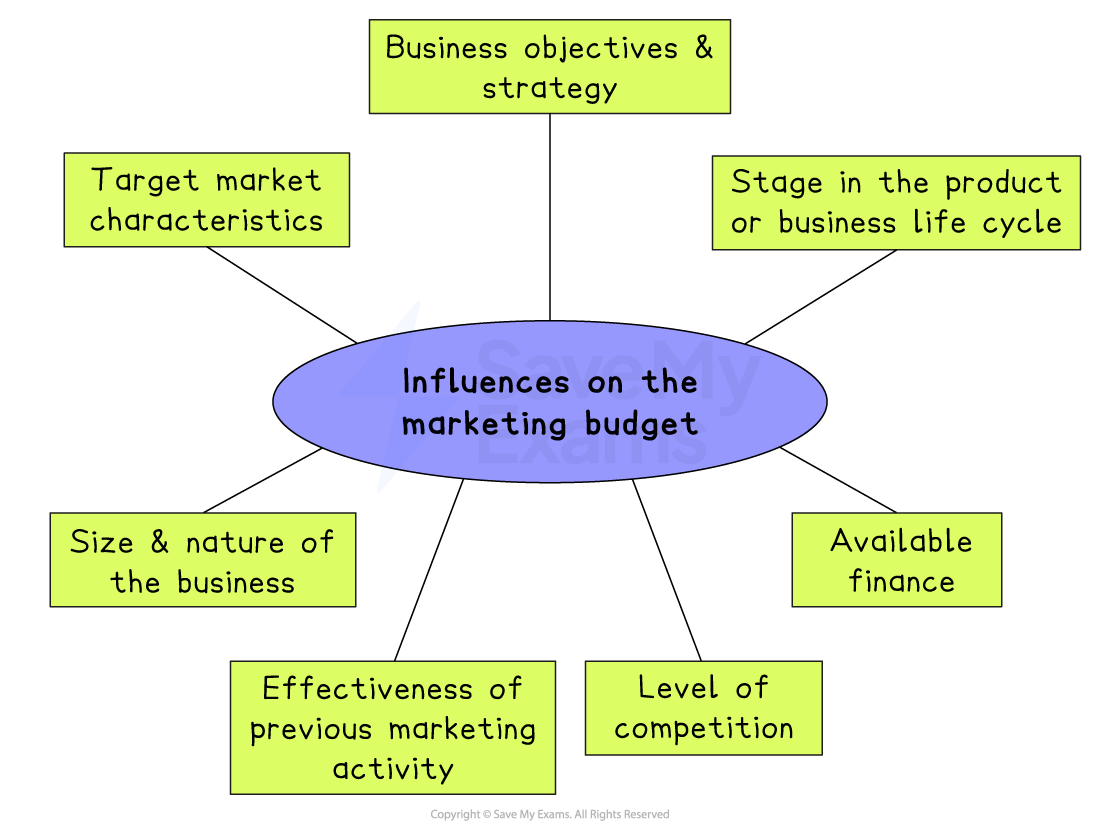
Business objectives and strategy
A business pursuing aggressive growth will invest heavily in marketing to drive awareness and sales
A business consolidating or cutting costs may reduce its marketing budget significantly
The budget must reflect what the business is trying to achieve
Stage in the product or business life cycle
New businesses and new products require significant investment to build brand awareness and attract first-time customers
Costs are high and returns are initially low
Established businesses with loyal customer bases may spend less on attracting new customers and more on lower-cost retention and engagement activities
Available finance
The budget is ultimately limited by what the business can afford
A highly profitable business can spend more
A business with tight cash flow or falling profits will typically cut the marketing budget
This can be a false economy if it leads to falling sales
Level of competition
In a highly competitive market, businesses may need to spend more simply to maintain visibility
If rivals are investing heavily in advertising, cutting the budget risks losing market share
Effectiveness of previous marketing activity
If past campaigns delivered a strong return on investment (ROI), the business is more likely to maintain or increase the budget
Poor results may lead to a reduction or a reallocation of the budget towards more effective promotional channels
Size and nature of the business
Large businesses targeting mass markets tend to spend more than smaller niche businesses
B2C (business-to-consumer) firms typically require larger marketing budgets than B2B (business-to-business) firms
Reaching large numbers of individual consumers usually demands greater investment
Target market characteristics
Reaching a younger, digitally active audience through social media is relatively low-cost
Targeting a broader or older audience through television, print publications, or direct mail is significantly more expensive; this will shape how large the budget needs to be
Examiner Tips and Tricks
When evaluating marketing budget decisions, consider the opportunity cost - money spent on marketing cannot be spent elsewhere, such as on product development or staff. A business must weigh the expected return from marketing against other uses of those funds.

Unlock more, it's free!
Join the 100,000+ Students that ❤️ Save My Exams
the (exam) results speak for themselves:

Was this revision note helpful?
